

Table of Contents
TL;DR:
- Outsourced content creation provides quick, specialized, and flexible production without building a large in-house team. Building clear brand voice guidelines and structured workflows ensures consistent tone and quality from external partners. Proper management and strategic control maximize outsourcing benefits for social media growth and brand integrity.
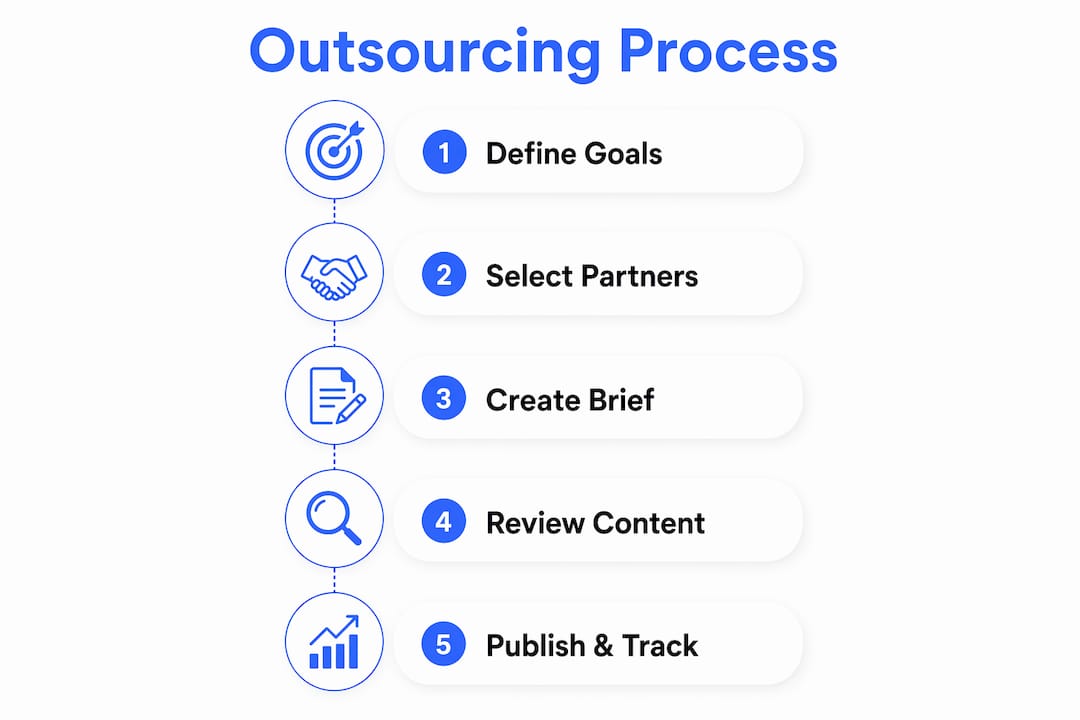
Outsourced content creation is the practice of hiring external professionals or agencies to produce content on your behalf, giving you immediate production capacity without building a full in-house team. For social media marketers and content creators, this model solves a real problem: in-house teams take 3–6 months to reach full productivity, while outsourcing delivers output from day one. The result is faster publishing, lower fixed costs, and access to skills like video editing and SEO that would cost far more to recruit permanently. This guide covers the core benefits, how to protect your brand voice, which outsourcing model fits your needs, and how to run the whole system without losing control.
What are the key benefits of outsourced content creation?
Outsourcing content production gives social media marketers three things an in-house hire rarely can: speed, specialization, and flexibility. Each one compounds the others.

Speed to market is the most immediate gain. A freelance writer or content agency can deliver a finished blog post in 2–5 business days. That turnaround is hard to match when an internal hire is still in onboarding.
Specialized skills on demand are the second advantage. Access to video editing and advanced SEO expertise is a primary reason marketers outsource. Hiring a full-time video editor for a channel that publishes twice a week rarely makes financial sense. Outsourcing that role means you pay only for what you publish.
Cost predictability rounds out the case. Content writing services price individual pieces at $50–$80 per blog post, with managed SEO bundles starting around $1,000 monthly. Compare that to a full-time content manager’s salary plus benefits, and the math favors outsourcing for most mid-size operations.
- Faster publishing cadence without hiring delays
- Access to video production, graphic design, and SEO without full-time salaries
- Flexible volume: scale up during product launches, scale back in slower months
- Internal team freed to focus on strategy, community engagement, and platform growth
Pro Tip: Start by outsourcing one content type, such as short-form social captions or weekly blog posts, before expanding. This lets you test a provider’s quality without committing your entire content calendar.
The scalability benefit matters most for social media creators managing multiple platforms. When a campaign demands 30 posts in two weeks, an external content team absorbs that spike without burning out your core staff.
How do you maintain brand voice when outsourcing content production?
Brand voice breaks down when outsourcing is treated as a transaction rather than a system. The fix is building that system before you hire anyone external.
Successful outsourcing starts with brand voice guidelines, SME interview protocols, and structured approval workflows defined before any external talent is engaged. A brand voice document should cover tone (casual, authoritative, or playful), vocabulary preferences, topics to avoid, and at least three example posts that represent your voice at its best. Without this document, every new freelancer starts from scratch.
Here is a practical setup sequence:
- Write a one-page brand voice guide covering tone, audience persona, and keyword targets.
- Build a content brief template that includes platform, format, word count, and a sample headline.
- Define your approval workflow: who reviews drafts, how many revision rounds are allowed, and what the turnaround expectation is.
- Schedule a 30-minute onboarding call with every new external writer or agency before the first piece is assigned.
- Create a feedback log so recurring issues are fixed at the system level, not repeated piece by piece.
Working with a unified agency rather than briefing multiple freelancers separately produces more consistent brand voice, keyword mapping, and tone across all deliverables. Fragmented freelancer networks create fragmented content. One partner who knows your brand deeply outperforms five writers who each know it slightly.
Pro Tip: Record a 10-minute video walking through your brand voice guide and share it with every new external partner. Hearing your tone is faster and more accurate than reading about it.
For creators managing digital branding across platforms, consistency is not just aesthetic. It directly affects audience trust and subscriber retention.
What outsourcing models work best for social media content?
Three main models cover most content needs: freelance marketplaces, dedicated content agencies, and managed content services. Each fits a different scale and budget.
Freelance marketplaces
Freelance marketplaces connect you directly with individual writers, designers, or video editors. You control the brief, the timeline, and the budget. The tradeoff is management time. You handle vetting, briefing, revisions, and quality checks yourself. This model works well for creators with a clear content process who need flexible, low-cost production.
Dedicated content agencies
A dedicated agency assigns a team to your account. They handle strategy alignment, writing, editing, and often publishing. Brand consistency is stronger because the same people work on your content repeatedly. Costs are higher than freelance, but the management burden drops significantly. This model suits marketers running high-volume social media programs across multiple channels.
Managed content services
Managed services bundle content production with SEO, analytics, and distribution. Pricing typically starts at $1,000 per month for entry-level packages. These services work best when you want a single vendor responsible for measurable outcomes, not just deliverables. The risk is reduced control over individual pieces, so a strong approval workflow is non-negotiable.
Hybrid approaches
Many content creators use a hybrid model: one internal strategist sets direction, and external specialists handle production. This structure keeps brand identity intact while capturing the cost and speed benefits of outsourcing. Keeping strategy in-house while outsourcing production is the most reliable way to maintain authentic brand identity at scale.
The right model depends on three factors: your monthly content volume, how much management time you can allocate, and whether you need measurable SEO outcomes or just raw output. A creator publishing 10 social posts a week has different needs than a marketer running a 50-piece monthly editorial calendar.
What are best practices for managing outsourced content effectively?
The biggest mistake in outsourcing is treating it as a vendor relationship instead of an operating system. Effective outsourcing builds brand voice guidelines and structured workflows into the process itself, not as afterthoughts.
- Define success metrics before you start. Clear goals and KPIs are critical for outsourcing to convert, not just produce. Know whether you are measuring engagement rate, organic traffic, or subscriber growth before briefing your first external piece.
- Start small, then scale. Assign one content type to an external partner, review three to five pieces, and assess quality before expanding the scope. Scaling a broken process only multiplies the problem.
- Build a regular communication cadence. A weekly 20-minute check-in with your content partner catches misalignments before they become published mistakes.
- Repurpose aggressively. Converting one expert interview into articles, social clips, and newsletters maximizes the return on every outsourced asset. One long-form piece can fuel an entire week of social content.
- Never outsource strategy. Direction, positioning, and audience insight stay internal. Production is what you hand off.
Pro Tip: Build a content repurposing brief alongside every long-form assignment. Ask your external partner to flag three to five moments in each piece that could become standalone social posts. You get more assets for the same fee.
For creators exploring content production on paid platforms, repurposing is especially valuable. A single video shoot can generate clips, stills, captions, and subscriber-only previews with the right workflow in place.
A common pitfall is confusing outsourcing production with outsourcing strategy. When an external agency sets your content direction, your brand voice drifts toward their defaults, not your audience’s expectations. Keep the thinking internal and let external talent execute it.
Key Takeaways
Outsourced content creation works best when you treat it as a production system, not a shortcut. Build brand voice guidelines and approval workflows first, then bring in external talent to execute against them.
| Point | Details |
|---|---|
| Build the system first | Define brand voice guidelines and approval workflows before hiring any external talent. |
| Outsource production, keep strategy | Direction and positioning stay internal to protect authentic brand identity. |
| Match the model to your volume | Freelancers suit low-volume needs; agencies and managed services fit high-volume programs. |
| Repurpose every asset | Turn one long-form piece into multiple social formats to maximize return on each outsourced piece. |
| Set metrics before you spend | Clear KPIs prevent wasted budget and ensure outsourced content actually drives results. |
Why I think most creators outsource content the wrong way
Most creators treat outsourcing as a fix for not having enough time. That framing leads directly to disappointment. You hand off a vague brief, get back generic content, and conclude that outsourcing does not work. The real problem was never the external partner. It was the absence of a system.
The creators I have seen get the most from outsourcing are the ones who invest two to three hours upfront building a brand voice document and a brief template. After that, external partners produce content that sounds like them, not like a content mill. The output quality is not a function of the freelancer’s talent alone. It is a function of how clearly you communicated what you needed.
The trend I am watching closely in 2026 is the outsourcing of short-form video production. Social media platforms continue to reward video, and video editing is genuinely expensive to keep in-house. Creators who build relationships with dedicated video editors, rather than using one-off gig platforms, get faster turnarounds and better brand consistency over time. That relationship investment pays off within three to four months.
The other thing I would push back on is the idea that outsourcing is only for large operations. A solo creator publishing on a paid social platform can outsource caption writing, thumbnail design, or newsletter drafting for a few hundred dollars a month and reclaim hours that go back into strategy and audience engagement. The scale does not need to be enterprise for the model to work.
— fan
How Fanspicy supports your content production goals
Fanspicy is built for creators who take their content seriously. Whether you are managing a paid social channel, a live cam presence, or a subscriber-based platform, the challenge of producing consistent, high-quality content at scale is the same.
Fanspicy gives adult content creators and social media marketers the tools to manage their content creation workflow without losing the brand voice that keeps subscribers coming back. The platform is designed for creators who want to grow their audience and their output at the same time. Visit Fanspicy to see how the platform supports creators building a professional, scalable content operation.
FAQ
What is outsourced content creation?
Outsourced content creation is the practice of hiring external writers, designers, or agencies to produce content for your brand. It gives you immediate production capacity without the cost of building an in-house team.
How much does outsourcing content cost?
Pricing ranges from $50–$80 per blog post for individual pieces to around $1,000 per month for managed SEO content bundles. Costs vary based on content type, volume, and provider experience.
How do I keep my brand voice consistent when outsourcing?
Build a brand voice guide, a content brief template, and a structured approval workflow before engaging any external partner. A unified agency partner produces more consistent results than multiple individual freelancers.
What should I never outsource?
Content strategy and audience direction should stay internal. Outsourcing production while keeping strategy in-house is the most reliable way to protect your brand identity and ensure content converts.
How fast can outsourced content be delivered?
Most content writing services deliver individual pieces in 2–5 business days. Video editing and more complex formats may require longer lead times depending on project scope.