

Table of Contents
TL;DR:
- LinkedIn sponsored content ads target professional audiences with high precision but tend to be costly. Thought Leader Ads generate significantly higher engagement and CTRs, especially when run from personal profiles. Structuring campaigns by audience intent and using personalized creative improves lead quality and reduces costs.
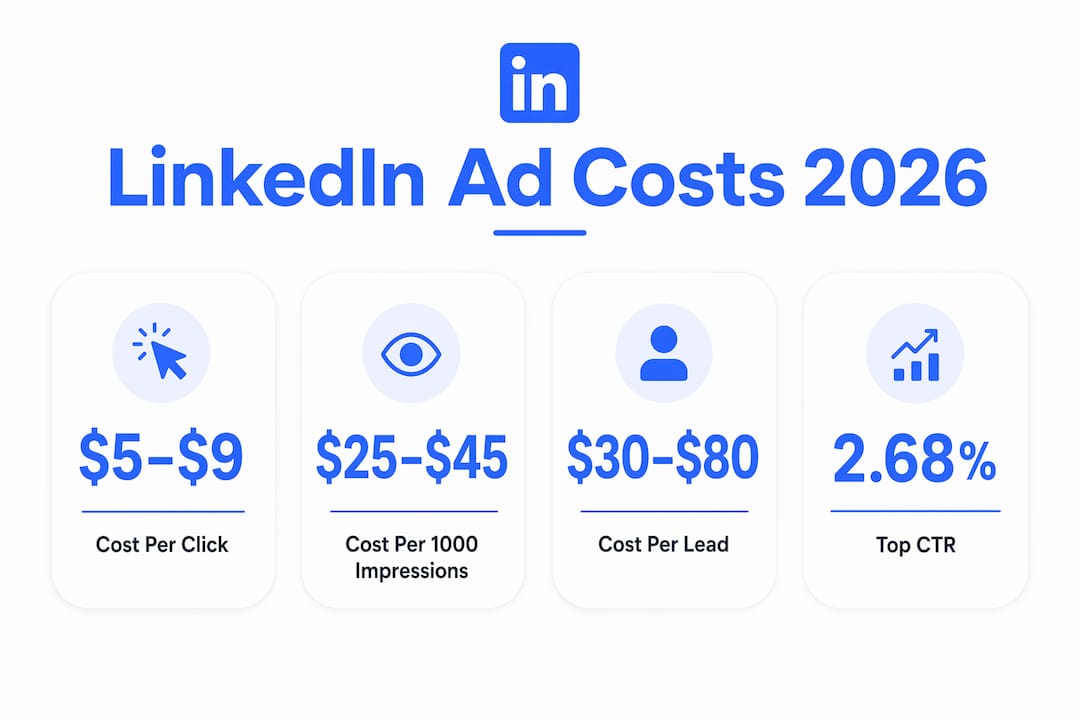
LinkedIn sponsored content ads are native advertisements that appear directly in the LinkedIn feed, targeting professional audiences by job title, industry, seniority, and company size. No other paid social channel gives B2B marketers the same precision for reaching decision-makers at scale. With costs ranging from $5 to $9 per click and lead generation costs between $30 and $80, the investment is real. The return depends entirely on how well you match format, targeting, and creative to your campaign goal.
What formats do LinkedIn sponsored content ads offer?
LinkedIn offers six primary ad formats under the sponsored content umbrella: Single Image, Video, Carousel, Document, Event, and Thought Leader Ads. Each format serves a different purpose, and choosing the wrong one for your goal is one of the fastest ways to burn budget.
Single image ads
Single image ads are the most widely used format on the platform. They are easy to produce and test, perform reliably across objectives, and work well as the backbone of any campaign. Average click-through rates (CTRs) for single image ads fall between 0.4% and 0.65%. That number sounds modest, but at scale and with tight targeting, it produces consistent pipeline volume.

Video and carousel ads
Video ads drive higher engagement than static images when the first three seconds are strong. Carousel ads let you tell a sequential story across multiple cards, making them effective for product walkthroughs or multi-step case studies. Document ads, a newer format, let users scroll through a PDF or slide deck directly in the feed. Marketers use them heavily for gated content like research reports and playbooks.
Thought Leader Ads
Thought Leader Ads are the format most marketers underuse. They deliver 2–3 times higher engagement than standard brand posts and carry a median CTR of approximately 2.68% as of Q1 2026. That CTR is roughly four to six times higher than a single image ad. The reason is simple: they look like personal posts from a real person, not a corporate ad. Authenticity drives clicks on LinkedIn in a way it does not on most other platforms.
| Format | Typical CTR | Best use case | Relative cost |
|---|---|---|---|
| Single Image | 0.4%–0.65% | Brand awareness, lead gen | Moderate |
| Video | Above average | Storytelling, product demos | Moderate to high |
| Carousel | Moderate | Multi-step narratives | Moderate |
| Document | Moderate | Gated content, thought leadership | Moderate |
| Thought Leader | ~2.68% | Executive visibility, trust building | Lower CPC |
| Event | Varies | Webinar and event registrations | Moderate |
Pro Tip: Run Thought Leader Ads from a senior executive’s profile rather than the company page. The personal attribution is what drives the engagement lift. Pair it with a Lead Gen Form to capture leads without sending users off-platform.
How much do LinkedIn sponsored content ads cost?
LinkedIn advertising costs more than most paid social channels, and that premium is justified by audience quality. LinkedIn ads cost between $5 and $9 per click, $25 to $45 per 1,000 impressions, and $30 to $80 per lead. Those figures represent broad averages. Your actual costs depend on three variables: industry, targeting precision, and ad format.
What drives cost up or down
Highly competitive industries like enterprise software, financial services, and recruiting push CPCs toward the top of the range. Narrow targeting, such as targeting VPs of Engineering at companies with 500 to 5,000 employees, raises costs because you are competing against fewer advertisers for a smaller audience. Broader audiences lower the CPC but often reduce lead quality at the same time.
Bidding strategy also moves the needle significantly. Manual CPC and Target Cost bidding give you control and work best for mature campaigns with established performance data. Automated bidding like Maximum Delivery can inflate costs quickly. Reserve it for very niche audiences or time-sensitive promotions where volume matters more than efficiency.
Pro Tip: Start every new campaign on Manual CPC. Set your bid at the low end of LinkedIn’s suggested range and raise it only if delivery is too slow. Jumping straight to Maximum Delivery on a new campaign is the single most common way to overspend in the first two weeks.
The cost-per-lead figure deserves special attention. At $30 to $80 per lead, LinkedIn is expensive compared to search or display. But a LinkedIn lead from a Director of Marketing at a 2,000-person company is worth far more than a lead from a generic display network. The math works when your average deal size justifies the acquisition cost.
What targeting strategies optimize LinkedIn sponsored content ads?
The biggest mistake in LinkedIn ad targeting is organizing campaigns by ad format instead of audience intent. Successful campaigns segment by funnel stage: awareness, consideration, and conversion. When you mix all three stages into one campaign, you end up bidding against yourself and paying more for every result.
Building your audience with intent in mind
Start by mapping your audience to a funnel stage before you touch Campaign Manager. An awareness audience might be all Marketing Directors at B2B software companies with 200 or more employees. A conversion audience is a retargeted list of people who visited your pricing page in the last 30 days. These two groups need different messages, different formats, and different bids.
The two-step inclusion and exclusion approach is the most effective way to sharpen audience quality. Broad targeting dilutes lead quality. If you target “Marketing Director” without exclusions, your audience fills with job seekers, students, and junior titles who inflated their profiles. Add exclusion filters for those groups and your CPL drops while lead quality rises.
Effective targeting combinations for marketing professionals include:
- Job title plus company size: Target Marketing Managers and Directors at companies with 500 to 10,000 employees to hit mid-market buyers.
- Job function plus seniority: Use “Marketing” as the function and filter to Senior, Manager, Director, VP, and C-Level to avoid junior roles.
- Matched Audiences with website retargeting: Upload a CRM list of warm prospects and serve them conversion-stage ads with a direct offer.
- Predictive lookalikes: LinkedIn builds a lookalike audience from your best-performing customer list, expanding reach without sacrificing relevance.
- Account-based marketing (ABM) lists: Upload a target account list and serve ads only to employees at those specific companies.
LinkedIn Matched Audiences and predictive lookalikes are the two features that separate average campaigns from high-performing ones. They let you move beyond demographic targeting and reach people who already have a demonstrated connection to your offer.
How do you create and optimize LinkedIn sponsored content campaigns?
Campaign Manager is LinkedIn’s ad platform, and the workflow follows a clear structure: choose an objective, define your audience, select your format, set your budget and bid, and build your creative. The objective you choose at the start determines which optimization options are available, so pick it carefully. Brand awareness, website visits, engagement, lead generation, and website conversions are the most relevant objectives for most marketing teams.
Personalization and creative testing
Personalized creative improves cost-per-lead by 20% on average, with some U.S.-based campaigns seeing improvements up to 33%. That is a significant efficiency gain from a relatively simple change. Personalization at the ad level means referencing the audience’s specific role, industry, or pain point in the headline or image. “How CFOs at mid-market SaaS companies reduce close time” outperforms “Reduce your close time” every time.
Run at least three creative variations per ad set when you launch. Test one variable at a time: headline, image, or call-to-action. LinkedIn’s Campaign Manager shows performance data by creative, so you can pause underperformers after reaching statistical significance. Most campaigns need at least 50 conversions per ad variant before the data is reliable enough to act on.
Using Lead Gen Forms
Lead Gen Forms reduce friction by auto-populating with the user’s LinkedIn profile data. The prospect clicks your ad, sees a pre-filled form with their name, email, job title, and company, and submits in two taps. Conversion rates on Lead Gen Forms consistently outperform landing page forms because there is no page load, no manual typing, and no reason to abandon. Use them for whitepapers, demo requests, webinar registrations, and any gated offer.
A numbered campaign launch sequence that works:
- Set your campaign objective to Lead Generation or Website Conversions.
- Build your audience using the two-step inclusion and exclusion method.
- Select your format based on funnel stage: Thought Leader or Single Image for awareness, Document or Video for consideration, Lead Gen Form for conversion.
- Start with Manual CPC bidding at the low end of the suggested range.
- Launch three creative variations per ad set.
- Review performance after 200 to 300 impressions per creative and pause the lowest performer.
- Scale budget on the winning creative by 20% increments to avoid triggering the learning phase reset.
Pro Tip: Do not run personalized and non-personalized creative in the same ad set. LinkedIn’s algorithm will favor one over the other based on early signals, and you will never get a clean read on which actually performs better. Separate them into distinct ad sets with identical targeting.
Key takeaways
LinkedIn sponsored content ads deliver the highest-quality B2B leads on paid social when campaigns are structured by audience intent, use precise targeting with exclusion filters, and match creative format to funnel stage.
| Point | Details |
|---|---|
| Format selection matters | Thought Leader Ads deliver a ~2.68% CTR, far above the 0.4%–0.65% average for single image ads. |
| Cost benchmarks for 2026 | Expect $5–$9 per click, $25–$45 per 1,000 impressions, and $30–$80 per lead. |
| Target by intent, not format | Segment campaigns by awareness, consideration, and conversion stages to avoid bidding against yourself. |
| Use exclusion filters | A two-step inclusion and exclusion approach removes low-quality profiles and lowers cost-per-lead. |
| Personalized creative pays off | Personalized ads improve cost-per-lead by 20% on average, with some campaigns reaching 33% gains. |
What I have learned running LinkedIn ad campaigns
The conventional wisdom says LinkedIn ads are too expensive for most budgets. I disagree. The cost is high, but the waste is low when you build campaigns correctly. The real problem is that most marketers set up LinkedIn campaigns the same way they set up Facebook campaigns, and the two platforms reward completely different behaviors.
On LinkedIn, authenticity is a performance variable, not a brand value. Thought Leader Ads work because LinkedIn users are trained to scroll past corporate ads and stop on personal posts. When you run an ad from a real person’s profile, you are borrowing that behavioral pattern. The engagement numbers prove it.
The other thing most guides skip: budget allocation across funnel stages is not optional. LinkedIn is a full-funnel channel, and treating it as a bottom-funnel-only tool produces poor results. If you only run conversion campaigns, you are paying to convert cold audiences who have never heard of you. Allocate at least 30% of your LinkedIn budget to awareness and consideration campaigns. The conversion campaigns get cheaper as a result.
Video and document ads are the two formats I expect to see dominate in 2026. Video because LinkedIn’s algorithm is actively rewarding it with organic reach boosts, and document ads because they let users consume content without leaving the feed. Both formats build the kind of trust that makes your retargeting campaigns convert at lower cost.
— fan
Fanspicy’s approach to paid content promotion
Paid social advertising on LinkedIn is one piece of a larger content promotion picture. Fanspicy publishes practical guides on paid content strategies for creators and marketers who want to build audiences and generate revenue across multiple platforms.
Whether you are running sponsored ads on LinkedIn or building a broader paid content presence, Fanspicy covers the tactics that move the needle. From media marketing ideas to platform-specific campaign guidance, the Fanspicy insights library gives you frameworks you can apply immediately. Visit Fanspicy to find the resources that fit your current campaign goals.
FAQ
What are LinkedIn sponsored content ads?
LinkedIn sponsored content ads are native ads that appear in the LinkedIn feed, targeted by professional attributes like job title, industry, and seniority. They include formats such as Single Image, Video, Carousel, Document, Event, and Thought Leader Ads.
How much do LinkedIn sponsored content ads cost in 2026?
LinkedIn ads cost between $5 and $9 per click, $25 and $45 per 1,000 impressions, and $30 and $80 per lead. Costs vary based on industry, targeting precision, and the ad format you choose.
Which LinkedIn ad format has the highest engagement?
Thought Leader Ads deliver the highest engagement, with a median CTR of approximately 2.68% in Q1 2026. That is roughly four to six times higher than the average single image ad CTR of 0.4% to 0.65%.
What is the best bidding strategy for LinkedIn ads?
Manual CPC and Target Cost bidding are the preferred strategies for established campaigns. Automated Maximum Delivery bidding can raise costs quickly and works best only for niche audiences or time-sensitive promotions.
How do Lead Gen Forms improve LinkedIn ad performance?
Lead Gen Forms auto-populate with the user’s LinkedIn profile data, removing the friction of manual form entry. They consistently produce higher conversion rates than landing page forms for gated content like whitepapers and demo requests.