
Indice dei contenuti
Promote content natively: test it organically first, repeat the promotion cycle across formats, then amplify winners with paid spend. This approach rests on four pillars: strong post anatomy, platform-specific tactics, a repeatable promotion schedule, and measurement built around real business outcomes rather than likes. Get those four right and a single piece of content can work for weeks instead of hours.
TL;DR:
- Promoting content organically first ensures posts gain genuine traction before investing in paid amplification, which should only be used to scale proven performers.
- Repeating content across formats like stories, carousels, and short videos over several weeks maximizes reach and engagement without creating new materials daily.
- Targeting specific audience segments and platform-appropriate habits improves the effectiveness of promotion, especially when using interest-based or demographic targeting.
- Consistent posting schedules and engaging actively with comments early in a post’s life can extend its reach and foster community interaction.
- Measuring success through business outcomes such as click-through, conversion rates, and time on page provides a clearer value signal than vanity metrics like likes or follower counts.
Indice dei contenuti
- Building a Post That Earns Attention
- Platform-by-Platform Tactics for Promoting One Idea Everywhere
- Balancing Value and Promotion Without Wearing Out Your Audience
- Using Paid Spend to Scale What Already Works
- Measuring Promotion by Business Outcomes, Not Vanity Metrics
- A Repeat-Promotion Schedule You Can Run Every Week
- Copy-Paste Templates for Hooks, Captions, and Tracking Links
- Reaching the Right Audience Segments
- Timing Your Posts for Maximum Reach
- Working With Collaborators and Influencers
- Keeping Engagement Alive After the Initial Push
- Handling Criticism and Negative Feedback During Promotion
- What I Learned Promoting the Same Post Five Ways
- Where Fanspicy Fits After the Promotion Work Is Done
- Sources
- FAQ
Building a Post That Earns Attention
Every post lives or dies in the first two seconds. A hook that names a concrete benefit, poses a sharp question, or contradicts a common assumption stops the scroll better than a vague opener ever will. Save the context for the caption; the hook’s only job is to buy you the next three seconds of attention.
Caption structure follows a simple pattern: open with the hook, deliver value in the middle, then close with a single clear call to action. Keep Instagram and Facebook captions tight for the feed but feel free to expand below the fold, since engaged readers will tap “more.” X rewards brevity, so keep the core point in the first 280 characters even inside a thread. LinkedIn captions can run longer when the value is professional and specific, but the first line still has to earn the click to “see more.”
Visuals need to match platform expectations rather than fight them. Vertical 9:16 video works for Reels, TikTok, and YouTube Shorts, while square or 4:5 images perform better in static feed posts. Subtitles matter everywhere: Centro di ricerca Pew data shows platform audiences differ sharply by age and video habits, and a large share of viewers watch with sound off, so burned-in captions are not optional if you want the message to land.
Hashtags and mentions still help discoverability when used with intent rather than volume. A handful of specific, niche hashtags outperform a wall of generic ones, and tagging a relevant creator or brand can put a post in front of a new audience without spending a cent.
- Hook: lead with a benefit, question, or contradiction in the first line.
- Caption: opener, value, single CTA, length matched to the platform.
- Visual: vertical for Shorts and Reels, square or 4:5 for static feed posts.
- Accessibility: add subtitles to video and alt text to every image.
- Hashtags: a few specific tags beat a dozen generic ones.
Alt text deserves its own line item because it is skipped so often. Writing a plain description of the image not only helps visually impaired followers, it gives platforms another signal about what the post contains, which can influence how it gets recommended.
Platform-by-Platform Tactics for Promoting One Idea Everywhere
The same core idea can fuel five different posts if you respect what each platform actually rewards. TikTok and Instagram Reels favor short-form video built around a trend, a sound, or a fast visual hook, edited natively rather than uploaded with another app’s watermark. Native editing tools tend to get more algorithmic favor than content that looks reposted, and jumping on a trending sound within its first few days of momentum still matters more than production polish.
YouTube runs on a different clock. A strong thumbnail and title pairing decides whether someone clicks at all, chapters help viewers jump to the part they want (which keeps watch time healthy), and a teaser clip cut for Shorts can point viewers back to the full video with a described CTA in the caption rather than relying on an end card alone.
X and LinkedIn reward a more conversational, opinion-forward style. A thread on X works best when each post can stand alone but builds toward one payoff, while LinkedIn rewards a professional angle: a lesson learned, a contrarian take on an industry norm, or a short breakdown of a process. Both platforms benefit from replying to your own top comment with additional detail, which keeps the thread alive in the algorithm.
Facebook has shifted toward community, so Groups and niche pages often outperform a brand’s own feed post. A small boosted-post budget behind content that already has organic comments tends to extend reach further than boosting a fresh, unproven post.
Un consiglio da professionista: Post the native video first, then wait 24 hours before cross-posting the same clip elsewhere so each platform’s algorithm treats it as fresh content rather than a duplicate.
Turning one long-form article into multiple posts is where this pays off. A single blog post can become a 60-second Reel that covers the single strongest point, a five-slide carousel that walks through the main steps, and a six-post X thread that expands the argument with one idea per post. Each format asks the same content to do different work: the Reel earns reach, the carousel earns saves, and the thread earns replies and profile visits.
- TikTok/Reels: trend-led hook, native edit, caption under 150 characters.
- YouTube: thumbnail plus title testing, chapters, Shorts teaser with a described CTA.
- X/LinkedIn: thread or single post with a clear opinion and a reply-to-comment habit.
- Facebook: Group-first sharing, then boost only what already has organic comments.
Balancing Value and Promotion Without Wearing Out Your Audience
Posting too much promotional content is the fastest way to lose reach, since social platforms downrank accounts that read as an ad feed. The most cited framework is the 80/20 split: 80% of posts deliver value, entertainment, or education, and only 20% ask for something directly, according to Forbes Advisor. Other variants suit different goals: a 70/20/10 mix (value, curated third-party content, promotion) works well for brands still building a content library, while a 5/3/1 mix (five curated posts, three original posts, one promotional post) suits accounts leaning on curation to stay consistent.
Repurposing is what makes any of these ratios sustainable without demanding new content every day. A repeatable workflow looks like this:
- Pull the single strongest quote, statistic, or line from a long-form piece.
- Turn that line into a static graphic or a short video clip with on-screen text.
- Build a three-to-five-slide carousel that expands the same idea step by step.
- Write a caption that links back to the full piece, framed as “the full breakdown is linked.”
- Schedule each format on a different day so the source material feeds a week of posts instead of one.
Map these repurposed pieces into an editorial calendar by platform and format rather than by date alone, so you can see at a glance whether a week leans too promotional or too quiet. A calendar that shows “value” and “promotional” as separate columns makes the ratio visible instead of theoretical, and it keeps a single source article working across formats for weeks rather than a single afternoon.
Using Paid Spend to Scale What Already Works
Paid promotion works best as an amplifier, not a rescue plan. Straight North frames the principle plainly: test organically first, and only put money behind posts that already show real traction, since paid spend behind a weak post just buys a faster failure.
A simple seed-and-scale pattern keeps risk low. Start with a small daily budget spread across two creative variations and two audience segments, let the test run long enough to gather a meaningful sample, then shift the full budget toward whichever combination is outperforming the other. A post that lands in the top tier of organic engagement, or clears a CTR threshold you have set in advance, is a reasonable candidate to scale; a post that misses that bar should be paused and reworked rather than pushed further.
- Rule one: never boost a post that has not already proven itself organically.
- Rule two: seed small across two creatives and two audiences before committing real budget.
- Rule three: scale the winner, pause the loser, and retest the loser later with a new hook.
- Rule four: set a CTR or engagement-rate threshold in advance so the decision is not emotional.
This discipline also protects the budget from platform algorithm swings. A creative that performed well two months ago can fatigue, so a working paid strategy always has a queue of fresh organic winners ready to test rather than one evergreen ad running indefinitely.
Measuring Promotion by Business Outcomes, Not Vanity Metrics
Likes and follower counts feel satisfying, but they rarely tell you whether promotion is working. Adobe for Business recommends tracking outcomes tied to the business instead: click-through rate, time on page after the click, and conversion rate, all traced back to the specific post that drove the visit.
UTM tagging is the mechanism that makes this traceable. A link like ?utm_source=instagram&utm_medium=social&utm_campaign=spring_launch tells your analytics platform exactly which post, which platform, and which campaign sent a visitor, and GA4 can then attribute a signup or purchase back to that single link instead of lumping all social traffic together.
- CTR tells you whether the hook and thumbnail actually earned the click.
- Conversion rate tells you whether the landing experience matched what the post promised.
- Time on page flags whether traffic quality matches traffic volume.
- Repeat visits from the same UTM show whether a post is still driving value weeks later.
There are roughly 5.79 billion active social media user identities globally as of April 2026. This scale means even a modest, well-targeted post can reach a meaningful new audience segment each time it is reshared, which is the entire logic behind a repeat-promotion cycle rather than a single publish-and-forget post.
Set benchmarks from your own account’s history rather than industry averages, since audience size and niche both swing typical engagement rates widely. Run simple A/B tests, one variable at a time (thumbnail, hook, or posting time), and give each test enough volume before declaring a winner.
A Repeat-Promotion Schedule You Can Run Every Week
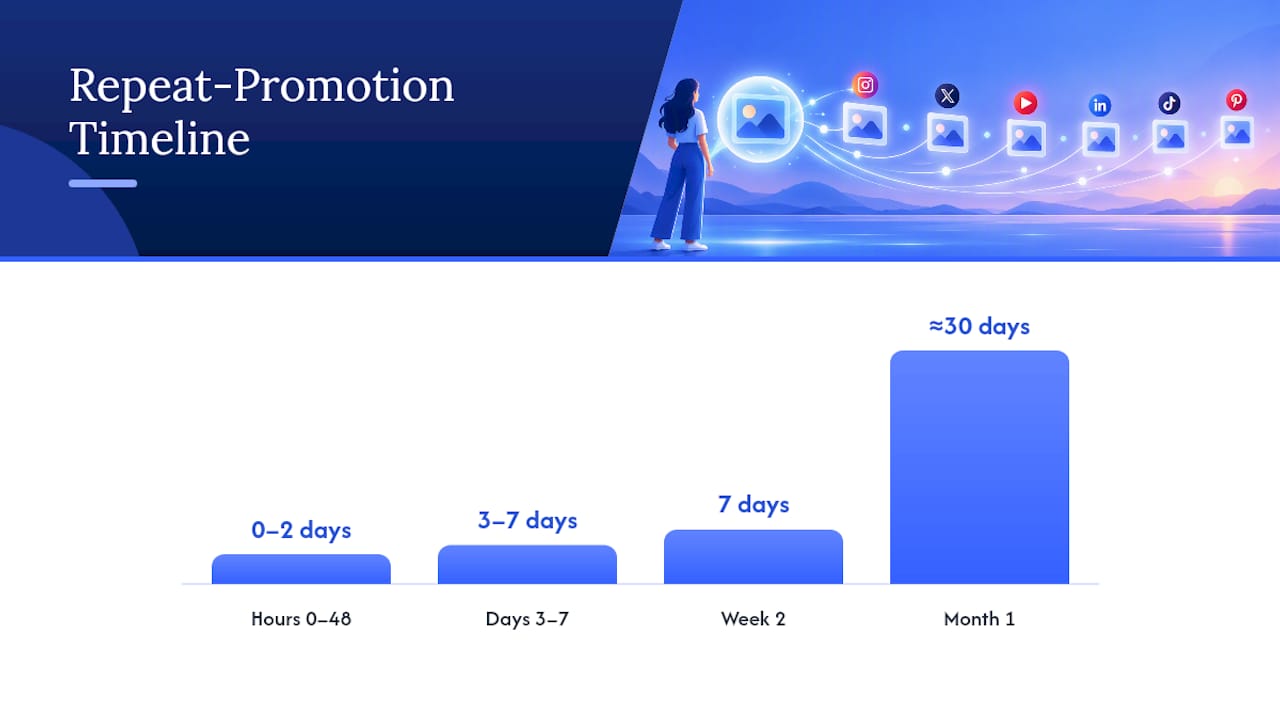
A single post rarely reaches its full audience the first time it goes out, which is why a repeating cycle beats a one-and-done publish. Straight North outlines a practitioner-tested cadence worth adapting to your own calendar:
- Hours 0 to 48: publish natively, then support the launch with Stories on Instagram and Facebook.
- Days 3 to 7: pull a single statistic or quote from the piece and post it as a standalone graphic.
- Week 2: repurpose the same idea as a short video clip or a carousel for a different segment of your audience.
- Month 1: resurface the content with a new hook tied to a current trend or news event, so it feels timely again rather than repeated.
Daily micro-actions matter between these bigger pushes. The 5/5/5 rule, five minutes liking, five minutes commenting, and five minutes sharing other accounts’ posts each day, keeps your profile active in a way that platforms tend to reward with better distribution, since early engagement signals help algorithms decide who else to show a post to.
Un consiglio da professionista: Keep a running note of trend sounds, formats, and headlines you spot each week, even ones you are not ready to use yet, so the next repurposing cycle starts with options instead of a blank page.
Evergreen posts deserve a place in this cycle too. A post that performed well six months ago can often be refreshed with a new visual or an updated statistic and reshared without starting from scratch. For creators building a paid audience specifically, FanSpicy’s insights on top promotion strategies walk through how this cadence adapts when the end goal is converting social attention into paying subscribers rather than general brand reach.
Copy-Paste Templates for Hooks, Captions, and Tracking Links
Having a few reliable templates on hand removes the blank-page problem on a busy posting day.
Three short-form hooks:
- “Nobody tells you this about [topic], but it changes everything.”
- “I tried [specific method] for 30 days. Here’s what actually happened.”
- “The biggest mistake people make with [topic] is…”
Three caption formulas:
- Educate: State the problem, give one clear tip, end with “save this for later.”
- Entertain: Open with a relatable moment, land a punchline, invite comments with a question.
- Convert: Name the outcome, show proof it works, close with one specific CTA and a link.
UTM strings keep every link traceable back to its source. A post on X promoting a new piece might use ?utm_source=twitter&utm_medium=social&utm_campaign=launch_week, while the same link shared in an Instagram bio would swap the source parameter to instagram so the two channels never get confused in reporting.
Before spending any money behind a post, run it through a short checklist:
| Check | What to confirm |
|---|---|
| Organic performance | Post is in your account’s top tier of engagement or clears your CTR threshold |
| Creative variation | At least two versions of the visual or hook exist to test |
| Audience split | Budget is divided across at least two audience segments |
| Tracking link | UTM parameters are attached and verified in analytics before launch |
| Landing experience | The destination page matches the promise made in the post |
Creators who want a head start on captions and hooks built specifically around paid content and subscriber conversion can find more detail in FanSpicy’s guide to promoting paid content, which covers how these same templates adapt when the CTA is a subscription rather than a click.
Reaching the Right Audience Segments
Broad posting wastes reach that targeted posting captures. Platform audiences differ by age, interest, and intent, and Pew Research Center data shows YouTube and Facebook reach broad adult populations while TikTok and Instagram skew younger and lean more heavily on video. Choosing where to promote should start with where your specific audience already spends time, not where competitors happen to post.
Segmentation goes further than platform choice. Within a single platform, custom audiences built from website visitors, email lists, or past engagers convert at a different rate than cold, interest-based targeting, and testing both in parallel reveals which segment responds to which message. A post promoting a beginner-level resource speaks differently to a cold audience than to people who already follow you.
Interest and behavior targeting inside ad platforms lets you layer demographic data with actual activity, such as people who have engaged with similar content recently. The narrower the segment, the more specific the message can be, and specific messages tend to outperform generic ones even at smaller reach. Building two or three defined segments and writing a slightly different hook for each one usually beats writing one hook and hoping it fits everyone.
Timing Your Posts for Maximum Reach
Posting time affects how many people see a post before the feed algorithm moves on, but the “best time to post” varies by platform, audience time zone, and niche rather than following one universal clock. The more reliable approach is testing your own account’s data: publish at a few different times over several weeks and compare reach and engagement for each window.
Audience activity tends to cluster around commute times, lunch breaks, and evening wind-down hours, though the exact peaks shift depending on whether your audience skews toward one region or spans several time zones. A global audience, in particular, benefits from staggered posting or reposting a strong piece a second time for a different time zone’s waking hours, which ties directly back to the repeat-promotion cycle covered earlier.
Consistency in posting cadence matters as much as the specific hour. An account that posts at unpredictable times sends a weaker signal to the algorithm than one that publishes on a steady rhythm, even if that rhythm is just three times a week. Once a pattern is established, small experiments, an hour earlier, a different day, become easy to read because the baseline is stable.
Working With Collaborators and Influencers
A collaboration puts your content in front of an audience that already trusts someone else, which is a faster path to new reach than paid promotion alone. The most effective partnerships pair creators with overlapping but not identical audiences, since a fully overlapping audience adds little new reach and a completely unrelated one rarely converts.
Micro-influencers, those with smaller but highly engaged followings, often deliver a stronger response rate per post than large accounts with broad but passive audiences, simply because their recommendation carries more personal weight. A joint Instagram Live, a shared Reel duet, or a simple shoutout exchange all work as lightweight starting points before committing to a paid partnership.
Cross-promotion does not require a formal influencer deal. Two creators in a similar niche can simply agree to feature each other’s content on a set schedule, which costs nothing but benefits both accounts equally. FanSpicy’s guide to cross-promotion covers templates for structuring these exchanges specifically for creators building a paid fanbase, including how to track which partner sends the most valuable traffic rather than just the most clicks.
Clear expectations up front, who posts what, when, and how results get shared, prevent the most common collaboration failure: one side doing more work than the other for an unclear return.
Keeping Engagement Alive After the Initial Push
The first 48 hours get most of the attention, but the posts that keep performing are the ones that stay active afterward. Replying to every comment in the first hour signals to the algorithm that a post is generating conversation, which can extend its initial reach window.
Pinning your own follow-up comment with extra detail, a source link, or an answer to a common question keeps a thread alive without requiring a whole new post. On platforms that support it, turning a strong comment into a Community post or a follow-up Story extends the life of the original idea by giving it a second entry point into the feed.

Asking a specific, easy-to-answer question in the caption, rather than a generic “thoughts?”, increases the odds someone actually replies, and replies carry more algorithmic weight than likes on most platforms. Resharing a strong comment as a quote graphic a few days later gives the original post a second wind while showing the audience that engagement actually gets noticed. None of this requires new content, only attention to what the first post already produced.
Handling Criticism and Negative Feedback During Promotion
Not every promoted post lands well, and how you respond in the first hour often matters more than the criticism itself. A calm, specific reply that addresses the actual concern, rather than a defensive or scripted one, tends to defuse a situation before it spreads, while silence or deletion often reads as avoidance and can amplify the complaint instead.
Distinguish between genuine feedback and bad-faith comments early, since responding to every troll the same way you respond to a legitimate concern wastes energy and can escalate a minor issue. A short, honest acknowledgment, “you’re right, we should have clarified that”, closes most legitimate complaints quickly.
For anything that escalates into a real pile-on, pause further promotion of that specific post rather than continuing to boost it, since paid spend behind a controversial post only accelerates the backlash. Document what happened and what you would change, since the same misstep tends to resurface if the underlying caption or claim is reused later in the repeat-promotion cycle. Most negative moments pass faster than they feel in the moment, but a rushed or defensive response is what actually causes lasting damage.
What I Learned Promoting the Same Post Five Ways
One post I reshared as a Reel, a carousel, and a quote graphic over three weeks ended up outperforming the original by a wide margin, simply because each format reached people who had missed the first version entirely. The trade-off was time: repurposing takes real effort, and skipping the organic testing step to save time is the mistake I see most often, since it means paid budget ends up chasing guesses instead of proof.
Common mistakes worth avoiding:
- Boosting a post before it has shown any organic traction.
- Reusing the exact same caption across every repurposed format.
- Abandoning a thread after the first wave of comments instead of staying active.
If I could change one thing about that campaign, I would have set up UTM tracking from the very first post instead of adding it midway, since the early data would have shown which format to lean into sooner.
— fan
Where Fanspicy Fits After the Promotion Work Is Done
Once social promotion starts sending real traffic, creators need a place built to turn that attention into income. There are platforms where creators can sell subscriptions, private messages, live streams, exclusive content, and paid posts, and collect tips directly from fans. It’s built around a revenue share model, meaning creators keep earning as their audience grows, without paying to join or list content.
The audience-to-revenue flow is straightforward: a fan who discovers a creator through a promoted post can subscribe, unlock exclusive content, or send a tip in the same place, rather than bouncing between a social profile and a separate payment tool. Some platforms support content migration for creators moving from another platform, so the promotion habits built here do not have to start over.
If the strategies above are already driving traffic, the next step is deciding where that traffic lands. Visit Fanspicy to see how creators are centralizing monetization, or check the become a model page to get started.
Sources
For audience data, Pew Research Center and DataReportal track platform demographics and global usage at scale. For strategy, Forbes Advisor, Straight North, and Adobe for Business cover content mix, promotion cycles, and measurement in more depth. For execution, a scheduling tool, a UTM builder, and GA4 cover the practical setup this playbook assumes.
- Digital Around the World — DataReportal
- Demographics of social media users — Pew Research Center
- Social media strategies for content promotion — Straight North
- How to get started with social media marketing — Adobe for Business
FAQ
How to promote your social media content?
Test each post organically first, then repeat the promotion across formats such as Stories, clips, and carousels before putting any paid budget behind it. Amplify only the posts that already show strong organic engagement, and track every link with UTM parameters so you can see which format actually drove results.
What is the 50/30/20 rule in social media marketing?
The most widely cited version of this type of framework is actually the 80/20 rule, where 80% of posts deliver value or entertainment and 20% are promotional, according to Forbes Advisor. Other variants exist, including 70/20/10 and 5/3/1, and the right mix depends on how much curated versus original content a creator can sustain.
What is promotional content on social media?
Promotional content is any post that directly asks the audience to do something for the creator’s benefit, such as buying a product, subscribing, or clicking a sales link, as opposed to content that simply informs or entertains. Keeping promotional posts to a minority share of your overall content, alongside consistent organic testing, tends to protect reach and audience trust over time.
How often should I repeat-promote the same piece of content?
A practical cadence involves an initial push in the first 48 hours, a follow-up highlighting a key stat or quote within the first week, a repurposed format like a clip or carousel in week two, and a full resurface with a new hook around the one-month mark.
Do I need paid ads to grow on social media?
No, paid ads are not required, but they work best as an amplifier for content that has already proven itself organically rather than as a starting strategy. Seeding a small budget across two creative variations and two audience segments, then scaling whichever performs better, is a lower-risk way to use paid spend once a post has organic traction.