

目录
Monetized videos are paywalled, subscriber-only, or tip-gated clips that fans pay to access directly on a cam or paid-content platform. This guide covers nothing about ad-supported video. Every model, checklist, and tactic here applies strictly to formats like subscriber-only short clips, pay-per-view premium drops, and tip-unlock videos. The sections below walk through the main monetization models, platform features to require, a step-by-step setup checklist, pricing guidance, US legal and tax checkpoints, retention tactics, and the metrics that tell you whether it’s working.
Key Takeaways
Monetized videos are paywalled, subscriber-only, or tip-gated clips sold directly to fans on a creator platform, and combining subscriptions with PPV consistently outperforms either model alone.
| Point | Details |
|---|---|
| 定义 | Monetized videos are paywalled or tip-gated clips; ad-supported video is a separate category entirely. |
| Top models | Subscriptions give predictable MRR; PPV drives high-margin spikes; combining both maximizes revenue. |
| Setup priority | Test the full purchase flow before promoting: paywall, video delivery, and payout must all work. |
| Pricing rule | Match PPV price to fan intent: $3–$7 for impulse, $10–$20 for established audiences, $25+ for premium drops. |
| Legal/tax must-do | Report all income including tips; keep payout records for three years; consult a tax professional. |
| Fanspicy | Offers paywall controls, free-preview selection, and analytics built for paywalled video creators. |
目录
- What are monetized videos on creator platforms?
- Which monetization models work best for paywalled content?
- What platform features do you actually need to host paywalled videos?
- How to set up a monetized video step by step
- How should you price and package monetized videos?
- US legal, payment, and tax checkpoints before you sell
- How do you convert viewers into paying fans and keep them?
- Which metrics tell you if your monetized videos are working?
- The metric most creators ignore until it’s too late
- Fanspicy gives you the paywall controls to put this into practice
- Sources
What are monetized videos on creator platforms?
On cam and paid-content platforms, a monetized video is any clip that sits behind a payment gate. The fan either holds an active subscription, pays a one-time fee, or sends a tip to unlock it. No payment, no access. That’s the defining mechanic, and it’s what separates this format from ad-supported video entirely.
PPV content on creator platforms typically appears as a locked post or a locked direct message. Subscriptions restrict entire libraries to paying members. Tip-unlock clips release after a fan hits a threshold. Each format serves a different fan intent and revenue pattern, which is why most successful creators combine at least two.
Which monetization models work best for paywalled content?
订阅 deliver predictable recurring income and a direct fan relationship, but they require consistent output and genuine engagement to hold. Miss a week and churn climbs. The upside is compounding: a stable subscriber base makes every new upload immediately profitable.
PPV flips that logic. Revenue spikes around a drop, then flattens. The margin can be high when the content is priced for intent, but it demands promotion effort each time. Pay-per-view works best for premium, time-sensitive, or exclusive content that subscribers would pay extra to access even if they already hold a membership.
Tip-unlock clips and token-gated content sit between those two poles. They’re low-friction for fans and easy to layer on top of a subscription. Early-access windows, where subscribers get a clip 48 hours before it goes to general PPV, add perceived value without extra production.
| Model | Revenue pattern | Price shape | Ideal fan intent | Production cadence |
|---|---|---|---|---|
| Subscription | Predictable, recurring | Flat monthly fee | Ongoing loyalty | Consistent, frequent |
| PPV / one-time unlock | Spiky, drop-driven | Per-clip fee | High-value moments | Selective, premium |
| Tip-unlock | Variable, impulse | Fan-set tip amount | Casual engagement | Flexible |
| Token / credit | Variable, session-based | Credit bundles | Interactive sessions | Live or on-demand |
| Early-access perk | Layered onto existing | Included in tier | Superfan exclusivity | Tied to main cadence |
For a deeper look at hybrid revenue models that stack subscriptions, PPV, and tips together, the approach consistently outperforms single-model strategies.
What platform features do you actually need to host paywalled videos?
Platform selection is an operational decision, not just a branding one. Missing a single feature can block revenue, create compliance gaps, or leave fans unable to access content they paid for.
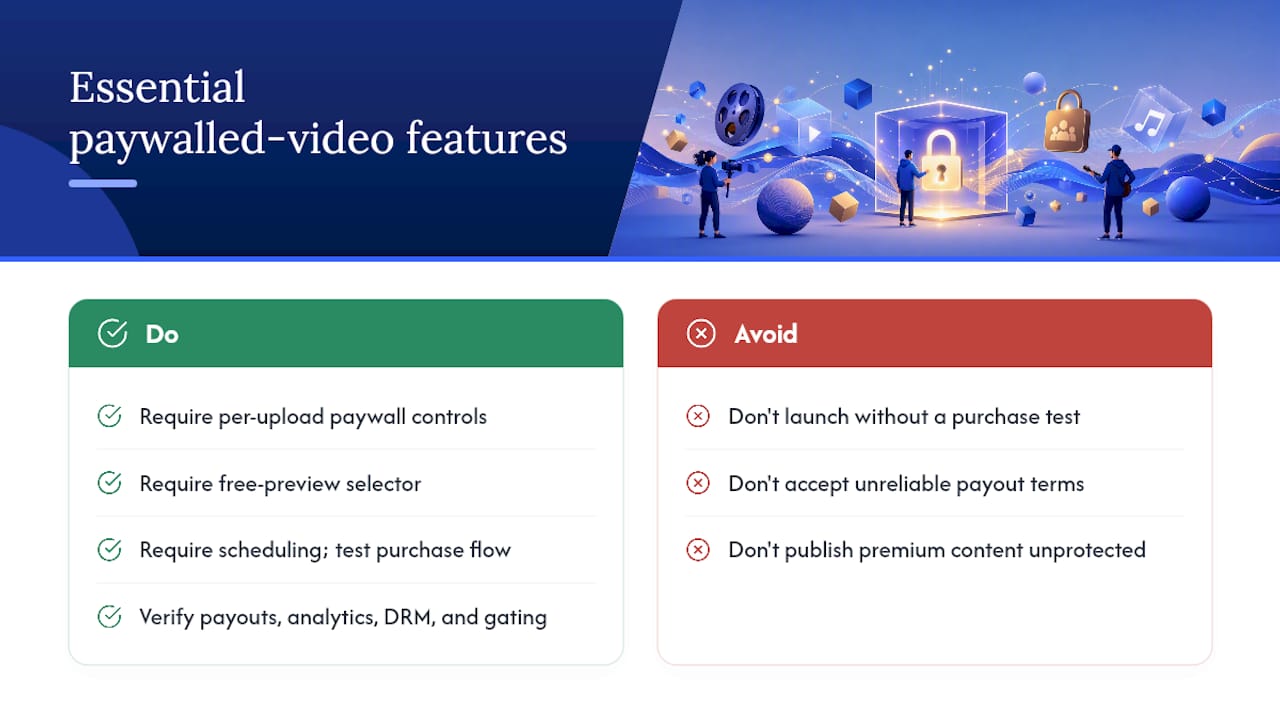
The non-negotiables: paywall controls that let you set subscriber-only or PPV visibility per upload, a free-preview selector so fans see enough to convert, scheduling tools for timed drops, and a purchase flow you can test before promoting. Substack’s video posts illustrate what flexible paywalls look like in practice: creators set a free preview segment, auto-generate transcripts, and gate the rest for paid subscribers. That preview-to-paywall structure materially reduces purchase friction.
Payout reliability matters as much as any content feature. Check payout frequency, minimum thresholds, KYC requirements, and whether the platform holds reserves. Reporting and analytics should show you conversion rates, revenue per drop, and subscriber counts at minimum. Content protection tools, including watermarking and DRM, are worth requiring before you publish anything premium. Comment and message gating rounds out the list, keeping subscriber spaces exclusive.
专业提示 Before committing to a platform, run a full purchase test with a secondary account. Confirm the paywall triggers correctly, the video delivers without buffering, and the payout registers. A platform that fails this test before launch will fail it with real fans.
YouTube’s members-only Shorts show how even mainstream platforms are adding native subscriber-only short-form options, with Shorts averaging massive daily views. For cam and paid-content creators, purpose-built platforms offer tighter paywall controls and better payout terms than general video hosts.
How to set up a monetized video step by step
- Age and compliance check. Confirm the content meets platform terms and any applicable US regulations before uploading.
- Upload and metadata. Add a clear title, thumbnail, and description. Good metadata improves discoverability within your subscriber feed.
- Set paywall and visibility. Choose subscriber-only, PPV, or tip-unlock. Lock the full video behind the gate.
- Select a free-preview segment. A 15–30 second preview lowers perceived risk and increases conversion.
- Set price or tier. Match the price to the content’s exclusivity and your fan base’s spending patterns.
- Schedule or publish. Use scheduling for early-access windows. Subscribers get access first; general PPV opens later.
- Enable captions and content protection. Auto-transcripts improve accessibility and SEO within the platform. Watermarking deters unauthorized sharing.
- Confirm payout settings. Verify your payout method, tax form status, and any reserve holds before the drop goes live.
- Monitor analytics post-launch. Track conversion rate, revenue per drop, and any access errors within the first 24 hours.
专业提示 Test the full purchase flow with a low-cost “friends” account before promoting. Confirm the paywall triggers, the video plays, and the payout registers. Catching a broken flow after promotion costs real revenue.
For practical, app-level steps on switching visibility to subscriber-only, TikTok’s subscriber-only upload settings show the general sequence most platforms follow in their creator tools.
How should you price and package monetized videos?
Pricing is where most creators leave money on the table. Low-price PPV ($3–$7) works for impulse buys and new fans testing the waters. Mid-range PPV ($10–$20) suits established audiences who already trust your content. Premium drops ($25–$50 or higher) require strong framing: clear length, explicit exclusivity, and a defined access window.
Subscription tiers typically run $5–$15 per month for entry-level access, with higher tiers ($20–$50) unlocking premium archives, early access, or direct messaging. These are illustrative ranges; your niche and fan base determine what converts. A smaller, highly engaged audience often supports higher prices than a large, passive one.
Bundles shift the value calculation. A three-clip bundle priced at a modest discount to individual PPV prices increases average order value without training fans to wait for sales. Early-access discounts for subscribers, where a PPV clip is $8 for subscribers and $15 for non-subscribers, reward loyalty and accelerate conversions before the general drop.
专业提示 Test price points in controlled drops. Release the same content type at two different price points to two comparable audience segments, then compare conversion rate and ARPPU. Two or three tests give you a defensible pricing baseline.
Explore top revenue models for a breakdown of how pricing strategy shifts across different creator niches and audience sizes.
US legal, payment, and tax checkpoints before you sell
- Age verification and recordkeeping. US regulations require platforms and creators to verify performer ages. Keep records; platforms typically handle primary verification, but creators bear responsibility for their own content.
- Platform terms and content policies. Read them. Payment processors impose restrictions that platforms pass down to creators. A policy violation can trigger a hold or account suspension.
- Payment processor rules. Processors often hold reserves, especially for new accounts. Understand your reserve schedule before counting on cash flow.
- Chargeback risk. Document every transaction. Dispute evidence should include purchase confirmation, delivery proof, and any fan communications.
- Income reporting. US creators receiving $600 or more from a platform in a calendar year typically receive a Form 1099-NEC or 1099-MISC. Report all income, including tips and PPV revenue, regardless of whether a 1099 arrives.
- Sales tax. Digital content sales tax rules vary by state. Some states tax digital downloads; others do not. Check your state’s rules or consult a tax professional.
- Bookkeeping. Keep receipts, payout records, and platform statements for at least three years.
- KYC requirements. Platforms require identity verification before processing payouts. Complete KYC early to avoid payout delays.
Consult a tax professional or entertainment attorney for guidance specific to your situation. The YouTube monetization eligibility rules illustrate how platform-specific thresholds and payment rules work; every platform has its own version of these requirements.
How do you convert viewers into paying fans and keep them?
The most reliable conversion tactic is a well-timed teaser. A 15–30 second blurred or cropped preview posted publicly creates demand before the paywall. Pair it with a direct message to high-intent fans who’ve engaged recently, and conversion rates climb noticeably.

Early-access windows do double duty: they reward existing subscribers and create urgency for non-subscribers. A week-long preview funnel works like this: Day 1, post a public teaser. Day 3, send a subscriber-only preview clip. Day 5, open PPV to subscribers at a discount. Day 7, release to general PPV at full price. Each step moves fans closer to purchase.
Subscriber-only Q&As, behind-the-scenes clips, and limited drops add value without requiring new premium content every time. Badges and perks tied to subscription tiers increase perceived status and reduce churn. The key is cadence: overusing PPV trains fans to wait rather than buy. One or two premium drops per month, supported by consistent subscriber content, tends to hold engagement better than weekly PPV pushes.
For subscriber perks that consistently move the retention needle, a structured perks ladder tied to subscription tiers outperforms ad-hoc bonuses.
专业提示 Schedule a subscriber-only preview 48 hours before a PPV drop and promote it via DM to fans who’ve purchased before. That single step typically produces the highest conversion rate of any tactic in the funnel.
Which metrics tell you if your monetized videos are working?
| Metric | How it’s calculated | What a trend signals |
|---|---|---|
| Conversion rate | Purchases ÷ preview views | Low rate: preview or price needs adjustment |
| ARPU / ARPPU | Revenue ÷ active subscribers or paying users | Declining: fans are downgrading or churning |
| MRR | Monthly recurring subscription revenue | Flat or falling: retention or acquisition issue |
| Avg. PPV revenue per drop | Total PPV revenue ÷ number of drops | Rising: pricing and promotion improving |
| Churn rate | Subscribers lost ÷ total subscribers (monthly) | High churn: content cadence or value gap |
| Lifetime value (LTV) | ARPU × average subscriber lifespan | Low LTV: focus on retention before acquisition |
| Purchase frequency | Total purchases ÷ unique buyers | Low frequency: PPV pricing or cadence off |
Benchmark ranges vary widely by creator size and niche. Use cohort analysis to track whether fans acquired through a specific campaign retain better than average.
The metric most creators ignore until it’s too late
Most creators obsess over subscriber count and ignore purchase frequency. A fan who buys once and never returns costs you acquisition effort with no compounding return. Purchase frequency, how often the same fan buys a PPV clip or upgrades a tier, is the clearest signal that your content and pricing are aligned with actual fan intent.
One experiment worth running this week: pull your last 30 days of PPV buyers and check how many purchased more than once. Adjust one variable, run the next drop, and measure again. Small, controlled changes produce clearer data than platform-wide overhauls.
Fanspicy is the platform context for this perspective, and the paywall controls and analytics tools there make this kind of cohort tracking straightforward without needing external tools.
Fanspicy gives you the paywall controls to put this into practice
Fanspicy is built specifically for creators who sell paywalled video content: subscriber-only clips, PPV drops, and tip-unlock posts. The platform combines flexible paywall controls, free-preview selection, and creator-focused analytics in one place, so you can run the setup checklist above without stitching together separate tools.
Payouts are reliable, KYC is straightforward, and the analytics dashboard surfaces the metrics that matter: conversion rate, MRR, and revenue per drop. If you’re ready to put a monetized video live with the right infrastructure behind it, start on Fanspicy 今天。
Sources
- YouTube is testing members-only Shorts for paying subscribers — TechCrunch
- Guide to video posts on Substack — Substack Support
- What are content monetization platforms? Here’s what creators should know — Stripe
- How to earn money on YouTube — YouTube Help
- What Is Pay Per View? How It Works & Getting Started With PPV — VPlayed
This article is general information, not a substitute for advice from a qualified financial advisor. Consult a qualified financial professional about your own circumstances before acting on anything here.