

目录
TL;DR:
- Piracy causes creators to lose 30-70% of potential earnings and increases subscriber churn.
- Protecting content involves layered strategies like DRM, AI scanning, and watermarking, but no single tool is perfect.
- Building loyalty through personalized and interactive content is key to long-term security and revenue growth.
Most adult content creators don’t realize how much money they’re quietly losing to piracy every single month. One leaked video can circulate across dozens of free sites within hours, stripping away the exclusivity your subscribers pay for. Piracy affects 70-80% of creators, slashing potential earnings by 30-70% and causing 15-25% subscriber churn. This guide breaks down exactly why content protection matters, which tools actually work, where they fall short, and what practical steps you can take right now to safeguard your income and grow your audience with confidence.
目录
- Why content protection is critical for creators
- Understanding modern content protection technologies
- Limits, ethics, and real-world challenges of digital protection
- Practical strategies: Maximizing income and minimizing piracy risk
- Our take: What most guides miss about content protection
- Take charge: Protect and profit with Fanspicy
- Frequently asked questions
Key Takeaways
| Point | Details |
|---|---|
| Piracy drains earnings | Unprotected content can cost creators up to 70% of potential revenue. |
| No tool is perfect | Combining DRM, AI, and smart strategy is necessary for comprehensive defense. |
| Diversification is key | Offering live or exclusive experiences reduces the impact of piracy. |
| Proactive steps pay off | Monitoring and instant takedowns can significantly lower financial losses. |
Why content protection is critical for creators
If you’ve ever wondered why your subscriber count plateaued after a strong launch, piracy may be a bigger factor than your content quality. When your exclusive videos appear on free platforms, potential subscribers simply stop paying. Why would anyone subscribe when they can watch for free? This is the core economic damage piracy inflicts on your recurring revenue model.
The scale of the problem is staggering. Top-earning creators report losing between $3,000 and $8,000 every month directly to content theft. That’s not a hypothetical. That’s rent, equipment, and growth capital evaporating because someone screen-recorded your exclusive content and uploaded it elsewhere.
Here’s what unprotected creators typically experience:
- Subscriber churn: Fans cancel when leaked content removes the exclusivity they were paying for
- Devalued brand: Free pirated content trains your audience to expect your work without paying
- Platform penalties: Some platforms flag accounts associated with leaked material, impacting your standing
- Lost negotiating power: Brands and collaborators pay less when your exclusivity is compromised
“Piracy isn’t a minor inconvenience. For most creators, it’s a slow revenue drain that compounds over time until the business model breaks entirely.”
Protecting your content directly supports your ability to boost recurring content revenue because subscribers stay loyal when they believe they’re getting something nobody else can access. The moment that exclusivity breaks, retention collapses.
Choosing where you publish matters enormously too. When you choose the right platform, you get access to native security tools that form the first layer of your defense. Combined with strong protecting digital content rights practices and hybrid monetization approaches, you can build a sustainable income even in a landscape where piracy is constant.
The threat isn’t slowing down either. Automated bots now scrape and repost content within minutes of publication, making reactive approaches almost useless without a proactive system in place.
Understanding modern content protection technologies
Now that the risks are clear, let’s look at the actual tools available and what they realistically deliver.
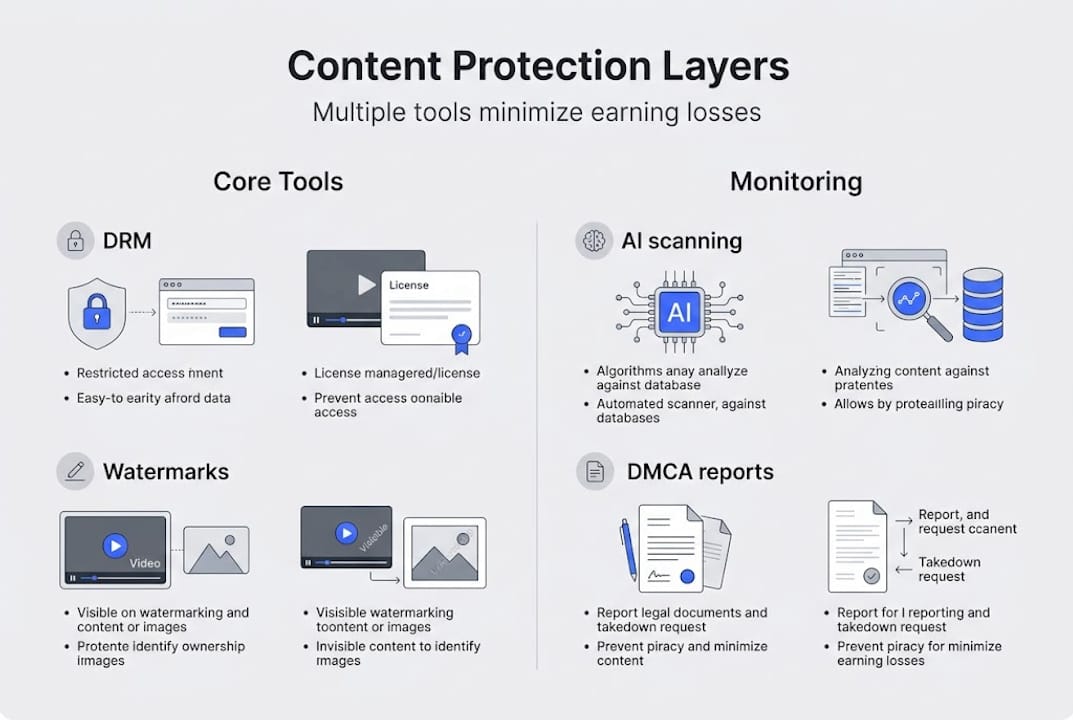
数字版权管理(DRM) is the foundation most platforms build on. DRM encrypts your content and controls playback, so files can’t simply be downloaded and shared. It’s effective for stopping casual theft. However, DRM remains vulnerable to screen recording, browser-based downloaders, and circumvention tools like Widevine crackers. A motivated pirate doesn’t need a downloaded file. They just need a screen recorder.
AI-powered scanning services fill the gap DRM leaves. These tools continuously crawl the web, identify your content on unauthorized sites, and file takedown notices automatically. AI services scan 1,500 to 12,000+ sites, achieving takedowns in 60 minutes to 24 hours, with Ceartas and Ovarra leading current benchmarks. This is meaningful speed when your content spreads virally.
Platform-native tools include watermarking, DMCA reporting dashboards, and IP monitoring. They’re useful but limited. Most only act after infringement is reported, meaning damage is already done.
Here’s a quick comparison of the main options:
| Tool | Strength | Weakness |
|---|---|---|
| DRM | Blocks direct downloads | Bypassed by screen recording |
| AI scanning | Rapid automated takedowns | Subscription cost, not instant |
| Platform tools | Built-in, zero setup | Reactive, limited scope |
| 水印 | Identifies leakers | Doesn’t prevent sharing |
| Manual DMCA | Free, direct | Slow, labor-intensive |
No single tool covers everything. Real security requires layering: DRM as a baseline, AI scanning for active monitoring, and watermarking to trace leaks back to their source. Learning safe sharing practices is also part of the equation, especially when sharing previews or working with collaborators.

Pro Tip: Embed invisible watermarks in every video before publishing. If a copy surfaces online, you can identify exactly which subscriber or platform it came from, giving you actionable evidence for a DMCA claim.
Limits, ethics, and real-world challenges of digital protection
With tools explained, it’s time to address what they genuinely can’t do and the ethical complexity surrounding digital protection.
DRM in particular creates friction for legitimate users. Device compatibility limits, playback errors, and region restrictions frustrate paying subscribers who did nothing wrong. DRM balances protection and user experience but raises real ethical issues around restricting fair use and device compatibility, while piracy persists due to deeply rooted economic factors. Some subscribers who hit playback walls simply leave rather than troubleshoot, making overly aggressive DRM a subscriber retention problem.
Fair use is another gray area. Short clips used in commentary or review contexts are legally protected in many jurisdictions, meaning not every use of your content qualifies as infringement. Sending aggressive takedowns for legitimate uses can damage your reputation and occasionally invite legal blowback.
Piracy also won’t disappear because technology improves. Consider the honest economics:
- Pirates often operate from regions where enforcement is difficult or impossible
- Free content has near-zero cost to reproduce and distribute
- Many piracy consumers would never have paid anyway, limiting actual revenue lost
- Determined pirates adapt faster than protection tools can update
“The goal isn’t a perfect defense. The goal is making theft inconvenient enough that casual pirates give up while protecting enough exclusivity to keep real subscribers paying.”
This realistic mindset matters. Creators who treat content protection as an all-or-nothing battle burn out and overspend on tools. Creators who accept some leakage as a cost of doing business while actively managing it tend to build more stable, profitable operations. Diversifying your income streams and understanding the actual ROI of protection spending puts you in control, not in a constant state of reactive panic.
Practical strategies: Maximizing income and minimizing piracy risk
With context and nuance covered, here are concrete steps that actually move the needle.
- Audit your current protection setup. Know what your platform provides natively and identify the gaps. Most platforms offer baseline DRM and DMCA tools, but no single tool suffices for full coverage. You need proactive AI monitoring on top of platform defaults.
- Add AI-powered monitoring immediately. Services like Ceartas or Ovarra run continuously without your involvement, catching leaks before they compound. Set this up before your audience grows, not after.
- Watermark every piece of content. Use both visible and invisible watermarks. Visible ones deter casual sharing. Invisible ones identify the source when theft occurs.
- Diversify into live and interactive content. Live streaming and direct fan interactions are effectively impossible to pirate after the fact. High-earners benefit most from professional services, but diversifying into live or unpiratable content significantly reduces risk at any income level.
- Calculate your ROI on pro services. If you earn $5,000 monthly and piracy cuts that by even 20%, that’s $1,000 lost. A $100-200 monthly protection service pays for itself many times over.
| Monthly earnings | Estimated piracy loss (20%) | Pro service cost | Net benefit |
|---|---|---|---|
| $1,000 | $200 | $100 | $100 |
| $3,000 | $600 | $150 | $450 |
| $7,000 | $1,400 | $200 | $1,200 |
Pairing strong content protection with solid secure payments advice prevents losses on both the content and the transaction side. Exploring diverse business models for creators and learning how to maximize revenue in 2026 will also ensure your income isn’t dependent on a single vulnerable stream. Strong content licensing tips can even turn some of your existing material into additional revenue.
Pro Tip: Set a Google Alert for your creator name and content titles. It’s a free early-warning system that catches indexed pirated copies before they spread widely.
Our take: What most guides miss about content protection
Here’s the uncomfortable truth most protection guides skip: technology is the smallest part of your long-term security.
The creators who lose the least to piracy aren’t necessarily the ones with the most sophisticated DRM stacks. They’re the ones with the most loyal fans. When a subscriber genuinely feels connected to you, they don’t look for free alternatives. They pay because the relationship, not just the content, is what they value.
Chasing every new protection tool is exhausting and expensive. A faster, more sustainable strategy is building your brand around experiences that simply can’t be replicated or pirated: live sessions, personalized messages, real-time interaction. These are things a leaked video can never replace.
Our unconventional rights guide digs into this philosophy further. The creators winning in 2026 treat protection as one layer of a resilient business, not as the entire strategy. Adaptability and genuine connection outpace any tool on the market.
Take charge: Protect and profit with Fanspicy
You’ve got the knowledge. Now it’s time to put it to work on a platform built for creators who take both protection and revenue seriously.
Fanspicy is designed specifically for adult content creators who want more than a place to upload. With built-in monetization features, live cam capabilities, and a community that values exclusive content, it’s a platform that works alongside your protection strategy, not against it. Whether you’re looking to streamline your content protection workflow, grow your content business with new tools and audience segments, or simply explore what a creator-first platform feels like, Fanspicy is the next logical step. Your content has value. It’s time to protect it like it does.
Frequently asked questions
How much money do pirates cost adult content creators?
Content piracy cuts potential earnings by 30-70% and affects as many as 70-80% of creators, making it one of the largest hidden threats to creator income.
Can DRM completely stop piracy of my content?
DRM reduces casual theft effectively, but remains bypassed by screen recording and advanced download tools, so determined pirates may still succeed.
What’s the fastest way to remove stolen content?
AI-powered services like Ceartas scan thousands of sites and achieve takedowns in as little as 60 minutes, making them the fastest available solution.
Is content protection worth it for new or smaller creators?
Even small creators face real losses, but ROI is highest for creators with larger subscriber bases and exclusive material that commands premium pricing.