

Зміст
To grow your audience on YouTube, do two things: get in front of people through Shorts and targeted search, then keep them watching with strong hooks, thumbnails, and retention-driven edits. Pick a niche, publish on a cadence you can sustain, cut long-form highlights into Shorts, and track your click-through rate and retention every week. Discoverability and watch time reinforce each other, and small improvements in both compound fast once the algorithm has enough signal to trust your channel.
TL;DR:
- Approximately 60% of organic YouTube views now originate from Shorts, making them the fastest way for new channels to gain initial reach and visibility.
- Focusing on niche, low-competition search keywords and posting 1 to 2 long-form videos weekly, combined with frequent Shorts, maximizes growth potential.
- Early engagement strategies like seeding videos in niche communities within the first 72 hours significantly influence YouTube’s distribution decisions.
- Improving retention through strong hooks, clear thumbnails, and pattern interrupts directly boosts the video’s reach and algorithm trust.
- Tracking key metrics such as click-through rate, retention curves, and subscriber conversion rate guides content refinement and sustains long-term growth.
Зміст
- High-Impact Checklist for Growing Your YouTube Audience
- How Does YouTube Discovery Actually Work in 2026?
- How Do You Hook Viewers and Keep Them Watching?
- Choosing a Niche and Cadence That Compounds Growth
- What Video-Level SEO and Metadata Actually Move Views?
- How Do You Turn Views Into Subscribers?
- Which Metrics Should You Track, and How Do You Experiment?
- How Do You Repurpose Content and Promote It Beyond YouTube?
- What Mistakes Slow Down YouTube Channel Growth?
- An 8-Week Starter Plan for New Creators
- A Practitioner’s Take on Realistic YouTube Growth Timelines
- Sources
- ПОШИРЕНІ ЗАПИТАННЯ
High-Impact Checklist for Growing Your YouTube Audience
If you only act on one section of this article, act on this one. These are the levers that move the needle fastest for a new or small channel.
- Pick a clear niche and one primary keyword per video so YouTube knows exactly who to show it to.
- Post 1 to 2 long-form videos weekly, and add Shorts as often as your quality bar allows without cutting corners.
- Hook viewers in the first 3 to 15 seconds. That window decides whether the algorithm keeps pushing your video.
- A/B test your thumbnails and titles, then check click-through rate (CTR) and average view duration against your channel baseline.
- Seed early views through niche Reddit threads, Discord servers, and your email list before the algorithm has any data on you.
Each of these gets its own deeper section below, but if you build a channel around just these five habits, you are already ahead of most beginners on YouTube.
How Does YouTube Discovery Actually Work in 2026?
Shorts, not search or suggested videos, is where most new viewers first meet your channel. Metricool’s 2026 analysis of nearly 800,000 videos found that roughly 60% of organic views now come from the Shorts feed. If you are building a channel from zero, that single number should reorder your priorities.
Statistic Callout: About 6 in 10 organic YouTube views now originate from Shorts, and Shorts view counts more than doubled year over year in 2026, according to Metricool’s study. For a new channel with no subscriber base, Shorts is currently the fastest on-ramp to being seen at all.
That does not mean long-form is dead. It means the two formats do different jobs. Shorts get you discovered; long-form is where you build the deeper watch time and subscriber relationships that keep a channel alive past its first few months. Search plays a third, quieter role: a new channel that targets low-competition, specific keywords can earn steady impressions on Google and YouTube search long before it has any subscriber momentum, because search ranking cares more about relevance than channel size.
Suggested video placement, the “recommended next” slot, scales with watch time and session value. YouTube wants to keep people on the platform, so a video that leads into another watch (via playlists, end screens, or a strong next-video tease) earns more suggested placement than an isolated upload. That is why organizing your catalog into playlists is not just tidy housekeeping. It is a discovery lever.
Here is a practical breakdown of where to put your energy by channel stage:
- New channel, under 1,000 subscribers: Prioritize Shorts for reach and low-competition search keywords for durable, compounding traffic.
- Growing channel, building watch time: Build playlists and internal video links to increase session length and earn more suggested placement.
- Every stage, first 72 hours after upload: Share the video (not spammy, just relevant) in niche Reddit threads, Discord communities, and your email list to generate the early engagement signal YouTube uses to decide whether to widen distribution.
Jon Youshaei, a former YouTube insider whose creator frameworks are widely cited by working creators, recommends using Reddit as an informal focus group for idea validation, which doubles as an easy way to seed your first views in a place where interested people already gather.
How Do You Hook Viewers and Keep Them Watching?
Getting the click is only half the job. The other half is proving, within seconds, that the click was worth it. Retention is now one of the strongest signals YouTube uses to decide how far to push a video, and it starts before your title card even fades.
- Open with the payoff, not the setup. Youshaei’s R.A.I.N.Y. hook framework, detailed by NoFilmSchool, pushes creators to state the result or stakes in the first 3 to 15 seconds rather than easing in with a greeting or an agenda. Tell viewers what they are about to get before they decide whether to stay.
- Design your thumbnail around one focal point. A single subject, a clear emotion or striking visual, high contrast against the background, and 3 to 5 words of readable text outperform busy, cluttered frames almost every time.
- Write titles that lead with the keyword and end with a specific benefit. Keep it under 60 characters, put your primary keyword in the first few words, and add a number or concrete outcome where it fits naturally.
- Edit for pattern interrupts. Cut anything that does not move the video forward. Use chapters to reset attention at natural break points, and match your runtime to how much story you actually have. A 14-minute video with 8 minutes of content will bleed retention no matter how good the hook is.
- Diagnose drop-offs with your retention graph. A steep early drop usually means the hook did not deliver on the title’s promise. A steady mid-video decline usually means pacing is too slow. Overlaying your best and worst-performing videos’ retention curves shows you exactly where viewers start leaving, which tells you whether to rework the opening or add an earlier payoff.
Порада професіонала: Test thumbnails and titles as a system, not a one-off. Small CTR gains compound across every video you publish afterward, since YouTube keeps showing higher-CTR content to more people. A 2-point CTR improvement on your channel average is worth more long-term than any single viral hit.
Choosing a Niche and Cadence That Compounds Growth
A niche is not just a topic. It is topic, audience, and format combined. “Cooking videos” is not a niche. “15-minute weeknight dinners for people who hate meal prep” is. Test your niche idea against a simple prompt: could you name your next 10 video ideas right now without straining? If not, the niche is still too broad or too vague to build momentum on.
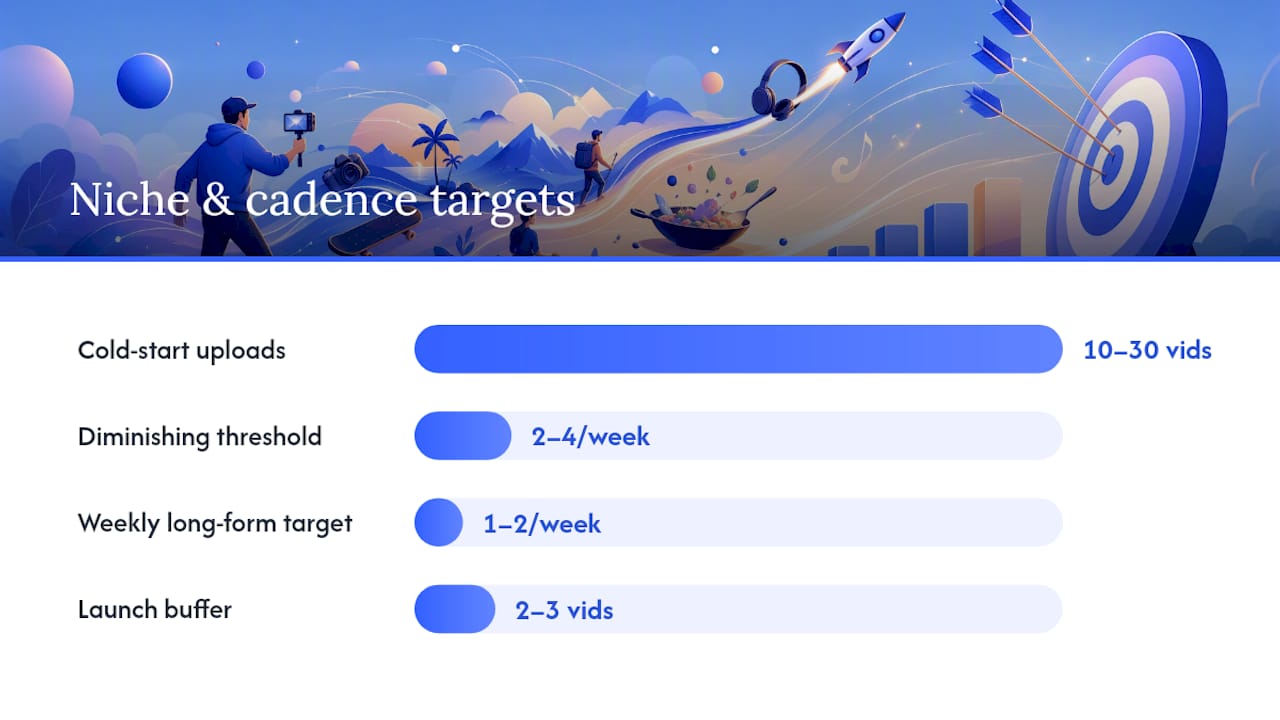
New channels run into what practitioners call the cold-start problem. Below roughly 1,000 subscribers, YouTube gives limited initial impressions until it has enough consistent signal to trust your channel, and that usually takes 10 to 30 uploads. This is exactly why you cannot wait passively for the algorithm to notice you. You have to manufacture your own early distribution, through Shorts, search-targeted keywords, and outside seeding, while the algorithm is still testing you.
On cadence, more is not automatically better. Metricool’s 2026 data shows long-form uploads beyond 2 to 4 videos a week hit diminishing returns fast, with little extra monthly view gain to show for the added workload. A sustainable target is:
- 1 to 2 long-form videos per week, produced to a quality bar you can actually maintain over months, not weeks.
- Shorts as often as quality allows, ideally pulled from long-form footage rather than treated as a separate content stream.
- A 2 to 3 video buffer built before you launch, so a bad week does not break your posting streak.
- A recognizable series or format so a viewer who liked one video can predict what your next one will be, which is what actually earns a subscribe.
What Video-Level SEO and Metadata Actually Move Views?
Metadata will not save a weak video, but it decides whether a good video ever gets found in the first place. Treat every upload like a small search-optimization project.
Start with keyword research using a tool like TubeBuddy or VidIQ. Alan Spicer’s tactical guidance recommends targeting one primary keyword per video and favoring lower-competition phrases early, since a new channel with no authority signal has almost no chance of outranking established channels on a high-competition term.
Once you have the keyword, place it deliberately:
- In the title, ideally within the first 4 to 5 words, where both viewers and YouTube’s search algorithm weigh it most heavily.
- In the first sentence of the description, since that line is what shows in search previews and gets the most algorithmic weight.
- Spoken naturally early in the video, since YouTube’s speech-to-text processing uses spoken keywords as a relevance signal too.
- In chapters and timestamps, which improve session value by making it easy for viewers to jump around, rewatch a section, or stay longer than they planned.
- Grouped into topic-based playlists, which signal to the algorithm that your channel has depth on a subject, not just one lucky video.
Skip hashtag stuffing on long-form content. Metricool’s research found long-form videos using hashtags actually pulled about 17% fewer views despite gaining more interactions, likely because hashtags narrow the audience YouTube considers relevant rather than widening it.
How Do You Turn Views Into Subscribers?
A view is a moment. A subscriber is a bet that your next video will be worth their time too. YouTube Studio shows a specific “subscribers gained” metric per video, and comparing it against your view count gives you a subscriber conversion rate you should actually watch.
- Find your subscriber conversion rate in YouTube Studio and identify which videos convert best. Those are your template for what to make more of, not just your highest-view videos.
- Ask for the subscription after you have delivered value, and frame the ask around a benefit (“subscribe for a new [specific thing] every week”) rather than a bare request. A CTA placed before any payoff reads as presumptuous and gets ignored.
- Reply to comments in the first hours after upload, use Community posts between uploads to stay visible, and build series that give people a concrete reason to come back rather than a vague hope they will remember you.
- Watch for Shorts-driven subscriber dilution. Shorts can spike subscriber counts quickly, but some of those subscribers came for a 30-second clip, not your long-form identity. If your average view duration on long-form drops as Shorts subscribers grow, adjust your content mix rather than assuming growth is universally healthy. FanSpicy’s own guidance on converting platform traffic into engaged followers covers this same conversion gap in more depth for creators managing multiple content formats.
Which Metrics Should You Track, and How Do You Experiment?
Five metrics tell you almost everything: impressions, click-through rate, average view duration, retention curves, and traffic source breakdown. Add subscriber conversion rate as a sixth, and you have a complete diagnostic panel.
- Low CTR points to a thumbnail or title problem. Fix that before touching anything else.
- Low average view duration or a steep early retention drop points to a weak hook or slow opening pacing.
- Low subscriber conversion despite strong retention suggests your CTA timing or framing needs work, not your content.
- Traffic source data tells you whether Shorts, search, or suggested is doing the heavy lifting, so you know where to double down next.
Run experiments in small batches: 2 to 3 thumbnail or title variations across similar videos over 2 to 4 weeks, then judge by retention and CTR rather than gut feeling. Metricool’s data shows roughly 83% of a video’s total interactions land within the first ten days, with the sharpest burst in the first 3 days. That window is when replying to comments and pushing the video to your existing communities matters most, because it is when YouTube is actively deciding how far to widen distribution.
How Do You Repurpose Content and Promote It Beyond YouTube?
The most efficient Shorts strategy is not making separate Shorts content. It is capturing your long-form video’s best 15 to 60-second moments during the edit and clipping them out, using AI clipping tools where useful to scale the process without sacrificing quality. In each Short, prompt viewers verbally or visually toward the full video, and put a direct link in the description so the Short functions as a discovery funnel rather than a dead end.
Then push outward. Share the upload in the niche communities and email list where your specific audience already gathers, rather than broadcasting into the void of general social platforms. FanSpicy’s breakdown of cross-platform content marketing covers this repurposing workflow for creators juggling multiple channels at once, and it applies just as well to a solo YouTuber trying to squeeze more mileage from one recording session.
What Mistakes Slow Down YouTube Channel Growth?
- Inconsistent posting or wandering topics. Commit to one niche and a cadence you can actually sustain past week three.
- Chasing virality over durable search and suggested value. One viral Short does not replace a repeatable content system.
- Asking for subscriptions too early or without a stated benefit. A vague ask before any payoff gets ignored.
- Treating Shorts as a growth stunt instead of integrating them into your channel’s actual identity and long-form catalog.
An 8-Week Starter Plan for New Creators
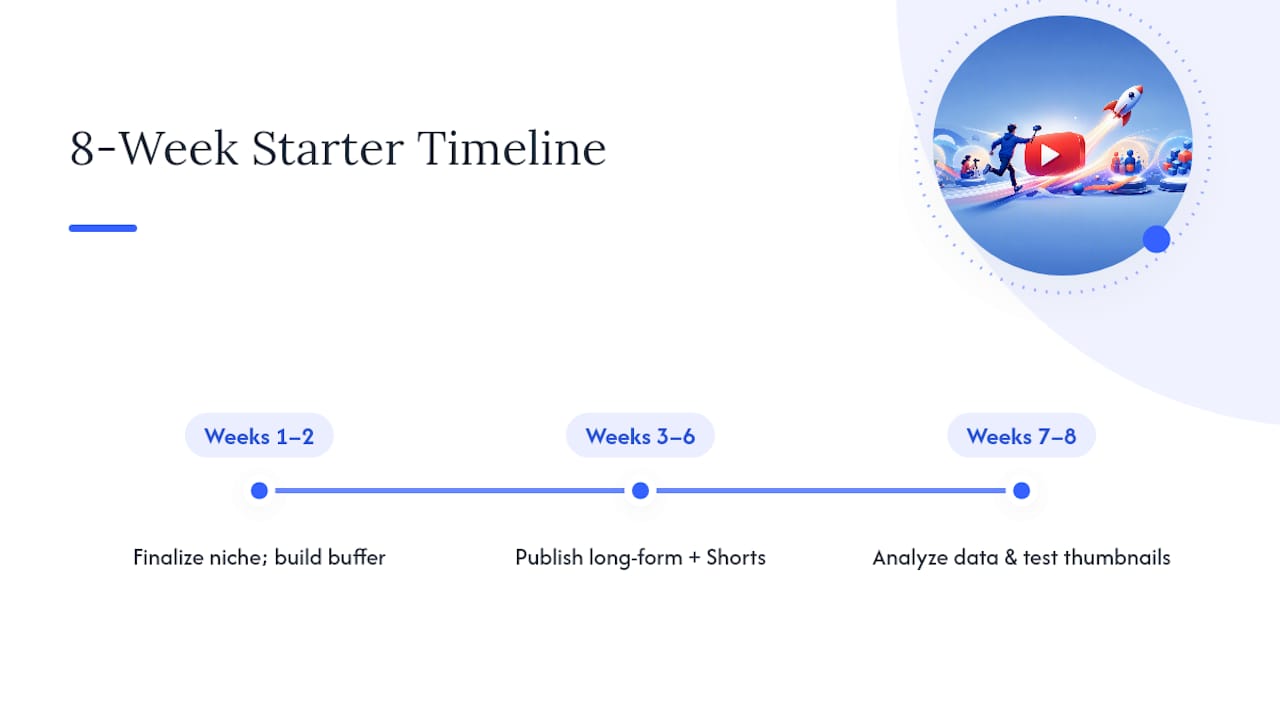
Weeks 1 and 2: finalize your niche, build a 2 to 3 video buffer, and set up your keyword workflow. Weeks 3 through 6: publish 1 to 2 long-form videos weekly, cut 2 to 3 Shorts per upload, and seed each release in relevant communities within the first 72 hours. Weeks 7 and 8: pull your first real data, run a thumbnail test, and compare subscriber conversion rate across your catalog to see which format and topic actually earned loyalty rather than just views.
Track your numbers weekly using FanSpicy’s analytics guidance for creators, and revisit the subscriber retention tactics once you have enough uploads to see a real pattern instead of noise from a handful of videos.
If your growth strategy also includes building a direct, paying audience rather than depending entirely on YouTube’s algorithm, Fanspicy gives creators a way to convert engaged viewers into paying subscribers, tips, and private message revenue on a platform built around keeping a higher share of creator earnings. Creators moving content over from other platforms can review Fanspicy’s model page to see how exclusive content, paid posts, and tips work alongside a YouTube growth strategy rather than instead of one.
A Practitioner’s Take on Realistic YouTube Growth Timelines
Growth on YouTube rarely moves in a straight line. Expect a slow, sometimes discouraging stretch through your first 10 to 30 uploads while the algorithm gathers signal, followed by a noticeable acceleration once it starts trusting your channel with wider distribution. Watch subscriber conversion rate more closely than raw view counts. Views without conversion tell you the algorithm noticed you. Conversion tells you the audience wants to stay.
— fan
Sources
The tactical advice in this article draws primarily from Metricool’s 2026 YouTube study, which analyzed nearly 800,000 videos to map out Shorts distribution, upload cadence, and interaction timing. Jon Youshaei’s creator-insider frameworks, covered by NoFilmSchool, shaped the hook and ideation guidance throughout. Practical workflow advice on cold-start dynamics and retention diagnosis came from TubeMilestone’s practical guide for new creators, while keyword and thumbnail testing tactics came from Alan Spicer’s growth guide.
- How To Grow On YouTube (Metricool)
- How to Build a YouTube Channel That Actually Grows (NoFilmSchool)
- How to Grow a YouTube Channel: A Practical Guide for New Creators (TubeMilestone)
- How To Grow A YouTube Channel Fast (Alan Spicer)
ПОШИРЕНІ ЗАПИТАННЯ
How Do I Expand My Audience on YouTube?
Expanding your audience means prioritizing two things at once: getting discovered through Shorts and targeted search, and holding attention once someone clicks. Roughly 60% of organic views now come from Shorts, so a channel with no subscriber base should lean on Shorts and low-competition search keywords first, then use strong hooks and retention-focused edits to convert that traffic into loyal viewers.
How Long Does It Take to Grow a YouTube Channel From Scratch?
Most new channels need 10 to 30 consistent uploads before YouTube’s algorithm gathers enough signal to widen distribution meaningfully. Growth tends to feel slow early on and then accelerate once the platform trusts the channel, which is why cadence and patience matter more than any single video’s performance.
Should Beginners Focus on Shorts or Long-Form Videos?
Both, but for different reasons. Shorts currently drive the majority of organic discovery for new channels, while long-form video builds the deeper watch time and subscriber relationships that sustain a channel over time. The most efficient approach is producing long-form content and cutting your strongest moments into Shorts, rather than treating them as two separate content strategies.
What’s the Ideal Posting Schedule for a New YouTube Channel?
A sustainable target is 1 to 2 long-form videos per week, since uploads beyond 2 to 4 a week show diminishing returns, plus Shorts as often as quality allows. Building a 2 to 3 video buffer before launch helps protect that cadence when life gets in the way.
How Do I Know If My Thumbnail or Hook Is the Problem?
Check your retention graph first. A steep drop in the first few seconds usually points to a weak hook or a thumbnail and title that overpromised, while a low click-through rate on an otherwise strong video points specifically to the thumbnail or title itself needing a test.