

Зміст
TL;DR:
- SFW and NSFW are content labels that protect viewers and creators, indicating appropriateness for public or professional environments. NSFL is a more extreme warning for content likely to cause lasting emotional harm, such as extreme gore or fatal incidents. Accurate labeling influences platform rules, moderation, and the success of creators’ content strategies.
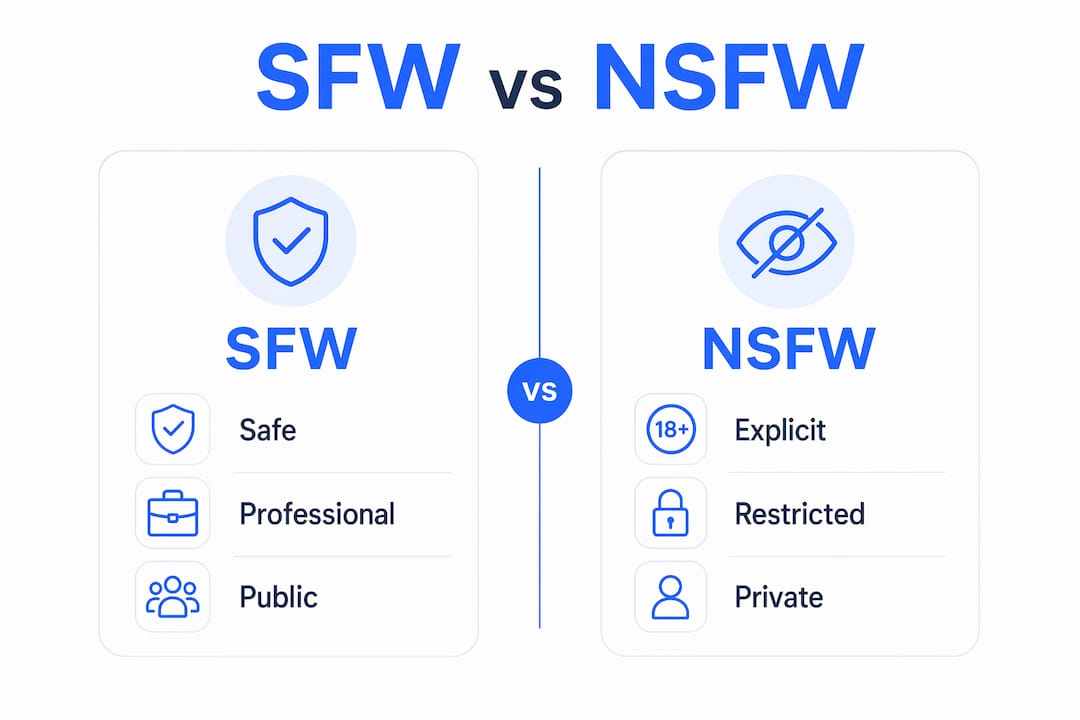
SFW stands for “Safe For Work” and NSFW means “Not Safe For Work,” two labels used to classify digital content based on its appropriateness for professional, public, or mixed-audience settings. These terms originated in early internet culture and now function as the default content warning system across social media, email, forums, and creator platforms. If you have ever received a link with a warning attached, or wondered why some posts are hidden behind a click-through screen, you already understand the core purpose of these labels. Knowing how to define SFW and NSFW correctly protects you, your audience, and your professional reputation online.
What types of content are labeled SFW or NSFW?
SFW content is defined as material appropriate for professional, educational, or public settings. It excludes sexual imagery, graphic violence, heavy profanity, and disturbing subject matter. Think of it as anything you could open on your laptop in a coffee shop or office without causing concern.
NSFW content covers a wide range of material that would be inappropriate or uncomfortable in those same contexts. Common NSFW content examples include:
- Pornography and explicit sexual imagery, including adult creator content on subscription platforms
- Graphic violence, such as footage of injuries, fights, or war imagery
- Extreme profanity or hate speech, particularly when used aggressively or in a targeted way
- Disturbing or emotionally distressing imagery, including content related to self-harm or death
Beyond these standard categories, there is a more severe label worth knowing: NSFL, or “Not Safe For Life.” NSFL warns viewers that content is likely to cause genuine emotional harm, covering extreme gore, fatal incidents, or deeply traumatic material. Where NSFW says “this may be uncomfortable at work,” NSFL says “this may stay with you.” The distinction matters because it helps audiences calibrate their own tolerance before clicking.
NSFW labels also appear in professional and educational contexts. Medical training visuals, investigative journalism footage, and forensic documentation all carry NSFW tags not because they are salacious, but because they require viewer preparation. This broader usage shows that the label is about viewer protection, not content quality.
Порада професіонала: If you are unsure whether your content qualifies as NSFW, ask yourself: “Would I be comfortable if my employer or a stranger’s child saw this on my screen?” If the answer is no, label it NSFW.

How did the terms SFW and NSFW originate?
NSFW has been in use since the early 2000s, emerging from message board and forum culture as a polite way to warn others before they opened a link. The first Urban Dictionary definition appeared in 2003, cementing its place in internet vocabulary. At the time, shared office computers and open-plan workplaces made accidental exposure to explicit content a real social hazard.
“NSFW originated from internet forum culture as a social courtesy, with no formal legal definition, so platform discretion varies widely.” — Content Moderation Glossary, ModerationAPI
SFW developed as a complementary label shortly after. Where NSFW warned of risk, SFW offered reassurance. Posting a link with “SFW” told the recipient they could open it freely without checking their surroundings first. Both terms spread quickly because they solved a genuine communication problem with minimal friction.
The evolution of these terms tracks closely with the growth of social media. Platforms like Reddit, Tumblr, and Twitter adopted NSFW tagging systems that automatically blurred or hid flagged content. Email culture followed, with professionals adding NSFW to subject lines when forwarding sensitive but work-relevant material, such as legal documents containing explicit evidence or HR training materials on harassment. Today, the labels appear in platform settings, content policies, and creator dashboards across every major digital channel.
What are the implications of SFW and NSFW for creators and platforms?
For digital creators, the SFW vs NSFW distinction is not just a content warning. It defines your entire business model, your platform options, your fee structure, and your legal exposure.
80% of new creators prefer producing SFW content, and many reach profitability faster because SFW platforms typically charge lower fees. SFW platforms may take around 10% in fees compared to roughly 20% on adult-content platforms. That difference compounds significantly at scale. SFW creators also gain access to mainstream advertising networks, brand sponsorships, and corporate partnerships that are categorically unavailable to NSFW creators.
| Factor | SFW creators | NSFW creators |
|---|---|---|
| Platform fees | ~10% | ~20% |
| Brand partnership access | Високий | Дуже обмежений |
| Advertising network eligibility | Broad | Restricted |
| Legal and regulatory risk | Низький | Elevated |
| Audience targeting flexibility | Wide | Niche-specific |
Improperly labeling NSFW content risks platform bans, demonetization, and loss of brand safety ratings, even when the content itself is professionally legitimate. A medical educator posting surgical imagery without an NSFW tag can trigger automated filters designed to catch explicit content. The filter does not understand context. It reads signals.
AI moderation has raised the stakes further. Modern platforms use AI-based classifiers combined with user self-tagging to catch mislabeled or hidden NSFW material. These systems are fast but imperfect, which means false positives can suppress legitimate content and false negatives can expose platforms to liability. For creators, this makes accurate self-labeling a compliance requirement, not an optional courtesy.
Producing or hosting NSFW AI-generated content carries significant legal and reputational risk. SpaceX flagged NSFW AI imagery liabilities directly in its S-1 filing, a signal that regulators and investors are watching this space closely. Any creator or platform working with AI-generated adult content should treat legal review as a baseline requirement.
Порада професіонала: Treat your content label as part of your metadata strategy. Correct NSFW tagging improves your content’s reach to the right audience and keeps you off automated ban lists. Incorrect tagging in either direction costs you visibility or your account.
How do SFW and NSFW labels shape online etiquette?
NSFW is a social navigation tool, designed to warn rather than judge. Attaching the label to a link or post does not mean the content is wrong, illegal, or low quality. It means the content requires a specific context to be received appropriately. This distinction matters because misunderstanding NSFW as a moral verdict leads people to either over-label harmless content or resist labeling genuinely explicit material out of defensiveness.
Respectful content sharing online follows a straightforward set of norms:
- Label before you share. If there is any chance your content would surprise or discomfort someone in a public setting, add the NSFW tag before sending.
- Respect platform community standards. Every platform publishes content guidelines. Knowing them prevents accidental violations that can result in account suspension.
- Do not use SFW as a trick. Labeling explicit content as SFW to get more clicks is a form of deception that damages trust and can result in bans.
- Understand your audience’s context. Sending NSFW content to a professional contact without warning, even in a casual tone, crosses a line that is difficult to walk back.
- Recognize that NSFW labels protect the viewer, not the creator. The label exists to give the person receiving content the ability to choose when and where they engage with it.
Mislabeling has real consequences. A creator who posts explicit content without proper tags on a platform like Reddit or Instagram risks permanent account removal. A professional who forwards a graphic news clip without an NSFW subject line can create a hostile workplace complaint. The label is a small act of consideration with outsized protective value for everyone involved.
Key takeaways
SFW and NSFW are the internet’s primary content classification system, and using them correctly protects creators, viewers, and platforms from avoidable harm.
| Point | Details |
|---|---|
| Core definitions | SFW means safe for professional settings; NSFW flags content inappropriate for public or work contexts. |
| Content severity scale | NSFL is more extreme than NSFW, covering content likely to cause lasting emotional distress. |
| Creator business impact | SFW creators typically pay lower platform fees and access broader brand partnership opportunities. |
| Labeling as compliance | Incorrect NSFW tagging triggers AI moderation systems and risks platform bans or demonetization. |
| Social purpose of NSFW | The label is a courtesy warning for viewers, not a moral judgment on content quality or creator intent. |
Why clear labeling matters more now than ever
I have spent years watching creators make the same avoidable mistake: treating SFW and NSFW as aesthetic choices rather than operational ones. The label you attach to your content determines which algorithm surfaces it, which advertisers will touch it, and whether your account survives the next platform policy update.
What most articles on this topic miss is how much the rise of AI-generated content has changed the stakes. When a human creates explicit content, there is intent behind it and a person accountable for it. When an AI generates it, the accountability question gets murky fast. Platforms are responding by tightening automated enforcement, which means even borderline content without proper labels gets caught in the net. Creators who relied on informal norms are now getting flagged for content they posted years ago.
The other thing I would push back on is the assumption that NSFW automatically means adult content. I have seen investigative journalists lose accounts because they posted graphic news footage without tags. I have seen medical educators get demonetized for clinical imagery. The label is not about morality. It is about context. A surgical photo is NSFW in a general feed and completely appropriate in a medical training environment. The content does not change. The context does.
My honest recommendation: treat your content labels the way you treat your contracts. Read the platform’s definitions, apply them consistently, and review them when platform policies update. It takes ten seconds to add a tag. It takes months to recover a banned account.
— fan
Start creating smarter with Fanspicy
Understanding the difference between SFW and NSFW content is the foundation of a sustainable creator strategy. Whether you are building an audience around lifestyle content or adult material, the platform you choose and the labels you apply shape everything from your revenue to your reach.
Fanspicy is built for creators who want to monetize their content without guessing at the rules. From NSFW marketing strategies to platform discoverability guides tailored for adult creators, Fanspicy gives you the tools to grow your audience safely and profitably. If you are ready to build a content business that works within the rules rather than around them, explore Fanspicy and see what the right platform looks like.
ПОШИРЕНІ ЗАПИТАННЯ
What does SFW mean?
SFW stands for “Safe For Work” and describes content appropriate for professional, educational, or public settings. It excludes sexual, violent, or profane material that could cause discomfort or offense in shared environments.
What does NSFW mean?
NSFW means “Not Safe For Work” and labels content that includes explicit sexual material, graphic violence, heavy profanity, or disturbing imagery. The label warns viewers to open the content only in private or appropriate settings.
What is the difference between NSFW and NSFL?
NSFW flags content inappropriate for professional settings, while NSFL (“Not Safe For Life”) warns of content likely to cause lasting emotional harm, such as extreme gore or footage of fatal incidents. NSFL represents a more severe category than standard NSFW.
Can NSFW content appear in professional or educational contexts?
Yes. Medical training visuals, forensic documentation, and investigative journalism footage are all examples of NSFW-labeled content used legitimately in professional settings. The label signals viewer preparation, not that the content lacks professional value.
Why does correct NSFW labeling matter for creators?
Incorrect labeling triggers AI moderation systems that can suppress content or ban accounts entirely. Platforms use automated classifiers combined with self-tagging to enforce content policies, so accurate labels protect both your visibility and your account standing.