

Innehållsförteckning
TL;DR:
- Over half of adult cam creators have experienced doxxing, risking harassment and safety threats.
- Platform data practices vary; some track keystrokes and record sessions, increasing privacy risks.
- Effective privacy measures include metadata removal, VPN use, geoblocking, and regular privacy reviews.
More than half of adult cam creators have experienced doxxing at least once. That’s not a fringe statistic or a worst-case scenario. It’s the reality for people working in live cam and adult content spaces right now. 55% of cam models across 27 countries reported being doxxed in a recent survey, and the consequences range from harassment and job loss to genuine physical danger. Whether you’re a creator building your brand or a viewer who values discretion, understanding digital privacy on adult live cam platforms is no longer optional. This guide gives you practical, evidence-based strategies to protect yourself.
Innehållsförteckning
- Understanding digital privacy risks on adult live cam platforms
- How adult platforms handle your data: Cookies, trackers, and session recording
- Effective privacy tools and settings: Protecting your identity
- Legal protections, reporting, and data rights in 2026
- Why conventional privacy advice misses the mark for adult creators
- Take your privacy to the next level with Fanspicy
- Frequently asked questions
Key Takeaways
| Point | Details |
|---|---|
| Privacy risks are real | Adult cam creators and users face serious risks like doxxing and leaks, requiring vigilance and proactive management. |
| Platform choices matter | Selecting platforms with strong privacy practices and minimal tracking offers safer experiences for creators and viewers. |
| Use practical privacy tools | Tools like EXIF removal, geoblocking, and watermarking give content creators control over their personal information online. |
| Legal rights protect you | New laws in 2026 and support organizations empower creators to report violations, remove leaked content, and demand data control. |
| Ongoing vigilance is key | Privacy requires continuous action—monitor, update your settings, and stay informed about platform policies and legal changes. |
Understanding digital privacy risks on adult live cam platforms
Privacy in the adult live cam world is not a single issue. It’s a cluster of overlapping risks that can hit creators and viewers from multiple directions at once. Understanding what you’re actually up against is the first step toward doing something about it.
The most common threats include:
- Doxxing: Someone publishes your real name, address, workplace, or other identifying information without your consent
- Content leaks: Private or paid content gets shared publicly, often on piracy sites or social media
- Harassment campaigns: Coordinated attacks targeting your personal life, family, or employer
- Account takeovers: Weak passwords or phishing attacks give bad actors access to your platform accounts
- Screen recording: Viewers capture live sessions and redistribute them without permission
- Reverse image search exposure: Photos from your profile get matched to other online accounts or profiles
These aren’t hypothetical scenarios. They happen regularly, and the consequences are serious. Creators lose income when content leaks undercut their paid subscriptions. Some face threats to their physical safety when personal addresses are exposed. Others deal with reputational damage that spills into their offline lives, affecting relationships and employment outside of the adult industry.
“Privacy protection isn’t just about security. It’s directly tied to how satisfied creators feel in their work. Perceived privacy protection strongly predicts job satisfaction (β=0.21) among cam models.”
That finding from a survey of 331 cam models across 27 countries reframes privacy as a professional issue, not just a personal one. When creators feel exposed and vulnerable, their ability to do their job well suffers. When they feel protected, they perform better and stay in the industry longer.
Viewers face their own set of risks. Many people who use adult cam platforms do so with a strong expectation of anonymity. They don’t want their viewing habits linked to their professional identity, their family, or their financial accounts. Understanding fan anonymity impact on platform trust shows just how much privacy shapes the viewer experience, not just the creator experience.
For anyone involved in privacy in live streaming, the risks are real and ongoing. The good news is that most of them are manageable with the right knowledge and tools.
How adult platforms handle your data: Cookies, trackers, and session recording
Given the risks outlined above, understanding platform privacy practices is your next line of defense. Not all cam platforms treat your data the same way, and the differences matter enormously.
A detailed technical analysis using Blacklight scans of 12 major cam sites revealed dramatic differences in tracking: Stripchat uses zero trackers, cookies, or fingerprinting. Chaturbate is nearly clean, with just one cookie. LiveJasmin, on the other hand, uses keystroke capture and session recording, meaning the platform can log what you type and track your behavior in real time.

| Plattform | Trackers | Cookies | Fingerprinting | Session recording |
|---|---|---|---|---|
| Stripchat | 0 | 0 | Nej | Nej |
| Chaturbate | 0 | 1 | Nej | Nej |
| LiveJasmin | Multiple | Multiple | Ja | Ja |
This table is not just interesting trivia. It has direct implications for your safety. Keystroke logging means a platform could capture passwords, private messages, or personal details you type during a session. Session recording can create a detailed behavioral profile tied to your account or device.
“Trackers cause ‘context collapse,’ linking your activity on adult sites to other online contexts like health or finance platforms through shared cookies and JavaScript fingerprinting.”
That context collapse risk is particularly dangerous. If a tracker on a cam site shares data with an ad network, your adult viewing activity could theoretically be associated with your health insurance browsing, your banking activity, or your work email. This is how seemingly isolated online behavior becomes a privacy liability across your entire digital life.
When choosing a platform, look for these privacy-friendly signals:
- Minimal or zero third-party trackers
- Clear, readable privacy policies that explain exactly what data is collected
- No session recording or keystroke logging
- Options to use the platform without creating a permanent account
- Transparent data retention and deletion policies
Understanding live cam streaming from a privacy angle means looking beyond the features and follower counts. The platform’s technical infrastructure is just as important as its earning potential.
Pro Tip: Before signing up for any new platform, run its URL through a free tool like Blacklight (themarkup.org/blacklight) to see exactly what trackers and cookies it loads. You’ll have a clear picture of its privacy practices before you share any personal information.
It’s also worth thinking about how social features and privacy interact. Features like public tipping, follower lists, and social sharing can expose more information than creators realize when they’re focused on engagement rather than privacy.
Separately, understanding cam analytics and privacy is important because platforms that offer detailed viewer analytics are often collecting significant amounts of data to generate those insights. That data collection cuts both ways.
Effective privacy tools and settings: Protecting your identity
Once you know how platforms treat your information, it’s crucial to take hands-on steps for your own protection. The right tools, used consistently, can significantly reduce your exposure.
Here are the most important steps to take, in order of priority:
-
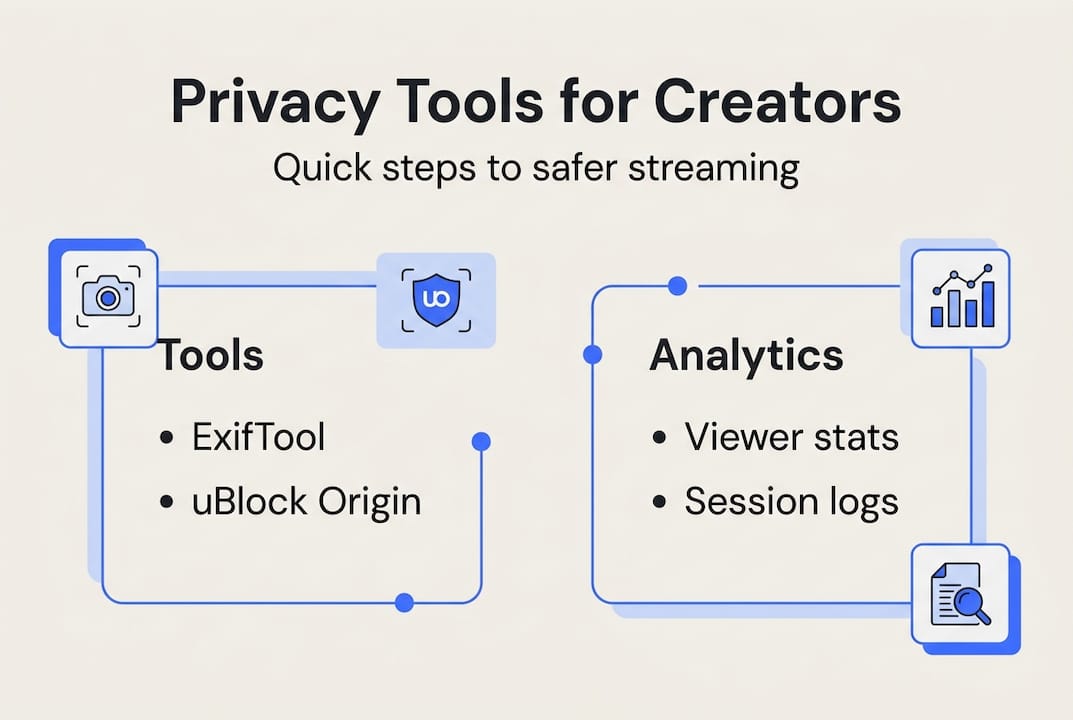
Remove metadata from every upload. Photos and videos contain hidden EXIF data including GPS coordinates, timestamps, and device information. Strip this data using a free tool like ExifTool before uploading anything to any platform. A single photo with embedded GPS data can reveal your home address.
-
Enable geoblocking. Many platforms including Chaturbate allow you to block viewers from specific regions or states. If you’re worried about being recognized by people in your local area, geoblocking is one of the most effective tools available. Use it to block your home state, city, or any region where you have professional or personal connections you want to keep separate.
-
Watermark your content. Add visible watermarks to photos and videos before distributing them. This makes it easier to trace leaks back to their source and deters casual redistribution.
-
Set up leak monitoring. Use reverse image search tools like Google Images or TinEye to periodically check whether your photos have appeared elsewhere online. Set up Google Alerts for your creator name or any aliases you use.
-
Use a VPN. A virtual private network masks your real IP address, making it harder for platforms, other users, or bad actors to determine your physical location. Choose a reputable paid VPN rather than a free one, since free VPNs often monetize your data.
-
Install a browser-level ad blocker. Extensions like uBlock Origin block third-party trackers before they load, reducing the context collapse risk described earlier.
-
Create a dedicated work identity. Use a separate email address, phone number, and payment method for your creator work. Never use your real name on any creator-facing account.
| Tool | Syfte | Kostnad |
|---|---|---|
| ExifTool | Remove photo/video metadata | Free |
| uBlock Origin | Block trackers and ads | Free |
| Reputable VPN | Mask IP address | $3-$12/month |
| Google Alerts | Monitor for name/content leaks | Free |
| TinEye | Reverse image search | Free (basic) |
Pro Tip: Run a reverse image search on your profile photos right now, before reading further. Many creators are surprised to find their images have already appeared on sites they never uploaded to. Knowing your current exposure level is the starting point for fixing it.
Understanding fan site privacy also means recognizing that your privacy settings need regular review. Platforms update their terms and features frequently, and a setting that protected you six months ago may have changed.
For creators thinking about audience growth, NSFW marketing privacy is a real consideration. Promoting your work on social media or through paid channels can inadvertently expose personal information if you’re not careful about what accounts and identities you connect.
Legal protections, reporting, and data rights in 2026
Having outlined practical tools, let’s now explore your legal options and protections in today’s digital landscape. The legal environment for adult content creators has changed significantly in recent years, and knowing your rights can make a real difference when something goes wrong.
If your intimate images are shared without your consent:
- Report the content directly to the platform where it appears. Most major platforms have specific processes for nonconsensual intimate image (NCII) removal.
- Den FTC advises reporting nonconsensual distribution of intimate images and provides guidance on next steps.
- The Cyber Civil Rights Initiative operates a helpline and provides personalized removal guidance for people whose images have been shared without consent.
- Many states now have specific criminal laws against nonconsensual image sharing. Document everything before requesting removal, since evidence disappears once content is taken down.
Your data rights under current law:
Laws like the Florida Digital Bill of Rights give residents the right to access the data a platform holds about them, request deletion, and opt out of data profiling and sales. Similar laws exist in California, Virginia, Texas, and other states. If you’re a creator or viewer based in one of these states, you can formally request that a platform delete your account data, not just deactivate your account.
Responsible platforms are adapting to these requirements with encryption, geoblocking options, and clearer consent forms. When evaluating a platform, check whether it has a formal data deletion process and how long it retains data after account closure.
The age verification privacy trap:
This is one of the most overlooked risks in the industry right now. Age verification on platforms increasingly requires biometric data or government ID submission. The Electronic Frontier Foundation recommends sharing only the minimum required information, since these verification systems create centralized databases of sensitive identity data that become high-value targets for breaches.
Pro Tip: When submitting ID for age verification, check whether the platform uses a third-party verification service and read that service’s privacy policy separately. Your ID data may be stored by a company you’ve never heard of under terms you haven’t reviewed.
Understanding payment processing and privacy is equally important. Payment processors collect and retain financial identity data. Using platforms that offer privacy-preserving payment options, or that work with processors that have strong data protection policies, reduces your exposure significantly.
The broader adult platform impact on creator privacy is shaped by regulation, platform choices, and individual practices working together. No single protection is enough on its own. And for those concerned about financial exposure, payment security for creators is a closely related topic worth understanding in depth.
Why conventional privacy advice misses the mark for adult creators
Most privacy guides are written for general audiences. They tell you to use strong passwords, enable two-factor authentication, and be careful about what you share online. That advice isn’t wrong. It’s just incomplete for anyone working in the adult cam space.
The reality is that creators face a specific combination of ongoing, high-stakes exposure that generic advice doesn’t address. Your work requires you to be visible and engaging while simultaneously protecting your identity. That tension doesn’t exist for most people who read standard privacy guides.
Research on cam model experiences shows that creators balance genuine empowerment, flexible income, creative control, and authentic connection against serious exploitation risks including doxxing, content theft, and harassment. Privacy tools enable safer operation, but the platforms themselves vary wildly in how invasive their tracking is.
The uncomfortable truth is that privacy for adult creators is not a one-time setup. It’s an ongoing practice. Platforms change their policies. New tracking technologies emerge. Your personal circumstances shift. What protected you last year may not protect you today. The creators who stay safest are the ones who treat privacy as a regular part of their professional routine, not a problem they solved once and forgot about. Check your creator privacy experiences regularly and update your approach as the landscape changes.
Take your privacy to the next level with Fanspicy
Privacy isn’t just a feature at Fanspicy. It’s built into how the platform operates. Fanspicy is designed for creators and fans who take their digital safety seriously, offering tools and a community that prioritize discretion, control, and trust.
Whether you’re just starting out or looking to move to a platform that respects your boundaries, Fanspicy gives you the infrastructure to create and connect without compromising your identity. Explore how creators like Jackiepott build engaged audiences while maintaining strong privacy practices. When privacy is part of the platform’s foundation, you spend less time worrying and more time creating. Join a community that takes your safety as seriously as you do.
Frequently asked questions
What should I do if my content is leaked or doxxed?
Immediately monitor for leaks using reverse image search and Google Alerts, document all evidence before requesting removal, and report the breach to the platform and relevant authorities right away.
How can I prevent platforms from tracking my activity across sites?
Choose platforms with low or no trackers, as Blacklight scans show major differences between sites, and use a VPN combined with a browser ad-blocker to block third-party tracking before it starts.
Are there legal remedies for nonconsensual image sharing?
Yes. The FTC advises reporting nonconsensual distribution of intimate images, and the Cyber Civil Rights Initiative provides direct removal guidance and a helpline for affected individuals.
What privacy risks come with age verification?
Age verification increases risk by requiring biometric or government ID submissions that are stored in centralized databases. Share only the minimum required data and review the privacy policy of any third-party verification service used.