

Innehållsförteckning
Social media video marketing is the practice of planning, producing, and distributing video content across platforms like TikTok, Instagram, and YouTube to build awareness, drive engagement, and convert viewers into customers. In 2026, the highest-priority move is simple: build a short-form-first strategy, match each format to a specific platform and funnel stage, and use AI to scale production without expanding your team.
Three actions matter more than the rest right now:
- Lead with short-form. Clips under 60 seconds get priority treatment from most platform algorithms and drive the strongest interaction and reach for marketers.
- Match format to platform. TikTok, Instagram Reels, and YouTube each reward different pacing, captions, and length.
- Map every video to a funnel stage. A viral clip and a conversion-focused demo need different scripts, CTAs, and success metrics.
This week: pick one funnel stage, produce three short clips against it, and track completion rate before you scale.
Key Takeaways
Short-form video mapped to funnel stages, paired with AI-assisted production, is the fastest way to grow both reach and measurable conversions in 2026.
| Point | Details |
|---|---|
| Lead with short-form | Clips under 60 seconds drive the strongest reach and interaction on most platforms. |
| Match format to funnel stage | Use short clips for awareness, tutorials for consideration, and demos for conversion. |
| Repurpose long-form aggressively | One long video can typically produce four to eight short clips across platforms. |
| Measure by funnel-stage KPI | Track completion rate, watch time, CTR, and conversions separately, not as one blended metric. |
| Monetize beyond the algorithm | Platforms like Fanspicy let creators turn video attention into subscriptions, tips, and paid content. |
Innehållsförteckning
- Why Social Media Video Marketing Works Right Now
- Which Video Formats Actually Work on Social Media?
- Which Platforms Should You Prioritize for Video?
- How Do You Build a Social Video Marketing Strategy?
- What Does an Efficient Production Workflow Look Like?
- What Technical Specs and Metadata Improve Discoverability?
- How Do You Promote Video Once It’s Published?
- How Do You Measure Whether Video Marketing Is Working?
- What Trends Should You Act on in 2026?
- What Legal Issues Should You Watch for in Social Video?
- How Should You Handle Negative Feedback on Video Content?
- An Editorial Take on What Actually Moves the Needle
- Turn Video Views Into Recurring Revenue
- Vanliga frågor och svar
- Sources
Why Social Media Video Marketing Works Right Now
Video wins attention because it does more work per second than text or static images. It shows movement, tone, and proof simultaneously, which is why platforms keep favoring it in distribution.
The business case is no longer theoretical. Video adoption among businesses is now close to universal, and audiences spend substantial weekly hours watching online video, which means the attention is already there waiting to be captured. Sprout Social’s research treats video as a core content format, with short-form clips recognized as an important ROI driver for marketers across industries.
The real advantage comes from mapping video types to funnel stages instead of producing generic content:
- Awareness: trend-driven short-form clips, teasers, and behind-the-scenes moments.
- Consideration: tutorials, comparison videos, and mid-length explainers.
- Conversion: product demos, testimonials, and limited-time offer clips.
- Retention: live Q&As, community shoutouts, and loyalty-focused UGC.
Adobe’s guidance reinforces this: businesses that connect video formats to funnel stages and measure outcomes see a clearer link between video spend and purchase decisions than those posting without a plan.
Which Video Formats Actually Work on Social Media?
Not every video format earns its place in your calendar. Each one has a job, an ideal length, and a funnel role, and mismatching them wastes production budget.
Short-form (under 60 seconds) is your discovery engine. It’s built for scroll-stopping hooks, trend participation, and rapid testing of messages. It converts well precisely because it demands almost nothing from the viewer: no click, no wait, just three seconds to decide whether to keep watching.
Mid-form and long-form video earns its place when depth beats speed. Tutorials, product walkthroughs, and episodic series perform better on YouTube, where viewers arrive already searching for a solution and expect a real explanation, not a teaser.
Live video, UGC, testimonials, and demos round out the mix. Live formats build real-time community and let you answer questions on camera, which builds trust faster than any scripted clip. UGC and testimonials carry credibility a brand-produced ad can’t fake. Demos remove friction right before a purchase decision.
| Format | Ideal length | Funnel fit | Production effort |
|---|---|---|---|
| Short-form clip | Under 60 seconds | Awareness, consideration | Låg |
| Tutorial / explainer | 2 to 10 minutes | Consideration | Medium |
| Live stream | 15 to 60 minutes | Retention, community | Low to medium |
| UGC / testimonial | 15 to 90 seconds | Conversion, trust-building | Låg |
| Product demo | 30 to 90 seconds | Conversion | Medium |
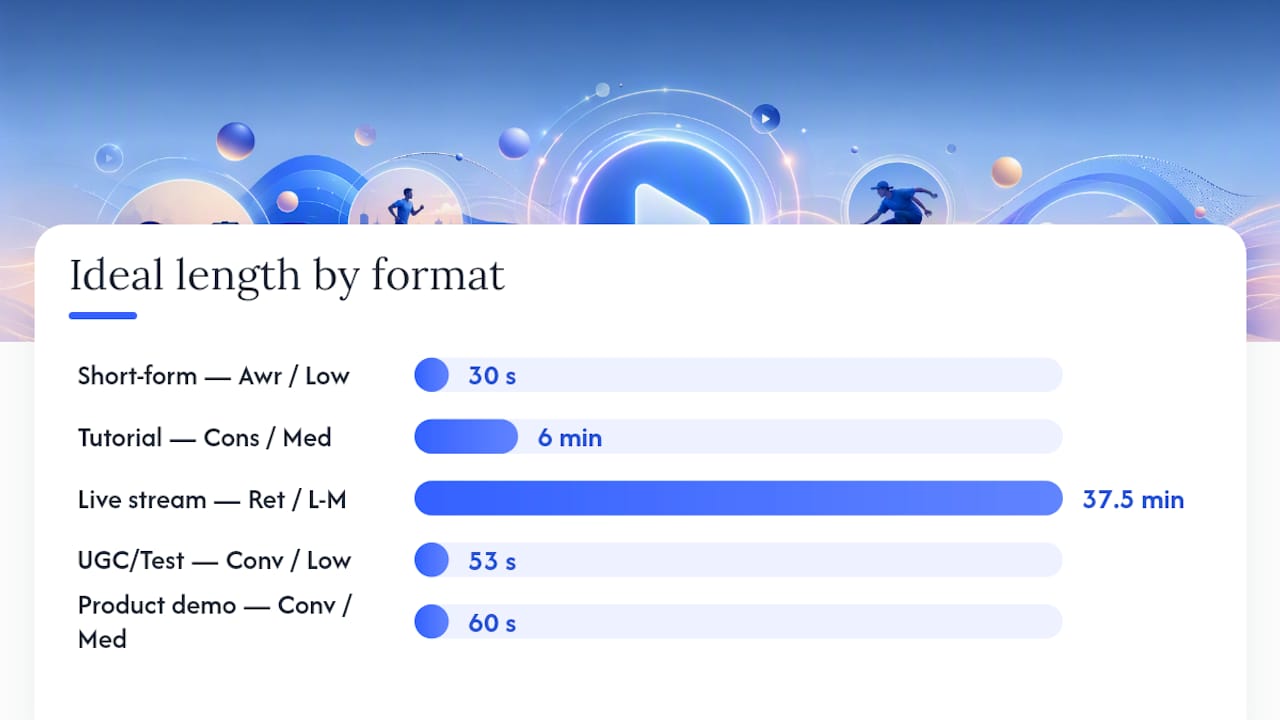
Heropost’s 2026 strategy guide recommends repurposing every long-form asset into several short clips rather than treating them as separate projects. One 10-minute tutorial can realistically produce five to eight short-form cuts, each testing a different hook against a different audience segment.
Which Platforms Should You Prioritize for Video?
Platform choice comes down to where your audience already spends time and what format that platform’s culture rewards. Posting the same video everywhere without adjusting for platform norms is one of the fastest ways to underperform.
HubSpot’s survey of more than 1,000 marketers found Instagram, YouTube, and TikTok are the top three platforms for driving traffic, engagement, and audience growth. Each behaves differently:
- TikTok: trend-native, fast-paced, rewards authenticity over polish.
- Instagram Reels: blends discovery and existing-follower reach; strong for product reveals and behind-the-scenes content.
- YouTube: best for searchable, long-form, and Shorts content that compounds over time via search.
- LinkedIn: favors thought-leadership clips and short explainer videos with a professional tone.
- Facebook: skews toward an older audience and rewards native uploads over shared links.
- X: works best for reactive, timely, and conversation-driven clips.
| Plattform | Content culture | Best format |
|---|---|---|
| TikTok | Trend-driven, fast | Short-form, under 60s |
| Instagram Reels | Visual, aspirational | Short-form, 15 to 30s |
| YouTube | Search-driven, evergreen | Long-form + Shorts |
| Professional, insight-led | Short explainers, 30 to 90s | |
| Community, older audience | Native short and mid-form | |
| X | Real-time, conversational | Short-form, under 60 seconds |
A useful rule of thumb: one polished long-form asset can typically yield four to six repurposed short clips without additional shoot days, just through re-editing, reframing to vertical, and rewriting hooks for each platform’s audience.
How Do You Build a Social Video Marketing Strategy?
A strategy without measurable goals is just a content calendar hoping for results. Start by defining what success actually looks like at each funnel stage, then work backward into themes, cadence, and budget.
Step 1: Set goals tied to KPIs. Awareness goals map to views and reach. Consideration goals map to watch time and click-through rate. Conversion goals map to landing page visits and sign-ups. Retention goals map to repeat engagement and community growth.
Step 2: Define audience segments and content pillars. Most brands do well with three to five editorial pillars, each serving a distinct audience need. A fitness brand, for example, might run pillars around technique tutorials, transformation stories, product demos, and community challenges.
Step 3: Build a content calendar. Cadence should match platform expectations, not internal convenience.
Adjust upward on paid spend once you’ve identified which organic content already converts.
Step 5: Launch with a 30/90-day checklist.
- Week 1 to 2: Define goals, pillars, and platform priorities.
- Week 3 to 4: Produce and publish first batch of short-form clips; track completion rate.
- Day 30: Review watch time and engagement; cut underperforming pillars.
- Day 60: Introduce one long-form asset per month and repurpose into short clips.
- Day 90: Reallocate budget toward the platform and format combination showing the strongest conversion signal.
Sprout Social’s strategy guide recommends revisiting this framework quarterly rather than annually, since platform algorithms and audience behavior shift faster than most planning cycles.
What Does an Efficient Production Workflow Look Like?
Consistent output beats occasional perfection. A repeatable workflow is what separates teams that post video weekly from teams that post it whenever inspiration strikes.
Script and storyboard first. Every script needs three components: a hook in the first three seconds, a clear value statement, and a specific call to action. A simple template: “Problem (2 seconds) → Solution demo (15 to 20 seconds) → CTA (3 seconds).”
Batch your shoot days. Instead of shooting one video per session, film five to ten pieces of raw footage in a single sitting using the same lighting and setup. This single habit cuts production time more than almost any other change a small team can make.

Edit with a checklist, not a vibe. Trim to the platform’s ideal length, add captions (most viewers watch with sound off), balance audio levels, and keep pacing tight, cutting dead air aggressively in the first five seconds especially.
Build in accessibility from the start. Closed captions are the baseline, not the finish line. Keep on-screen text large enough to read on a phone screen, use high-contrast colors, and add a brief audio description note in your script for any visual information critical to understanding the message, particularly for demos and tutorials.
Run an export checklist before publishing:
- Correct aspect ratio for the target platform (9:16, 16:9, or 1:1)
- Bitrate high enough to avoid compression artifacts after upload
- Captions burned in or uploaded as a separate file
- Thumbnail selected and tested at small size
- File format matches platform requirements
Lemonlight’s production framework och Wilson College Online’s guide both stress that skipping the export checklist is one of the most common (and avoidable) reasons videos underperform after publishing.
Proffstips: Shoot your hook three different ways during the same session. Testing multiple openers against the same footage costs almost nothing extra on shoot day but tells you which hook actually earns the first three seconds of attention.
What Technical Specs and Metadata Improve Discoverability?
Getting the specs wrong is the fastest way to sabotage a good video before anyone sees it. Cropped faces, blurry compression, and mismatched aspect ratios all signal low effort, even when the content itself is strong.
Sprout Social’s specs guide documents the aspect ratios and file limits that keep your video rendering cleanly across placements.
| Aspect ratio | Best for | Common use |
|---|---|---|
| 9:16 (vertical) | TikTok, Reels, Stories, Shorts | Short-form mobile-first content |
| 16:9 (landscape) | YouTube, LinkedIn feed | Tutorials, long-form |
| 1:1 (square) | Facebook and Instagram feed | Cross-platform flexibility |
Beyond aspect ratio, a few metadata habits consistently improve click-through and watch time:
- Write titles that state the benefit, not just the topic.
- Design thumbnails with one clear focal point and readable text at small sizes.
- Add captions and a full transcript; both improve accessibility and give platforms more text to index for search.
- Write descriptions with natural keyword phrasing instead of a stuffed list of tags.
Before publishing, confirm the file meets the platform’s length cap, resolution minimum, and caption format, since rules shift periodically and a video rejected at upload costs you the trend window you were targeting.
How Do You Promote Video Once It’s Published?
Publishing is the start of distribution, not the end. A video with no promotion plan behind it relies entirely on algorithmic luck.
Organic tactics carry the base load: consistent posting cadence, replying to comments within the first hour to boost early engagement signals, and jumping on relevant trends while they’re still active rather than days later.
Paid amplification works best as a series of small, iterative tests rather than one large spend. Put a modest budget behind your best-performing organic clip, test against a lookalike audience, and only scale spend once cost-per-result stabilizes.
Creator partnerships extend reach into audiences you don’t already own. HubSpot’s research found micro-influencer collaborations often outperform broader influencer deals on engagement and ROI, especially when the creator’s niche matches your content pillar closely.
A simple repurposing checklist turns one asset into a week of content:
- Cut the long-form video into three to five short clips, each with its own hook.
- Reformat one clip vertically for Stories and one horizontally for LinkedIn.
- Pull audio-only highlights for platforms that favor voice or podcast-style content.
- Turn key quotes or stats into static graphics for feed variety.
- Schedule the repurposed pieces across the following week instead of dumping them all at once.
How Do You Measure Whether Video Marketing Is Working?
Vanity metrics feel good but rarely tell you what to fix. Tie every KPI to the funnel stage the video was built for.
| Funnel stage | Primary KPI | Secondary signal |
|---|---|---|
| Awareness | Views, reach | Completion rate |
| Consideration | Watch time, CTR | Comments, shares |
| Conversion | Landing page visits | Sign-ups, sales |
| Retention | Repeat engagement | Community growth |
Set a reporting cadence and stick to it: weekly for fast-moving platforms like TikTok, monthly for long-form YouTube performance. Use consistent UTM parameters and a clear naming convention (platform, format, campaign, date) so attribution doesn’t turn into guesswork three months later.
Run a simple testing playbook: change one variable at a time, whether it’s the thumbnail, the hook, or the CTA placement, and give each test enough volume before declaring a winner. Small, sequential tests compound into real performance gains faster than sporadic large overhauls.
What Trends Should You Act on in 2026?
Short-form isn’t a passing trend anymore. It’s the default entry point for discovery, and Sprout Social’s data confirms it remains the top-priority format for marketers focused on reach and interaction.
The second shift worth acting on: AI is now embedded in real production workflows, not just experimental pilots. Marketers are using it for storyboarding, editing, and audio cleanup, applying it to repeatable tasks like subtitle generation and rough cuts while keeping creative direction and hooks human-led.
A low-friction way to pilot this: pick one repetitive task, such as caption generation or first-pass editing, and hand it to an AI tool for one month. Track time saved against output quality before expanding further. The risk isn’t the technology; it’s over-automating the parts of your video that actually need a human’s judgment, like the hook and the CTA.
What Legal Issues Should You Watch for in Social Video?
Copyright and privacy mistakes are avoidable, but they show up constantly in social video because teams move fast and skip the check.
Music licensing is the most common trip wire. Platform-native music libraries (TikTok’s sound library, Instagram’s music tool) are generally cleared for use within that platform, but pulling a trending song into a downloaded, cross-posted video without a license can trigger takedowns or claims. If you’re producing branded content for wider distribution, license music through a cleared library rather than assuming platform-native audio travels safely everywhere.
Copyright on visual assets applies to stock footage, third-party clips, and even fonts used in on-screen text. Always confirm the license covers commercial use and the specific platforms you’re publishing to, since some stock licenses restrict paid or sponsored use.
Integritet matters whenever real people appear on camera, whether that’s a customer testimonial, a UGC repost, or a livestream with visible bystanders. Get written consent before featuring identifiable people, and check platform and regional rules on filming in public spaces before you post footage from live events or public locations.
Repost and UGC rights deserve a written policy. Reposting a fan’s video without permission, even with credit, can create disputes. A simple standing agreement (a comment reply asking permission, tracked in a spreadsheet) protects you far better than assuming a public post equals blanket usage rights.
None of this is legal advice specific to your situation, but building these checks into your production workflow costs minutes and avoids costly reshoots or takedowns later.
How Should You Handle Negative Feedback on Video Content?
Every video that gets real distribution eventually draws some negative response, and how you handle it shapes brand perception more than the criticism itself.
Respond, don’t delete, unless the comment violates platform policy. Deleting critical but legitimate feedback tends to escalate frustration and can spark accusations of censorship. Reserve removal for spam, harassment, or clear policy violations.
Separate volume from validity. A flood of negative comments on a trending clip doesn’t always mean the content failed; sometimes it means the clip reached an audience outside your usual base. Read for patterns before reacting, and don’t pull a video over a handful of loud complaints if the broader engagement metrics are healthy.
Have a response protocol ready before you need it. Decide in advance who owns comment moderation, what tone to use in public replies, and when an issue should escalate to a written statement rather than a comment reply. Improvising this in the moment usually makes things worse.
If a video genuinely missed the mark, a brief, direct acknowledgment beats a defensive non-apology. Audiences respond better to “we got this wrong, here’s what we’re changing” than to silence or corporate hedging.
Monitor sentiment, not just volume. A spike in comments isn’t automatically a crisis. Track whether sentiment is trending negative across multiple posts, which signals a real problem, versus an isolated reaction to one polarizing clip, which usually settles on its own within a day or two.
An Editorial Take on What Actually Moves the Needle
Most teams over-invest in production polish and under-invest in the first three seconds of the hook. Focus there first: a rough clip with a strong opener outperforms a polished one with a slow start. Scale only after you’ve found a format and hook combination that already converts; scaling mediocre content just multiplies the mediocrity.
Choose quality over quantity when testing a new pillar, then flip to quantity once you’ve found what works. And when criticism hits, respond fast and plainly. Silence reads worse than an honest, brief correction.
Turn Video Views Into Recurring Revenue
Everything covered here gets creators attention. What happens after someone watches your video and wants more is where the real revenue lives. Fanspicy gives creators a direct path from a viewer’s attention to paid income, through subscriptions, exclusive content, paid clips, live tipping, and private messages, without needing a separate storefront or a patchwork of tools.
The workflow is straightforward: use your short-form clips on TikTok, Instagram, and YouTube to build discovery and trust, then point your bio and video CTAs toward your Fanspicy page where fans can subscribe, tip during live streams, or unlock exclusive content. Creators keep control of pricing and content while the platform handles payments and delivery. If you’re already producing consistent social video, the next step is setting up a Fanspicy page and testing one CTA at the end of your next clip to see how many viewers convert to paying fans.
Vanliga frågor och svar
What is social media video marketing?
It’s the process of planning, producing, and distributing video content on platforms like TikTok, Instagram, and YouTube to build awareness, drive engagement, and generate conversions, with each video mapped to a specific funnel stage.
How long should a social media marketing video be?
Short-form clips under 60 seconds work best for awareness and reach, while tutorials and explainers between two and eight minutes perform better on platforms like YouTube where viewers expect depth.
Which platform is best for video marketing?
TikTok, Instagram, and YouTube consistently rank as the top three platforms for traffic, engagement, and audience growth, though the right choice depends on where your specific audience already spends time.
How much does it cost to start a social media video strategy?
How can AI help with social media video production?
AI tools are most effective on repeatable tasks like caption generation, rough editing cuts, and audio cleanup, which frees your team to focus on creative direction, hooks, and calls to action that actually drive performance.
Sources
- HubSpot: Social media video trends
- Adobe Business: A full-funnel approach to video marketing
- Argil: Video marketing guide 2026