

Innehållsförteckning
For social-first creators, the fastest reliable income comes from productized services, paid subscriptions, and affiliate funnels backed by an email list. Display ads are the slowest path to meaningful revenue and the first method most experienced creators quietly deprioritize.
Here is the short version by creator type:
- Authorities (coaches, educators, subject-matter experts): Lead with a productized service or consulting offer; build toward a digital course or paid newsletter.
- Operators (systems-focused, process-driven creators): Prioritize a paid newsletter or membership; layer in sponsorships once you hit consistent open rates.
- Storytellers (narrative, lifestyle, personal-brand creators): Paid subscriptions and affiliate funnels are your strongest early plays; email is the multiplier.
- Visual Creators (live streamers, short-form video, photographers): Affiliate links, tips and donations, and brand sponsorships convert well with visual proof; add a digital product once your audience is warm.
Whatever your archetype, build your email list before you monetize anything else. A small, engaged list consistently out-earns large anonymous traffic pools, and it multiplies every other channel you add later.
Innehållsförteckning
- How do you choose a monetization stack that fits your creator type?
- What are the best methods to set up, and what do they actually require?
- How do you price and launch a digital product or paid subscription?
- Which metrics actually move your blog revenue?
- What legal and tax basics do U.S. creators need to handle?
- What monetization mistakes destroy creator trust?
- What does a realistic monetization timeline look like?
- Key Takeaways
- What most creators get wrong about monetization
- Fanspicy: a creator-first platform for subscriptions and direct fan payments
- Useful sources for creators
How do you choose a monetization stack that fits your creator type?
Matching monetization to your creator archetype is the single decision that separates creators who earn consistently from those who chase every new tactic. The goal is a stack of two to four streams that reinforce each other rather than compete for your time.
| Creator Archetype | Primary Method | Secondary Method | Avoid Early |
|---|---|---|---|
| Authority | Productized services / consulting | Digital course or paid newsletter | Display ads |
| Operator | Paid newsletter / membership | Sponsorships | Merch |
| Storyteller | Paid subscription | Affiliate funnels | High-volume ads |
| Visual Creator | Affiliate + tips/donations | Brand sponsorships | Subscription-only |
According to Riman Agency, profitable blogs stack three to five revenue streams while protecting audience trust. The practical framing: choose one fast-payoff stream (services, affiliate), one mid-term stream (digital product, sponsorship), and one long-term compounding stream (membership, newsletter). Ads can fill gaps later, but they should not anchor your early strategy.
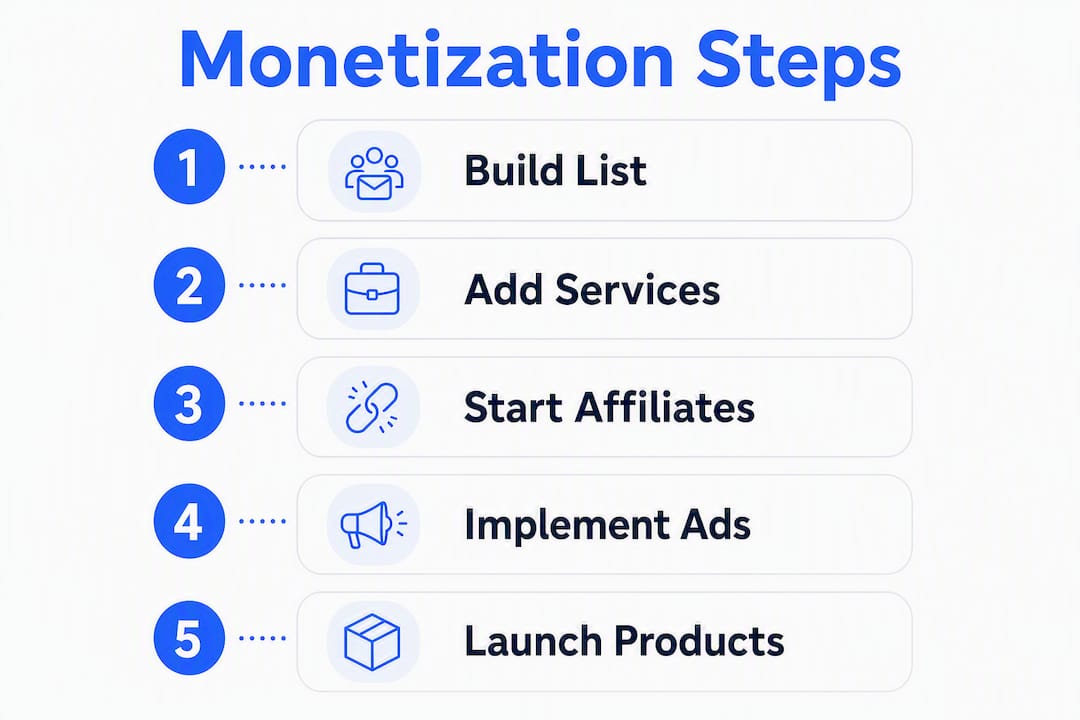
Proffstips: Never launch more than two new revenue streams at once. Splitting your attention across five untested methods produces weak results across all of them. Pick your archetype’s primary method, execute it for 60–90 days, then add the secondary.
What are the best methods to set up, and what do they actually require?
Each method has a realistic activation point. Launching the wrong one too early wastes time and can damage trust with an audience that is not yet ready to buy.

| Method | Minimum Signal Needed | Realistic Revenue Range | Notes |
|---|---|---|---|
| Productized services | Any engaged audience | Immediate, scales with demand | Highest effort per dollar |
| Affiliate funnels | 1K–10K monthly visitors | Scales with traffic | Comparison posts convert best |
| Digital products | Warm email list, 500+ subscribers | High margin after production | Decouples revenue from traffic |
| Paid subscriptions | Consistent content cadence | Recurring, compounds over time | Requires ongoing value delivery |
| Sponsorships | Niche authority + engaged metrics | Varies widely by niche | Pitch with a media kit |
| Display ads | 50K+ monthly visitors for premium networks | $2–$8 RPM on AdSense | Traffic-hungry; low early ROI |
| Tips / donations | Any loyal audience | Supplemental | Low friction to set up |
For affiliate funnels, the format matters as much as the link placement. Comparison posts and tutorials with real screenshots convert far better than thin product reviews. Gatilab’s research confirms that honest, proof-backed comparison content outperforms generic reviews consistently.
For digital products, the margin case is compelling. Once created, a digital product costs almost nothing to deliver again, which means every additional sale is nearly pure profit. That margin stability is why AfterSocial and Riman Agency both frame digital products and memberships as the compounding layer of any serious monetization stack.
For display ads, Google AdSense is the entry point most creators use, but the RPM reality is sobering. Most blogs see RPMs in the $2–$8 range on AdSense. You need substantial traffic before ads contribute meaningfully. Premium ad networks set higher traffic minimums. Use ads as a supplemental layer, not a foundation.
How do you price and launch a digital product or paid subscription?
Pricing is where most creators undercharge out of anxiety and overcharge out of ambition. A practical starting framework: price your entry tier at what a loyal reader would spend without deliberating, and your premium tier at what a serious buyer would pay for direct access or deeper content.
Launch checklist:
- Validate with a pre-sell: announce the product to your email list before it exists and count responses.
- Build a single, focused landing page with one clear call to action.
- Write a three-email launch sequence: tease, open cart, close with a deadline.
- Add a limited-time offer (a bonus, not a discount) to create urgency without devaluing the product.
- Collect one or two pieces of social proof from early buyers before the public launch.
Promotion tactics for social-first creators:
- Clip your live stream moments that demonstrate the problem your product solves and post them as short-form promos.
- Offer newsletter subscribers early access or a bonus tier unavailable publicly.
- Repurpose your best-performing social posts into a free lead magnet that feeds your email list.
An email list multiplies every launch. A small, engaged list of 500 subscribers who trust you will consistently out-buy a cold audience of 10,000 who found you through a search.
Which metrics actually move your blog revenue?
Track fewer numbers, but track them consistently. The metrics that matter most for creator monetization are email list growth rate, email-to-sale conversion rate, average revenue per user (ARPU), subscription churn, and RPM if you run ads.
Proffstips: Run one optimization experiment at a time. Test your email subject line for two weeks, then your CTA placement, then your pricing tier. Stacking experiments simultaneously makes it impossible to know what worked.
A modest conversion rate from email list to paid product is a reasonable benchmark for most creator niches. A low monthly churn rate on a subscription is healthy. If your RPM sits below $8 and traffic is under 50K monthly, affiliate and product revenue will almost always outperform ads at your current scale.
For affiliate content specifically, comparison posts with real proof are the highest-converting format. If you are not tracking which post types generate affiliate clicks versus which generate email signups, you are optimizing blind.
What legal and tax basics do U.S. creators need to handle?
Getting paid is the goal. Getting paid without compliance problems is the actual goal.
- IRS self-employment income: Any blog or creator income is taxable. Platforms and clients that pay you $600 or more in a calendar year are required to issue a 1099-NEC. Set aside roughly 25–30% of net income for federal self-employment and income taxes.
- FTC disclosure rules: Any affiliate link, sponsored post, or gifted product requires a clear, conspicuous disclosure. “This post contains affiliate links” placed at the top of the post satisfies the requirement. Buried disclosures do not.
- State sales tax on digital goods: Rules vary by state. Some states tax digital products and subscriptions; others do not. Check your state’s revenue department before selling digital downloads or memberships.
- Payment setup: Use your SSN or apply for an EIN through the IRS before setting up payment processors. Keep a separate business bank account from day one. Simple bookkeeping software makes quarterly estimated tax payments manageable.
- Platform payouts vs. direct payments: Platforms typically handle payment processing and issue year-end tax forms. Direct client payments require you to invoice, collect, and track independently.
This article is general information, not tax or legal advice. Confirm your specific obligations with a qualified CPA or tax attorney.
What monetization mistakes destroy creator trust?
Trust is the only asset that cannot be rebuilt quickly. These are the moves that erode it fastest:
- Monetizing before your audience has a reason to trust your recommendations.
- Overloading posts with affiliate links that serve your revenue rather than the reader’s decision.
- Accepting sponsorships from brands you have not used or would not recommend privately.
- Hiding disclosures or placing them where readers will not see them.
- Raising subscription prices without adding visible value first.
The fix for most of these is the same: slow down. Riman Agency is direct on this point: display ad revenue is in long-term decline, while newsletters, sponsorships, and products built on genuine trust are growing. Prioritize trust over short-term ad dollars, and use service income to fund the slower-building passive streams.
Proffstips: Vet every sponsor against one question: “Would I recommend this to my best reader even if they weren’t paying me?” If the answer is no, pass. One misaligned sponsorship costs more in audience trust than the fee is worth.
What does a realistic monetization timeline look like?
| Phase | Timeframe | Priority Activities | Expected Outcomes |
|---|---|---|---|
| Foundation | Few months | Build email list, publish consistently, offer one service | First dollars from services; list under 500 |
| First revenue | Several months | Add affiliate funnels, launch a small digital product | Affiliate commissions; first product sales |
| Stacking | Over a year | Launch membership or paid newsletter, pitch sponsorships | Recurring subscription revenue begins |
| Compounding | 18–36 months | Scale products, negotiate sponsorship deals, optimize stack | Multiple streams reinforcing each other |
ByteVerse frames this as a ladder: services and email come first, affiliates and ads arrive with traffic, and products and memberships scale at the top. Riman Agency’s phase-based model aligns closely, showing that the revenue mix typically flips from active income (services) to passive income (products, memberships) somewhere between months 18 and 36.
Key Takeaways
The most effective way to monetize a blog as a social-first creator is to match your revenue stack to your creator archetype, build an email list before anything else, and sequence methods from fast-payoff to compounding.
| Point | Details |
|---|---|
| Match method to archetype | Authorities lead with services; Visual Creators start with affiliate and tips. |
| Email list first | A small engaged list out-earns large anonymous traffic; build it before launching any paid offer. |
| Sequence your stack | Services and affiliate funnels first, digital products and memberships as you scale. |
| Ads come last | Display ads require a high number of monthly visitors to contribute meaningfully. |
| Fanspicy as your platform | Fanspicy offers integrated subscriptions, tips, and direct fan payments for creators who want fast onboarding without self-hosting complexity. |
What most creators get wrong about monetization
The conventional advice is to start with ads because they are passive. That framing is backwards. Ads are passive in the sense that they require no sales effort, but they are deeply active in their demand for traffic volume you almost certainly do not have yet. The creators who build durable income start with the highest-effort, highest-margin methods first: services, consulting, a single digital product. They use that active income to fund the slower channels, including SEO content, email list growth, and eventually memberships.
The other thing most beginners underestimate is how much a single email list compounds. Not a large list. An engaged one. The difference between a creator earning $500 a month and one earning $5,000 is rarely traffic volume. It is usually whether they own a direct line to their audience that no algorithm can cut off.
Fanspicy: a creator-first platform for subscriptions and direct fan payments
Creators who want recurring subscription revenue, tips, and direct fan payments without the overhead of self-hosting have a faster path available. Fanspicy is a paid social media and live cam platform built for the creator economy, with integrated payouts, discoverability, and subscription tiers that go live quickly.
For Visual Creators and Storytellers especially, Fanspicy removes the friction between building an audience and getting paid by them. There is no need to stitch together a payment processor, a membership plugin, and a landing page builder. The platform handles payouts, fan management, and subscription infrastructure in one place. Self-hosting gives you higher margins and full ownership; a hosted platform like Fanspicy gives you speed, integrated discoverability, and a hybrid monetization model that combines subscriptions, tips, and pay-per-view content. If you are ready to start earning directly from your audience, explore Fanspicy and set up your creator profile today.
Useful sources for creators
- IRS Self-Employment Tax guidance — Start here for quarterly estimated tax obligations and 1099 basics.
- FTC Endorsement Guides — The definitive source on affiliate and sponsorship disclosure requirements for U.S. creators.
- Google AdSense — Useful for understanding ad mechanics, RPM, and publisher program thresholds before you apply.
- Upwork’s blog monetization guide — Practical overview of 15 monetization methods with setup context for each.
- Teachable’s monetization breakdown — Covers courses, memberships, and coaching with step-by-step setup guidance.
- AfterSocial’s 2026 monetization guide — Strong on traffic thresholds and sequencing logic for each revenue stream.
- Riman Agency’s stacking framework — Best source for the three-to-five stream model and phase-based revenue timelines.
- Gatilab’s RPM and affiliate analysis — Honest breakdown of ad RPM realities and why affiliate and product strategies often outperform ads at mid-sized traffic levels.