

Innehållsförteckning
The fastest way to get more TikTok likes is to stop optimizing for likes. Prioritize your hook and watch time first, then design your content to earn saves, shares, and comments, since those signals carry more weight in how TikTok’s algorithm works than a raw like count ever will. Likes still matter, but they tend to follow completion rate and rewatches, not the other way around.
A few things you can do on your very next post:
- Write three different opening lines and film all three before you pick a winner.
- Add on-screen text in the first frame that repeats your spoken hook, since not everyone watches with sound on.
- Pick one specific call to action, such as asking viewers to save the video for later, instead of a vague “like and follow.”
- Test a trending sound that’s still gaining traction in your niche rather than one that’s already saturated.
The rest of this guide breaks down each of these levers, including how creators sequence them into a 90-day plan built from Fanspicy’s work with independent creators monetizing engaged audiences.
Key Takeaways
Getting more TikTok likes requires optimizing your hook and watch time first, then designing content that earns comments, saves, and shares as secondary amplifiers.
| Point | Details |
|---|---|
| Hook wins in three seconds | Capture attention immediately with a question, mid-action open, or visual interrupt to lift completion rate. |
| Completion beats likes | TikTok weighs watch time, rewatches, and shares more heavily than raw like counts when distributing content. |
| Use trending audio strategically | Join brand-new sounds fast, but take two to four days to adapt saturated trends with your own angle. |
| Write captions for search | Place keywords in your caption, spoken audio, and on-screen text, and pair three to five relevant hashtags. |
| Test one variable at a time | Run each change for seven to fourteen posts before scaling the winning version. |
| Monetize the audience you build | Fanspicy lets creators convert engaged TikTok followers into paying subscribers through a revenue-share marketplace. |
Innehållsförteckning
- Why the First 1 to 3 Seconds Decide Your Video’s Fate
- How Do You Pick the Right Trending Sound?
- What Is TikTok SEO and How Do You Use It?
- Which Engagement Signals Actually Lead to More Likes?
- How Should You Structure Content Over Time?
- What Metrics Should You Track to Improve Your Like Rate?
- A 90-Day Plan for Turning Tactics Into Habits
- What Shortcuts Actually Hurt Your TikTok Growth?
- What Creators Consistently Get Wrong About Likes
- Turn TikTok Engagement Into Real Revenue With Fanspicy
- Vanliga frågor och svar
- Sources
Why the First 1 to 3 Seconds Decide Your Video’s Fate
TikTok’s own behavioral data supports what’s often called the three-second rule: if you don’t capture attention almost immediately, the algorithm reads that as a signal to stop distributing your video, according to Adobe Express’s guide to TikTok engagement. Every second before your payoff is a second someone can swipe away, and TikTok is watching how many people do.
Three hook styles consistently outperform a slow warmup. A direct question (“Why does nobody talk about this?”) forces a mental response before the viewer can scroll. A mid-action open, where you start the video already doing the interesting part rather than explaining what you’re about to do, removes the throat-clearing entirely. A visual interrupt, like an unexpected color, prop, or camera angle in the first frame, breaks the scroll pattern on a purely visual level, before your words even register.
Getting people to watch is only half the job. Getting them to watch twice is where the real distribution boost happens, since completion and rewatch behavior are stronger algorithmic signals than likes according to Hootsuite’s breakdown of the TikTok algorithm. A few tactics that reliably produce rewatches:
- End on a loop, where the last frame connects visually or narratively back to the first.
- Pack a dense, information-heavy payoff near the end that people need a second viewing to fully absorb.
- Keep each video built around a single idea, since a cluttered multi-topic video gives viewers no reason to watch again.
Production details matter more than most creators assume. Cut dead air ruthlessly. Add on-screen text that reinforces (not just repeats) your spoken point. Use audio cues, like a sound effect or beat drop, to punctuate the moment your hook lands.
Proffstips: Film your hook last, after you’ve shot the rest of the video. You’ll know exactly what payoff you’re setting up, which makes the opening line sharper and more specific.
How Do You Pick the Right Trending Sound?
TikTok groups content partly by audio, which means the sound you choose determines which pocket of the platform sees your video first. TikTok’s Creative Center and in-app search surface which sounds are climbing, and creators who catch a sound early get a discovery boost that late adopters miss, per Shopify’s research on getting more TikTok views.
Timing is the harder part. A sound that’s exploding across the entire platform right now might already be oversaturated in your specific niche, which means your video competes against dozens of similar takes instead of standing out. A useful decision rule: if a sound is brand new and has fewer than a few hundred videos using it, jump on it within the day. If it’s already common but hasn’t peaked in your niche specifically, take two to four days to build something that adapts the trend rather than copies it directly. That window is usually enough to add your own angle without missing the wave entirely.
Before committing, scroll your own For You page and search the sound directly to see how creators in your space are already using it. If every video looks identical, that’s your cue to twist the format, change the setting, or apply the audio to an unexpected topic instead of following the format others already claimed.
A few practical steps to make this repeatable:
- Check Creative Center weekly for sounds trending in your content category, not just platform-wide.
- Preview saturation by searching the sound and filtering by recency.
- Adapt your visuals to match the sound’s rhythm or punchline rather than layering it on top of unrelated footage.
What Is TikTok SEO and How Do You Use It?
TikTok now functions like a search engine almost as much as a discovery feed, and creators who write for search extend their video’s shelf life well past the first 48 hours, according to Shopify’s guide on TikTok visibility. That means your caption, your spoken words, and your on-screen text all function as searchable metadata, not just decoration.
Here’s where keywords actually need to live:
- Caption. Write the phrase someone would type into TikTok search, not a clever pun. If you’re posting a skincare routine, “nighttime skincare routine for dry skin” beats a vague one-liner.
- Spoken audio. Say your main keyword phrase out loud somewhere in the video. TikTok’s speech recognition indexes this.
- On-screen text. Reinforce the same keyword visually, especially in the first few seconds, so it’s captured even by viewers watching on mute.
- Profile fields. Your bio and display name should reflect your niche in plain language, since search results pull from there too.
For hashtags, use three to five tags that mix one broad category tag with two or three niche-specific ones. A fitness creator might pair #fitness with #beginnerstrengthtraining and #homeworkoutideas rather than stacking ten generic tags or spamming #fyp, which does nothing for discoverability and can actually make your caption look low-effort to both viewers and the algorithm.
Simple keyword research doesn’t require special tools: type your topic into TikTok’s search bar and see what autocomplete suggests, then check which phrasing shows up most often in the top results for that query.
Which Engagement Signals Actually Lead to More Likes?
Comments, saves, shares, and duets carry more algorithmic weight than a bare like tap, and each one requires a different kind of invitation from you as the creator, per Sprout Social’s research on TikTok engagement. The trick is making the ask specific enough that it’s frictionless.
Vague prompts like “let me know what you think” rarely work because they require the viewer to generate their own response from scratch. Specific prompts work better: “Comment your zip code and I’ll tell you if this recipe is in season near you” or “Save this if you’re trying this next week” gives people an exact, low-effort action to take.
Replying to comments with a full video, rather than a text reply, turns your comment section into a content pipeline. It’s one of the more reliable ways to boost comment rates and convert casual viewers into followers, since each reply video re-surfaces to people who engaged with the original post.
Duets and stitches only work if your original video leaves room for someone else to react. A video that already answers every question or fills the entire frame with reaction shots gives future duet partners nothing to add. Leave a visual or narrative gap, an unanswered question, an unexpected claim, something a duet partner can respond to on camera.
- Ask a specific, low-effort question tied directly to the video’s content.
- Reply to your best comments with a follow-up video, not just a text response.
- Frame at least part of the screen so a duet partner’s reaction fits naturally beside yours.
- If running a giveaway, tie entry to a real action (a specific comment, a save, a share) rather than a blanket “like this post to enter,” which produces hollow engagement that doesn’t compound.
Proffstips: Pin your own comment with a follow-up detail or teaser. It gives people a reason to open the comment section even if they weren’t planning to.
How Should You Structure Content Over Time?
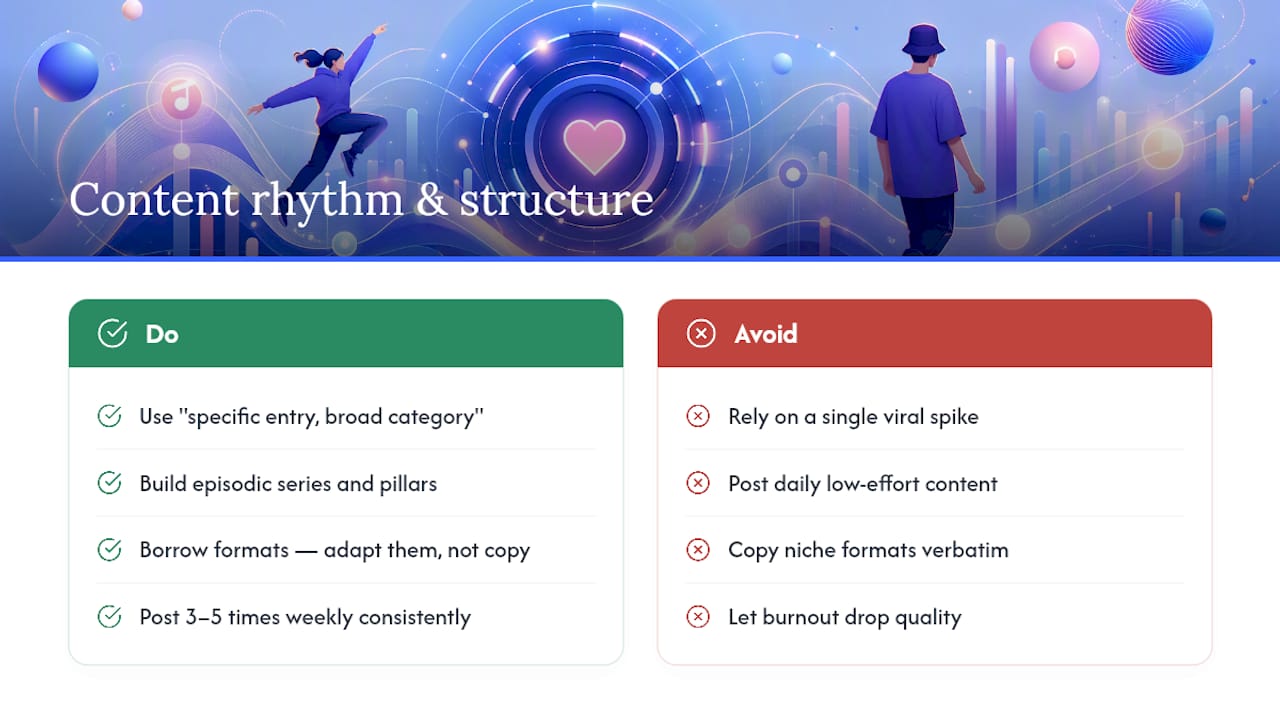
A single viral video is a spike. A content system is what turns that spike into a sustained like curve, because episodic content and consistent pillars give people a reason to visit your profile instead of just watching one clip and moving on, according to Sprout Social’s engagement research.
The “specific entry, broad category” clustering approach works by anchoring each video in something narrow and searchable (a specific product, a specific mistake, a specific day-in-the-life moment) while still tagging it under a broader category the algorithm already understands. This helps TikTok match your video to the right micro-audience faster, which speeds up the algorithm’s read on who should see it, per Hootsuite’s algorithm analysis. A cooking creator might post “the mistake everyone makes with garlic” (specific entry) filed under general cooking content (broad category), rather than a generic “cooking tips” video with no distinct hook.
Borrowing formats from adjacent niches is a legitimate way to access new audiences, as long as you adapt the format rather than copy it outright. A finance creator borrowing a “get ready with me” structure to explain a budgeting habit reaches a completely different audience segment than a standard finance video would, without pretending to be a lifestyle creator.
Posting cadence matters more than most creators think. A sustainable rhythm of three to five posts a week, done consistently, tends to outperform daily low-effort posting, according to Socialinsider’s data on TikTok engagement. Quality decline from burnout shows up in your completion rate before it shows up anywhere else.
What Metrics Should You Track to Improve Your Like Rate?
Chasing likes directly is a bad measurement strategy because likes are a lagging indicator, not a lever you can pull. Track these instead, in order of priority:
- Average watch time and completion rate. These are the clearest signals of whether your hook and pacing are working.
- Rewatch rate. A high rewatch rate on a short video is a strong sign your ending is doing its job.
- Comment-to-view ratio. This tells you whether your CTAs are actually landing, independent of raw view count.
- Saves and shares. These indicate content people consider worth returning to or worth sending to someone else.
- Profile-visit rate. This shows whether a video is converting viewers into people curious about the rest of your content.
A disciplined testing rhythm beats guesswork every time. Isolate one variable, such as hook style, video length, or posting time, and hold everything else constant for seven to fourteen posts or roughly two to three weeks, since that’s usually enough posts to separate a real pattern from random variance, based on Socialinsider’s engagement research. Reviewing performance through a proper analytics dashboard rather than eyeballing individual post metrics makes this pattern much easier to spot.
Once the test window closes, read the results by which metric actually moved. If completion rate jumped but comments didn’t, your hook improved but your CTA didn’t land, so test prompt phrasing next. If comment-to-view ratio rose but watch time stayed flat, your community engagement is strong but your content itself may need a stronger opening. Scale whichever single variable moved the needle, and only change one thing at a time going forward.
A 90-Day Plan for Turning Tactics Into Habits
Sequencing matters more than intensity. Creators who try to fix their hook, chase five trends, and overhaul their hashtag strategy in the same week rarely learn which change caused which result. Fanspicy’s work with independent creators building monetizable audiences points to a simple week-by-week structure that avoids that trap, detailed further in Fanspicy’s 90-day TikTok monetization plan.
- Weeks 1 to 3: Hook testing. Film three hook variations per video idea and track completion rate exclusively. Don’t touch hashtags or posting time yet.
- Weeks 4 to 6: Trend experiments. Layer in early-stage trending sounds using the two-to-four-day adaptation window, while keeping your hook approach from the previous sprint.
- Weeks 7 to 9: SEO batch. Rewrite captions and on-screen text around specific search phrases, and track profile-visit rate as your primary signal.
- Weeks 10 to 12: Engagement sprints. Introduce specific CTAs and comment-reply videos, watching comment-to-view ratio closely.
- Ongoing: Analytics sprints. Every two weeks, review which metric moved most and double down on that lever rather than starting a new experiment from scratch.
Most creators following this order see their first meaningful lift during the SEO batch, since it’s often the most neglected lever going in. The most common sequencing mistake is skipping straight to engagement CTAs before the hook is solid, which produces comments on videos nobody finishes watching, a pattern that rarely converts into real audience growth.
Proffstips: Keep a simple log of what changed each sprint and what happened to your top metric. Three months from now, that log is worth more than any single viral post.
What Shortcuts Actually Hurt Your TikTok Growth?
Buying likes or using engagement pods might bump a vanity number temporarily, but TikTok’s detection systems flag unnatural engagement patterns, and doing so can suppress future distribution and jeopardize eligibility for creator monetization programs, according to Shopify’s TikTok growth research. Fake likes come from accounts that never watch, comment, or return, so they add nothing to the signals that actually drive reach.
Engagement bait, the “comment 🔥 if you agree” style of prompt with no real content behind it, tends to backfire for the same reason: hollow comments don’t correlate with completion or rewatch behavior, so the algorithm doesn’t reward them the way it rewards genuine discussion. Hashtag stuffing has a similar problem. Ten unrelated tags dilute your video’s topic signal instead of sharpening it.
Small production habits quietly kill completion rate too:
- Slow, unnecessary intros before the actual content starts
- Text on screen that’s too small to read on a phone at arm’s length
- Background noise that competes with your spoken hook
- Videos that run long simply because you didn’t trim the middle
What Creators Consistently Get Wrong About Likes
Most creators treat likes as the goal instead of the byproduct. That framing leads people to optimize the wrong things: catchy captions instead of retention, hashtag volume instead of relevance, posting frequency instead of posting quality. The videos that actually accumulate likes at scale are the ones engineered for a rewatch or a save, because those signals tell the algorithm this content is worth showing to more people, and the like count follows from there.
The most underrated lever isn’t a hook trick or a hashtag formula. It’s the discipline to isolate one variable and actually wait out the test window instead of changing three things at once and guessing which one worked. Creators who build an actual audience, one they can eventually monetize through subscriptions, tips, or exclusive content, tend to be the ones who treated growth as a repeatable system rather than a string of lucky posts.
Turn TikTok Engagement Into Real Revenue With Fanspicy
Growing your TikTok likes and following is only half the equation. The other half is converting that attention into something sustainable, and that’s where a paid social platform built specifically for creator monetization changes the math.
Fanspicy is a paid social media and live cam marketplace built for independent creators to turn engaged fans into paying subscribers. Once your TikTok audience is warmed up through hooks, trending audio, and consistent engagement, you can direct that traffic toward subscriptions, exclusive content, bundles, private messages, live streams, and tips, all through one creator-controlled storefront rather than relying on TikTok’s own limited monetization tools. Fanspicy’s revenue-share model means you keep earning as your following grows, with no upfront fees to join.
If you’re ready to map your TikTok growth directly to income, the 90-day creator monetization plan walks through exactly how to sequence content growth with fan conversion. Start by setting up your Fanspicy profile and linking it from your TikTok bio today.
Vanliga frågor och svar
Does posting more often directly increase my TikTok likes?
Not by itself. A cadence of three to five quality posts a week tends to outperform daily posting when the extra volume comes at the cost of production quality, according to Socialinsider’s engagement research. Consistency matters more than raw frequency.
What’s the best video length for maximizing likes?
There’s no single perfect length, but videos built around one clear idea, with no dead air and a strong rewatch-worthy ending, tend to hold completion rate regardless of whether they run 15 seconds or 60. Longer videos only work if every added second earns its place.
How many hashtags should I actually use?
Three to five tags that mix one broader category tag with a couple of niche-specific ones works better than stuffing ten generic tags, which dilutes your topic signal instead of clarifying it.
Can buying likes or followers help my TikTok grow faster?
No. Purchased engagement doesn’t come from real viewers who watch, comment, or return, and TikTok’s systems are built to detect these patterns, which can suppress future distribution rather than help it, per Shopify’s TikTok research.
How do I know which tactic is actually working for my account?
Isolate one variable, whether it’s your hook style or posting time, and hold it steady for two to three weeks while tracking completion rate and comment-to-view ratio before drawing conclusions.
Sources
- How TikTok’s algorithm works (Hootsuite)
- How To Get More Views on TikTok in 2026 (Shopify)
- Guide to TikTok engagement (Adobe Express)
- How to increase TikTok engagement (Sprout Social)