
Innehållsförteckning
“Paid promotion on Instagram” means one of two things. Either you pay Instagram to show your own post to more people (a boost), or a brand pays you to feature its product (a sponsorship). The first is an ad you buy. The second is income you earn. This guide walks through both, with the steps, the budgets, the pitching process and the disclosure rules in the US, so you can pick the route that fits your goal.
If you are a creator, you will probably use both. Boosts help you grow an audience you can then monetize. Brand deals turn that audience into income. And if you sell subscriptions or exclusive content on your own platform, a well-run Instagram presence becomes one of the best ways to send new fans to it.
TL;DR
- Boosting means paying Instagram to push one of your posts to a wider, targeted audience. You choose a goal, an audience, a daily budget and a duration.
- Getting paid by brands is a separate route: build a niche profile, make a media kit, pitch brands directly and agree on deliverables in writing.
- Start small. Meta’s guidance points to a daily budget of about $5 for six days, so a first test costs around $30.
- In the US, you must clearly disclose any paid relationship. The Paid Partnership label alone may not be enough, so put “#Ad” near the top of the caption too.
- Creators who sell their own content can use both routes to move Instagram followers onto a platform where they keep more of what they earn.
Innehållsförteckning
- The two meanings of paid promotion on Instagram
- How to boost an Instagram post, step by step
- Measuring whether a boost worked
- How to get paid by brands on Instagram
- Disclosure rules for paid promotion in the US
- Why smart creators use Instagram promotion to build their own audience
- Our perspective
- Ready to turn followers into income?
- A simple first-month plan
- VANLIGA FRÅGOR
- Sources
The two meanings of paid promotion on Instagram
People search for this topic with two different goals in mind, and the steps differ completely.
| Boosting a post | Brand sponsorship | |
|---|---|---|
| Who pays | You pay Instagram | A brand pays you |
| What you get | More reach for your own post | Income and a brand relationship |
| Who owns the post | You, on your own account | You, usually with brand approval |
| Label shown | “Sponsored” | “Paid partnership” |
| Best for | Growing followers, profile visits, traffic | Monetizing an existing audience |
The distinction matters. As one marketing glossary puts it, boosting is a relationship between a brand and the platform, where you pay for distribution, while a sponsored post is a relationship between a brand and a creator, where the brand pays for the creator’s credibility and audience.
Boosting turns an existing organic post into an ad. According to Buffer’s social media glossary, it reaches a wider audience than your current followers and appears with a “Sponsored” label.
How to boost an Instagram post, step by step
Boosting is the quickest way to do paid promotion, and it takes a few minutes. Instagram’s own instructions run like this:
- Go to your profile and tap the post you want to boost.
- Tap Boost below the post.
- Set your goal, audience, daily budget and duration, then tap Next.
- Tap Preview ad to review the placements.
- Tap Boost post to submit it.
If you do not see the Boost button, the post may not be eligible, or your account may not be set up for boosting. Instagram’s help page lists the requirements to check. Some tools label the same button “Promote”, but the flow is the same.
Choose a goal that matches what you sell
The goal decides who Instagram shows your post to and what it counts as a result. The options commonly offered are more profile visits, more website visits and more direct messages. Match them to your aim:
- Profile visits suit creators who want followers first. A visitor lands on your bio, sees your grid and can follow you or tap your link.
- Website visits suit anyone with a link in their bio that leads to a page where fans can subscribe, buy or sign up.
- Meddelanden suit creators who sell through conversation, such as custom requests or consultations.
Pick one goal per boost. A post that tries to do everything usually measures nothing clearly.
Pick an audience
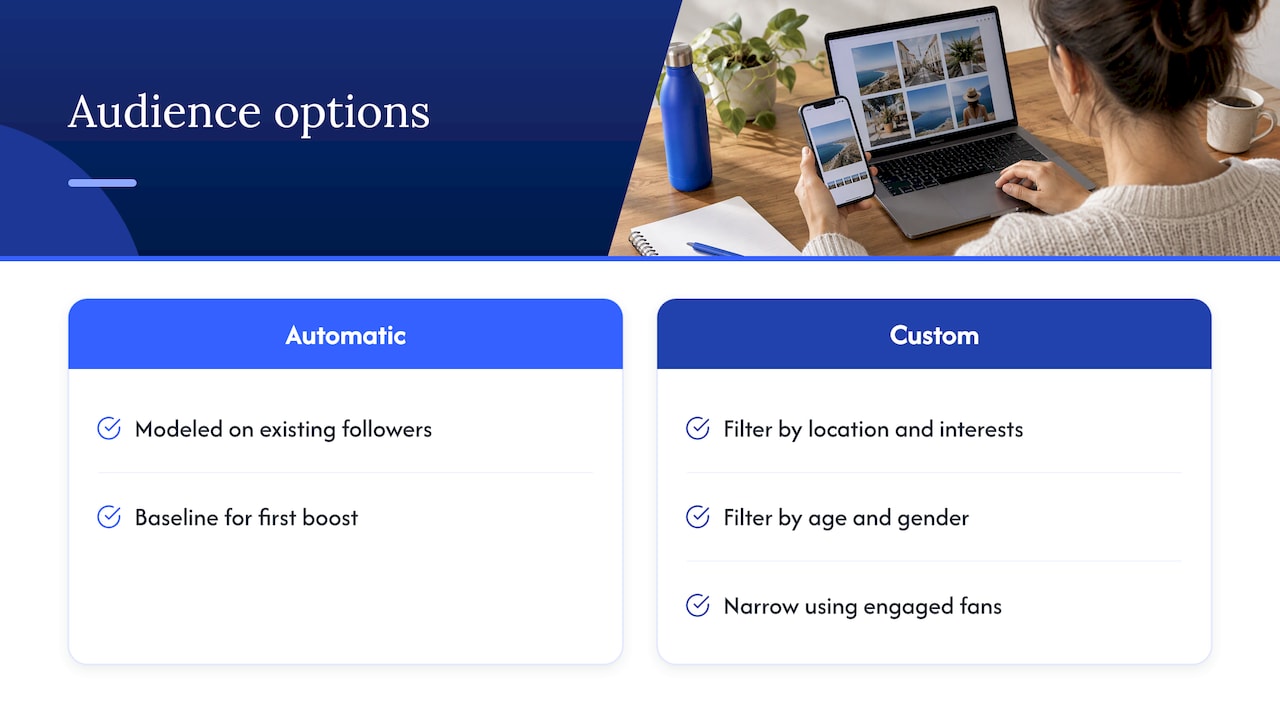
You can generally let Instagram choose an audience that resembles your followers, or build your own. Building your own lets you filter by location, interests, age and gender. For a first boost, try the automatic option as a baseline. For the second, narrow things down using what you already know about the fans who engage most with you.
Set a realistic budget and duration
You do not need a big budget to test. Reports indicate you can spend as little as $3 per day, though Meta advises a daily minimum of $5 for six days, which is roughly $30 for a first test. Duration and daily budget together determine reach, so a very short, very cheap boost often ends before Instagram has learned who responds.
A simple way to plan:
- Test round: about $5 a day for six days on your best-performing organic post.
- Review: compare cost per result across two or three posts.
- Scale: put more behind the post with the lowest cost per result, and stop boosting the rest.
Costs rise in crowded niches. One 2026 pricing guide puts typical clicks at $0.50 to $1.00, with fashion, beauty and fitness sometimes above $3.00. Treat those as ballparks, not promises, since your own results depend on your audience, creative and goal.
Which post to boost
Boosting amplifies what already works. Look at your Insights and choose a post that earned strong saves, shares or comments from followers without any paid push. A weak post stays weak when more people see it. A clear first frame, a short caption and one obvious next step (follow, visit, message) give the boost something to convert.
Measuring whether a boost worked
Check the promotion’s results in Instagram’s Insights and, for more detail, in Meta’s Ads Manager. The numbers worth watching are reach, impressions, profile visits, website clicks, cost per result and the share of impressions from non-followers.
Reading them together tells you more than any single figure:
- High reach, few profile visits: the post attracted views but not curiosity. Test a stronger hook or a clearer call to action.
- Many profile visits, few follows: your bio or grid is not telling new visitors why to follow. Fix those before spending more.
- Many clicks, no sign-ups: the problem sits after Instagram, on your landing page or link.
- Low cost per result: keep that post running and copy its format.
Keep a simple log of post, goal, budget, days, cost per result. After four or five boosts you will know which formats earn their budget.
How to get paid by brands on Instagram
The other kind of paid promotion starts with your audience, not your ad budget. Brands pay for access to people who trust you, so your job is to make that audience visible and easy to evaluate.
Build a profile brands can read in five seconds
Guides on getting sponsored agree on the basics: define a clear niche, know your audience demographics, post consistently and optimize your bio with relevant contact information. A brand manager scrolling through dozens of creators should see, immediately, what you cover, who follows you and how to reach you.
Instagram’s own creator marketplace has entry requirements as well. One guide lists being 18 or older, having a professional public account and at least 1,000 followers. Check Instagram’s current eligibility page, since criteria can change.
Put together a media kit
A media kit is a one- or two-page document that answers a brand’s questions before they ask. Include:
- Your niche and a one-line description of your content
- Follower count, engagement rate and audience demographics
- Examples of your best content
- Past collaborations, if any
- The services you offer, such as a feed post, Reels or Stories
- Contact details
Pitch with a short, personal message
A good pitch introduces you, names your niche and one standout metric, proposes a concrete content idea and attaches the media kit. Keep it under 150 words. Reference something specific the brand has done recently, so it is clear you are not mass-emailing.
Targets worth pitching first are brands you already use, smaller companies with active Instagram accounts, and products your audience already asks you about. Creator marketplaces can help, but direct outreach still works.
Price your work and agree deliverables
Pricing is where new creators struggle. One method is to estimate your impressions and apply a target CPM, with many mid-market deals around $15 to $40 CPM, then add fees for usage rights and a premium for exclusivity. Treat these figures as one reference point and adjust for your niche and engagement.
Whatever the rate, put these in writing before you start:
- Number and type of posts (feed, Reels, Stories)
- Deadlines and the approval process
- Payment amount, due date and method
- How long the brand can reuse your content
- Whether you are exclusive in that category
- Disclosure requirements
One detail that surprises people: Meta says creators who make content for partnership ads are paid off the platform, since Meta does not support payments made through the Instagram app. Invoice the brand directly.
Disclosure rules for paid promotion in the US
If a brand pays you, or gives you anything of value, you have to say so. The FTC says to disclose any financial, employment, personal or family relationship with a brand, and that financial relationships are not limited to money. Free products count.
In practice on Instagram:
- Use the Paid Partnership label when it is available. Meta says branded content must be tagged with the business partner, and the “Paid partnership with” label then appears above the post.
- Do not rely on the label alone. In a 2023 letter, the FTC told an influencer that the Paid Partnership tool by itself is not sufficient because viewers may miss it, and that video disclosures should appear in the video itself.
- Put a plain disclosure such as “#Ad” near the start of the caption, and say it in the video or show it on screen when you post Reels and Stories. Skip vague tags like “#Collab”.
- If you post from abroad, US law can still apply when the post is likely to affect US consumers, and local rules may apply too.
For legal questions about a specific contract or campaign, speak to an advertising or media lawyer. The FTC’s own guidance pages are the best starting point for the rules themselves.
Why smart creators use Instagram promotion to build their own audience
Boosts and brand deals both depend on a platform you do not control. Reach can change, formats come and go, and a brand deal ends when the contract does. That is why many independent creators treat Instagram as a front door and build their income somewhere they own the relationship with fans.
The practical version looks like this:
- Use Instagram to attract attention with content that is suited to a general audience.
- Point people to one link in your bio.
- Convert interested followers into paying fans through subscriptions, exclusive content, private messages and tips.
If this is your model, our guides on how to promote paid content och proven ways to boost your profile views go deeper into turning attention into subscribers. For wider tactics, see cross-promotion strategies for creators och social media content marketing.
Our perspective
We see the same pattern across the creator economy: the creators who grow fastest treat every promotion, paid or organic, as a way to build an audience they own.
A boost can bring thousands of new eyes to a post. A brand deal can pay a month’s bills. But neither one gives you a lasting relationship with the people who actually value your work. Fans do that, when they subscribe, send tips, buy exclusive content and message you directly.
That is the thinking behind Fanspicy. We built a paid social media and live cam platform where creators keep a higher percentage of their earnings, own their direct audience relationship and choose from flexible ways to earn: subscriptions, paid posts, private messages, live streams, bundles and tips. Creators do not pay fees to join or use the platform, and our commission applies per transaction. Migrating content from other platforms is designed to be easy, so you can test the waters without starting from zero.
Our advice is simple. Use Instagram promotion to find people, then give them a place where supporting you is easy.
fan
Ready to turn followers into income?
If your Instagram promotion is working but your earnings are not following, the missing piece may be where followers land. Fanspicy lets independent creators sell subscriptions, exclusive content, private messages and live streams, and receive tips from fans, all in one place. You can create your creator profile and see how it fits your funnel, or explore the platform first.
When your link in bio leads somewhere with a clear offer, every boost and every brand post works harder for you.
A simple first-month plan
If you want a practical path, here is one way to sequence the work.
Week 1: set up. Switch to a professional account, tidy your bio, add one clear link and write down your goal. Pull your Insights and mark your three best organic posts.
Week 2: run a test boost. Boost your best post with one goal, an automatic audience and about $5 a day for six days. Record reach, profile visits and cost per result.
Week 3: build your pitch. Create your media kit and shortlist ten brands that fit your niche. Send personal pitches to the first five.
Week 4: review and adjust. Compare your boost results, try a second audience with a custom setup, and follow up with brands that have not replied. Keep what worked and drop what did not.
Repeat the cycle. Small, measured tests beat one large guess.
VANLIGA FRÅGOR
How much does it cost to promote a post on Instagram?
You can start with a few dollars a day. Reports indicate boosts can run as low as $3 per day, while Meta advises about $5 per day for six days. Your actual cost per result depends on your niche, audience and goal, so watch it in Insights.
Is boosting a post the same as a paid partnership?
No. A boost is an ad you buy from Instagram for your own post. A paid partnership is branded content you make for a brand that pays you, and it carries the “Paid partnership with” label. The two can be combined, but they are different tools.
Do I need a minimum follower count to get paid promotions?
There is no single rule for direct brand deals, since brands set their own standards and many work with smaller niche creators. Instagram’s creator marketplace has its own criteria, which one guide lists as 1,000 followers and a professional account. Check Instagram’s current requirements before applying.
Do I have to disclose a sponsored post?
Yes, in the US. The FTC says you should disclose any material connection with a brand, including free products. Use the Paid Partnership label and also add a clear “#Ad” near the top of the caption.
How do I know if my boosted post is working?
Compare cost per result with the goal you picked. Look at reach, profile visits, website clicks and the share of non-follower impressions in Insights. If results are strong, extend the boost or repeat the format. If not, change the post before spending more.
Sources
- Boost a post on Instagram, Instagram Help Center
- Disclosures 101 for Social Media Influencers, FTC
- Warning Letter to Keri Gans, FTC
- About branded content on Instagram, Instagram Help Center
- Sponsored post on Instagram: what it is and how it works, Posttar
- What is a Boosted Post?, Buffer
- How To Boost an Instagram Post, Shopify
- How to Boost a Post on Social Media, HubSpot
- Instagram Promotion Cost 2026, Social Rails
- When and How to Boost an Instagram Post, Neal Schaffer
- How to get sponsored on Instagram, HubSpot
- Instagram Creator Marketplace guide, CreatorFlow
- How to Get Sponsored on Instagram: Beginner’s Guide, AInfluencer
- Instagram sponsorships: Get Paid With Real Rates, InfluencerDB