

Índice
TL;DR:
- Digital relationships are unique connections established and maintained through digital tools, operating on distinct norms and emotional risks. They encompass romantic, platonic, professional, creator-fan, and AI companionship types, each with varying intimacy and platform dynamics. Maintaining healthy digital relationships requires clear expectations, intentional communication, privacy respect, and balancing online interactions with offline life.
Most people assume digital relationships are just regular relationships conducted through a screen. That assumption misses almost everything interesting about them. What is digital relationships, really? It’s a distinct form of interpersonal connection, one where the rules, expectations, and emotional risks operate by their own logic. Digital relationships involve sustained connections built through digital communication technologies, and they carry unique dynamics that offline bonds simply don’t replicate. This guide breaks down what makes them different, where they can go wrong, and how to navigate them with clarity.
Principais conclusões
| Point | Details |
|---|---|
| Digital relationships are distinct | They follow their own norms and expectations, not just a digital copy of offline bonds. |
| Boundary ambiguity drives conflict | Mismatched expectations about online behavior cause stress and jealousy more than direct arguments do. |
| AI companions carry real risks | Moderate use can reduce loneliness, but heavy reliance worsens isolation and social skills. |
| Explicit communication matters most | Stating your expectations clearly prevents more conflict than trying to interpret someone’s intent. |
| Balance digital and offline time | Healthy digital relationships complement in-person connection rather than replacing it. |
What is digital relationships and why they’re different
A digital relationship is any sustained interpersonal connection primarily established and maintained through digital tools. That includes texting, social media, video calls, live platforms, messaging apps, and increasingly, AI-powered companions. The definition sounds simple. The reality is not.
What separates these connections from traditional ones is not just the medium. It is the relational norms that come with it. Offline relationships have centuries of social scripting behind them. When you meet someone in person, you both read hundreds of physical, social, and situational cues to calibrate your behavior. Digital spaces strip most of that away. What’s left is an environment where boundaries are fluid and ambiguous, and where two people can hold completely different assumptions about what a given behavior means.

Consider something as small as response time. In an offline friendship, taking three days to reply to a message carries implicit meaning shaped by context. Online, it can trigger anxiety, overthinking, or conflict, depending on what each person expects. Digital relationships don’t come with a shared rulebook. That’s both their freedom and their friction.
Key characteristics that define digital relationships include:
- Asynchronous communication that shifts the pace and tone of emotional exchange
- Reduced nonverbal cues, which increases the risk of misreading intent
- Platform-specific norms that vary wildly between, say, a LinkedIn connection and a Discord friendship
- Permanent digital records of conversations that can be revisited, screenshotted, or taken out of context
- Transcendence of geography, making connection possible across time zones and cultures
Dica profissional: When starting any new digital relationship, whether romantic, platonic, or professional, have an early conversation about communication expectations. It sounds formal, but it prevents months of avoidable misunderstanding.
Types of digital relationships
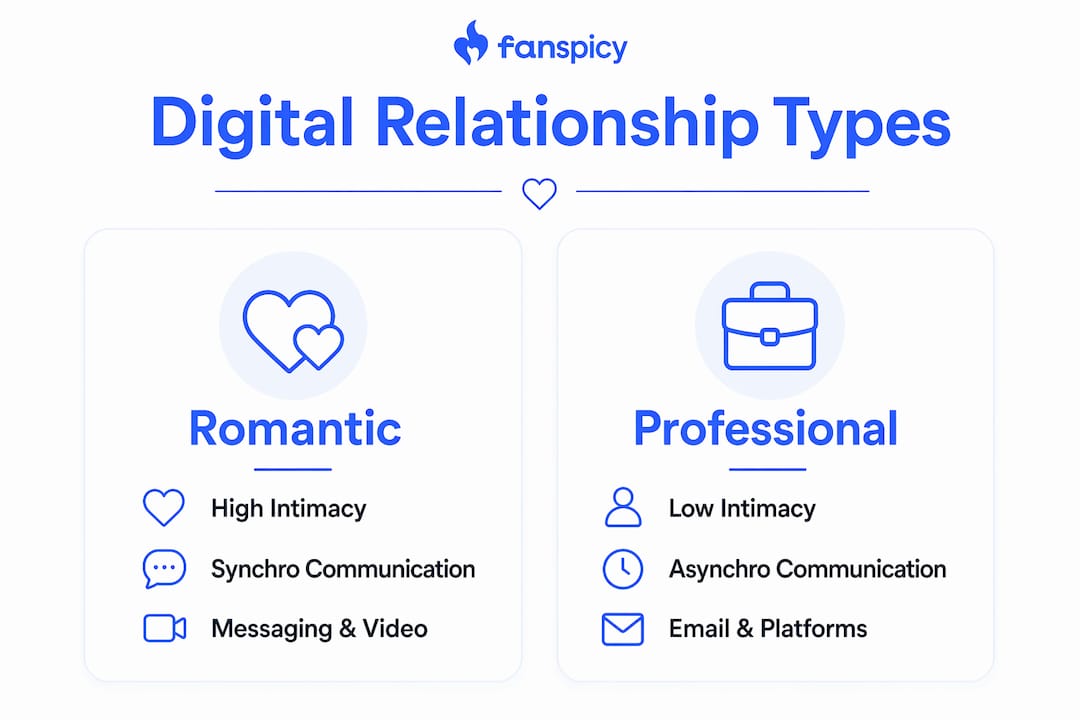
Understanding digital relationships means recognizing how many forms they take. Not all online connections carry the same emotional weight, level of intimacy, or set of risks. Here’s a breakdown of the main categories:
- Romantic relationships conducted primarily or entirely online, including long-distance couples who met digitally and partners who maintain intimacy through video and messaging.
- Platonic friendships formed through gaming communities, fan spaces, forums, or social media platforms where shared interests drive connection.
- Professional relationships built through LinkedIn, Slack, email, or remote work tools, where trust and collaboration develop without physical meetings.
- Creator-fan relationships on platforms like Fanspicy, where content creators build genuine bonds with subscribers through direct messaging, live sessions, and exclusive content.
- AI companionship through apps that simulate emotional responses, offer validation, and provide a sense of connection on demand.
The platforms driving these relationships are just as varied. Internet relationships are sustained through messaging, video, and social media, often without any in-person component. Each platform introduces its own norms. A relationship built through live video carries a different intimacy level than one maintained purely through text.
Here’s how the major relationship types compare across key dimensions:
| Type | Intimacy level | Communication style | Primary platform |
|---|---|---|---|
| Romantic | Alta | Synchronous and asynchronous | Video calls, messaging |
| Platonic | Moderate to high | Asynchronous, group-based | Discord, social media |
| Professional | Low to moderate | Formal, asynchronous | Email, Slack, LinkedIn |
| Creator-fan | Variable | Parasocial to personal | Paid platforms, live cam |
| AI companion | Simulated | Always-on, responsive | Dedicated apps |
Digital platforms foster connection while introducing complex communication dynamics that no single category fully escapes.
Challenges unique to digital relationships
Here’s where digital relationship dynamics get genuinely complicated. The most consistent source of friction isn’t infidelity or incompatibility. It’s ambiguity.
Research published in BMC Psychology found that unclear online expectations cause jealousy and conflict at a rate that scales with how inconsistent each person’s digital norms are. One partner thinks liking an ex’s photo is meaningless. The other reads it as a signal. Neither is wrong by some objective standard. The problem is that they never established a shared standard.
Social media intensifies this. Platforms make every action visible and searchable. The relational turbulence model explains how constant social media visibility prolongs perceived violations. A comment that would vanish in a room stays permanently visible online, available to be re-read and re-analyzed.
| Challenge | Root cause | Emotional impact |
|---|---|---|
| Boundary ambiguity | Mismatched digital norms | Jealousy, stress, withdrawal |
| Miscommunication | Lack of nonverbal cues | Misread intent, conflict |
| Social media monitoring | Constant visibility | Anxiety, perceived violations |
| AI companion overreliance | Unrealistic validation | Increased real-world loneliness |
| Privacy exposure | Digital permanence | Trust damage, safety concerns |
AI companions add another layer of complexity. Moderate AI interaction reduces loneliness, but heavy use correlates with increased isolation and weakened social skills. The appeal is obvious. AI companions are always available, never irritable, and endlessly validating. But AI validation can set users against real relationships by making the messiness of human connection feel like a flaw rather than a feature. Research also shows that AI apps use praise loops and FOMO to maximize engagement, not to support genuine emotional growth.
Dica profissional: If you use an AI companion app, treat it like a supplement, not a substitute. Use it to process thoughts, but make sure you’re also having real conversations with people who can push back on you.
Strategies for maintaining healthy digital relationships
Building digital relationships that actually hold up requires more intentionality than most people expect. You can’t rely on ambient physical presence to create closeness. You have to build it deliberately.
- Name your expectations early. Whether it’s response time, privacy around screenshots, or how you handle conflict over text, talk about it before it becomes a problem. Clarifying expectations outperforms debating intent every time.
- Create rituals. Consistent touchpoints, like a weekly video call, a shared playlist, or a daily check-in message, build the sense of continuity that face-to-face interaction provides naturally.
- Balance screen time with offline grounding. Even fully digital relationships benefit when each person has a rich offline life. It reduces the pressure placed on any single connection to meet every emotional need.
- Respect digital privacy. Sharing someone’s private messages, photos, or personal information without consent is a serious violation of trust. Learn more about protecting yourself and others with digital privacy practices that apply across all online relationships.
- Practice intentional disconnection. Logging off isn’t abandonment. It’s a healthy boundary. Communicating when you’re unavailable prevents misread silences from becoming misread signals.
- Audit your AI companion use. If you notice you’re turning to an app instead of reaching out to a real person, that’s worth paying attention to. Voice and text AI interactions produce different outcomes, and mindful moderation keeps those tools in their proper place.
The importance of digital relationships in modern life is undeniable. But “important” doesn’t mean “effortless.” These connections require active maintenance.
Where digital relationships are heading
The future of digital connection is being written right now, and it’s moving fast. AI companions are no longer niche. They’re mainstream products with hundreds of millions of users, and their emotional sophistication is increasing. The question isn’t whether AI will play a role in social connection. It already does. The question is how much of that role we want to hand over.
“The risk isn’t that people will fall in love with chatbots. The risk is that people will gradually recalibrate their tolerance for real human unpredictability downward, until ordinary relationships feel like too much work.”
This shift puts digital literacy at the center of modern emotional intelligence. People who can read platform-specific norms, set clear boundaries, and recognize when a digital tool is serving them versus shaping them will be far better equipped than those who don’t think about it at all. Adult content creators in 2026 are already navigating these dynamics at a sophisticated level, building genuine fan relationships within explicitly defined digital contexts.
The future also demands ethical design. Platforms that prioritize genuine digital intimacy over engagement metrics will produce healthier relational outcomes. That’s not inevitable. It requires pressure from users and accountability from builders.
My honest take on digital relationships
I’ve spent years watching people try to force digital relationships into the shape of offline ones. It almost never works. The discomfort usually comes not from the relationship itself but from applying the wrong framework to it.
What I’ve learned is that digital relationships need their own emotional language. The rules around response time, visibility, and expression of affection are genuinely different online. Pretending otherwise doesn’t protect you. It just delays the conversation you’ll eventually need to have.
I’m also cautious about AI companions, but not dismissive. I’ve seen moderate, intentional use help people process loneliness during genuinely hard seasons. What concerns me is the design intent behind many of these apps. When a tool is built to keep you engaged rather than help you grow, it’s working against you even when it feels supportive.
The most grounded digital relationships I’ve observed share one trait: both people are willing to say what they actually need. Not hint at it. Not assume the other person can figure it out from their posting behavior. Say it. That directness feels awkward online because the medium conditions us to be performative. Resist that instinct. Honest communication is what makes online connections feel real.
— fan
Connect authentically on Fanspicy
Digital relationships thrive when the platform they live on respects both parties. Fanspicy is built for exactly that. Whether you’re a creator building real connections with fans or someone looking for genuine interaction with content creators you actually like, Fanspicy gives you the tools to make that happen on your terms.

Fanspicy combines the intimacy of direct messaging with live cam sessions and exclusive content, so every interaction carries real weight. Privacy is built in, not bolted on. Explore creators like Jackie Pott or connect with somlusolme to experience what a thoughtfully designed digital connection actually feels like. Also check out tips on virtual flirting to strengthen how you engage. On Fanspicy, connection is the product.
PERGUNTAS FREQUENTES
What is digital relationships in simple terms?
A digital relationship is any sustained interpersonal connection maintained primarily through digital tools like messaging apps, social media, video calls, or live platforms. It follows its own norms and expectations that differ significantly from offline relationships.
What are the main types of digital relationships?
Digital relationships include romantic, platonic, professional, creator-fan, and AI companion connections. Each type varies in intimacy level, communication style, and the platforms that support it.
Why do digital relationships feel harder to maintain?
The absence of nonverbal cues and shared physical context means both people must actively communicate expectations that offline relationships often establish passively. Ambiguity is the primary driver of conflict and stress.
Are AI companions a real form of digital relationship?
They simulate relational dynamics and can reduce loneliness when used in moderation. However, heavy use undermines real-world social skills and sets unrealistic expectations for human connection.
How do you build trust in an online relationship?
Trust in digital relationships grows through consistent communication, clear boundary-setting, respect for privacy, and follow-through on commitments. Stating your expectations directly is more effective than assuming shared understanding.