

Índice
You can start steady, organic follower growth on Twitter today by following a compact, six-step engagement-first playbook: optimize your profile, lock in 2–3 focused topics, build a content mix weighted toward native formats, run a daily reply strategy, test one variable at a time, and track three core metrics weekly. Most creators who commit to this approach consistently see their first meaningful traction within 30 days and a compounding effect by month three.
Your 7-day starter experiment:
- Day 1: Audit and rewrite your bio using the formula below. Pin your strongest post.
- Day 2: Identify 15–20 accounts in your niche with active, engaged comment sections.
- Day 3: Write and publish three posts: one insight tweet, one thread opener, one question.
- Day 4–6: Spend 20 minutes each morning replying to posts on your target account list before publishing anything yourself.
- Day 7: Pull your analytics. Record impressions, profile visits, and new followers for the week.
Realistic milestones to set before you start:
- 1 week: Baseline data, first replies generating impressions beyond your existing audience
- 1 month: Consistent posting rhythm established, early follower momentum visible
- 3 months: Topical authority building, follower growth compounding from reply reach and shares
Principais conclusões
Growing Twitter followers organically in 2026 requires early engagement velocity, a narrow topical focus, and a daily reply strategy that borrows reach from larger accounts in your niche.
| Point | Details |
|---|---|
| Profile conversion first | Fix your bio and pinned tweet before scaling reach; a profile-visit-to-follow rate below 5% means more reach won’t help. |
| Topical focus beats volume | Stick to 2–3 topics for 30 days so the algorithm can place you in the right discovery cluster. |
| Reply before you post | Spend 70% of your daily time engaging on larger accounts; replies generate profile visits that standalone posts from small accounts rarely match. |
| Hook rewrites drive the biggest lift | Improving your first 5–7 words delivered a 35–50% engagement lift in tested cohorts; test hooks before any other variable. |
| Track three metrics weekly | Monitor engagement rate per post, profile-visit-to-follow rate, and follower conversion per post to know what’s actually working. |
Índice
- How does the X algorithm actually work in 2026?
- Does your profile convert visitors into followers?
- What content mix actually builds a loyal following?
- How do you build real engagement every single day?
- Eight post templates you can use this week
- Which tools should you use for scheduling and analytics?
- What metrics should you actually track?
- How long does organic growth actually take?
- What mistakes will quietly kill your growth?
- Why topical clustering and reply reach are research-backed growth levers
- Why conversation compounds faster than any shortcut
- Sources
How does the X algorithm actually work in 2026?
The X algorithm has shifted decisively toward engagement quality over posting volume. Understanding which signals it weighs most heavily is the difference between posts that reach only your existing followers and posts that break into new audiences.
The four ranking levers that matter most right now:
- Early engagement velocity: The algorithm measures replies, bookmarks, and retweets in the first 30–60 minutes. Posts that earn strong early signals get pushed to non-followers; posts that don’t are largely contained. This first-hour window is the single most important distribution lever you control.
- Reply weight: Replies carry more algorithmic weight than passive likes. A post that generates a genuine conversation signals quality content to the ranking system.
- Bookmark and dwell signals: When someone saves your post or spends time reading a thread, the algorithm treats that as a high-quality signal — more so than a quick like-and-scroll.
- External link penalty: Posts containing external links are actively deboosted in distribution. The practical fix is to post your core content without a link, let it gain traction, then drop the link in a reply.
Topical clustering is the underlying mechanism that makes niche focus so powerful. X groups accounts into topic clusters based on what they consistently post about and who engages with them. When your account sits firmly inside a cluster, the algorithm surfaces your content to others already interested in that topic. Spreading across ten unrelated subjects dilutes that placement and slows discovery.
Stop doing these immediately:
- Dropping external links in your primary post
- Stuffing three or more hashtags into every tweet (one relevant hashtag, used selectively, is fine)
- Posting at random times without checking your own analytics for audience-active windows
Start prioritizing these instead:
- Native content: text threads, native video, image posts without outbound links
- Reply-based reach: engaging on larger accounts before publishing your own content
- Consistent topical focus that lets the algorithm place you accurately
Does your profile convert visitors into followers?
Most creators underestimate how much a weak profile costs them. Someone who finds you through a reply or a shared post lands on your profile for roughly three seconds before deciding whether to follow. Every element needs to earn that follow.
Profile optimization checklist:
- Handle: Keep it short, readable, and close to your real name or brand name. Avoid underscores and numbers where possible.
- Display name: Include one keyword that describes what you do (e.g., “Maya Chen | Fitness & Nutrition”).
- Bio formula: Who you help + the outcome you deliver + how often you post. Example: “Helping indie founders build in public. Weekly threads on product, growth, and revenue.”
- Avatar: A clear, high-contrast headshot or logo. No blurry photos, no default eggs. Profile photos and visual consistency directly affect whether visitors trust the account enough to follow.
- Bandeira: Use it to reinforce your niche. A simple graphic with your core topic or tagline works better than a generic landscape photo.
- Pinned tweet: Pin your single best-performing post, or a thread that demonstrates your expertise. Rotate it every 4–6 weeks, or whenever you publish something that outperforms it.
Weak vs. optimized bio example:
| Elemento | Weak | Optimized |
|---|---|---|
| Biografia | “Writer. Coffee lover. Tweets about stuff.” | “Helping SaaS founders write copy that converts. Threads every Tuesday.” |
| Pinned tweet | Random recent post | Best-performing thread or a clear value-first introduction |
| Avatar | Blurry group photo | Clean headshot, good lighting, recognizable at small size |
Dica profissional: Add a soft call to action at the end of your bio, such as “Follow for weekly threads on X.” It sounds minor, but explicitly telling visitors what they get by following removes the ambiguity that causes hesitation.
What content mix actually builds a loyal following?
Account legibility is the concept that your audience and the algorithm both need to immediately understand what your account is about. Pick 2–3 topics and stay strict. A creator who posts about personal finance, travel photography, and parenting advice confuses both the algorithm’s topical clustering and the human deciding whether to follow.
Choosing your 2–3 topics:
Test your shortlist by asking: “Would someone who follows me for topic A also care about topic B?” If the answer is usually yes, the pairing works. If not, cut one.
Recommended content format mix:
- 50% single insight tweets: Short, punchy, standalone observations that drive replies and shares. These are your reach engine.
- 25% threads: Longer-form content that increases dwell time and earns bookmarks. Threads and content that increase dwell time perform consistently well with the current algorithm.
- 15% native video or image posts: Sprout Social’s analysis of engagement patterns shows visual content consistently outperforms text-only posts on reach and interaction rates.
- 10% replies and quote tweets: Borrowing reach from larger accounts and adding your perspective to trending conversations.
Hook and opening-line guidance:
The first 5–7 words of any post determine whether someone stops scrolling. Quip’s tested data shows that improving hook formulas delivered the largest single-lever engagement lift among all variables tested, with operators reporting a 35–50% improvement when they focused on hook rewrites alone.
Strong hook patterns:
- Contrarian: “Most creators get this completely backwards.”
- Specific number: “I analyzed 90 days of posting data. Here’s what I found.”
- Direct question: “Why do some accounts grow 10x faster than others?”
- Confession: “I spent six months doing this wrong before I figured it out.”
Content pillar example (personal finance creator):
- Pillar 1: Investing basics (insight tweets, how-to threads)
- Pillar 2: Behavioral money psychology (contrarian takes, polls)
- Pillar 3: Behind-the-scenes of building wealth (show-your-work threads)
Use your account analytics rather than generic “best time to post” charts to find when your specific audience is active. A creator with a European audience will see different peak windows than one whose followers are concentrated in the US Pacific time zone.
How do you build real engagement every single day?
The fastest way to grow a small account is to borrow reach from larger ones. A thoughtful reply on a post with 50,000 impressions can generate more profile visits than a standalone post from an account with 500 followers. MeetEdgar’s research identifies targeted replies and consistent engagement as one of the most reliable techniques for building followers organically.
Building your target engagement list:
- Identify 15–25 accounts in your niche with active comment sections (not just large follower counts — you want accounts whose replies get replies).
- Add them to a private Twitter List so you can monitor their posts without scrolling your main feed.
- Check the list every morning before you post anything yourself.
How to reply effectively:
- Choose posts published within the last 30–60 minutes so your reply appears while the post is still gaining traction.
- Add a specific, substantive point: a data point, a counterexample, a follow-up question, or a short story that extends the original idea.
- Avoid “Great point!” or “Totally agree” — generic replies are invisible and waste the opportunity.
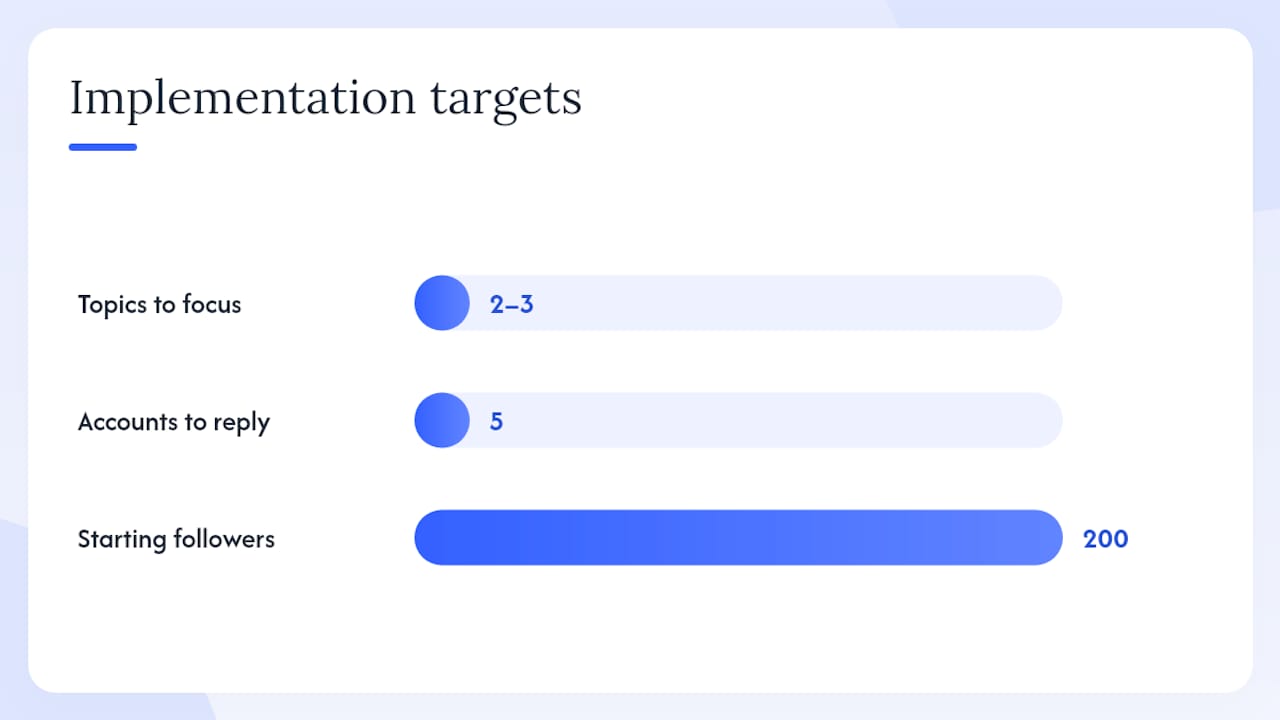
- Reply to 5–8 posts per session, then publish your own content.
Using Twitter Lists, Spaces, and Communities:
- Lists: Create one for your target engagement accounts and one for your most engaged followers. The latter becomes your early-engagement squad when you need first-hour velocity on a new post.
- Twitter Spaces: Host or co-host a Space on your core topic. Spaces surface in the app’s audio tab and attract listeners who don’t yet follow you. Even a 20-minute conversation with two or three other creators in your niche generates profile visits.
- Communities: Join 1–2 Communities relevant to your niche. Posting inside a Community reaches members who are already interested in that topic, which means higher follow-through rates than cold impressions.
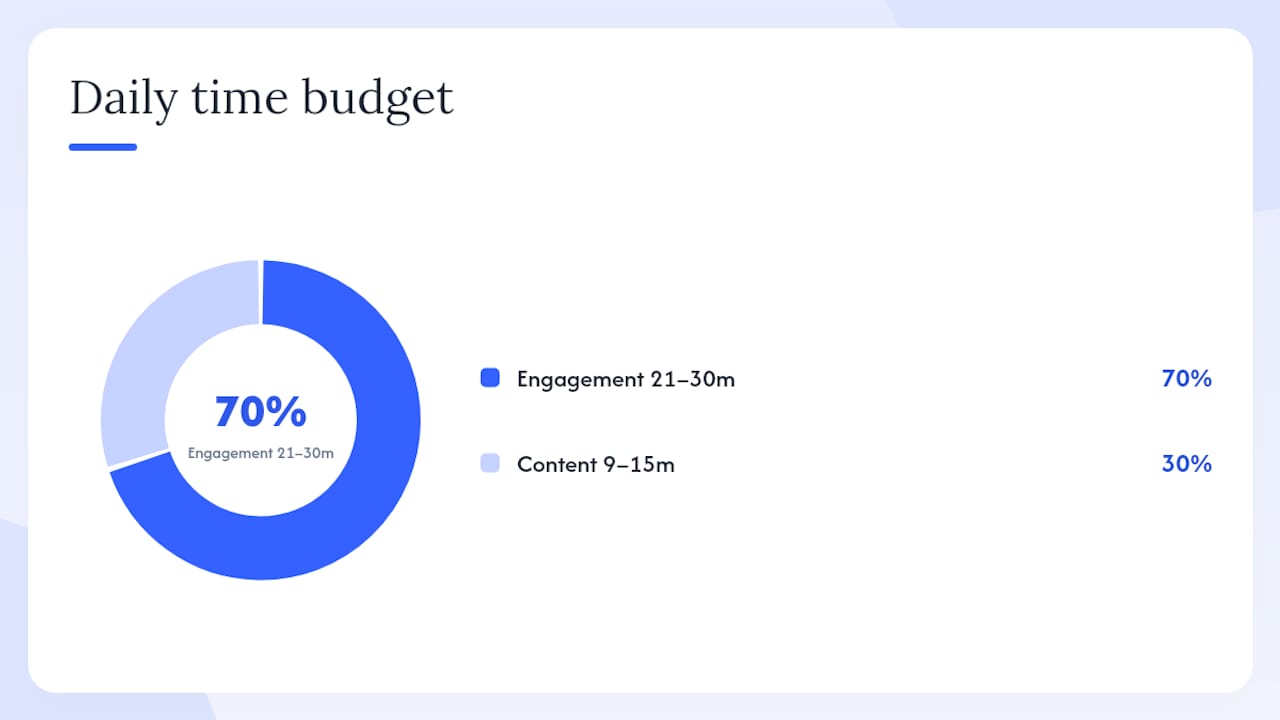
Daily time budget (30–45 minutes total):
- 70% engagement (21–30 minutes): Reply strategy, List monitoring, Community posts
- 30% content creation (9–15 minutes): Writing, scheduling, or publishing your own posts
Eight post templates you can use this week
These templates are designed to generate the signals the algorithm rewards most: replies, bookmarks, and profile visits. Adapt the framing to your niche.
-
Hook tweet: “Most people think [common belief]. They’re wrong. Here’s what actually happens: [short, specific insight].” Melhor para: reach and replies. Signal target: replies and quote tweets.
-
Single insight tweet: “[Specific, counterintuitive fact or observation in 1–2 sentences.] Save this.” Melhor para: bookmarks. Signal target: saves and shares.
-
How-to thread: “How to [achieve specific outcome] in [timeframe]: [Thread] 1/ [Step one with detail] 2/ [Step two] … [Final tweet with summary and CTA to follow for more].” Melhor para: dwell time and new followers. Signal target: bookmarks and follows.
-
Micro case study thread: “I [did X] for [timeframe]. Here’s exactly what happened: [Thread] 1/ [Context] 2/ [What worked] 3/ [What didn’t] 4/ [The result and what you can take from it].” Melhor para: credibility and shares. Signal target: replies and retweets.
-
Contrarian take: “[Widely accepted belief] is actually [why it’s wrong or incomplete]. The real answer is [your position].” Melhor para: replies and debate. Signal target: replies and quote tweets.
-
Poll with purpose: “Quick question for [your niche]: [Poll question with 2–4 options]. I’ll share what the data says on [day].” Melhor para: engagement and follow-up content. Signal target: votes and replies.
-
Show-your-work thread: “I’m building [X] in public. Week [N] update: [Thread] 1/ [What I set out to do] 2/ [What I actually did] 3/ [Numbers] 4/ [What’s next].” Melhor para: retention and community. Signal target: bookmarks and follows.
-
Welcome/DM CTA: “If you’re new here: I post [topic] every [day/week]. My most useful thread is pinned. DM me ‘[keyword]’ and I’ll send you [specific resource].” Melhor para: converting profile visitors into followers and subscribers. Signal target: DMs and follows.
A/B testing a template: Change one element (the hook only, or the CTA only), run each version on two separate posts within the same week, and compare engagement rate and profile visits. A 30-day window gives you enough data to see a pattern. Hook-first testing consistently shows the largest measurable lift of any single variable.
Which tools should you use for scheduling and analytics?
A lightweight content pipeline removes the friction that causes inconsistency. These six tools cover every stage from drafting to reporting, and all are available to US-based creators.
-
Typefully: The best drafting environment for threads. It shows you a live preview of how your thread will render, lets you schedule posts, and tracks basic engagement. Start here if you write threads regularly.
-
Buffer: Clean, affordable scheduler for creators managing one or a few accounts. The free tier covers basic scheduling; paid plans add analytics. Good entry point for creators on a budget.
-
MeetEdgar: Adds content recycling to scheduling. You build a content library and MeetEdgar rotates evergreen posts automatically. Useful once you have a backlog of posts worth republishing.
-
Hootsuite: A broader social media management platform with listening features and team collaboration. More infrastructure than most solo creators need, but worth it if you manage multiple platforms or work with a team.
-
TweetDeck: X’s native column-based dashboard. Free, real-time, and the best tool for monitoring your Lists and engaging quickly during your daily reply session. No scheduling, but unmatched for live engagement.
-
Sprout Social: The analytics layer. Sprout Social’s engagement data and reporting tools give you a clear picture of which content drives follows, what your peak engagement windows are, and how your account trends over time. Higher price point, but the depth of insight justifies it for creators serious about data-driven growth.
Simple workflow:
Brainstorm topics and hooks (any notes app) → Draft and schedule threads (Typefully) → Schedule single tweets (Buffer or MeetEdgar) → Monitor and engage in real time (TweetDeck + Lists) → Review weekly performance (Sprout Social or X’s native analytics).
Budget note: Start with Typefully’s free tier and TweetDeck. Add Buffer’s paid plan when you’re publishing consistently. Sprout Social makes sense once you’re generating enough data to act on.
What metrics should you actually track?
Most creators track follower count and nothing else. That’s the least useful number on your dashboard. Three formulas give you a much clearer picture of what’s working.
Core metric formulas:
- Engagement rate per post: (Replies + Retweets + Likes + Bookmarks) ÷ Impressions × 100. A rate above 1% is solid for most accounts; above 3% signals strong content.
- Profile-visit-to-follow rate: New followers ÷ Profile visits × 100. If this number is below 5%, your profile needs work before more reach will help you.
- Follower conversion per post: New followers gained in the 24 hours after publishing ÷ Impressions × 100. This tells you which content types actually convert reach into followers.
Weekly tracking snapshot:
| Metric | What to record | What good looks like |
|---|---|---|
| Engagement rate | Per post, weekly average | Above 1%; above 3% is strong |
| Profile-visit-to-follow rate | Weekly total | Above 5% |
| Follower conversion per post | Top 3 posts of the week | Identify your highest-converting format |
| Impressions | Weekly total | Week-over-week growth trend |
Experiment checklist:
- Write a hypothesis: “If I change [X element], engagement rate will increase by [Y%] within 30 days.”
- Identify your control: your current average engagement rate over the past 30 days.
- Change one variable only (hook formula, post format, posting time).
- Run for 30 days minimum before drawing conclusions.
- Set a target lift threshold: a 20% improvement in engagement rate is a meaningful signal worth acting on.
Structured workflows and analytics tools let creators identify what actually drives follows rather than guessing. Native X analytics cover the basics for free; Sprout Social adds the depth needed for systematic testing.
How long does organic growth actually take?
Organic growth on X is real, but it’s not fast. Setting accurate expectations protects you from abandoning a strategy that’s working simply because it hasn’t worked yet.
Milestone windows for consistent, daily effort:
- First 1,000 engaged followers: Typically 3–6 months for creators who post 4–5 times per week, run a daily reply strategy, and optimize their profile. Creators who
often compress this to 6–8 weeks by prioritizing reply-based reach from day one.
- 10,000 followers: Usually 12–18 months of consistent activity, assuming at least one piece of content per month earns significant organic reach.
- 50,000 followers: A multi-year commitment for most creators, though accounts that hit a viral thread or land a collaboration with a larger account can accelerate significantly.
Where paid options fit:
Paid promotion on X (promoted posts or X Premium verification) can increase the reach of content that’s already performing organically. What paid reach cannot buy is engagement quality. Promoted posts that reach cold audiences generate impressions, not necessarily replies or bookmarks. Use paid amplification to boost posts that have already earned strong organic engagement signals, not to rescue posts that flopped.
Approximate cost ranges for US creators:
- Tool subscriptions: $0 (free tiers of Typefully, TweetDeck) to roughly $99/month for Sprout Social’s entry plan.
- X Premium (verification): $8/month for individual accounts. Verified accounts may receive modest algorithmic preference in some distribution contexts.
- Promoted posts: Budgets vary widely; even $50–100/month can meaningfully amplify a top-performing post to a targeted audience.
Time is the primary cost for organic growth. Expect to invest 30–45 minutes daily for the first 90 days before the compounding effect of reply reach and topical authority becomes self-sustaining.
What mistakes will quietly kill your growth?
Several common behaviors actively suppress reach or damage the community trust that makes followers stick around. Most of them feel productive in the moment.
- Buying followers: Purchased followers don’t engage, which means your engagement rate drops as your follower count rises. The algorithm reads a low engagement rate as a signal of low-quality content and reduces distribution. Posts with external links are already deboosted; a low engagement rate compounds the problem.
- Link-heavy posts: Dropping a URL in your primary post is one of the fastest ways to limit reach. Put links in replies after the post has gained traction.
- Generic replies: “Love this!” and “So true!” add nothing and generate no profile visits. They’re invisible to everyone except the original poster.
- Overposting without engagement: Publishing ten posts a day while ignoring your replies signals to the algorithm that you’re broadcasting, not participating. Quality and early engagement velocity matter more than volume.
- Hashtag stuffing: Three or more hashtags per post reads as spam to both the algorithm and human readers. One relevant hashtag, used selectively, is enough.
Red flags to watch in your analytics:
A sudden spike in follower count with no corresponding increase in engagement rate usually means you’ve been followed by bot accounts or low-quality profiles. Monitor your profile-visit-to-follow rate weekly. If it drops sharply, check your recent follower list for obvious bot patterns and consider whether a recent post attracted the wrong audience.
Handling trolls and negative feedback:
Respond to genuine criticism briefly and factually, then move on. Engaging at length with bad-faith comments amplifies them and pulls your replies away from productive conversations. For clear harassment, block without reply. For managing community tone and moderation, the principle is simple: protect the quality of your comment section because it directly affects how the algorithm reads your content’s engagement quality.
Why topical clustering and reply reach are research-backed growth levers
The two tactics with the strongest evidence behind them are also the two most consistently underused by new creators: staying narrowly focused on 2–3 topics, and spending more time replying than posting.
How topical clustering works in practice:
X’s recommendation system groups accounts into topic clusters based on posting history, engagement patterns, and who engages with whom. When your account consistently produces content on a narrow set of topics and earns engagement from others in that cluster, the algorithm surfaces your content to people already interested in those topics. This is why a creator who posts exclusively about personal finance will often grow faster than one who posts about finance, fitness, and travel equally.
Step-by-step implementation:
- Choose your 2–3 topics and write them down as a constraint, not a guideline.
- For 30 days, publish only content that fits those topics. No exceptions.
- Build your reply list exclusively from accounts in the same topical cluster.
- At the end of 30 days, check your analytics for impressions from non-followers. If topical clustering is working, that number should be growing.
- Adjust your topic mix only if data shows one topic consistently underperforms the others.
The reply-reach mechanism:
Early engagement velocity and reply-weighted signals are two of the most consistently cited factors in how posts get distributed beyond an existing audience. A reply that adds genuine value to a post with strong early traction can generate hundreds of profile visits from people who would never have found your account otherwise.
Mini case study framework:
A creator in the productivity niche with 200 followers applied this approach: 30 days of posting only about time management and deep work, combined with 20 minutes of daily replies on five larger accounts in the same niche. By the end of the month, impressions from non-followers had grown substantially, and the profile-visit-to-follow rate improved from under 3% to above 7% after a bio rewrite.
Dica profissional: When replying to a larger account, don’t just agree or summarize. Add one specific detail, counterexample, or follow-up question that extends the conversation. Replies that generate their own replies are the ones that drive profile visits.
Why conversation compounds faster than any shortcut
The creators who build durable audiences on X share one trait: they treat the platform as a conversation, not a broadcast channel. Viral posts feel like the goal, but they’re actually a byproduct of consistent, high-quality engagement over time.
The compounding effect of daily replies is real and measurable. Each reply that earns a response from a larger account exposes your profile to that account’s audience. Over 90 days, that exposure accumulates into a meaningful pool of potential followers who’ve already seen you add value somewhere they trust. One viral thread is exciting; 90 days of thoughtful replies is what actually builds a following that stays.
Shortcuts, by contrast, tend to reset the clock. Buying followers drops your engagement rate, which suppresses distribution, which means you need to buy more followers to maintain the appearance of growth. It’s a loop that costs money and produces nothing durable.
If you’re ready to test this, start with the 7-day experiment outlined at the top of this article. Track your profile-visit-to-follow rate on day one and again on day seven. That single number will tell you more about your growth trajectory than your follower count ever will.
Sources
These resources cover the specific jobs this playbook references, from algorithm explainers to thread drafting to deep analytics.
- How to Grow on X (Twitter) in 2026: A Complete Growth Guide
- How to Grow on Twitter/X in 2026: The Complete Guide | XLab
- How to increase Twitter (X) engagement | Sprout Social
- How to Increase X (Twitter) Followers: 13 Brilliant Techniques
- How to Improve Tweet Engagement in 2026: 10 Levers Tested | Quip
- How to increase Twitter followers organically | Simplilearn
- How to Increase Engagement on X (Twitter) in 2026: Complete Guide | AutoTweet
-