

Índice
TL;DR:
- Effective content planning combines goal clarity, audience research, and structured strategies to boost reach and authority. Regular audits, a balanced calendar rule, and pillar-cluster structures help maintain growth and SEO performance. Consistent planning turns publishing into a strategic process that drives sustained audience engagement.
Content planning is the process of organizing your content around clear goals, audience needs, and publishing timelines to maximize reach and engagement. Without a structured plan, even talented creators publish inconsistently and lose momentum fast. The best content planning tips share one thing in common: they treat content as a system, not a series of one-off posts. Consistent publishers gain 55% more website visitors than those who post without a schedule. That gap is not about talent. It is about structure. This guide covers how to plan content from goal-setting through auditing, with practical frameworks that work for both solo creators and full marketing teams.
What are the best content planning tips for 2026?
The most effective content planning tips start with one question: what does success look like for this content? Without a clear answer, creators default to producing content that feels busy but delivers little. The industry term for this problem is “content without strategy,” and 58% of B2B marketers rate their own strategies as only moderately effective because they plan production schedules before defining goals. That stat reveals a widespread pattern: execution before direction.
SMART goals fix this. SMART stands for Specific, Measurable, Achievable, Relevant, and Time-bound. A vague goal sounds like “get more traffic.” A SMART goal sounds like “increase organic blog traffic by 20% in 90 days by publishing two SEO-optimized posts per week.” The second version tells you exactly what to create, how often, and how to measure progress.
Goals also shape every downstream decision. When you know a piece of content must drive email signups, you write a different call to action than if the goal is brand awareness. Defining the goal first prevents wasted effort and makes optimization much easier after publishing.
- Traffic goals target search visibility and new audience discovery.
- Engagement goals focus on comments, shares, saves, and time on page.
- Conversion goals measure signups, purchases, or subscriptions directly tied to content.
- Retention goals track how often existing followers return for new content.
Dica profissional: Write your goal at the top of every content brief before you write a single word. This one habit eliminates the most common cause of off-topic content.
How do you research and segment your audience effectively?
Audience research is the step most creators skip when they feel pressure to publish quickly. Skipping it is expensive. Content built around assumptions misses the specific questions real people are typing into search engines. Long-tail keywords of three or more words drive about 70% of total search traffic, which means the detailed, specific questions your audience asks are far more valuable than broad topics.

Effective audience research uses three inputs: search data, community conversations, and direct feedback. Search data from tools like Google Search Console shows what queries already bring people to your site. Community conversations on Reddit, Quora, and niche forums reveal the exact language your audience uses to describe their problems. Direct feedback from surveys or comments tells you what existing readers want more of.
Once you have that data, segment your audience into personas. A persona is a profile of a specific reader type, including their goals, pain points, preferred content format, and the platform where they spend time. A creator building content for both beginners and advanced practitioners needs two different content tracks, not one generic feed.
- List your audience’s top three goals. What outcome are they trying to reach?
- List their top three frustrations. What keeps them from reaching that outcome?
- Identify their preferred format. Do they watch videos, read long articles, or scroll short posts?
- Map their platform behavior. Where do they discover new content, and where do they engage?
- Build one persona per distinct segment. Keep each profile to one page and revisit it quarterly.
Dica profissional: Paste your top five performing posts into a spreadsheet and note what audience segment each one served. Patterns appear fast, and they tell you exactly where to focus next.
How do strategic pillars and topic clusters build authority?
Strategic pillars and topic clusters are the architecture behind every high-performing content creation process. A pillar is a broad, high-value topic your brand owns. A cluster is a group of specific subtopics that support and link back to that pillar. Together, they signal topical authority to both readers and search engines.
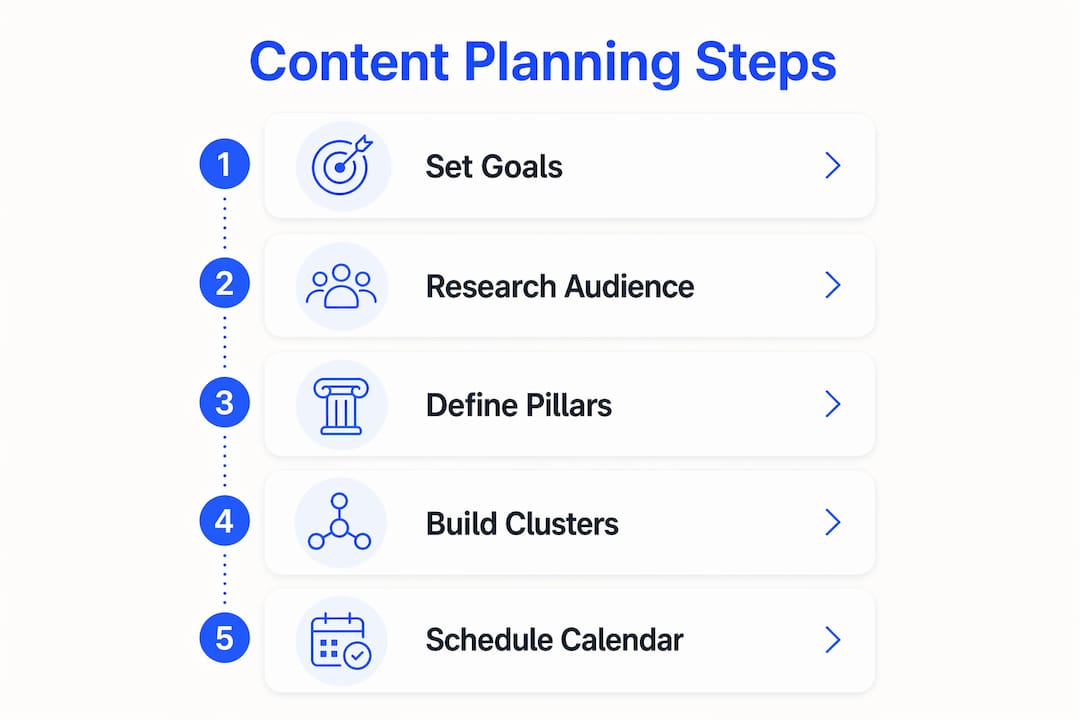
Content ecosystems built with 3–5 strategic pillars supported by 8–12 subtopic clusters deliver the topical authority that modern SEO and AI search favor. That structure matters because search algorithms now evaluate whether a site covers a topic deeply, not just whether a single page contains the right keywords.
Here is how pillars and clusters differ in practice:
| Recurso | Strategic pillar | Topic cluster |
|---|---|---|
| Scope | Broad, high-level topic | Specific subtopic within the pillar |
| Length | Long-form, comprehensive | Focused, single-question format |
| SEO role | Earns authority for the topic | Captures long-tail search traffic |
| Linking | Links out to cluster pages | Links back to the pillar page |
| Update frequency | Quarterly refresh | As new subtopics emerge |
The practical rule is to plan all cluster articles within a pillar before moving to the next pillar. Partial clusters leave gaps that competitors fill. A creator covering fitness, for example, might build a pillar on “strength training for beginners” and then write clusters on equipment choices, weekly schedules, recovery methods, and nutrition basics before starting a new pillar on cardio.
Prioritizing consistency over volume builds stronger topical authority than publishing scattered content across unrelated topics. Depth beats breadth every time.
How do you build a content calendar that actually works?
A content calendar is only useful if it reflects reality. The most common mistake is building a calendar that looks great in a spreadsheet but collapses under the pressure of actual production. Top content plans operate on a 1–3 month rolling horizon with updates planned for 30, 90, and 180 days ahead. That rolling structure keeps the calendar current without requiring a full rebuild every month.
The 70/30 content calendar rule is the most practical framework for balancing consistency and flexibility. Seventy percent of your calendar slots hold planned evergreen content. The remaining 30% stay open for trending topics, timely responses, and spontaneous ideas. This ratio prevents the calendar from becoming a rigid schedule that ignores what is actually happening in your niche.
Assigning specific roles, deadlines, and backward-mapped timelines is what separates calendars that get executed from those that stall. Backward mapping means starting from the publish date and working backward to assign every task: research, writing, editing, design, and scheduling. Each task gets a named owner and a deadline.
- Block batch production days. Write three to five pieces in one session instead of one piece per day.
- Add buffer time before every publish date. A two-day buffer catches errors without derailing the schedule.
- Color-code by content type. Pillar articles, cluster posts, and social content should be visually distinct.
- Review the calendar every Friday. A weekly check catches problems before they become missed deadlines.
Dica profissional: Schedule your hardest content first in the week. Creative work suffers when it gets pushed to Friday afternoons after a week of meetings and admin tasks.
How do you measure and improve your content plan over time?
Measurement turns a content plan from a publishing schedule into a growth engine. The three metrics that matter most are traffic, engagement, and conversions. Traffic tells you whether people find your content. Engagement tells you whether they value it. Conversions tell you whether it drives the outcomes your goals defined.
Quarterly content audits are the highest-leverage activity for content ROI. An audit evaluates every published asset and assigns it one of four actions: keep, improve, repurpose, or delete. Content that ranks well and converts stays as is. Content with good traffic but low conversions gets improved. Content that performed well in one format gets repurposed into another. Content that neither ranks nor converts gets removed or redirected.
- Pull a full list of published URLs from your CMS or sitemap.
- Add traffic and engagement data from Google Analytics or your platform’s native analytics.
- Tag each piece with one of the four audit actions: keep, improve, repurpose, or delete.
- Prioritize the “improve” list. Updating existing content often delivers faster results than writing new pieces.
- Schedule repurposing tasks in your next calendar cycle. Repurposing high-performing content into new formats extends its lifespan and reaches new audiences.
Structured content with clear headers, factual density, and direct answers improves both AI visibility and SEO performance. That means formatting matters as much as the words themselves. Use headers that answer real questions, include specific data points, and write conclusions that restate the core claim directly.
Principais conclusões
A content plan built on SMART goals, audience research, pillar-cluster architecture, and quarterly audits consistently outperforms ad hoc publishing in both traffic and conversions.
| Point | Details |
|---|---|
| Set SMART goals first | Define specific, measurable outcomes before writing a single word of content. |
| Research before you publish | Use search data and community forums to find the exact questions your audience asks. |
| Build pillar-cluster ecosystems | Organize 3–5 pillars with 8–12 clusters each to earn topical authority in search. |
| Use the 70/30 calendar rule | Keep 70% of slots for evergreen content and 30% open for timely, flexible posts. |
| Audit quarterly | Evaluate every asset to keep, improve, repurpose, or delete for maximum ROI. |
Why I stopped winging it and started planning like an editor
The shift that changed everything for me was treating content like a publication, not a feed. When I ran content ad hoc, I published whenever inspiration struck. Some weeks I produced five pieces. Other weeks, nothing. The inconsistency killed any momentum I built.
The first time I mapped out a full pillar with its cluster articles before writing anything, the results were different. Organic traffic to that pillar grew steadily over three months because every cluster article reinforced the pillar’s authority. No single piece did the heavy lifting alone.
The part most creators resist is the audit. Deleting content feels like admitting failure. But cutting a low-performing article that confuses your topic focus is one of the most productive things you can do. It clarifies your site’s authority signal and frees up time you would have spent updating something that was never going to rank.
My honest advice: spend 20% of your content time on planning and auditing. Most creators spend less than 5%. That gap is exactly where the difference in results comes from. Data should inform your calendar, but it should not replace your creative instincts. The best plans leave room for both.
— fan
How Fanspicy supports your content planning and creation
Fanspicy is built for creators who take their content seriously. The platform gives you the tools to publish, monetize, and grow without the friction that slows down most content workflows. Whether you are building a pillar content strategy or experimenting with new formats, Fanspicy’s paid social and live cam features give you direct access to your audience.
Creators on Fanspicy can apply the content creation ideas covered in this guide directly to their publishing schedule. The platform supports the kind of consistent, audience-focused publishing that drives real growth. If you are ready to put your content plan into action, start on Fanspicy and build the audience your content deserves.
PERGUNTAS FREQUENTES
What is content planning and why does it matter?
Content planning is the process of organizing content goals, topics, formats, and publishing schedules before production begins. Consistent publishers gain 55% more website visitors than those who post without a plan.
How often should I update my content calendar?
Top-performing content plans use a rolling 1–3 month calendar with weekly reviews and quarterly full updates. This keeps the schedule current without requiring a full rebuild each month.
What is the 70/30 rule for content calendars?
The 70/30 rule means filling 70% of your calendar with planned evergreen content and leaving 30% flexible for trending topics and timely responses. This balance keeps your brand consistent and responsive at the same time.
How do topic clusters improve SEO?
Topic clusters group specific subtopic articles around a broad pillar page, and each cluster article links back to the pillar. This structure signals topical authority to search engines and improves rankings across the entire cluster.
How often should I conduct a content audit?
Quarterly content audits deliver the highest return on existing content. Each audit evaluates every published asset and assigns it one of four actions: keep, improve, repurpose, or delete.