

Índice
TL;DR:
- Online intimacy involves emotional closeness built through digital communication, such as messaging, voice notes, and calls. It is backed by psychological theories like Social Penetration and Hyperpersonal, which explain how online relationships deepen and sometimes intensify. Building lasting digital intimacy requires deliberate disclosure, varied communication, mutual trust, boundaries, and consistent presence.
Online intimacy is far more than flirting through a screen or sharing explicit content. At its core, what is online intimacy really about? It’s the emotional closeness two people build through digital communication, whether that’s a heartfelt voice note sent at midnight, a meme that says “I thought of you,” or a vulnerable conversation in a DM thread. Most people dismiss these connections as shallow. That’s a mistake. Digital intimacy, the recognized term researchers use, is a measurable psychological phenomenon backed by decades of communication theory. And it’s reshaping how all of us relate to each other.
Índice
- Key takeaways
- What is online intimacy, explained through psychology
- Forms of digital intimacy beyond the obvious
- Online vs. in-person intimacy
- How to build online intimacy that actually lasts
- My honest take on digital intimacy after years in this space
- Experience real connection on Fanspicy
- PERGUNTAS FREQUENTES
Key takeaways
| Point | Details |
|---|---|
| Online intimacy is emotional | Digital connection builds real emotional depth, not just physical or sexual closeness. |
| Psychology backs it up | Social Penetration Theory and the Hyperpersonal Model explain how online bonds form and intensify. |
| Small gestures count | Memes, emoji reactions, and voice notes create genuine co-presence between people online. |
| Online vs. in-person trade-offs exist | Digital intimacy accelerates closeness but lacks nonverbal cues needed for long-term satisfaction. |
| Consent and boundaries matter | Safe, reciprocal self-disclosure is what separates empowering digital connection from harmful pressure. |
What is online intimacy, explained through psychology
To understand how digital intimacy works, you need two foundational theories. Together, they explain why some online relationships feel more real than ones you’ve had with people you’ve known for years in person.
The first is Social Penetration Theory. Developed by psychologists Irwin Altman and Dalmas Taylor, it frames intimacy as layers of an onion. Relationships deepen as people gradually share more, moving from surface-level topics (weather, sports, weekend plans) to deeper personal values, fears, and vulnerabilities. The breadth of topics expands first. Then depth increases. Both have to grow together for real intimacy to form.
What makes online communication fascinating is that it accelerates this process. Reduced social inhibition online means people often disclose personal information faster than they would face to face. The screen creates a kind of buffer. That buffer lowers the perceived cost of vulnerability. As a result, online self-disclosure tends to happen quicker and, in some cases, goes deeper faster than in-person conversation.
The second theory is the Hyperpersonal Model, developed by Joseph Walther. It explains something you’ve probably experienced without having a name for it. When you communicate online, you naturally edit yourself. You choose your best photo, craft your message carefully, and present a version of yourself that feels more polished. According to research on idealized self-presentation, this creates relational impressions that are often more intense than what forms in person. The person on the other end fills in what they don’t know with favorable assumptions.
Here’s why that matters practically:
- Reciprocity drives depth. When one person shares something personal and the other responds in kind, trust compounds. This back-and-forth is the engine of intimacy, online or offline.
- Context shapes disclosure. People share more when they feel the environment is private, the other person is trustworthy, and the social norms permit it.
- Perceived risk calibrates openness. The more someone believes sharing won’t be used against them, the more they’ll reveal. Platforms that protect privacy actively support the conditions for real intimacy.
Dica profissional: If you want a digital connection to deepen, match the other person’s level of vulnerability. When they share something personal, don’t deflect. Share something back. Reciprocity is what moves a conversation from small talk to something real.
Research in 2025 also confirmed a dual-pathway model showing that digital intimacy reduces loneliness and builds both close personal trust and broader social connection. It’s not just for romantic relationships. It applies to friendships, community bonds, and creator-audience relationships too.
Forms of digital intimacy beyond the obvious
When most people hear “online intimacy,” they think of cybersex or explicit content. That’s one expression of it. But digital intimacy encompasses a far wider range of emotional and relational behaviors. Recognizing the full spectrum is what actually helps you build stronger connections.
“Intimacy is not always about what’s said. Sometimes it’s a reaction, a meme, a two-second voice note. It’s about being seen.” — a core insight from digital communication researchers
Here’s how online emotional connection shows up in everyday digital life:
- Affectionate messaging. Consistent, genuine check-ins (“how’d that thing go today?”) create a felt sense of being cared for. Frequency matters less than attentiveness.
- Meme sharing. This one surprises people. Research on meme sharing and co-presence shows that sending someone a meme is an act of identity negotiation. You’re saying: I know how your mind works, and this is proof.
- Voice and video calls. Audio adds tone. Video adds facial cues. Both significantly deepen the quality of online emotional connection compared to text alone.
- Emoji reactions and small acknowledgments. A heart react to a story, a specific emoji response to a confession, these lightweight signals sustain relational presence even asynchronously. They say “I’m here, I noticed.”
- Cybersex and sexually explicit interaction. Consent and privacy are the defining factors in whether these experiences feel connective or coercive. When both people are engaged willingly and safely, sexual online intimacy can be a genuine expression of closeness.
The distinction between casual and deep digital intimacy signals is usually consistency and specificity. Anyone can send a generic “thinking of you.” What creates real closeness is when the message proves that you’ve been paying attention.
Online vs. in-person intimacy
These two forms of closeness are not opponents. They’re complements. But they do operate differently, and knowing the difference helps you use each one better.

| Dimension | Online intimacy | In-person intimacy |
|---|---|---|
| Speed of disclosure | Faster, due to reduced inhibition | Slower, social norms apply more strictly |
| Nonverbal cues | Limited or absent | Full access: tone, body language, touch |
| Acessibilidade | Available across distances, any time | Requires physical proximity |
| Emotional intensity | Can feel very intense, quickly | Builds more gradually |
| Long-term satisfaction | May feel incomplete without physical contact | More complete but less accessible |
| Risk factors | Idealization, privacy concerns | Misreading cues, social anxiety |
The clearest benefit of online intimacy is access. Relationships that would never form across geography or social context can develop online. For people with social anxiety, physical disabilities, or limited social circles, digital spaces may be the primary place where genuine emotional closeness gets built.
The clearest limitation is embodied synchrony. Touch, shared physical space, synchronized breathing during a difficult conversation, these are hard to replicate. Studies show that while online disclosure heightens intimacy in the short term, the absence of nonverbal cues can create a gap when people meet in person. The relationship you built on screen may feel different face to face.
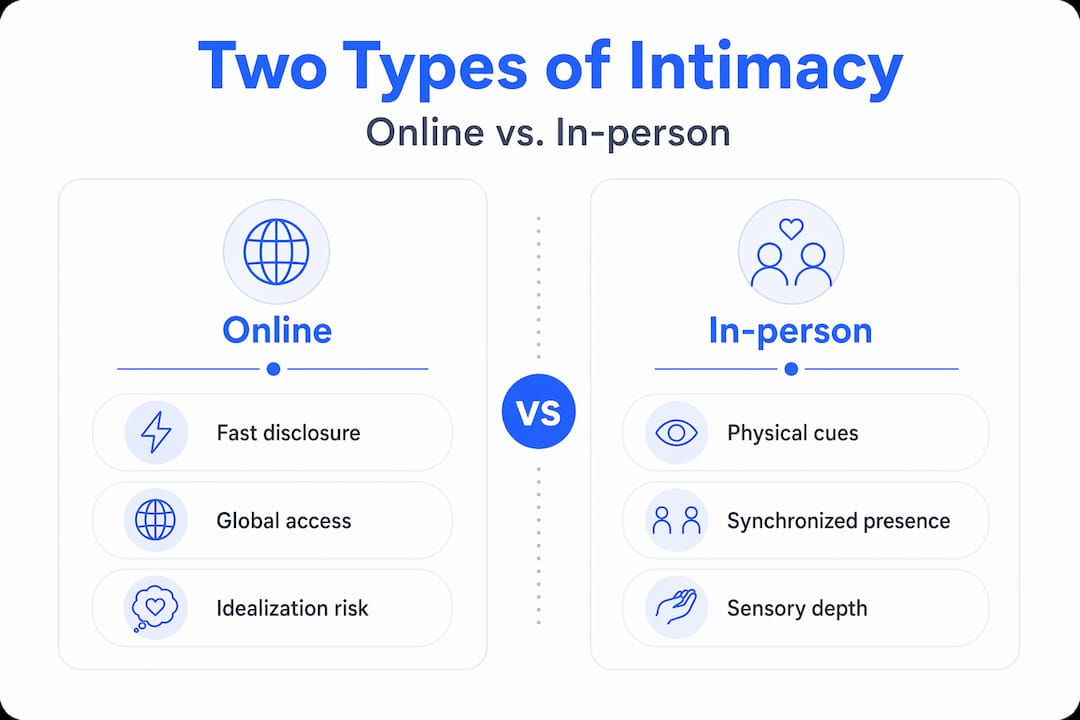
The other major risk is idealization. Because the Hyperpersonal Model predicts people fill gaps in knowledge with positive assumptions, online relationships can generate unrealistic expectations. Managing those expectations honestly is part of building healthy digital intimacy.
Dica profissional: If an online relationship matters to you, incorporate voice or video communication regularly. Audio and visual cues add layers of information that text can’t carry. They also make the eventual in-person transition, if there is one, much smoother.
How to build online intimacy that actually lasts
The importance of online intimacy isn’t just emotional. For many people, digital relationships are primary sources of belonging and support. Building them well requires intentionality. Here are the practices that actually work.
- Disclose deliberately, not impulsively. Share personal information in layers, matching the other person’s pace. Dumping everything at once can overwhelm. Sharing nothing keeps the connection surface-level.
- Vary your communication modes. Relying only on text limits the connection. Send a voice note occasionally. Jump on a video call. Different modes carry different emotional information and each one adds a new dimension to how you know each other.
- Recognize bids for connection. When someone shares something small (“ugh, rough day”), that’s an invitation. Responding attentively to those moments builds far more intimacy than long conversations initiated at convenient times. Learn to respond to bids in the moment.
- Set boundaries and respect them. Clear, mutual boundaries create the psychological safety that makes deeper sharing possible. Without that safety, people self-censor in ways that prevent real closeness from forming.
- Protect privacy actively. Especially in digital spaces, the conditions for safe intimacy depend on knowing your information won’t be misused. This matters both for your own protection and for privacy practices that make others feel safe sharing with you.
- Be consistently present asynchronously. You don’t have to reply instantly. But showing up reliably, even with a short message, tells the other person that they’re on your mind. Consistency is the long-game version of emotional attentiveness.
Dica profissional: Intimacy isn’t built in big moments. It’s built in the small, consistent ones. The person who remembers what you mentioned three weeks ago and follows up is building real closeness, whether they’re sitting next to you or on another continent.
My honest take on digital intimacy after years in this space
I’ll be straight with you: digital intimacy is one of the most misunderstood forces in modern relationships. I’ve seen it dismissed as fake, treated as a lesser version of “real” connection, and reduced entirely to sexual content. All of that misses the point.
What I’ve learned is that the emotional depth possible in a digital relationship isn’t determined by the medium. It’s determined by the people using it. Two people who show up honestly, disclose carefully, and respect each other’s limits can build something genuinely close, regardless of whether they’ve ever been in the same room.
What I’d caution against is the idealization trap. The Hyperpersonal Model isn’t just a theory. It describes a real tendency to project qualities onto someone you’ve only met online. I’ve watched people mistake the intensity of a fast-moving digital relationship for depth that hasn’t actually been built yet. Intensity and intimacy are not the same thing.
The aspect of online intimacy I think deserves far more attention is what it does for people who are isolated. Digital spaces open emotional access for people who don’t have rich offline social lives. That’s not a consolation prize. That’s a real and meaningful form of human connection. Treating it with seriousness, including thinking carefully about consent, privacy, and emotional safety, is how we make sure it stays that way.
My practical advice: don’t choose between online and offline intimacy. Let each feed the other. The emotional clarity you develop in digital communication can make you more present and articulate in person. The physical synchrony of in-person connection gives you something to bring back to your digital conversations. They work better together.
— fan
Experience real connection on Fanspicy
Building meaningful digital intimacy starts with finding spaces that actually support it. Fanspicy is a paid social media and live cam platform built for real interaction between creators and their communities. Creators on Fanspicy connect with audiences through live video, direct messaging, and exclusive content that goes beyond surface-level entertainment.

If you want to experience what thoughtful online connection looks and feels like with a creator who shows up authentically, Fanspicy is the place to start. Privacy protections, consent-forward community standards, and a platform built for genuine engagement make it one of the best spaces to explore digital closeness responsibly. Browse creators like somlusolme who build real community, not just a following.
PERGUNTAS FREQUENTES
What is online intimacy in simple terms?
Online intimacy is the emotional closeness two people develop through digital communication, including messaging, voice notes, video calls, and shared content, without needing to be physically present.
Is online intimacy as real as in-person intimacy?
Research supports that online emotional connection can be deep and genuine, but it differs from in-person closeness because it lacks nonverbal cues and physical synchrony that contribute to long-term relationship satisfaction.
How does the Hyperpersonal Model affect online relationships?
The Hyperpersonal Model describes how people present idealized versions of themselves online, which can intensify early relational impressions. This can create unrealistic expectations when partners meet in person.
What are some practical ways to build online intimacy?
Vary your communication modes (text, voice, video), disclose personal information gradually, respond to small bids for connection, and maintain consistent emotional presence. Reciprocal self-disclosure is the single most effective method.
Why does consent matter in digital intimacy?
Consent shapes whether online intimacy feels empowering or pressured. This is especially true in sexual digital interactions where privacy and boundaries determine whether the experience builds trust or erodes it.