

Spis treści
TL;DR:
- Privacy on adult platforms is essential for safeguarding user and creator identities, payment data, and behavioral patterns from breaches and misuse. Advanced technologies like Zero-Knowledge proofs, self-sovereign identity, and on-device processing enhance privacy while maintaining discoverability and trust. Designing platforms with privacy embedded from the start builds user confidence, retention, and loyalty, making privacy a core feature rather than an optional setting.
Privacy on adult platforms is the foundational safeguard that allows users and creators to engage with sensitive content without exposing their real-world identities, financial data, or behavioral patterns. A single data breach on an adult site carries consequences far more severe than on a mainstream platform. Blackmail, professional ruin, and harassment are documented outcomes. The role of privacy in adult platforms has shifted from a compliance checkbox to a core product feature, driven by user demand, regulatory pressure, and the rise of technologies like Zero-Knowledge architecture and decentralized identity systems. What you do with that knowledge determines how safely you operate in this space.
What privacy technologies actually protect adult platform users?
The adult industry is adopting Zero-Knowledge architecture that allows age verification without storing or exposing real identity data. Cryptographic proofs confirm that a user meets age requirements without transmitting a passport scan, driver’s license number, or date of birth to a central server. This matters because centralized ID databases are high-value targets for attackers, and a breach of that data on an adult platform is catastrophic in ways that a leaked email list simply is not.
Decentralized identity systems, often called self-sovereign identity (SSI), take this further. With SSI, users hold their own credentials in a personal digital wallet rather than surrendering them to a platform. The platform verifies the credential without ever seeing the underlying data. Projects like the W3C Verifiable Credentials standard are already shaping how this works in practice across multiple industries, and the adult sector is beginning to adopt the same model.
End-to-end encryption protects messages and media in transit, but the more significant shift is happening at the device level. Edge computing enables AI personalization to run locally on a user’s device, meaning preference data and behavioral signals never leave the hardware. Recommendations get smarter without feeding a central data warehouse that could be subpoenaed or breached.
- Zero-Knowledge Proofs: Confirm age or identity attributes without transmitting raw ID data to the platform.
- Self-Sovereign Identity (SSI): Users control their own credentials; platforms verify without storing.
- End-to-end encryption: Protects messages and media between sender and recipient.
- Edge processing: AI personalization runs on-device, keeping behavioral data local.
- Layered access controls: Segregating public site elements from sensitive backend systems limits insider threat risk, as strong access controls reduce exposure even when one layer is compromised.
Pro Tip: If a platform offers on-device preference settings rather than cloud-synced profiles, use them. Local storage means your content habits stay on your hardware, not on a server you do not control.
How does privacy balance with discovery on adult content platforms?
Privacy and discoverability feel like opposites, but the best-designed adult platforms treat them as a spectrum rather than a binary choice. Creators use privacy as pacing disclosure, revealing information gradually as trust builds with a subscriber or follower. A creator’s public profile might show a stage name, a content category, and a preview image. Their real name, location, and contact details never appear at any stage of the interaction.
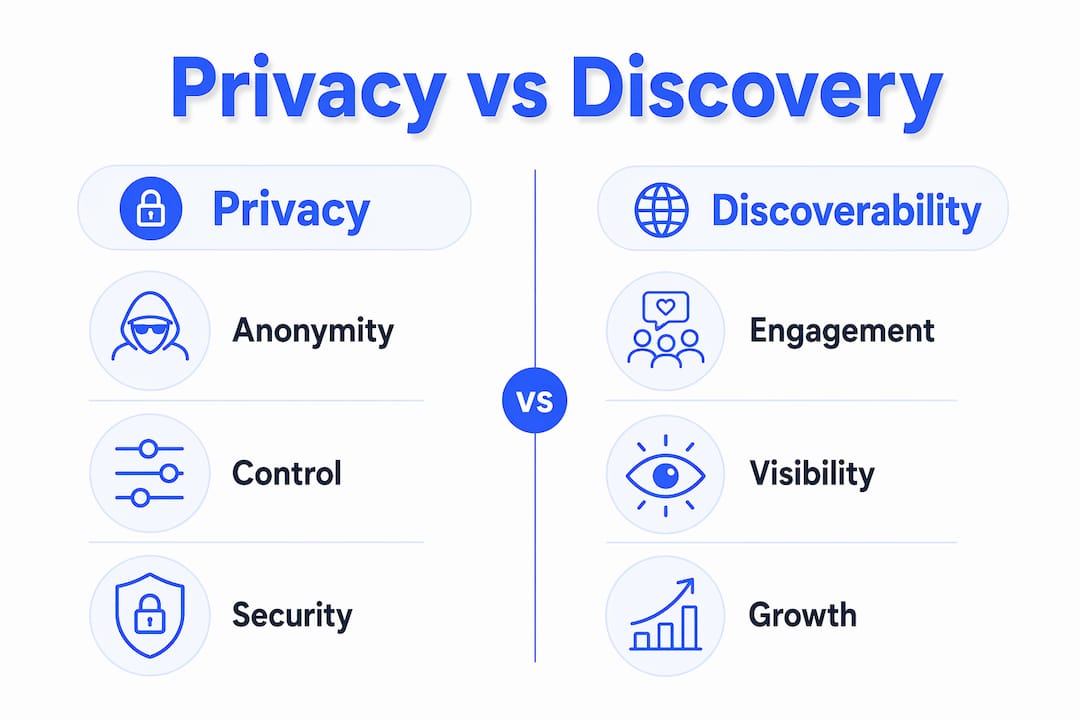
This graduated approach works because users demand the same separation. The concept of biological insulation describes the growing user expectation that adult platform activity remains completely walled off from their professional and social identities. Platforms that design for this expectation retain users longer and generate more trust-based spending.
Here is how a well-structured privacy-and-discovery balance looks in practice:
- Public layer: Stage name, content genre, preview media. Visible to anyone, indexed by platform search.
- Subscriber layer: Full content library, direct messaging access. Visible only to paying subscribers.
- Private layer: Real name, payment details, communication history. Never shared with other users under any circumstances.
- Communication controls: In-platform messaging prevents users from sharing or requesting personal contact information, protecting both parties.
- Search and filter controls: Creators can restrict their profiles from appearing in certain search categories, limiting overexposure to audiences they have not chosen.
Pro Tip: Set your profile to require account verification before a new follower can message you. This single setting eliminates the majority of unsolicited contact attempts while keeping your content fully discoverable to genuine subscribers.
Understanding why fans seek anonymity on adult platforms also helps creators design their disclosure strategy. When you know your audience values privacy as much as you do, you build trust faster by demonstrating that you protect their data with the same care you apply to your own.
What privacy risks do adult creators and users actually face?
The risks are specific and serious. Data breaches on adult platforms do not just expose email addresses. They expose subscription histories, payment records, and content preferences that users have strong personal and professional reasons to keep private. Blackmail using leaked subscription data is a documented threat, not a hypothetical one.
Beyond breaches, the tracking environment on adult sites is actually better than most people assume. Privacy scans on 95 adult websites found a median of zero trackers and one cookie per site, compared to mainstream news sites averaging over 15 trackers per page. That finding is counterintuitive, but it reflects the adult industry’s commercial incentive to minimize third-party data exposure.
The real risks come from specific vectors that users often overlook:
- Third-party payment processors: Payment data passes through external systems that operate under different privacy policies than the platform itself.
- AI chatbot data retention: NSFW AI platforms vary widely in how long they retain conversation logs, with some keeping data beyond user-initiated deletion requests.
- Offshore hosting misconceptions: Offshore hosting alone does not guarantee privacy compliance. Layered technical defenses matter far more than server geography.
- Legal recordkeeping requirements: Regulations like 18 U.S.C. § 2257 in the United States require platforms to maintain creator identity records, creating a data store that exists regardless of platform privacy policy.
| Tracking type | Adult platforms | Mainstream news sites |
|---|---|---|
| Third-party trackers (median) | 0 | 15+ |
| Session recording scripts | Rare | Common |
| Keystroke logging | Rare | Occasional |
| Behavioral ad targeting | Ograniczony | Extensive |
| First-party cookies | 1 (median) | Multiple |
The table above shows that adult platforms are not the privacy nightmare many assume. The actual risks are concentrated in payment infrastructure, AI data handling, and legal compliance records rather than in front-end tracking.
For creators specifically, the data exposure risks extend to live streaming sessions, where metadata like stream timestamps and viewer counts can reveal behavioral patterns even when content itself is protected.
What are the best practices for protecting your privacy on adult platforms?
Protecting your privacy on an adult platform requires decisions at the account level, the device level, and the payment level. No single tool covers all three.
At the account level, use a stage name with no connection to your legal identity. Create a dedicated email address through a provider like ProtonMail or Tutanota that you use exclusively for adult platform accounts. Review the platform’s privacy policy specifically for data retention schedules and third-party sharing agreements before you upload anything. Age verification methods vary in how much data they collect, so choose platforms that use cryptographic verification over document upload where possible.

At the device level, a VPN masks your IP address from the platform and from any third-party services the platform loads. Browsers like Brave or Firefox with uBlock Origin installed reduce fingerprinting risk. Avoid using your primary device for adult platform activity if you share it with others or use it for work.
At the payment level, payment security for adult creators is a distinct challenge because most mainstream payment processors impose restrictions on adult content, pushing transactions toward specialized processors with their own data practices. Prepaid cards and cryptocurrency payments, where platforms support them, reduce the link between your financial identity and your platform activity.
For account deletion, understand that most platforms retain data for a defined period after deletion to comply with legal requirements. Request a full data export before deleting your account so you know exactly what the platform held. Follow up with a formal deletion request under GDPR or CCPA if you are in a covered jurisdiction.
Key takeaways
Privacy on adult platforms works best when it is built into the platform architecture from the start, not added as a setting users must find and enable themselves.
| Point | Details |
|---|---|
| Zero-Knowledge verification | Age confirmation without storing identity documents reduces breach risk at the source. |
| Pacing disclosure builds trust | Creators who reveal information gradually retain subscribers longer and face fewer privacy incidents. |
| Tracking is lower than expected | Adult sites average zero third-party trackers, but payment and AI data risks remain significant. |
| Offshore hosting is not enough | Layered technical defenses and privacy-by-design architecture protect users more than server location. |
| Device-level privacy matters | Edge computing and local data storage keep behavioral preferences off central servers entirely. |
Privacy is a design choice, not a feature toggle
I have spent years watching platforms treat privacy as a legal obligation rather than a product decision, and the difference in user trust is visible in every retention metric. The platforms that build Zero-Knowledge verification, layered profile controls, and on-device processing into their core architecture do not just protect users better. They attract users who are willing to pay more because they feel genuinely safe.
The pleasure-privacy paradox is real. Users want immersive, personalized experiences and they also want those experiences completely separated from their professional lives. The platforms that solve this tension through design, rather than through a privacy policy nobody reads, are the ones that will define this industry over the next five years.
For creators, the lesson I keep coming back to is this: your privacy strategy is also your brand strategy. When subscribers know you protect their data with the same discipline you apply to your own identity, they trust you with their money and their loyalty. That is not a soft benefit. It is a direct revenue driver.
The future of adult digital intimacy runs on decentralized identity, edge computing, and transparent data practices. Creators and users who understand these systems now will be far better positioned than those who wait for a breach to force the conversation.
— fan
Explore privacy-first adult content on Fanspicy
Fanspicy is built for creators and users who take privacy seriously. The platform combines secure payment infrastructure, in-platform messaging that never exposes personal contact details, and profile controls that let creators manage exactly what each audience tier can see.
Whether you are a creator building a subscriber base or a user who wants to engage with adult content without that activity touching your professional identity, Fanspicy’s architecture is designed around that separation. Explore what a privacy-focused creator experience looks like in practice, or browse the platform to see how layered visibility controls work for real accounts. Privacy on adult platforms is not a promise. On Fanspicy, it is a structure.
FAQ
What is the role of privacy in adult platforms?
Privacy on adult platforms protects user and creator identities, payment data, and behavioral patterns from exposure, breach, or misuse. It enables safe, anonymous engagement by separating platform activity from real-world personal and professional identities.
How do adult platforms verify age without storing identity data?
Platforms using Zero-Knowledge cryptographic proofs confirm that a user meets age requirements without transmitting or storing raw identity documents. This method satisfies regulatory requirements while minimizing the data held by the platform.
Are adult sites more or less private than mainstream websites?
Adult sites average zero third-party trackers and one cookie per page, compared to over 15 trackers on mainstream news sites. The primary privacy risks on adult platforms come from payment processors, AI data retention, and legal compliance records rather than front-end tracking.
What should creators do to protect their privacy on adult platforms?
Creators should use a stage name, a dedicated email from a provider like ProtonMail, a VPN, and a fingerprint-resistant browser. Reviewing the platform’s data retention policy and using cryptographic age verification rather than document upload reduces exposure significantly.
Does offshore hosting protect adult platform users?
Offshore hosting alone does not provide meaningful privacy protection. Layered technical defenses including end-to-end encryption, access controls, and privacy-by-design architecture protect users far more effectively than server geography.