

Spis treści
TL;DR:
- Interactive marketing content actively engages users through formats like quizzes, polls, and dynamic emails, leading to higher retention and conversions. Effective strategies rely on the ARC Framework and prioritizing utility, relevance, and entertainment, while measuring success through comprehensive metrics. Utilizing the right tools and adopting audience-centered design enables brands to create authentic, shareable experiences that drive measurable business outcomes.
Interactive marketing content is any content format designed for active user participation, producing measurably higher engagement and conversion rates than static alternatives. Unlike passive blog posts or display ads, formats like quizzes, polls, ROI calculators, and dynamic emails create a two-way conversation between brand and audience. The result is deeper attention, stronger recall, and faster buying decisions. This guide covers the formats that perform best, the frameworks that make them work, and the tools marketing professionals use to build them in 2026.
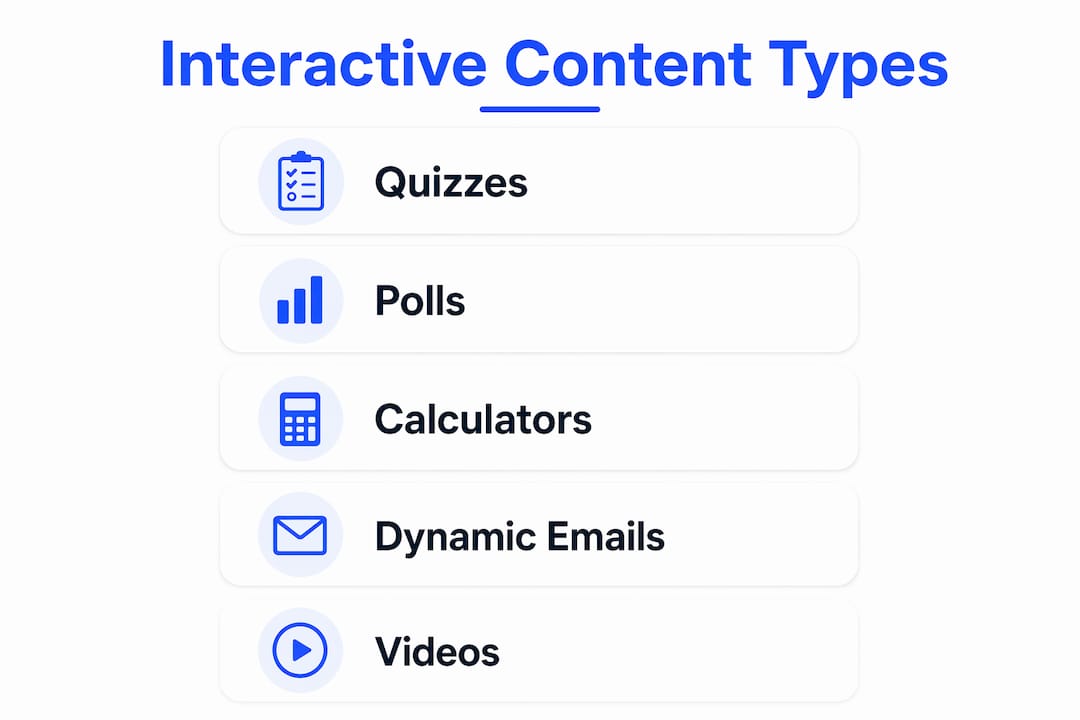
What types of interactive marketing content drive the most engagement?
Not all interactive formats perform equally. The right choice depends on your audience’s stage in the buying cycle and the action you want them to take.
Quizzes and polls are the highest-volume engagement drivers. Polls, quizzes, and Q&A sessions increase user retention 2.5x compared to static content. That retention lift matters because it translates directly into more time on page, more data collected, and more opportunities to convert.
ROI calculators and product configurators work differently. They reduce friction at the decision stage by helping buyers quantify value before committing. Interactive utility tools like these consistently outperform static messaging because they help buyers think and decide rather than just read and scroll.
Dynamic email content is the most underrated format in the mix. Dynamic email increases open rates by up to 29% and click-through rates by over 40%. Those numbers reflect what happens when content adapts to the recipient’s behavior, location, or purchase history instead of sending the same message to everyone.
Interactive videos and infographics round out the core formats. Branching videos let viewers choose their own path through content, which increases completion rates and personal relevance. Clickable infographics turn data into explorable experiences rather than static charts.
| Format | Podstawowa korzyść | Best Use Case |
|---|---|---|
| Quizzes and polls | 2.5x retention lift | Awareness and lead capture |
| ROI calculators | Reduces buyer friction | Mid-funnel decision support |
| Dynamic email | 29% higher open rates | Retention and re-engagement |
| Interactive video | Higher completion rates | Product demos and storytelling |
| Clickable infographics | Deeper data exploration | Educational and B2B content |
Pro Tip: Run a poll before launching a quiz campaign. The poll data tells you which quiz topics your audience actually cares about, which increases completion rates before you write a single question.
What are the best practices for creating interactive content?
The most effective interactive content follows a clear strategic framework. The ARC Framework, which stands for Authenticity, Relevance, and Conversationality, is the most cited model for 2026. ARC Framework implementation boosts content engagement by 35% on average within six months. That result comes from aligning every content decision with what the audience genuinely wants to experience, not what the brand wants to say.
Prioritize utility over technology
The most common mistake in dynamic content marketing is building for spectacle instead of function. Interactive content fails when it prioritizes technology over utility. A flashy branching video that confuses the viewer performs worse than a simple quiz that helps them identify the right product. Design every interactive element around a specific decision the user needs to make.

Use identity signaling to drive sharing
Viral interactive experiences share one trait: they make users feel seen. Successful viral content focuses on signaling user identity, turning behavioral data into shareable social artifacts. Spotify Wrapped is the clearest example. It packages listening data into a personal identity statement that users want to broadcast. You can apply the same logic at a smaller scale by designing quiz results, calculator outputs, or poll summaries that users will want to share because they reflect something true about themselves.
Wrap your message in entertainment
Audiences resist marketing. They do not resist entertainment. Embedding marketing messages inside long-form entertainment formats preferred by your audience drops resistance and improves message retention. This is the “entertainment trojan horse” approach. KFC Arabia used it by turning a product crisis into an AI-driven social drama that audiences chose to follow. The brand message arrived inside content people actually wanted to consume.
Here are the core practices that separate high-performing interactive content from forgettable campaigns:
- Lower friction at every step. Each additional click or form field reduces completion rates. Keep interactive experiences to the fewest steps needed to deliver value.
- Maintain real-time relevance. Dynamic personalization is now a baseline expectation. Audiences expect content to respond to their intent in real time, not deliver a generic experience.
- Let audiences co-create. Brands that abandon narrative control and invite users to shape the story see stronger authentic engagement. Dove’s Reddit campaign is the proof point.
- Test one variable at a time. Change the quiz headline, the calculator input labels, or the email subject line independently. Stacking changes makes it impossible to know what drove results.
Pro Tip: Design your interactive content’s output screen first. If the result, score, or recommendation is not something a user would screenshot and share, rebuild the experience around a more compelling payoff.
Which tools enable interactive marketing content creation?
The right platform depends on your team’s technical capacity and the formats you plan to deploy. Here are the most widely used options in 2026:
- Typeform builds quizzes, surveys, and lead forms with a conversational interface that keeps completion rates high. It integrates with HubSpot, Salesforce, and Mailchimp natively.
- HubSpot covers dynamic email, smart content blocks, and landing page personalization within a single CRM-connected platform. Its smart content rules let you swap entire page sections based on lifecycle stage or list membership.
- Salesforce Marketing Cloud handles large-scale dynamic email campaigns with advanced segmentation. It suits enterprise teams running personalized journeys across email, SMS, and paid media simultaneously.
- Adobe Marketo is the standard for B2B dynamic email at scale. Marketo recommends limiting dynamic elements to under 20 per email and always including fallback content. Exceeding that limit increases the risk of broken personalization, which erodes audience trust faster than a static email ever would.
- Mailchimp offers dynamic content blocks and basic behavioral triggers at a price point accessible to smaller teams. It works well for creators and small brands running social media content alongside email campaigns.
For live engagement, tools like Slido and Mentimeter add real-time polling and Q&A to webinars and virtual events. These formats are particularly effective for content creators who run live sessions and want to turn passive viewers into active participants.
How do you measure the impact of interactive content?
Measurement is where most interactive campaigns fall short. Tracking clicks and opens is not enough. You need metrics that connect interactive behavior to business outcomes.
The core metrics to track are engagement rate (percentage of users who complete the interactive experience), click-through rate from the output screen, and conversion lift compared to a static control. Use UTM parameters on every interactive asset so you can trace traffic from a quiz result share back to a specific campaign. Conversion pixels on thank-you pages and calculator output screens close the loop between interaction and revenue.
| Metric | What It Measures | Dlaczego to ma znaczenie |
|---|---|---|
| Completion rate | Percentage finishing the experience | Indicates friction and relevance |
| Click-through rate | Clicks from output or result screen | Measures conversion intent |
| Social share rate | Users sharing results | Signals identity-driven virality |
| Conversion lift | Revenue vs. static control | Proves business impact |
Dove’s campaign on Reddit is the clearest recent proof of scale. Dove’s Reddit campaign surpassed 1 billion impressions using 50 unfiltered user reviews as the creative foundation. The campaign worked because it measured what users were already saying and turned that data into the campaign itself. That is co-creation as a measurement strategy: the audience tells you what resonates, and you amplify it.
For iterative improvement, run A/B tests on the entry point (the headline or thumbnail that drives users into the experience) and the output screen separately. Most teams test only the entry point and miss the fact that a weak output screen kills sharing and downstream conversion regardless of how strong the experience itself is.
Key takeaways
Interactive marketing content outperforms static formats because it creates participation, not just consumption, and that participation drives measurable gains in retention, sharing, and conversion.
| Point | Details |
|---|---|
| Format selection matters | Match the format to the buyer’s stage: quizzes for awareness, calculators for decision-making. |
| ARC Framework delivers results | Authenticity, Relevance, and Conversationality increase engagement by 35% within six months. |
| Dynamic email is underused | Dynamic email lifts open rates 29% and click-through rates over 40% compared to static sends. |
| Identity signaling drives virality | Design outputs users want to share because they reflect something true about the user. |
| Measure beyond clicks | Track completion rate, share rate, and conversion lift to connect interaction to revenue. |
Why most interactive campaigns miss the point
I have watched marketing teams spend months building elaborate interactive experiences that nobody finishes. The pattern is almost always the same: the team fell in love with the technology and forgot to ask what the audience actually needed from the interaction.
The brands that get this right treat interactive content as a service, not a spectacle. Spotify Wrapped does not succeed because it is technically impressive. It succeeds because it tells users something true about themselves that they want the world to know. That is a fundamentally different design goal than “let’s make something interactive.”
The other mistake I see constantly is treating co-creation as a risk. Dove handed 50 unfiltered Reddit reviews to its creative team and got over a billion impressions. Most brands would have killed that idea in the first approval meeting because they could not control the message. Letting go of narrative control is not a risk. Boring your audience is the risk.
For content creators specifically, the opportunity is even more direct. Your audience already wants to participate. They want to vote on your next content idea, answer a poll about their preferences, or see their input reflected in what you create next. The interactive features that drive the most engagement on creator platforms are not complicated. They are just consistent and genuinely responsive to what the audience says.
The future of this space is modular content ecosystems where a single interactive asset generates personalized outputs across email, social, and live formats simultaneously. The brands building that infrastructure now will have a significant advantage in 2026 and beyond.
— fan
Build your interactive content strategy with Fanspicy
Fanspicy is built for content creators who want to turn passive followers into active, paying fans. The platform combines paid social media, live cam tools, and creator-first monetization features that make interactive advertising techniques practical rather than theoretical.
If you are a creator ready to put these strategies into practice, Fanspicy gives you the live Q&A tools, polling features, and direct fan engagement mechanics that static platforms cannot match. The content creation ideas i media marketing strategies on the Fanspicy insights hub are built specifically for creators who want to grow their audience and increase earnings through genuine interaction. Start building your interactive content presence at Fanspicy.
FAQ
What is interactive marketing content?
Interactive marketing content is any format that requires active user participation, such as quizzes, polls, calculators, or dynamic emails. It creates a two-way exchange between brand and audience rather than a one-way broadcast.
How does dynamic email content improve performance?
Dynamic email content adapts to each recipient’s behavior or profile, producing up to 29% higher open rates and over 40% more clicks compared to static email sends.
What is the ARC framework for interactive content?
The ARC Framework stands for Authenticity, Relevance, and Conversationality. Brands that apply it consistently see a 35% average increase in content engagement within six months.
Which interactive format works best for lead generation?
Quizzes and polls are the strongest lead generation formats because they deliver a personalized result in exchange for contact information, producing 2.5x higher retention than static content.
How do you measure interactive content success?
Track completion rate, click-through rate from the output screen, social share rate, and conversion lift against a static control using UTM parameters and conversion pixels.