

Spis treści
Start with services and one digital product, since those pay fastest, then layer in affiliate coverage as traffic grows. The winning formula for how to monetize a blog isn’t one big idea. It’s stacking three to five complementary revenue streams and adding each one only once your traffic or email list can actually support it. Expect a first dollar relatively soon, but treat several months as the realistic runway to steady income.
TL;DR:
- Selling services and consulting provides the fastest first dollar due to immediate demand from engaged readers, regardless of traffic volume.
- Launch digital products only after validating demand with existing readers, typically within one to two months, and only when you have an engaged audience.
- Monetize through affiliate marketing and sponsorships only once your traffic reaches at least 5,000 monthly visitors, and estimates improve significantly at higher thresholds.
- Starting with three to five revenue streams, prioritized by your current audience size and engagement, creates a more resilient income structure.
- Building an email list from the beginning enhances all monetization efforts, especially memberships and paid newsletters, and should be a core focus early on.
Spis treści
- How to Monetize a Blog: Every Proven Method Explained
- When Should You Launch Each Monetization Method?
- Why Your Email List Matters More Than Traffic
- How Do You Price and Launch a Blog Product?
- How Do You Choose Affiliates and Land Sponsorships?
- Should You Run Ads on Your Blog?
- What Should You Track to Know What’s Working?
- What Mistakes Kill Blog Monetization Fastest?
- How Publisher Tactics Translate to Platform-Led Revenue
- The Playbook Works, But Most Bloggers Skip Step One
- Turn Engaged Readers Into Paying Subscribers With Fanspicy
- Sources
- FAQ
How to Monetize a Blog: Every Proven Method Explained
Every blogger asking how to monetize their blog eventually runs into the same seven methods. What differs is which ones fit your traffic, your niche, and how much hands-on time you can spend. Google AdSense’s own rundown of blog monetization models groups the field into ads, affiliate links, products, subscriptions, and coaching; that’s still the right mental map for 2026.
- Services and consulting. Sell your expertise directly (writing, design, coaching, done-for-you audits). Setup is a single landing page with a booking link. Time-to-first-dollar is often the fastest of any method, because you don’t need traffic, just one convinced reader. Best fit: bloggers with a marketable skill and a small but engaged audience.
- Digital products. Templates, ebooks, courses, presets. Setup means building a minimum viable version, a checkout page, and one sales email. First dollar usually lands in a month or two once you have buyers lined up. Best fit: bloggers who’ve already answered the same reader question a dozen times.
- Affiliate marketing. Promote tools or products you already use and earn a commission per sale. Setup is joining a network or brand program and adding disclosed links to relevant posts. Time-to-first-dollar depends entirely on whether your content targets buyers already comparing options. Best fit: review-heavy or how-to blogs.
- Sponsored content. Brands pay for a dedicated post, mention, or newsletter placement. Setup requires a simple media kit and outreach list. This method rarely pays until you have a defined, decent-sized audience a brand can point to. Best fit: bloggers with a specific, describable niche audience.
- Display ads. Networks pay per thousand impressions. Setup is an application to an ad network and a plugin or script install. It only becomes worthwhile once traffic clears a meaningful volume threshold, covered in the next section. Best fit: high-traffic, high-page-view blogs (recipes, lifestyle, news).
- Memberships and paid newsletters. Recurring payments for exclusive content or community access. Setup means a payment processor, a content calendar, and clear member benefits. This one is slow to build but compounds, since paid memberships need proven demand and a real list first. Best fit: blogs with a loyal, returning readership.
- Tips, donations, and merch. Direct reader support through a tip jar or branded products. Setup is a single payment link or a print-on-demand store. It rarely replaces income on its own, but it stacks well alongside anything above. Best fit: personality-driven blogs with a devoted comment section.
The fastest path to a first dollar, across almost every case study, is services and consulting, simply because you’re selling directly to someone who’s already reading you.
When Should You Launch Each Monetization Method?
Sequencing prevents the single most common blogging mistake: bolting ads onto a blog with 200 monthly visitors and wondering why it earns pennies. Guides that use visitor and subscriber thresholds to order monetization consistently outperform blogs that monetize everything at once.
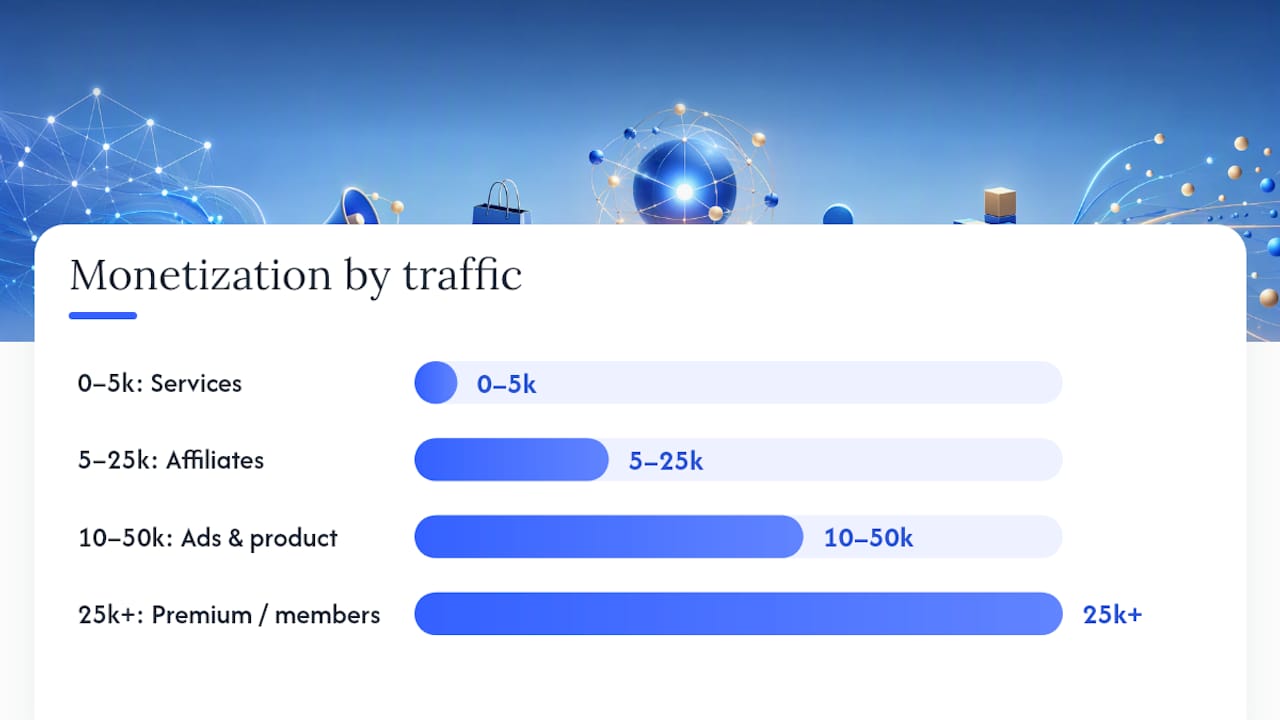
- 0 to 5,000 monthly visitors. Focus entirely on services or a small digital product. Test one affiliate link inside your best-performing post. Skip ads completely, since payouts at this stage are close to nothing.
- 5,000 to 25,000 monthly visitors. Add structured affiliate content (comparison posts, buyer guides) and pitch your first small sponsorships. Build your email list aggressively; this is your future asset.
- 10,000 to 50,000 monthly visitors. Run a small ad network experiment on a subset of pages and compare revenue against the user experience cost. Launch your first real digital product with a proper sales sequence.
- 25,000-plus monthly visitors. Apply to premium ad networks, negotiate direct sponsorships instead of taking inbound offers, and consider a membership tier if your list shows repeat engagement.
A useful 90-day version of this ladder: spend days 1 through 10 choosing your stack and setting up accounts, days 11 through 40 building your offers and affiliate links, days 41 through 75 growing your list and pitching sponsors, and days 76 through 90 running ad or affiliate tests before launching a small paid offer.
Pro Tip: Pick your three to five streams before you launch any of them. Writing the list down forces you to stop chasing every new monetization trend that shows up in your inbox.
Why Your Email List Matters More Than Traffic
Traffic without an email list is rented attention. Your list is the only monetization infrastructure you actually own, and it’s where free readers become paying ones. Platform guides consistently point to building email capture before layering on paid tiers, because a list gives you a direct line to convert, launch, and re-launch without depending on algorithms.
Lead magnets work best when they mirror what your best post already promised. A recipe blog might offer a printable meal-planning template; a freelance-writing blog might offer a pitch email swipe file; a personal-finance blog might offer a budgeting spreadsheet.
A simple three-to-five email welcome sequence does the heavy lifting:
- Email 1: Deliver the lead magnet and set expectations for what’s coming.
- Email 2: Share your best, most-shared piece of content.
- Email 3: Tell a short story about why you started the blog and who it’s for.
- Email 4: Introduce a related product or service, softly.
- Email 5: Ask a direct question to boost engagement and segment your list.
Prioritize traffic sources that build the list directly: guest posts with a lead magnet call-to-action, Pinterest for visual niches, and SEO-driven posts targeting buyer-intent keywords. Skip paid ads until you have a proven funnel to send that traffic through.
For free-to-paid conversion, treat 1% to 5% as a normal range and 5% to 8% as excellent.
Pro Tip: Send your welcome sequence to yourself from a fake email first. If you’d unsubscribe by email three, your actual list will too.
How Do You Price and Launch a Blog Product?
Turning expertise into a sellable product starts small. Build a minimum viable version first: a single PDF guide instead of a twelve-module course, a one-off consulting call instead of an ongoing retainer. Ship it to real buyers before investing in a polished version.
The products and services that convert best solve one specific problem a reader has already told you about, in comments, emails, or survey replies. That specificity is what separates a $27 template that sells from a $200 course that doesn’t.
- Digital downloads (templates, swipe files, presets): price low ($15 to $47) and sell in volume.
- Mini-courses or workshops: price mid-range ($97 to $297) once you have testimonials.
- One-on-one services: price by outcome delivered, not hours spent, and cap availability to protect your time.
- Done-for-you packages: bundle a service with a template to increase perceived value without adding much extra work.
For services, define scope tightly. A vague “I’ll help with your blog” offer converts worse than “I’ll audit your top 10 posts and hand you a prioritized fix list in five business days.” Build a simple booking flow: a landing page, a calendar link, and a deposit or full payment upfront.
Your launch needs three things regardless of product type: a landing page that states the exact transformation on offer, a short email sequence building anticipation, and one honest scarcity driver, whether that’s a real deadline, a limited number of client slots, or a bonus that disappears after launch.
How Do You Choose Affiliates and Land Sponsorships?
Affiliate income only works when the product fits what your readers were already going to buy. Chasing high commissions on unrelated products burns trust fast and rarely converts anyway.
Brand-direct programs typically pay better commissions than network-based affiliate programs, but networks offer easier bulk sign-up and reporting. Match the source to your niche size: smaller or newer blogs usually get approved faster through networks, while established blogs with clear traffic numbers can pitch brands directly for better terms.
- Buyer-intent formats convert best: in-depth reviews, side-by-side comparisons, and “best X for Y” roundups.
- Link inside content readers are already using to decide, not in generic sidebar banners.
- A basic media kit needs three things: audience size and niche, engagement proof (comments, email open rates), and past brand results if you have any.
- A pitch template stays short: who you are, why your audience fits their product, and one concrete idea for the collaboration.
Disclosure isn’t optional. The FTC’s guidance for social media influencers requires clear, unavoidable disclosure of any paid or affiliate relationship, placed where readers will actually see it, not buried in a footer. Something as simple as “This post contains affiliate links; I earn a commission at no extra cost to you” placed near the top of a review satisfies both the letter and the spirit of the rule.
Bloggers who diversify into three or more revenue streams build more durable income than those relying on one large source, since a single algorithm change or lost sponsor doesn’t wipe out the whole month.
Should You Run Ads on Your Blog?
Ads make sense once your traffic is high enough that even modest RPM (revenue per thousand pageviews) adds up to real money, and not a moment before. Google AdSense accepts most sites regardless of size, but premium networks like Mediavine, AdThrive (now part of Raptive), and Ezoic set traffic minimums, often in the tens of thousands of monthly sessions, because their higher payouts depend on selling bulk inventory to advertisers.
RPM math is simple once you see it: a $15 RPM on 40,000 monthly pageviews earns roughly $600 a month, while the same traffic at $8 RPM earns about $320. That gap is exactly why publishers chase premium network acceptance instead of settling for entry-level ad tools. Ad ops resources explain that RPM is shaped by niche, seasonality, ad viewability, and device mix, not just raw traffic volume.
- Test ads on a subset of pages first, not your entire site, so you can compare load speed and bounce rate before and after.
- Watch page speed closely; a few seconds of added load time can cost you more in lost readers than the ads earn.
- Place ads where they don’t interrupt the reading flow that got you the traffic in the first place.
- Measure ROI over a full month, since ad revenue fluctuates with advertiser demand and season.
A meaningful RPM difference between entry-level and premium ad networks is often the deciding factor in whether ads are worth the user-experience trade-off at all.
What Should You Track to Know What’s Working?
A minimal monetization dashboard beats a complicated one you’ll abandon after two weeks. Track five numbers monthly and you’ll know exactly which stream deserves more attention.
- RPM (ad revenue per thousand pageviews): tells you if ads are pulling their weight.
- Affiliate conversion rate (clicks to purchases): reveals whether your content or your product choice needs work.
- Average order value (AOV): shows whether upsells or bundles are worth building.
- Customer lifetime value (CLV): matters most for memberships and repeat-purchase products.
- Tempo wzrostu liczby abonentów: your leading indicator for every other number on this list.
A simple spreadsheet with one row per month and columns for each stream’s revenue, plus traffic and subscriber count, is enough to spot trends. Set a monthly target per stream, not just a blog-wide total, so you catch a slipping stream before it drags the whole month down.
What Mistakes Kill Blog Monetization Fastest?
Five mistakes account for most failed monetization attempts: monetizing before you have an audience to sell to, stacking too many sponsored posts back to back, choosing affiliate products that don’t match your content, underpricing your first product out of fear, and skipping metrics entirely so you never know what to fix.
Recovering from a trust breach, like an obviously mismatched sponsored post, means acknowledging it directly with your audience and being visibly more selective afterward. Readers forgive one bad call. They don’t forgive a pattern.
Clear, unavoidable disclosure of a paid relationship isn’t a suggestion; it’s a requirement any time money or free product changes hands for content. Placing “#ad” at the very end of a long caption, where most readers never scroll, does not meet that bar.
Put your disclosure in the first few lines of a post or right before the affiliate link itself, in plain language a reader can’t miss.
How Publisher Tactics Translate to Platform-Led Revenue
Your blog audience is already segmented by how deeply they engage. That’s the exact logic behind subscription-based content models: your most engaged readers will pay for closer access, even when your casual readers won’t.
Mapping this onto a platform is straightforward. Your regular free posts stay exactly as they are. Your deeper, more personal, or more exclusive content, behind-the-scenes updates, extended tutorials, direct access, becomes a paid tier.
- Identify your top 10% most-engaged readers (heaviest commenters, most email opens) as your first subscription pitch list.
- Bundle your best-performing content series into a paid post or exclusive drop instead of publishing it free.
- Offer live sessions or Q&As as a paid, time-limited event to test demand before building a full membership.
- Use tips or pay-per-message options for readers who want direct interaction beyond your regular content.
Creators who run this kind of hybrid stacking model typically see conversion concentrated in a small, highly engaged slice of their audience rather than spread evenly, which is exactly why the segment-first approach outperforms a blanket paywall.
The Playbook Works, But Most Bloggers Skip Step One
The advice to “diversify your income” gets repeated so often that it’s lost its teeth. What actually matters is the order you diversify in. Bloggers who add affiliate links and ad networks before they have any real audience are optimizing a number that’s still too small to matter, while ignoring the one thing, an email list, that would make every later stream more valuable.
Conventional monetization advice treats all revenue streams as equally available at any stage. They’re not. Services and one product should come first, always, because they don’t require scale, just a specific answer to a specific problem your reader already has. Ads and premium sponsorships are a reward for traffic you’ve already earned, not a strategy for getting there.
If there’s one thing worth doing differently: stop asking “how do I monetize” and start asking “which three streams fit my current traffic stage.” That reframe alone would fix most of the stalled blogs asking this question.
— fan
Turn Engaged Readers Into Paying Subscribers With Fanspicy
Affiliate links and ad networks depend on volume you may not have yet. Fanspicy works differently: it lets your most engaged readers pay you directly, through subscriptions, paid posts, live streams, and tips, without needing tens of thousands of monthly visitors first.
If your blog already has a segment of readers who comment on everything, reply to every email, and ask for more, that’s your starting subscriber base. The platform keeps a competitive share of what creators earn compared to typical platform cuts, gives you direct ownership of your audience relationship, and supports multiple content formats so you’re not locked into one format to get paid. Migrating existing content over is straightforward if you’re moving from another platform. Sign up as a creator and set up your first paid tier this week, or visit Fanspicy to see how subscriptions, live streams, and paid messages work together as one stack.
Sources
These sources back the specific numbers and legal guidance used throughout this guide, so you can verify them yourself before making pricing or compliance decisions.
- Disclosures 101 for social media influencers (FTC)
- How to make money from blogging (Google AdSense)
- Blog monetization in 2026: Stack three to five revenue streams (Riman Agency)
- 15 Tips to monetize your blog (Upwork)
- How to Monetize a Blog in 2026 (ByteVerse)
FAQ
How Long Does It Take to Monetize a Blog?
Most bloggers see their first dollar within a few months of launching services or a small product, but sustainable income typically takes 18 to 24 months of consistent stream-building. The timeline shortens significantly if you start with services instead of waiting on ad or affiliate traffic thresholds.
Can You Monetize a Blog With Low Traffic?
Yes. Services, consulting, and digital products don’t require significant traffic since you’re selling directly to a small, engaged audience rather than relying on ad impressions. Ads and premium sponsorships are the methods that genuinely need higher traffic to pay meaningfully.
How Many Income Streams Should a Blog Have?
Aim for three to five complementary streams rather than one dominant source, since diversified income proves more durable than a single large stream. Add each new stream only once your current traffic or list size can support it.
What’s the Best First Monetization Method for a New Blog?
Services and consulting typically deliver the fastest first dollar, since they don’t depend on scale, just one reader willing to pay for your expertise. A small digital product is usually the second addition once you’ve validated demand through direct sales conversations.
Do I Need an Email List Before Monetizing?
An email list is not strictly required to sell a service or product, but it dramatically improves conversion for every later stream, especially memberships and paid newsletters. Building list capture from day one saves you from starting that infrastructure late, after you already need it.