

Spis treści
A content promotion platform, in the sense that matters to independent creators, is a paid marketplace where you host subscriptions, live streams, paid posts, and tips under one roof instead of scattering them across five apps. The verdict: evaluate a creator-focused marketplace like Fanspicy now, then spend this week building one landing page and running one launch stream. Everything else is execution detail.
TL;DR:
- Creators should prioritize platforms offering quick payout schedules and frictionless mobile checkout to maximize short-term revenue.
- Building a landing page template and automating follow-up sequences during streams can significantly boost conversion rates.
- Relying solely on a single platform risks losing audience data and revenue if policies or traffic channels change unexpectedly.
- Supporting tools like community engagement features and export options are essential for long-term growth and audience control.
- Fanspicy aligns with creator needs by integrating subscriptions, live streams, tips, and private messaging into one platform for faster, smoother monetization.
Spis treści
- What Do Content Promotion Platforms Actually Do for Creators?
- What Should You Check Before Committing to a Platform?
- How Do You Turn a Live Stream Into Paying Fans?
- What’s the 7-Step Checklist to Launch Your First Paid Offer?
- How Do Top Creator Platforms Compare?
- How Do You Match a Platform to Your Content and Audience?
- What Red Flags Should You Watch for When Choosing a Platform?
- What Do Real Creator Success Patterns Look Like?
- How Does Platform Support and Community Actually Help You?
- What Actually Moves the Needle for Creators
- Why Fanspicy Fits the Creator Playbook
- Sources
- FAQ
What Do Content Promotion Platforms Actually Do for Creators?
A creator marketplace exists to solve one problem: turning attention into recurring revenue without you needing to build payment infrastructure from scratch. That means bundling the tools creators actually use into a single dashboard instead of stitching together a payment processor, a video host, and a messaging app.
The core feature set has become fairly standardized across the industry:
- Subskrypcje for predictable, recurring income from your most loyal fans
- Paid posts and bundles for one-off sales of exclusive photo or video sets
- Live streams with tipping for real-time monetization during a broadcast
- Private messages for direct, paid fan interaction
- Payout tools and analytics so you can see what’s converting and get paid on schedule
None of that matters much if you don’t own the relationship underneath it. Nearly 95% of full-time and part-time creators now use direct-to-fan monetization models, and live streaming alone accounts for about 32% of creator income, with subscriptions contributing another 27%. That revenue split tells you something important: a platform that only supports one monetization type is leaving money on the table. First-party data, meaning your own email and SMS list, is what protects you when a platform changes its rules or your reach drops overnight.
What Should You Check Before Committing to a Platform?
Before you sign up anywhere, run the numbers past a short checklist. Fees and friction compound over a year in ways that aren’t obvious from a signup page.
- Revenue share and payout frequency. A few percentage points of difference in commission, multiplied across a year of subscriptions, adds up to real money. Ask how often payouts hit your account, not just what the cut is.
- Checkout friction. Platforms supporting Apple Pay, Google Pay, or Stripe Link convert better on mobile because fans complete a purchase in one tap instead of typing card numbers on a phone keyboard.
- Discovery versus ownership. Some platforms drive you traffic but keep the fan relationship locked inside their app. Others let you export your list and migrate content if you leave. Ask directly before you build your catalog somewhere.
- Support and integrations. Look for responsive support, built-in clip tools, and the ability to connect email or Discord, since none of that is optional once you have real subscribers to manage.
Fan support behavior also varies by country and community, so research on cross-country creator support patterns is worth a skim before you finalize pricing on a new offer.
Pro Tip: Ask any platform’s support team a real question before signing up. How fast and how useful the answer is tells you more about day-to-day reliability than any features page.
How Do You Turn a Live Stream Into Paying Fans?
The workflow that consistently converts attention into revenue follows a simple arc: live, then landing page, then nurture. It’s not complicated, but skipping steps is where most creators lose fans they already had in the room.
Before you go live, build a reusable episode landing page template so you’re not designing from scratch every session. Set up UTM parameters ahead of time so you can track exactly which stream drove which sale, and shorten your URL so it’s easy to say out loud and easy to type from memory.
During the stream, resist the urge to promote five things at once. Drop a single short link or QR code, pin it in chat, run a short trailer clip of what you’re selling, and give one clear call to action. Viewers on mobile devices, watching vertically with one thumb, won’t parse multiple offers.
Your landing page needs to do very little, very well: an autoplay vertical hero clip, one CTA button, an email and SMS capture field, one-tap checkout, and some visible social proof. Every extra element is a chance for a fan to hesitate and close the tab.
After the stream ends, an automated email and SMS sequence should follow up immediately, tease your next episode, and retarget anyone who visited but didn’t buy. This is where most of the money that gets left on the table actually is.
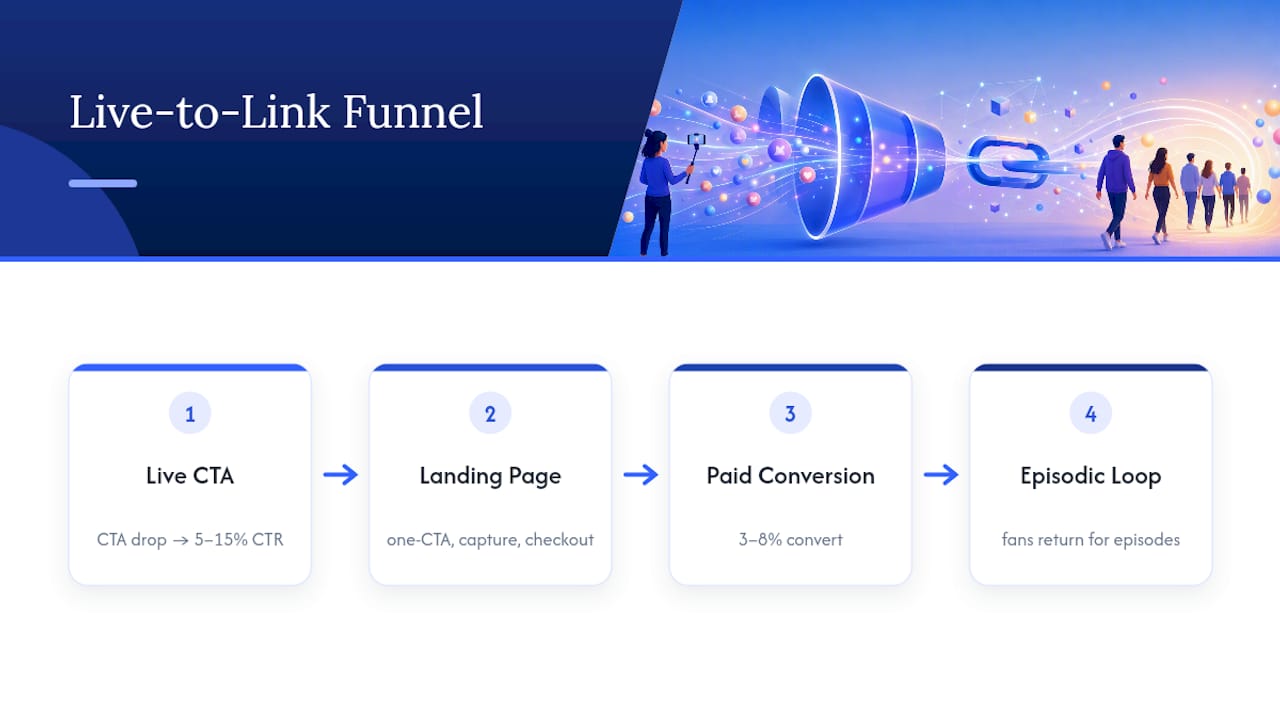
A well-built live-to-link funnel typically produces a click-through rate of 5% to 15% on CTA drops during a live session, with paid offer conversion landing between 3% and 8%. If your numbers sit meaningfully below those ranges, the fix is usually not more content, it’s fewer distractions in the funnel. Episodic, serialized content also tends to outperform one-off posts for retention, since fans come back for the next installment the same way they’d tune into a show.
What’s the 7-Step Checklist to Launch Your First Paid Offer?
Getting your first paid offer live doesn’t require a big production. It requires sequencing.
- Connect payments first. Set up Stripe, Apple Pay, or Google Pay, enable one-tap checkout, and run a real test transaction before you announce anything.
- Pick one primary offer and one secondary offer. A subscription plus a per-episode paid post is a common, workable combination. Adding revenue methods one at a time beats launching four simultaneously.
- Build a mobile-first landing page with email capture and fast checkout baked in from day one.
- Put the link in your bio, pin an announcement post, and schedule your first launch stream on the calendar.
- Automate post-purchase access so new subscribers get tagged and granted community roles without you manually managing a spreadsheet.
- Set up UTM tracking and server-side data capture so your conversion numbers survive ad blockers and app-tracking restrictions.
- Watch four numbers for 90 days: click-through rate, conversion rate, average revenue per fan, and retention. Everything else is noise at this stage.
Pro Tip: Resist adding a third offer in your first month. A focused test of one primary and one secondary product for 90 days teaches you far more than launching everything at once and not knowing what actually worked.
How Do Top Creator Platforms Compare?
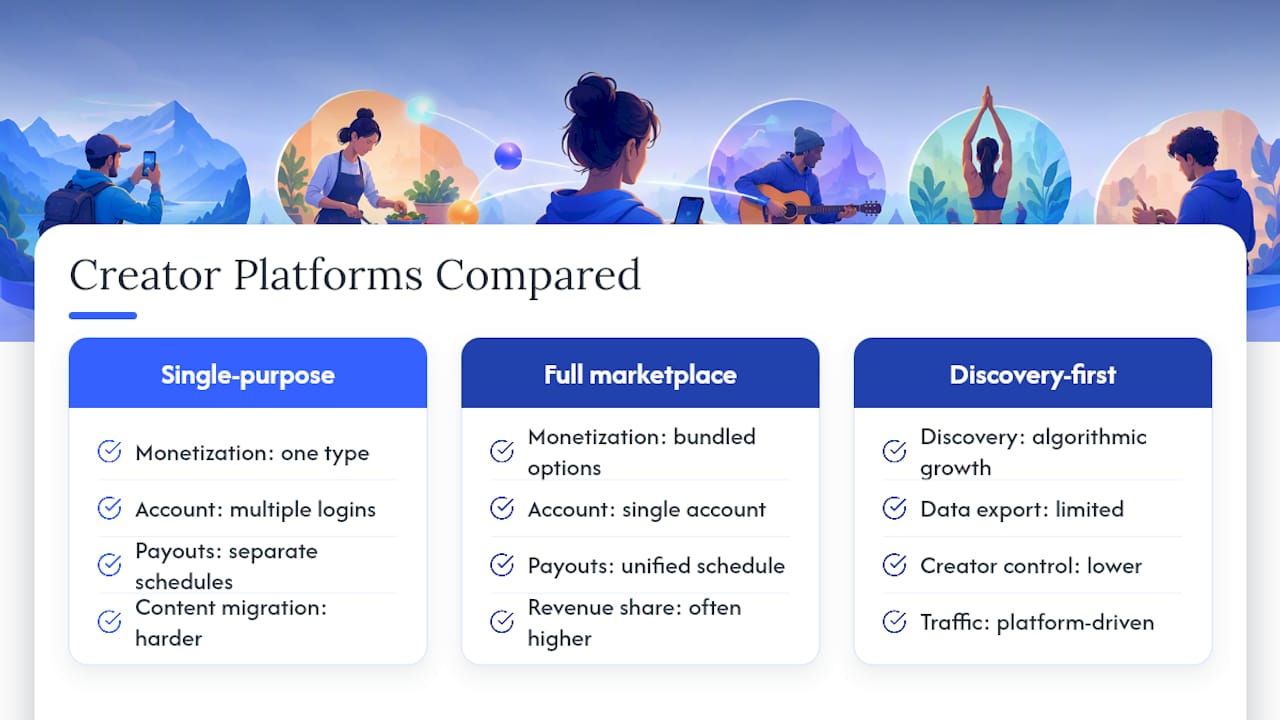
Not every platform in this category is built the same way, and the differences show up the fastest in fee structure and content flexibility. Entry-level, single-purpose apps often handle one monetization type well, tipping, for instance, but force you elsewhere for subscriptions or live streaming, which means juggling multiple logins and multiple payout schedules.
Full creator marketplaces bundle subscriptions, paid posts, live streams, tipping, and private messaging into one account, which simplifies both your workflow and your fan’s experience. The trade-off usually comes down to revenue share percentage, payout speed, and how easily you can migrate existing content if you switch platforms later. Some platforms lean heavily on algorithmic discovery to bring you new fans but limit how much of your audience data you can export. Others prioritize creator control and portability but expect you to drive more of your own traffic.
The practical question isn’t which platform is universally best. It’s which trade-off matches how you already work: if you rely on live streaming as your main format, tipping tools and stream stability matter more than a marketplace’s browse-and-discover feed. If subscriptions are your bread and butter, payout frequency and churn-reduction tools matter more than live features. Weigh the comparison against your actual content mix, not a generic feature checklist.
How Do You Match a Platform to Your Content and Audience?
Your content format should drive the decision more than brand reputation or a slick homepage. A creator who streams three times a week needs a platform with reliable live tools, tipping during broadcast, and low-latency video. A creator who posts photo sets and written content weekly needs strong paid-post and bundle tools more than live infrastructure.
Audience matters just as much as format. A younger, mobile-native fan base responds well to one-tap checkout and vertical video, while a fan base built through longer-form content may tolerate more friction if the payoff feels substantial. Regional differences in how fans support creators mean an offer structure that converts well with one audience may underperform with another, so price and cadence decisions deserve testing rather than copying whatever a creator in a different niche is doing.
Also weigh how many content types you plan to sell simultaneously. A platform that handles subscriptions, live streams, and paid posts under one login saves you from re-entering payout details three times and gives fans one place to find everything you sell. If you’re just starting and only plan one offer type, a narrower tool might feel simpler, but most creators expand their format mix within the first year, so plan for where you’re headed, not just where you are today.
What Red Flags Should You Watch for When Choosing a Platform?
The biggest mistake creators make is signing up based on commission rate alone, without checking payout frequency or migration terms. A platform advertising a low fee but paying out monthly, with a 30-day hold on new accounts, can hurt your cash flow more than a slightly higher fee with weekly payouts.
Watch for vague or shifting content policies. If a platform’s terms of service are unclear about what content is allowed, that ambiguity tends to surface later as unexpected takedowns or account holds, usually at the worst possible time. Ask for specifics before you upload your catalog.
Locked-in data is another warning sign. If a platform doesn’t let you export your subscriber list or migrate your content elsewhere, you’ve effectively rented your audience rather than owned it. Given that platform diversification is now standard risk management for most creators rather than an optional extra, a platform resisting portability should raise questions about why.
Finally, be skeptical of any platform promising guaranteed discovery or algorithmic boosts without clear terms. Discovery tools genuinely help, but “guaranteed visibility” language usually means something vaguer once you read the fine print. A platform confident in its tools will explain exactly how discovery works instead of leaning on a marketing slogan.
What Do Real Creator Success Patterns Look Like?
The creators who scale fastest on marketplace platforms tend to share one habit: they treat every live stream as a funnel step, not a standalone event. Instead of streaming and hoping fans subscribe organically, they build a landing page before the stream, drop one link during it, and follow up automatically afterward. That sequence, repeated weekly, compounds in a way a single viral moment never does.
Subscription-focused creators who succeed long-term usually diversify early, adding a tipping option during live sessions or a paid-post bundle alongside their core subscription tier. Building recurring subscription revenue alongside episodic paid content gives you an income floor that a single live event can’t provide on its own.
The pattern that separates steady growth from stalled accounts is rarely a single viral post. It’s a repeatable, boring-on-purpose weekly rhythm: consistent stream schedule, consistent landing page, consistent follow-up. Creators who treat promotion as a system outperform creators waiting for a lucky break.
How Does Platform Support and Community Actually Help You?
Support quality matters more once real money is flowing through your account, not before. A platform that answers billing and payout questions quickly during a payment dispute protects both your income and your relationship with paying fans who expect fast resolution.
Community features matter just as much for retention. Tools like pinned announcements, member-only chat, and community roles tied to subscription tiers give fans a reason to stay subscribed beyond just accessing content, since they’re also buying a sense of belonging to something. Discord integrations extend that community beyond the platform itself, letting your most engaged fans interact with each other, which tends to reduce churn because canceling means leaving a group, not just unsubscribing from a feed.
Look for platforms that publish clear response time expectations and offer multiple contact channels, not just a generic contact form that disappears into a queue. When you’re troubleshooting a failed payout at 11 p.m. before a launch stream, the difference between a live chat option and a three-day email wait is the difference between a smooth launch and a stressful one.
What Actually Moves the Needle for Creators
Most creators overestimate how much a fancy platform interface matters and underestimate how much a single, clean call to action matters. In every campaign breakdown worth studying, the accounts with one CTA per stream consistently out-convert accounts running three offers at once, simply because confused fans don’t buy anything.
The recurring failure pattern is predictable: multiple competing CTAs, no follow-up sequence after the stream ends, and no server-side tracking to confirm what’s actually converting. Fix those three things before touching anything else. This week, pick one primary offer, build one landing page, and set up one automated follow-up message. That’s a more valuable use of your time than researching a dozen platform features you won’t touch for months.
— fan
Why Fanspicy Fits the Creator Playbook
Fanspicy is built around the exact monetization mix this playbook describes: subscriptions, paid posts, live streams, tips, and private messages, all under one login instead of five disconnected tools. Fanspicy offers creators multiple monetization tools integrated into one platform, aiming to support content migration and audience engagement.
That matters because the workflow in this guide depends on speed. You need a landing page you can reuse episode after episode, one-tap checkout that doesn’t lose mobile fans at the payment screen, and analytics that show you what’s converting without digging through spreadsheets. Fanspicy’s structure supports that live-to-landing-to-nurture rhythm directly, rather than forcing you to bolt on third-party tools to make it work. If you’re already running lives or building a paid post catalog elsewhere, migrating in is designed to be straightforward rather than a rebuild from scratch.
Visit the Fanspicy homepage to see how subscriptions, live streams, and private messages work together, or head to the Become a Model page to start setting up your first paid post and test a landing template before your next live session.
Sources
For deeper context on the direct-to-fan shift, read the creator economy adoption report and Epidemic Sound’s creator economy outlook. For implementation detail, the live-to-link funnel playbook and Fanspicy’s guide on promotion strategies for creators offer practical next steps.
- Report: 95% Of Creators Embrace Direct-To-Fan Models As Creator Economy Matures
- The Future of the Creator Economy Report 2025 | Epidemic Sound
- Monetizing Live Streams: Live-to-Link Funnels
FAQ
How Much Does Fanspicy Cost to Join?
Fanspicy does not charge creators a fee to join or use the platform; instead, it earns a commission on fan transactions like subscriptions and paid content. Current pricing and revenue share details are available directly on Fanspicy’s site.
Should I Start With a Subscription or Per-Episode Sales?
Start with one primary offer, typically a subscription for recurring income, plus one secondary offer like a per-episode paid post. Adding monetization methods gradually rather than all at once tends to produce clearer, more reliable results.
What’s the Minimum Tech Setup to Launch a Paid Offer?
You need a connected payment method, a mobile-first landing page with email capture, and one-tap checkout enabled before your first launch stream. UTM tracking and server-side data capture round out the setup so you can measure what’s actually converting.
What Metrics Should I Track in the First 90 Days?
Focus on four numbers: click-through rate, conversion rate, average revenue per fan, and retention. Healthy live-to-link funnels typically see click-through rates of 5% to 15% on CTA drops and conversion rates of 3% to 8% on paid offers.
Is It Risky to Rely on One Platform for All My Income?
Yes. Platform diversification and first-party data ownership are now standard practice among creators, since relying on a single platform leaves you exposed if reach or policies shift suddenly.