

Spis treści
TL;DR:
- Content creation involves planning, producing, and distributing digital media to attract audiences and meet business goals.
- Focusing on a clear strategy, selecting suitable formats, and establishing measurable goals are essential for success.
Content creation is the process of planning, producing, and distributing digital media to attract a defined audience and meet specific business goals. The creator economy tops $250 billion in 2026, with 207 million content creators worldwide. That scale means the competition for attention is real, and only creators with a clear system win. The Content Marketing Institute and HubSpot both confirm that documented strategy, not raw output, separates high-performing teams from those spinning their wheels. Understanding what content creation actually involves is the first step toward building something that lasts.
What are the essential stages of the content creation process?
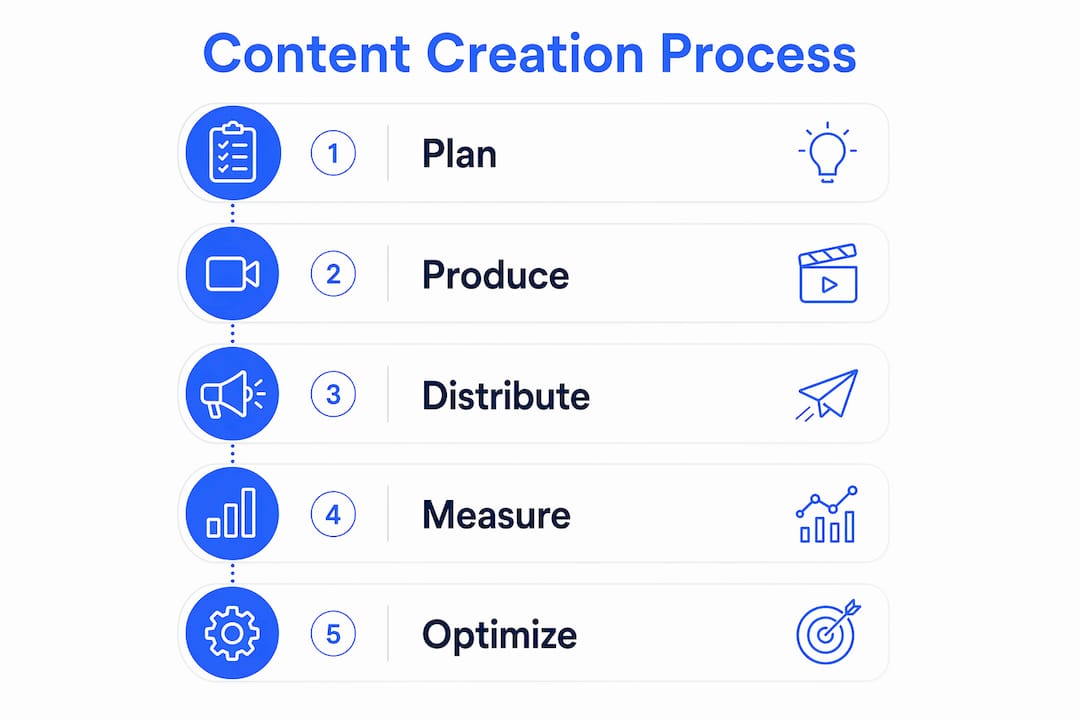
Content creation is not a single act. It is a six-stage workflow: research, planning, production, editing, distribution, and measurement. Each stage feeds the next. Skipping planning to jump straight into production is the most common mistake teams make, and it shows up in content that gets published but never performs.
The six stages work like this:
- Research — Identify audience needs, search intent, and competitive gaps before writing a single word.
- Planning — Build a content calendar, assign roles, and define the goal for each piece.
- Production — Write, record, or design the asset with a clear brief in hand.
- Editing — Review for accuracy, tone, and alignment with brand standards.
- Distribution — Publish and promote across the right channels for your audience.
- Measurement — Track KPIs, analyze what worked, and feed those insights back into research.
Without a documented strategy and attribution model, teams often fail to connect their output to business pipeline and prove ROI. A production schedule is not a strategy. A strategy defines who you are reaching, what you want them to do, and how you will know if it worked.
Pro Tip: Build a one-page content brief template that captures audience, goal, keyword, format, and distribution channel before any asset goes into production. It cuts revision cycles in half.
AI tools are reshaping this workflow fast. Marketing teams using AI-powered workflows reduce content production time by 50% or more while maintaining quality. That time savings does not replace human judgment. It frees writers and strategists to focus on the work that actually requires thinking.
Which content formats are most effective for your audience?
Content formats include written, video, audio, and interactive media, each with distinct workflows and platform requirements. Choosing the wrong format for your audience wastes production time and kills distribution reach. The right format depends on three things: where your audience spends time, what stage of the buying journey they are in, and what your team can produce consistently.
Here is a breakdown of the major formats and their best use cases:
- Blog posts and articles — Best for search-driven discovery. Long-form content ranks well in Google and builds topical authority over time. Requires strong keyword research and internal linking.
- Short-form video — Best for social platforms where attention is short. Works well for tutorials, behind-the-scenes content, and personality-driven brands. High production frequency is expected.
- Podcasty — Best for building deep audience loyalty. Listeners spend more time with podcast content than almost any other format. Requires consistent scheduling and audio quality.
- Infografika — Best for simplifying complex data or processes. Highly shareable but require design resources and accurate sourcing.
- Interactive tools — Best for bottom-of-funnel engagement. Calculators, quizzes, and assessments generate leads and collect first-party data.
| Format | Best platform fit | Primary goal |
|---|---|---|
| Blog posts | Google Search, LinkedIn | Organic traffic and authority |
| Short-form video | Social feeds | Awareness and engagement |
| Podcasty | Streaming platforms | Loyalty and retention |
| Infografika | Pinterest, email | Shareability and education |
| Interactive tools | Website landing pages | Lead generation |
Starting on 1 or 2 platforms with a focus on quality over quantity prevents burnout and builds solid metric tracking foundations. Spreading across five channels at launch sounds ambitious. In practice, it produces mediocre content everywhere and strong content nowhere. Pick the format your audience already consumes, master it, then expand.
For creators looking to diversify their content types and monetization, understanding which formats drive revenue is as important as knowing which ones drive traffic.
How do you set measurable goals and track content performance?
Every piece of content needs a goal before it gets produced. Not a vague goal like “increase brand awareness,” but a specific, time-bound objective. Defining specific, time-bound marketing objectives, like gaining a set number of subscribers in 90 days, gives you a real benchmark to measure against. Vague goals produce vague results.
The key performance indicators that matter most depend on your goal:
- Traffic metrics — Pageviews, unique visitors, and organic search rankings show whether content is being discovered.
- Engagement metrics — Time on page, scroll depth, comments, and shares show whether content is resonating.
- Conversion metrics — Email signups, form completions, and purchases show whether content is driving action.
- Retention metrics — Return visitor rate and subscriber growth show whether content is building a loyal audience.
Attribution is where most teams fall short. Missing an attribution model leads to strong content output but an inability to prove ROI and pipeline contribution. If you cannot connect a blog post to a lead or a video to a sale, your content budget will always be the first thing cut. Set up UTM parameters, use a CRM that tracks content touchpoints, and review attribution data monthly.
Pro Tip: Run a quarterly content audit. Score every published asset by traffic, engagement, and conversion. Cut or update the bottom 20% and double down on what the data says is working.
Successful creators integrate storytelling with performance data as a form of systems thinking. That means treating analytics not as a report card but as a feedback loop that shapes the next round of production.
What technology trends are shaping scalable content creation?
The biggest shift in content creation right now is the move from fragmented tools to unified platforms. Most teams still use one tool for research, another for writing, another for scheduling, and another for analytics. Each handoff between tools creates friction, delays, and data loss.

Unified AI-powered platforms replace fragmented point solutions and produce hundreds of on-brand assets quarterly without team burnout. That is not a small efficiency gain. It is a structural change in how content teams operate. When research, drafting, editing, and publishing live in one connected system, the entire workflow accelerates.
The most effective technology integrations for content teams right now include:
- AI writing assistants — Tools that generate first drafts, suggest headlines, and rewrite for tone. They reduce blank-page paralysis and speed up production cycles.
- Content management systems with built-in analytics — Platforms that connect publishing with performance data eliminate the need for manual reporting.
- Automated distribution tools — Scheduling and cross-posting tools that push content to multiple channels from a single dashboard.
- AI research tools — Systems that surface trending topics, competitor gaps, and audience questions before a brief is written.
Teams that build unified GTM AI platforms connecting content creation with sales and account research outperform those using fragmented tools. They avoid manual handoffs and data silos that slow down every stage of the workflow. The result is content that is faster to produce, easier to measure, and more tightly connected to revenue.
The creators and marketers who treat content as a scalable business asset by integrating production with sales outreach and research workflows are the ones building durable competitive advantages. Content creation for marketing is no longer just a creative function. It is an operational one.
For creators building toward a full content business, exploring proven business models that connect content output to revenue streams is the natural next step.
Key Takeaways
Effective content creation requires a documented strategy, the right format for your audience, measurable goals, and a unified workflow that connects production to business outcomes.
| Point | Details |
|---|---|
| Strategy before production | Document your audience, goals, and KPIs before creating any asset. |
| Format fit matters | Match content format to platform and audience behavior, not personal preference. |
| Measurement is non-negotiable | Set specific, time-bound goals and use attribution models to connect content to revenue. |
| AI accelerates workflows | AI-powered platforms cut production time significantly without sacrificing quality. |
| Quality beats volume | Focus on 1–2 channels and master them before expanding to new platforms. |
What I’ve learned from watching teams treat content as a task, not a system
Most content teams I have seen struggle with the same problem. They are great at producing content and terrible at connecting it to anything that matters. They publish consistently, hit their word counts, and still cannot explain why their content budget should grow. The issue is almost never creativity. It is the absence of systems thinking.
The teams that win treat every piece of content as part of a larger machine. A blog post is not just a blog post. It is a top-of-funnel asset that feeds an email sequence, gets repurposed into a short-form video, and gets tracked through to a conversion event. When you build that way, every hour of production time compounds instead of disappearing into the archive.
For creators just starting out, the instinct is to be everywhere at once. That instinct is wrong. Focusing on 1–2 platforms and building quality before scale is the approach that actually produces results. I have watched creators burn out trying to maintain a blog, a podcast, a YouTube channel, and three social accounts simultaneously. None of it was good. None of it grew.
AI changes the math here in a real way. When drafting and research take a fraction of the time they used to, you can maintain quality across more channels without burning out. But AI does not replace the need for a strategy. It just makes executing a bad strategy faster. Get the system right first, then use technology to run it at scale.
— fan
How Fanspicy supports creators building scalable content systems
Fanspicy is built for creators who are serious about turning their content into a sustainable income stream. The platform combines paid social media, live cam tools, and direct fan monetization in one place, so creators spend less time managing tools and more time producing content that earns.
Whether you are just starting to map out your content creation ideas or you are ready to build a full content business, Fanspicy gives you the infrastructure to do it. The platform is designed for creators who want real revenue, not just reach. Visit Fanspicy to see how the platform supports creators at every stage of their content journey.
FAQ
What is content creation, exactly?
Content creation is the process of planning, producing, and distributing digital media to attract a specific audience and meet defined business goals. It includes formats like blog posts, videos, podcasts, and interactive tools.
How do I choose the right content format?
Match your format to where your audience already spends time and what your team can produce consistently. Starting with 1–2 formats and building quality before expanding gives you the best growth foundation.
How does AI help with content creation?
AI-powered workflows reduce production time by 50% or more while maintaining quality. AI handles research, drafting, and scheduling so creators can focus on strategy and storytelling.
Why do content teams fail to prove ROI?
Most teams lack an attribution model that connects content to pipeline. Without tracking tools like UTM parameters and CRM integration, strong content output cannot be tied to business results.
How many platforms should a new creator focus on?
New creators should focus on 1–2 platforms. Spreading across too many channels at once produces lower quality content everywhere and makes metric tracking nearly impossible.