

Spis treści
TL;DR:
- Content marketing is a digital marketing discipline focused on building trust through valuable, educational content over time. It supports other channels like SEO, social media, and email by enhancing their effectiveness and generating cost-efficient leads. Success requires patience, clear goals, audience understanding, and consistent content production to achieve long-term results.
Content marketing is a specific type of digital marketing that focuses on creating and distributing valuable, relevant, and educational content to attract and retain a clearly defined audience. Unlike paid ads or email blasts, it builds trust over time rather than chasing immediate conversions. Content marketing is a type of digital marketing, but it operates differently from the other six foundational pillars: SEO, PPC, social media, email, affiliate, and influencer marketing. Understanding where it fits, and how it works alongside those other channels, is what separates marketers who get results from those who just produce content.
What makes content marketing different from other types of digital marketing?
Content marketing and digital marketing are not the same thing. Digital marketing is the umbrella. Content marketing is one discipline within it, and its intent sets it apart from every other tactic under that umbrella.

Most digital marketing tactics focus on promotion: getting a message in front of someone and converting them fast. PPC ads, retargeting campaigns, and email promotions all push toward an immediate action. Content marketing pulls the audience in by answering their questions, solving their problems, and building a relationship before asking for anything.
The timeline difference is significant. A paid search campaign can drive traffic within hours. A content marketing program typically takes six to twelve months to build measurable organic momentum. That slow build is not a weakness. Content builds topical authority over time, compounding into durable organic assets that keep generating traffic and leads long after a paid campaign ends.
The cost and lead generation data make the case clearly. Content marketing generates 3x more leads than traditional outbound marketing while costing 62% less per lead. That efficiency gap explains why the global content marketing industry is projected to reach $107.5 billion by the end of 2026.
Trust is the other major differentiator. 96% of people do not trust interruptive advertisements. Content marketing sidesteps that resistance entirely by educating rather than interrupting, shifting the dynamic from push to pull.
Pro Tip: Map every piece of content to a specific audience question before you create it. Content that answers a real question earns trust. Content that promotes a product without context gets ignored.
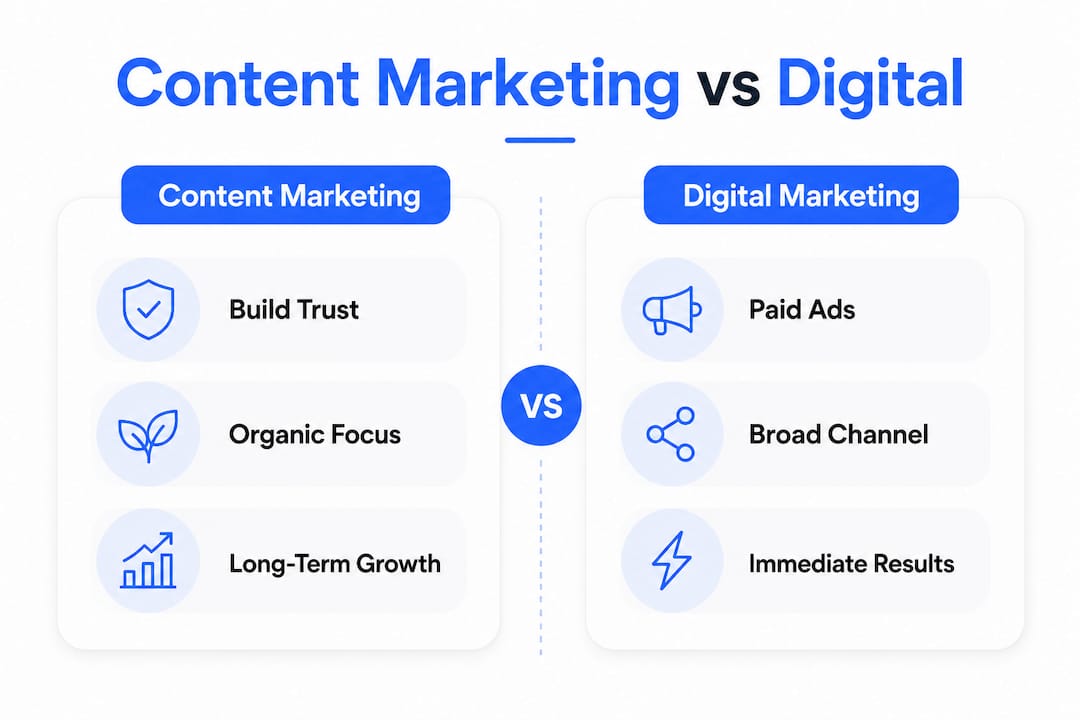
Here is how the core differences break down:
| Dimension | Content marketing | Broader digital marketing |
|---|---|---|
| Primary intent | Build trust and authority | Drive conversions and visibility |
| Approach | Organic, value-first, educational | Paid and organic, direct, promotional |
| Timeline | Months to years | Immediate to short-term |
| Cost per lead | Lower over time | Higher, especially for paid channels |
| Longevity | Assets compound in value | Results stop when spend stops |
How does content marketing support other digital marketing channels?
Content marketing does not operate in isolation. It functions as the fuel that makes every other digital marketing channel perform better. Marketers who treat it as a standalone tactic miss most of its value.
-
SEO. Search engines reward fresh, authoritative content. Every well-researched blog post or guide earns backlinks and builds domain authority. Content supports SEO by creating the pages that rank, the assets that attract links, and the signals that tell Google a site deserves to appear at the top of search results. Google’s E-E-A-T framework (Experience, Expertise, Authoritativeness, Trustworthiness) rewards sustained quality content that satisfies user intent, directly improving search rankings.
-
Social media. Valuable content gives social channels something worth sharing. A short-form video that explains a concept, an infographic that breaks down a process, or a case study that proves a result all perform far better than promotional posts. Social media engagement rises when the content itself delivers value rather than just advertising a product.
-
Email marketing. Email nurture sequences need content to work. A welcome sequence that sends educational guides, how-to articles, or curated insights keeps subscribers engaged between purchase decisions. Content gives email marketers a reason to show up in someone’s inbox without asking for a sale every time.
-
Paid advertising. Paid ads that point to a landing page full of promotional copy convert poorly. Ads that point to a genuinely useful piece of content, a guide, a webinar, or a detailed case study, convert at a much higher rate because the content does the trust-building work before the ask.
Pro Tip: Repurpose one strong piece of content across every channel. A detailed blog post becomes a social carousel, an email sequence, a short video script, and a paid ad landing page. One asset, four channels.
High-quality content assets amplify long-term value for SEO, social, email, and paid campaigns, making these channels interconnected rather than isolated tactics. That interconnection is the real argument for treating content marketing as a foundation, not an afterthought.
What formats does content marketing use within digital marketing strategies?
Content marketing covers a wide range of formats, and each one serves a different purpose in the buyer’s journey. Choosing the right format for the right stage is what separates effective content strategy from random content production.
Common content marketing formats include blogs, videos, infographics, podcasts, ebooks, case studies, and guides. Each format targets specific audience needs and buyer journey phases.
- Blogs and long-form guides work best at the awareness stage. They answer broad questions, attract organic search traffic, and introduce a brand to someone who did not know it existed.
- Videos and infographics work across awareness and evaluation. They simplify complex ideas and get shared more readily than text-heavy content.
- Podcasty build deep loyalty over time. Listeners who follow a podcast for months develop a level of trust that no ad campaign can replicate.
- Case studies and success stories belong at the evaluation stage. They show proof without making a direct sales pitch, letting results speak instead.
- Ebooks and whitepapers work at both evaluation and conversion. They signal authority and often serve as lead magnets that capture contact information.
Content marketing aligns each format with buyer journey stages for strategic impact, avoiding direct selling until the conversion stage. That discipline is what makes content marketing feel helpful rather than pushy.
Consistency and relevance matter as much as format choice. A brand that publishes one exceptional blog post per week outperforms a brand that publishes five mediocre ones. Quality signals to both readers and search engines that the content is worth their time.
How do you build a content strategy within a digital marketing plan?
A content strategy without clear objectives produces content that nobody reads. Every content program needs to start with measurable goals tied to broader digital marketing outcomes.
-
Set specific KPIs. Decide whether you are measuring organic traffic, lead volume, email subscribers, or time on page. Vague goals like “increase brand awareness” produce vague results. Specific KPIs create accountability and make it possible to iterate.
-
Build audience personas. Know exactly who you are writing for before you write anything. A persona includes the questions your audience asks, the problems they face, and the content formats they prefer. Mapping content to personas and buyer journey stages is the foundation of content marketing success.
-
Integrate SEO research from the start. Keyword research tells you what your audience is already searching for. Writing content around those searches means you are answering real questions, not guessing. Use tools like Google Search Console, Ahrefs, or Semrush to identify high-intent queries in your niche.
-
Build a content calendar. Consistency is the single most common failure point in content marketing. A calendar with assigned topics, formats, and publication dates removes the guesswork and keeps production on track.
-
Measure and adjust. Publish, track performance for 60–90 days, and then revise based on what the data shows. Pages with high impressions but low click-through rates need better titles. Pages with high traffic but low conversions need stronger calls to action.
Pro Tip: Audit your existing content before creating anything new. Most brands have underperforming pages that need a refresh, not a replacement. Updating a strong post with new data and better structure often outperforms publishing a brand-new article.
81% of marketers report that content marketing builds brand awareness, and 76% say it drives lead generation. Those numbers reflect programs built on strategy, not random publishing. The marketers who see those results plan before they produce.
Key Takeaways
Content marketing is a distinct, organic-focused discipline within digital marketing that builds trust and compounds value over time, making it the most cost-efficient channel for long-term lead generation.
| Point | Details |
|---|---|
| Content marketing is a subset | It is one of seven core digital marketing pillars, focused on organic, educational content rather than paid promotion. |
| Cost and lead efficiency | Content marketing generates 3x more leads than outbound marketing at 62% lower cost per lead. |
| Multi-channel fuel | Strong content assets improve SEO, social media, email, and paid ad performance simultaneously. |
| Format matches journey stage | Blogs attract awareness; case studies support evaluation; ebooks and guides drive conversion. |
| Strategy before production | Clear KPIs, audience personas, and SEO research must precede content creation for measurable results. |
Why patience is the most underrated content marketing skill
Content marketing rewards patience in a way that almost no other digital marketing tactic does. I have watched marketers abandon strong content programs after three months because the traffic numbers did not move fast enough. Those same programs, had they continued, would have compounded into significant organic assets within a year.
The fundamental difference between content marketing and digital marketing lies in intent: promotion versus connection. Most digital marketing asks for something. Content marketing gives something first. That shift in posture changes how an audience responds, and it changes how long the relationship lasts.
64% of buyers trust brands that produce educational content, and that number rises to 73% after they engage with that content. Trust does not transfer instantly. It accumulates through repeated, consistent exposure to content that actually helps. That is why a brand with two years of quality content in the market has a structural advantage that a paid campaign cannot replicate overnight.
The advice I give to every marketer integrating content into a multi-channel program is this: treat content as infrastructure, not decoration. Paid ads are a faucet. Turn them off and the water stops. Content is a well. Build it properly and it keeps producing.
— fan
Fanspicy: built for creators who take content seriously
Content marketing works best when the platform matches the creator’s goals. Fanspicy is a paid social media and live cam platform built for creators who want to monetize their content directly, without relying on algorithms or ad revenue.
Fanspicy gives creators the tools to build a paid content program, connect with their audience through live streaming, and grow a sustainable income from the content they already produce. For creators who want to apply content marketing strategies to a platform designed for direct monetization, Fanspicy is the place to start. Visit Fanspicy to see how the platform supports creators at every stage of their content strategy.
FAQ
What is content marketing in simple terms?
Content marketing is the practice of creating and distributing educational or entertaining content to attract and retain an audience, with the goal of building trust that eventually leads to sales or subscriptions.
How is content marketing different from digital marketing?
Digital marketing is the broader category that includes paid ads, SEO, email, and social media. Content marketing is one specific type within that category, focused on organic, value-driven content rather than direct promotion.
Why does content marketing cost less than other digital marketing tactics?
Content assets continue generating traffic and leads long after they are published, unlike paid ads that stop producing results the moment the budget runs out. That compounding effect lowers the cost per lead over time.
What types of content work best for digital marketing strategies?
Blogs and guides work best for SEO and awareness. Videos and infographics perform well on social media. Case studies and ebooks support evaluation and conversion. The right format depends on where the audience is in the buyer’s journey.
How long does content marketing take to show results?
Content marketing typically takes six to twelve months to build measurable organic momentum. Brands that commit to consistent, high-quality publishing see compounding returns that paid channels cannot match over the same period.