

目次
TL;DR:
- Effective content guidelines align creation efforts with legal, brand, and platform standards, reducing risks and streamlining workflows. They include clear roles, tiered approval processes, actionable rules, and regular reviews, fostering trust and faster publishing. Most teams succeed by prioritizing high-risk categories first and treating guidelines as living documents to adapt to evolving content landscapes.
Content guidelines are the documented rules and standards that align content creation with brand values, legal compliance, and strategic goals. Without them, teams produce inconsistent output, approval cycles drag on, and one poorly worded post can trigger an FTC violation or platform ban. The role of content guidelines extends far beyond style preferences. They function as operational infrastructure that protects creators, speeds up publishing, and builds audience trust at scale. Tools like Grammarly, platforms governed by GDPR, and FTC disclosure rules all intersect inside a well-built content framework.
What are the key components of effective content guidelines?
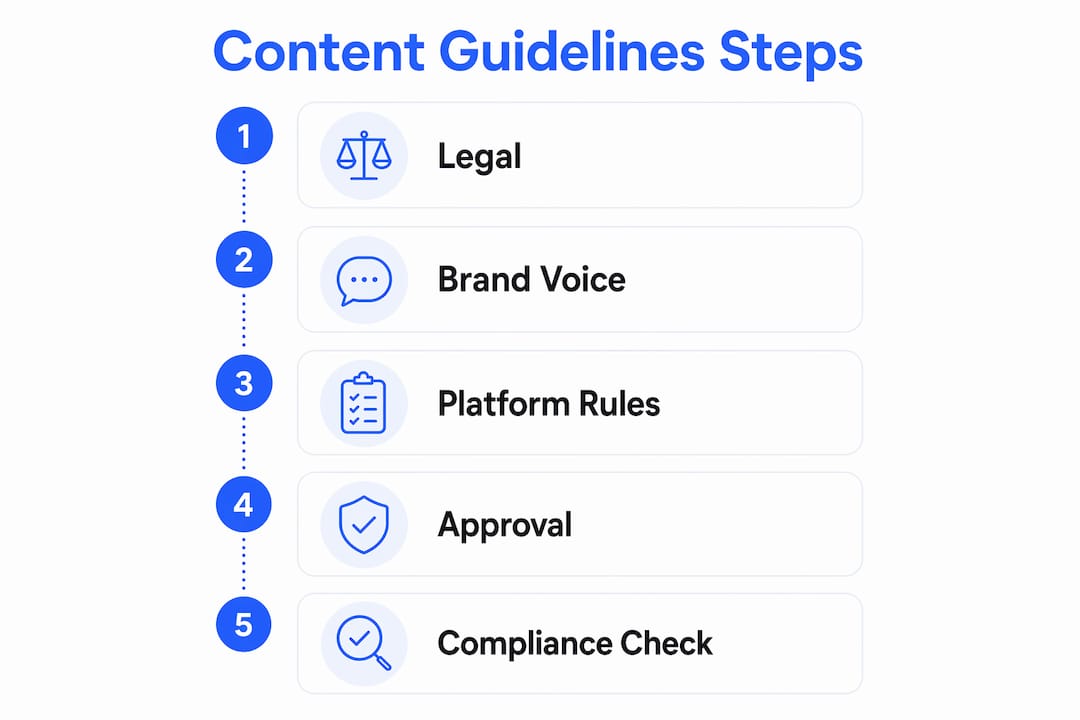
Effective guidelines include legal compliance, brand voice, platform-specific rules, approval processes, content risk tiers, and defined team roles. Each component serves a distinct function, and missing even one creates gaps that compound over time.

Legal and compliance rules form the non-negotiable foundation. GDPR data handling, FTC disclosure requirements for sponsored content, and platform-specific community standards all carry real financial and reputational consequences. Compliance guidelines in 2026 extend beyond legal rules to include brand value alignment and platform policy adherence with tiered risk-based review. This means a creator posting on a paid social platform like Fanspicy needs rules that cover both federal disclosure law and the platform’s own content policies simultaneously.
Brand voice and tone standards prevent the drift that happens when multiple contributors write without a shared reference point. A documented voice guide specifies vocabulary, sentence structure, and emotional register. It answers questions like: Do we use first person? Do we address the audience as “you”? What topics are off-limits? Without these answers written down, every new team member or freelancer defaults to their own instincts.
Approval workflows and team roles determine who reviews what before anything goes live. The key components of a working approval system include:
- A clear list of content types and their assigned risk level
- Named owners for each stage of the review process
- Defined turnaround times per content tier
- Escalation paths for edge cases or disputed content
- A final sign-off authority for high-risk material
Risk-tiered review processes match the depth of review to the actual stakes involved. A social media caption promoting a new post carries different risk than a legal disclosure or a sponsored partnership announcement. Applying the same heavy review to both wastes time and frustrates creators.
AI tools like Grammarly and automated compliance checkers now handle first-pass reviews for grammar, tone, and flagged keywords. This frees human reviewers to focus on judgment calls rather than mechanical corrections.
プロのアドバイス Build a one-page “quick reference” version of your guidelines alongside the full document. Creators are far more likely to check a single-page summary before publishing than scroll through a 40-page policy document.
How do content guidelines improve workflow efficiency and reduce risk?
Clear ownership and streamlined approval compress publishing timelines significantly, reducing approval times from weeks to days by minimizing redundant revisions and improving alignment. That compression matters most when content volume is high and publishing windows are tight.
The efficiency gains come from eliminating the three most common bottlenecks in content production:
- Ambiguous standards that force creators to guess what “approved” looks like, generating multiple revision rounds before anyone is satisfied.
- Unclear ownership where no one knows who has final authority, so content sits in limbo waiting for a decision that never arrives.
- Inconsistent risk assessment where reviewers apply different standards to similar content, creating unpredictable outcomes and eroding creator confidence.
Separating content creators from approvers is one of the most direct fixes available. “Self-approval is not governance”; clear roles boost speed and quality by removing the conflict of interest that slows decisions. When the person who created the content also approves it, the review becomes a formality rather than a genuine quality check.
Governance effectiveness should be measured through quality scores, pass rates, revision rounds, time-to-publish, and compliance incidents. Metrics make governance operational rather than aspirational. A team that tracks time-to-publish weekly will spot bottlenecks faster than one that relies on anecdotal feedback.
Content governance is a risk management function as much as a quality function, requiring joint effort among legal, compliance, and content operations teams. For creators on paid platforms, this means compliance failures are not just embarrassing. They can result in account suspension, revenue loss, or legal liability.
Brand guidelines vs. compliance frameworks: which do you need?
Most content teams need both, but they serve different purposes and operate at different levels of urgency. Understanding the distinction helps you build a framework that covers all your exposure without creating unnecessary process overhead.
| Framework type | Primary purpose | Who owns it | Review frequency |
|---|---|---|---|
| Brand voice guidelines | Consistency of tone, style, and vocabulary | Marketing or brand team | Annually or after major rebrands |
| Compliance guidelines | Legal, regulatory, and platform rule adherence | Legal and compliance team | Quarterly or after regulatory changes |
| Operational workflows | Approval paths, roles, and publishing processes | Content operations | Every 6 months or after team changes |
| Measurement standards | Quality scores, pass rates, revision tracking | Content ops or analytics | Monthly review cycles |
A five-level governance hierarchy covering standards, roles, workflows, enforcement, and measurement prevents bottlenecks that stifle content production. Following this sequence builds quality without bureaucratic slowdown. Most teams skip directly to enforcement without establishing clear standards first, which produces inconsistent outcomes and resentment from creators who feel policed rather than guided.
Governance frameworks work best when guardrails are framed by outcomes rather than strict rules, encouraging judgment rather than arbitrary compliance. A rule that says “do not make unverified health claims” is less useful than a standard that says “every health-related claim must link to a peer-reviewed source or carry a disclosure.” The second version tells creators exactly what good looks like.
Starting with minimum viable governance, meaning clear quality criteria, an AI reviewer, and defined quality gates, lays the foundation for scalable quality without complexity overload. This approach works especially well for solo creators or small teams who need structure without a full compliance department.
プロのアドバイス If you are building governance for the first time, start with your three highest-risk content categories and write rules only for those. Expand the framework once those rules are tested and adopted.
Best practices for creating and maintaining content guidelines
Building guidelines that teams actually use requires more than writing good rules. It requires designing for adoption from the start.
Start with legal and strategic alignment. Before writing a single style rule, map your regulatory exposure. For creators on paid social platforms, this means understanding FTC disclosure requirements, platform community standards, and any applicable data privacy rules. Legal teams should translate rules into actionable instructions for creators rather than reproducing statutory language. A guideline that reads “comply with 16 CFR Part 255” tells a creator nothing. One that reads “add #ad or #sponsored in the first line of any post where you received payment or free product” is immediately usable.
Use clear, simple language throughout. Clear, simple language in guidelines fosters higher adoption compared to legal jargon-heavy documents. This is not about dumbing down the content. It is about respecting the creator’s time and removing friction between the rule and the behavior you want.
Define ownership for every content type. True governance separates asset ownership from decision ownership to avoid drift and ensures accountability for content quality and compliance. A post can have one person responsible for writing it and a different person responsible for approving it. Both roles need to be named, not implied.
Apply tiered approval paths based on content risk. Governance frameworks that apply approval workflows proportionate to risk prevent bottlenecks and increase overall workflow speed. Low-risk content like standard social captions can move through a single-reviewer path. High-risk content like partnership disclosures or medical claims requires legal sign-off before publishing.
Schedule regular reviews. Periodic review of content standards every 4 to 6 years ensures alignment with evolving industry practices, often requiring only minor adjustments around 3%. For fast-moving platforms, annual reviews are more appropriate. Governance is a continuous loop requiring scheduled reviews, monitoring, and adjustments to maintain trust, mitigate risks, and support growth.
プロのアドバイス Assign a “guidelines owner” who is responsible for flagging when a rule feels outdated or is being consistently ignored. Ignored rules are a signal that the standard needs updating, not that the creator is wrong.
For creators managing content across social platforms, the content moderation process adds another layer of practical governance that complements written guidelines with real-time enforcement.
Key takeaways
Content guidelines function as operational infrastructure, and the teams that treat them as living systems consistently outperform those that treat them as one-time documents.
| Point | Details |
|---|---|
| Guidelines reduce approval time | Clear ownership and tiered review compress publishing from weeks to days. |
| Five-level governance hierarchy | Standards, roles, workflows, enforcement, and measurement prevent bottlenecks. |
| Outcome-based guardrails work better | Rules framed around desired outcomes encourage judgment, not just compliance. |
| Simple language drives adoption | Actionable instructions outperform legal jargon in creator compliance rates. |
| Regular reviews keep standards relevant | Schedule reviews annually for fast-moving platforms to prevent guideline drift. |
Why I think most content teams are building guidelines backwards
Most teams write their content guidelines starting from brand voice and working outward. I have watched this approach fail repeatedly, and the pattern is always the same. The brand guide gets finished, everyone nods, and then the first compliance incident happens because no one mapped the legal exposure before writing a single style rule.
The smarter sequence is to start with your highest-risk content categories, define the compliance floor, and then build brand voice on top of that foundation. Style is flexible. Regulatory exposure is not. A creator who sounds slightly off-brand is recoverable. A creator who posts undisclosed sponsored content on a paid platform faces account termination and potential FTC action.
The other mistake I see constantly is treating guidelines as a finished product. Governance frameworks need to evolve with organizational changes; otherwise, they create friction and inhibit content production. The creators who thrive on platforms like Fanspicy are the ones who treat their personal content standards the same way a media company treats its editorial policy: as a living document that gets reviewed when the platform changes its rules, when the audience shifts, or when a new content format emerges.
The balance between enforcement and creative freedom is real, and it requires ongoing attention. Guidelines that are too rigid kill the spontaneity that makes creator content compelling. Guidelines that are too loose leave creators exposed. The goal is a framework that protects without constraining, and that only happens when the people creating the content have a voice in shaping the rules they follow.
— fan
Start building smarter content governance with Fanspicy
Fanspicy gives creators on paid social platforms the tools to publish confidently without sacrificing speed or compliance. Whether you are managing approval workflows, maintaining brand consistency across multiple content types, or navigating platform-specific rules, having the right infrastructure behind your content makes the difference between growth and risk exposure.

Fanspicy’s creator resources cover everything from paid platform content processes to audience growth strategies built around compliant, high-performing content. If you are ready to put the principles in this article into practice, explore Fanspicy’s creator tools and see how structured governance translates directly into faster publishing and stronger audience engagement.
よくあるご質問
What is the role of content guidelines in content creation?
Content guidelines define the rules for style, compliance, and quality that align every piece of content with brand values and legal requirements. They reduce revision cycles, prevent compliance failures, and give creators a clear standard to work toward.
How do content guidelines reduce legal and platform risk?
Guidelines that include FTC disclosure rules, GDPR requirements, and platform-specific policies create a documented compliance record that protects creators during audits or disputes. Tiered risk review ensures high-stakes content receives appropriate scrutiny before it goes live.
What should be included in a content governance framework?
A working governance framework covers standards, roles, workflows, enforcement, and measurement, forming a five-level hierarchy that prevents bottlenecks without slowing production. Each level builds on the previous one to create consistent, auditable content operations.
How often should content guidelines be reviewed and updated?
Fast-moving platforms warrant annual reviews, while more stable environments can follow a longer cycle. The trigger for an update is not just the calendar. It is any significant change in platform policy, regulatory environment, or content format that makes existing rules ambiguous or outdated.
Can solo creators benefit from content guidelines?
Solo creators benefit from even a minimum viable governance setup: clear quality criteria, a tool like Grammarly for first-pass review, and a personal checklist for compliance before publishing. Structure at any scale reduces errors and builds the habits that support growth on platforms like Fanspicy.