
目次
The fastest path to monetizing a Facebook account is to treat it as a discovery engine, not a storefront: keep posts free, build one clear destination link, and send engaged followers there to buy subscriptions, live streams, tips, private messages, and exclusive posts. Expect modest conversion from that traffic at first, often in the low single digits, so the system depends on volume and retention rather than any one viral post.
TL;DR:
- Identify your most engaged followers through comments, shares, and messages, then use one destination link in your bio, pinned post, and relevant captions.
- Engaged, niche creator audiences typically convert at 1% to 5%; track landing page conversion, payment success, and subscriber lifetime value to find funnel weaknesses.
- Before promoting a live stream, test the full payment flow with a $1 transaction, arrange chat moderation, and display an alternate payment link.
- Offer subscribers a recurring weekly format, and supplement subscriptions with tips or paid posts; monitor churn and response times to protect renewals.
- Facebook’s Stars, Fan Subscriptions, and paid events have changing eligibility rules, so use them as supplements and verify current requirements before planning around them.
目次
- Step-by-step strategy to convert Facebook followers into paying fans
- What a converting landing page and offer actually look like
- Operational checklist for monetized live streams
- Designing offers and a content rhythm that keeps subscribers paying
- Facebook promotion tactics that drive clicks and the metrics to track
- Why a single destination link matters more than it seems
- Legal and compliance considerations for paid content and messaging
- Facebook’s built-in monetization features and their eligibility rules
- How to connect Facebook to an external subscription and payment platform
- Building and engaging a Facebook community that fuels monetization
- Tips for using Facebook Ads to promote monetized content
- Best practices for pricing subscription tiers and paid content
- A straight take on the single-link approach
- Start monetizing with Fanspicy
- よくあるご質問
- Sources
Step-by-step strategy to convert Facebook followers into paying fans
Converting followers starts with knowing who is actually paying attention. Not every follower is a prospect, so the first job is sorting the audience before you ever ask for money.
- Identify your most engaged followers by scanning comments, shares, and DMs, then prioritize them for direct outreach.
- Decide what stays free on Facebook (short clips, personality content, behind-the-scenes posts) versus what becomes a preview that teases paid material.
- Build one destination link, placed in your bio, pinned post, or recurring post, so every piece of content points to the same place.
- Set a promotion cadence: a mix of daily organic posts and occasional paid boosts once you have proof the organic version converts.
This sequence matters because creators increasingly build their own owned channels rather than relying on a platform’s algorithm to deliver repeat buyers. Facebook can introduce you to thousands of people, but only a direct relationship, through a subscription or a private message thread, turns that reach into recurring income.
The single-link approach also removes a common source of lost conversions: followers who want to pay but can’t find where. Every additional click or decision point between a Facebook post and a payment page costs you buyers, so resist the urge to post five different links across five different formats.
プロのアドバイス Pin your destination link in the first line of your Facebook bio and repeat it in every caption, even when it feels redundant, since most followers never scroll past the first sentence.
What a converting landing page and offer actually look like
Once a follower clicks through, the landing experience decides whether they pay. A cluttered page with five competing offers and a slow load time will lose people who were ready to buy seconds earlier.
- State one clear value proposition above the fold, not a list of everything you offer.
- Make the payment button or subscribe action visible without scrolling on a phone screen.
- Keep the page fast-loading, since most Facebook traffic arrives on mobile data, not Wi-Fi.
- Offer a small number of clear choices: a monthly subscription, a content bundle, or a paid live event, rather than a dozen pricing variants.
- Minimize signup fields and surface trust signals like secure payment badges or clear refund terms.
Direct-to-fan subscription conversion from social audiences typically lands in the 1 to 5 percent range for engaged, niche creators, according to research on the creator economy. That range is a planning number, not a ceiling: it tells you to measure your actual conversion rate and treat every percentage point of improvement as a meaningful revenue gain, since small funnel fixes (fewer fields, faster load, a sharper headline) compound across thousands of clicks.
Testing matters more than guessing here. Try a subscription against a one-time bundle, or a paid live event against a flat monthly price, and let the data tell you which offer your specific audience responds to.
Operational checklist for monetized live streams
Live streams generate some of the highest-intent moments in creator monetization, but they also carry the highest risk of losing a sale to a technical failure. A payment that fails mid-stream rarely gets recovered in the moment.
- Test your payment flow end-to-end before you promote the stream, including tokenization and the exact steps a fan takes to tip or subscribe.
- Set up moderation in advance so you can manage chat and payment prompts without breaking your own focus on the broadcast.
- Keep an alternate link visible on-screen in case your primary payment path has an issue.
- Plan a fallback: a follow-up direct message or automated reminder for anyone whose payment didn’t go through.
Payment performance, meaning approval rates, authorization speed, and tokenization, directly shape how much revenue a live session actually captures, and creators who skip this testing step often blame low turnout when the real problem was a payment screen that timed out. Supporting multiple payment methods also matters, since fans in different regions favor different options, and a missing local method is a silent revenue leak. For a closer look at setting this up correctly, our guide on secure payment steps for creators walks through the practical setup.
プロのアドバイス Run a $1 test transaction on any new payment setup before your first live stream, so you catch a broken flow before fans do.
Designing offers and a content rhythm that keeps subscribers paying
A subscription only survives if it gives fans a reason to stay past the first payment. The offers that retain best give people something to look forward to on a schedule, not just a one-time unlock.
- Build a recurring format, like a weekly show or a subscriber-only chat, so paying fans know when to expect new value.
- Layer in microtransactions such as tips and one-off paid posts to supplement subscription revenue without requiring a new sign-up.
- Track churn and reply-response times closely, since slow responses to paying subscribers are one of the quietest ways to lose them.
- Test limited-time bundles and subscriber-only live events periodically to give long-term subscribers a reason to renew rather than cancel.
Tipping and virtual gifting during live sessions have become a meaningful income driver alongside subscriptions, so don’t treat them as an afterthought. A subscriber who tips during a live show is telling you exactly what content to make more of. Optimizing your welcome flow, the first message or post a new subscriber sees, also pays off, since that first interaction sets the tone for whether they stay past month one.
Facebook promotion tactics that drive clicks and the metrics to track
Promotion on Facebook works best when it’s built around discovery content that funnels toward one place, not scattered calls to action across every post.
- Post short clips, behind-the-scenes moments, and Stories that build curiosity without giving away the paid material.
- Use a pinned post as your permanent, single CTA placement so new visitors always find the same link.
- Add small paid boosts to extend reach into lookalike audiences, but only after an organic post has already proven it converts.
- Track link click-through rate, landing page conversion rate, payment success rate, and subscriber lifetime value as your core funnel metrics.
A single destination link reduces decision friction compared with scattering multiple links across posts, and matching each post’s intent (a short teaser clip for discovery, a direct offer post for conversion) keeps your funnel clean. Our breakdown of promotion strategies for 2026 covers format-specific tactics in more detail, and our piece on subscriber growth tactics includes A/B test ideas worth running on your own page.
Why a single destination link matters more than it seems
Every extra link you post is a decision point, and decision points cost conversions. A follower who sees three different links in a week, one for subscriptions, one for tips, one for a live event, has to figure out which one applies to them, and many simply won’t bother.
The fix is straightforward: pick one landing page that houses every offer, and send all Facebook traffic there regardless of the specific post. That page can still present multiple options once a visitor lands, but the click itself should never require a choice. Keeping Facebook as the discovery layer while routing transactions to one owned page balances the platform’s reach with the control you need to actually convert and retain fans.
This also simplifies your analytics. When every post points to the same URL, you can measure which content style drives the most clicks without untangling performance across five different landing pages. Over time, that clarity tells you exactly what kind of Facebook post earns the click, whether it’s a short video teaser, a text post with a question, or a photo carousel.
Keep the link itself short and memorable where possible, and update it only when necessary, since a changed link breaks saved bookmarks and muscle memory among repeat visitors.
Legal and compliance considerations for paid content and messaging
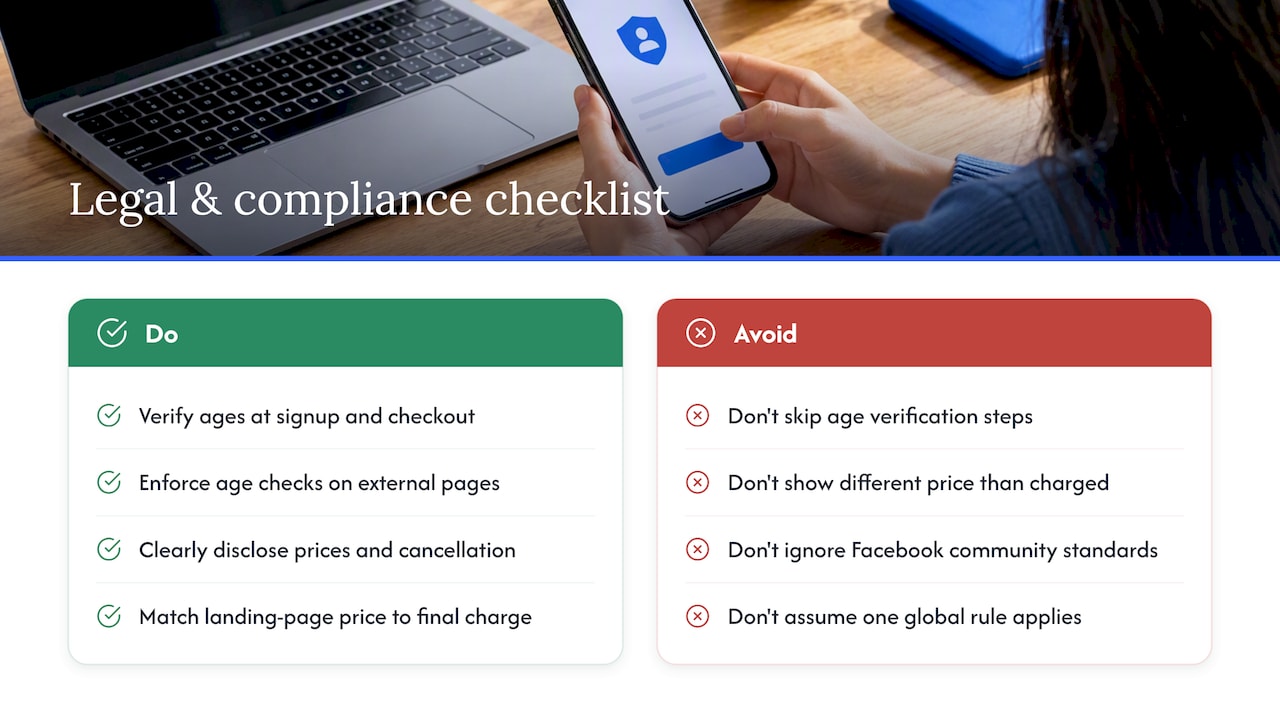
Paid content and direct messaging on Facebook sit inside rules that vary by region, so a few principles apply broadly even without a single global standard. Age verification is non-negotiable: any paid offer involving adult-oriented content must confirm that both the creator and the audience meet the applicable age requirements in their jurisdiction, and platforms you route fans to should enforce this at sign-up.
Paid messaging and subscription content involving EU-based fans may fall under consumer protection and electronic commerce rules that require clear pricing disclosure and straightforward cancellation. US-based transactions typically involve state-level consumer protection standards alongside federal rules on deceptive advertising, so pricing shown on your landing page should match exactly what a fan is charged.
Facebook’s own community standards govern what you can post and link to directly on the platform, and violations can affect your account’s visibility or standing, separate from whatever rules apply on your external paid page. Because these requirements differ by country and change over time, treat this section as a starting point rather than a complete compliance review, and consult a professional familiar with your specific market before finalizing pricing disclosures, terms of service, or age-verification processes. Getting this right protects both your income and your audience’s trust.
Facebook’s built-in monetization features and their eligibility rules
Facebook offers its own native monetization tools, including Stars, Fan Subscriptions, and paid online events, each with eligibility requirements tied to follower counts, content history, and adherence to community standards. These programs pay creators directly through Facebook’s own systems for interactions that happen on the platform itself.
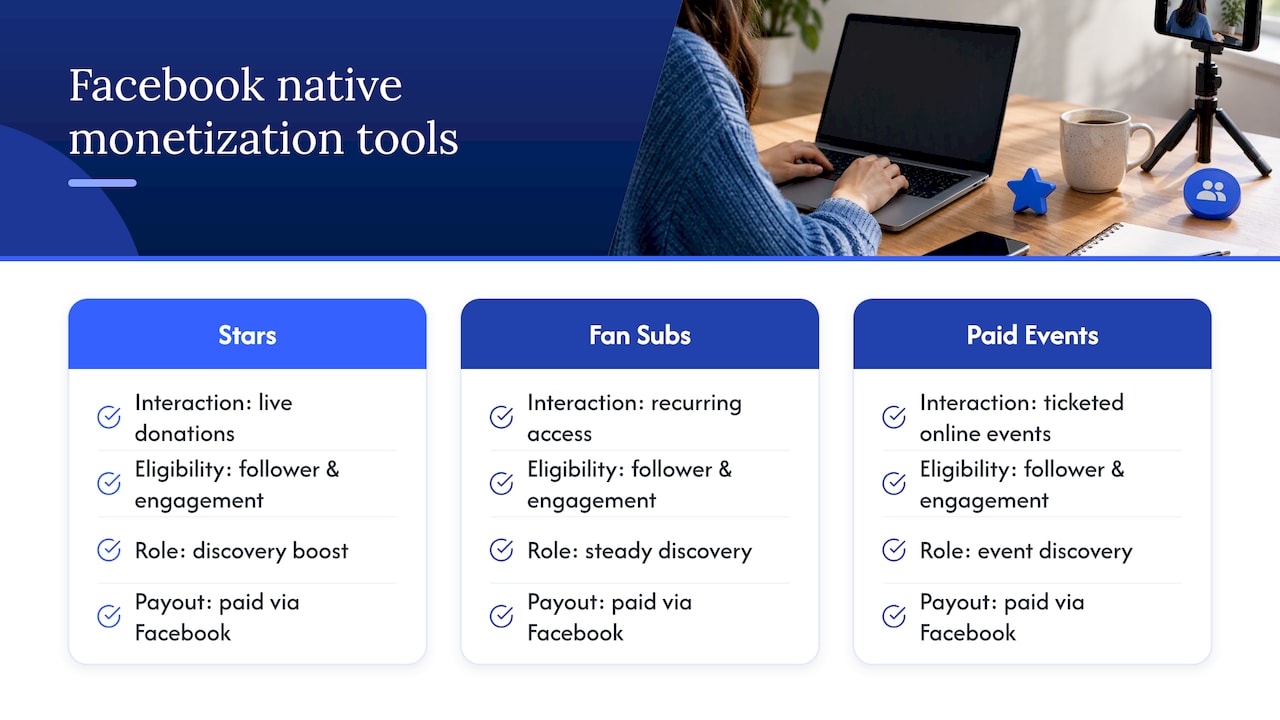
For creators focused on building a paid audience off-platform, these native tools serve best as a discovery supplement rather than the main revenue engine. A Stars-enabled live stream or a paid online event can introduce your content to new viewers, but the real conversion work happens when those viewers click through to your owned subscription page, where you control pricing, retention, and the full relationship with the fan. Treating Facebook’s programs as a secondary layer, rather than the destination, keeps your income resilient if eligibility rules or payout terms change, since you’re not dependent on a single platform’s policies for your primary revenue.
Eligibility for these native features typically depends on meeting specific follower and engagement thresholds set by Facebook, and those thresholds are subject to change, so check current requirements directly before planning around them. The practical takeaway is simple: use whatever native visibility tools you qualify for to widen your funnel, then rely on your own paid page for the transactions that actually build your income.
How to connect Facebook to an external subscription and payment platform
Linking Facebook to an outside platform for payments is mostly a matter of consistent placement and clear expectations, not complicated technical setup. Your external platform handles the subscription billing, payment processing, and content delivery, while Facebook’s job is simply to point people toward it.
Start by placing your platform’s profile link in your Facebook bio, then repeat it in pinned posts and relevant captions so it’s never more than one click away. When you post a preview clip or teaser image on Facebook, the caption should name exactly what the fan gets by clicking through, whether that’s a subscription, a specific paid post, or access to a live event. Vague captions produce vague clicks.
Payment reliability on the external side matters as much as the link placement itself. Payment infrastructure choices, including approval rates and support for local payment methods, materially affect revenue in live commerce, so the platform you choose to handle payments should support the methods your specific audience actually uses. Our overview of why payment processing matters for creators goes deeper into what to check before committing to a platform.
Keep your Facebook presence and your paid platform visually consistent, same profile photo, similar tone, recognizable branding, so a follower who clicks through immediately recognizes they’re in the right place.
Building and engaging a Facebook community that fuels monetization
A Facebook audience converts better when it feels like a community rather than a broadcast list. Replying to comments, asking questions in captions, and running occasional polls all signal that there’s a person behind the page, and that recognition translates into trust when you eventually ask for a paid relationship.
Groups and recurring content series help here too. A weekly post format, a running behind-the-scenes series, or a regular Q&A gives followers a reason to check back organically, which keeps your discovery content performing well in the algorithm and keeps your destination link in front of more eyes over time.
Engagement also doubles as market research. The comments and DMs that come from your most active followers tell you what kind of paid content they’d actually pay for, whether that’s a specific type of live session, a particular content theme, or more direct access through private messages. Pay attention to recurring requests and build your paid offers around them rather than guessing.
Community-building is also where the groundwork for retention gets laid before a fan ever pays. Someone who has commented on your posts for months and feels recognized is far more likely to subscribe when you finally present your paid page, and far more likely to stay subscribed, than someone who clicked a cold ad.
Tips for using Facebook Ads to promote monetized content
Paid promotion on Facebook works best as an amplifier for content that’s already proven itself organically, not as a substitute for organic proof. Boost a post that’s already earning strong engagement and click-through to your destination link, rather than guessing which new content might perform.
Lookalike audiences built from your existing engaged followers or past converters tend to outperform broad interest-based targeting, since they start from people who resemble those who already clicked through and paid. Keep ad creative consistent with your organic content style; an ad that looks noticeably different from your usual posts can feel like a bait-and-switch to anyone who clicks.
Budget discipline matters more than budget size early on. Small, consistent boosts on proven content typically outperform a single large spend on an untested post, because you’re paying to extend reach to an audience that’s already shown it converts, not hoping a new creative concept will work. Track the same metrics you use for organic posts, link click-through rate and landing conversion, so you can directly compare paid and organic performance and shift budget toward whichever is actually producing payers.
Always route ad clicks to the same single destination link you use everywhere else. Running ads to a separate landing page fragments your data and makes it harder to know what’s actually working.
Best practices for pricing subscription tiers and paid content
Pricing works best when it’s simple enough that a fan can decide in seconds. A single monthly subscription price, clearly stated, tends to outperform a confusing tier structure with overlapping benefits that are hard to compare at a glance.
If you do offer tiers, make the difference between them obvious: a base subscription for ongoing content, and a higher tier that adds something concrete, like direct messaging access or exclusive live events, rather than a vague “more content” promise. Bundles of exclusive posts work well as a lower-commitment entry point for fans who aren’t ready for a recurring subscription but want to pay for something specific.
Diversifying income across subscriptions, tips, and one-off paid content, rather than relying on a single stream, builds more resilient creator income, so price your tips and paid posts as genuine complements to your subscription, not as an afterthought. Review your pricing periodically against what your most engaged fans are actually purchasing, and adjust based on real behavior rather than guessing what the market will bear. A price that’s slightly too high but matched to a highly engaged niche audience often outperforms a lower price aimed at a broad, less-invested one.
A straight take on the single-link approach
We’ve watched creators try to run a paid business across five scattered links and wonder why conversion stays flat. The ones who commit to one destination, one clear offer, and a retention plan before they ever go live tend to build steadier income than the ones chasing viral reach. Facebook brings the crowd. What you build off-platform decides whether that crowd becomes income.
— fan
Start monetizing with Fanspicy
We built Fanspicy as a destination where your Facebook followers can become paying fans through subscriptions, live streams, tips, private messages, and exclusive posts. 
Our platform is designed for the single-link approach outlined above: one profile, every monetization option in one place. If you’re ready to turn Facebook discovery into real income, set up your creator page on Fanspicy and point your next post there.
よくあるご質問
How do I start monetizing my Facebook account?
Build an audience on Facebook through consistent, free content, then direct your most engaged followers to a single external page where you offer subscriptions, live streams, tips, and exclusive content. Facebook serves as discovery; the actual monetization happens on your owned destination page.
How to get monetized on Facebook using an external platform?
Set up a profile on a creator platform like Fanspicy, place that single link in your Facebook bio and pinned posts, and consistently point your captions toward it. Conversion from engaged social traffic typically falls in the 1 to 5 percent range, so focus on volume and retention rather than expecting every follower to convert.
How to monetize Facebook videos for a paid audience?
Use short video clips as free previews that tease longer or more exclusive content available on your paid page, rather than trying to monetize the videos directly on Facebook. The video’s job is to drive the click to your destination link, where the actual subscription or paid content purchase happens.
What is a realistic conversion rate from Facebook followers to paying subscribers?
Engaged, niche creator audiences typically convert at 1 to 5 percent when moving from free social content to a paid subscription. Improving landing page speed, reducing signup friction, and testing offers can push that rate higher over time.
Should I rely on Facebook’s own monetization tools or an external platform?
Facebook’s built-in options, like Stars and paid online events, work well as supplementary discovery tools but come with eligibility rules tied to follower counts and platform policies that can change. Routing fans to your own external paid page gives you more control over pricing, retention, and the full subscriber relationship.
Sources
- Escaping the algorithm Creators seek greater control
- Turning payment performance into a competitive edge for livestreaming platforms
- The State of the Creator Economy (2026)