

目次
Growing a Facebook audience fast in 2026 comes down to three moves working together: prioritize Reels and win the first two seconds, fix your Page so it converts curious visitors into followers, and reply to comments fast enough to keep the conversation alive. Post consistently against three content pillars, then use small paid boosts only on content that’s already proving itself. Skip any of the three, and the other two lose most of their power.
TL;DR:
- Prioritize Reels with strong hooks in the first two seconds and post 2 to 4 times weekly to maximize reach among non-followers.
- Fully optimize your Page by completing all profile fields, setting consistent usernames, and pinning a clear “start here” post to boost discoverability.
- Engage promptly with comments, ask follow-up questions, and monitor recurring themes to turn interactions into content ideas that foster ongoing growth.
- Use Facebook Groups actively by creating niche communities and participating in others to gather feedback and build a more engaged audience.
- Only boost top-performing posts with targeted audiences after organic success to attract high-quality followers without diluting engagement rates.
目次
- How Do You Grow a Facebook Audience Starting Today?
- Why Do Reels Get You in Front of People Who Don’t Follow You Yet?
- What Three Content Pillars Should Your Facebook Page Post Around?
- What Kind of Comments Actually Signal to Facebook That People Care?
- Can Facebook Groups Really Speed Up Page Growth?
- When Does It Make Sense to Put Money Behind a Post?
- What Metrics Actually Predict Whether Your Growth Will Compound?
- How Fanspicy Creators Apply These Same Growth Tactics
- Should You Team Up With Influencers or Partner Pages?
- How Do Facebook Events Bring in New Followers?
- When Is the Best Time to Post on Facebook?
- Do Contests and Giveaways Still Grow Facebook Pages?
- A 60 to 90 Day Plan You Can Copy
- Sources
- よくあるご質問
How Do You Grow a Facebook Audience Starting Today?
Before any of that works, your Page has to look and function like a business that’s ready for new visitors. Facebook’s own guidance on growing Page audience and engagement ties discoverability directly to profile completeness, not just content quality. A half-finished Page bleeds the traffic your content works to earn.
Run through this checklist in order:
- Write your About section with a keyword-rich first sentence. If you run a bakery in Austin, the first line should say so plainly, not bury it in the third paragraph.
- Lock in a consistent username across your Page, Instagram, and website so search and cross-links actually connect.
- Set the correct category, working contact info, an active website link, and accurate map data if you have a physical location.
- Size your profile image at 170×170 pixels and your cover image at 820×312 pixels, and pin a “start here” post that tells new visitors what you do and where to look next.
- Switch to professional (Page) mode and turn on message buttons and CTA buttons so a visitor can act the moment they land.
Skipping the pinned post is the mistake that costs the most. Somebody clicks through from a viral Reel, lands on a Page with no context, and bounces before they ever hit “follow.”
Why Do Reels Get You in Front of People Who Don’t Follow You Yet?
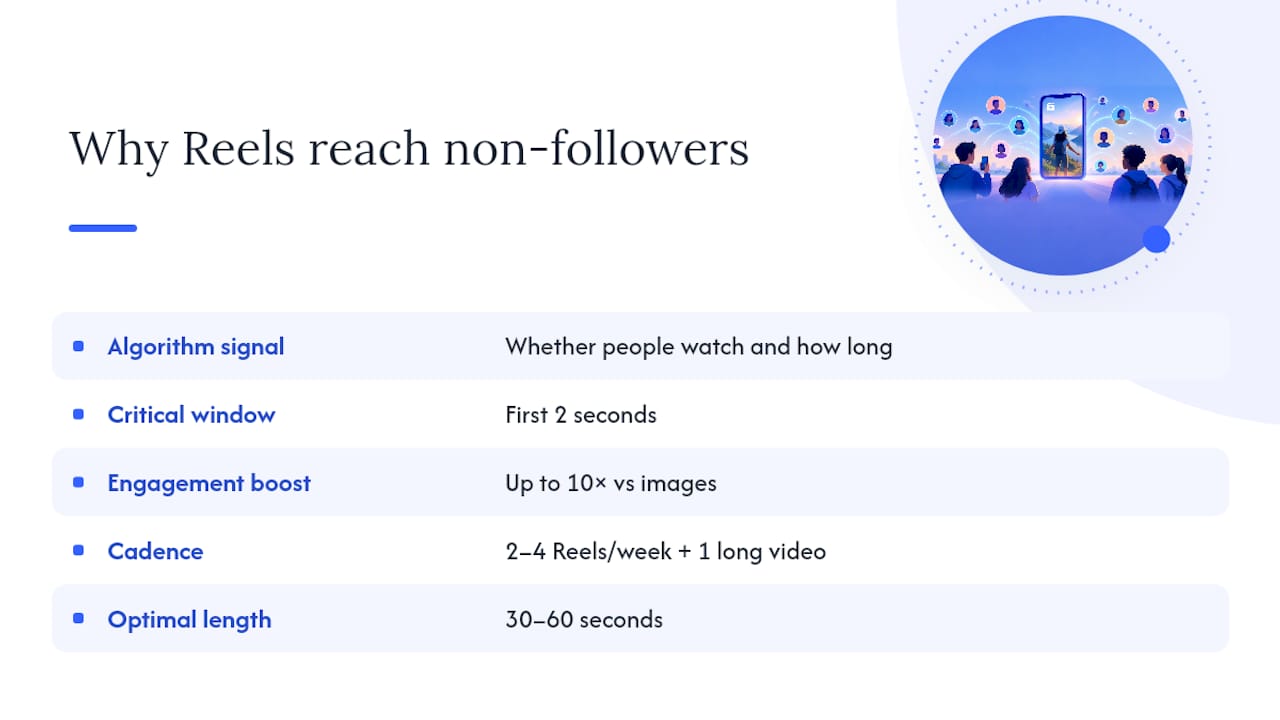
Facebook’s distribution model doesn’t much care how many followers you have. It cares whether people watch, and whether they watch long enough to signal the post is worth pushing further. Video posts can drive up to 10 times more engagement than static images, and Reels are the format Facebook rewards most heavily for reaching non-followers right now.
The first two seconds decide everything. If a viewer doesn’t stop scrolling in that window, the algorithm reads it as low interest and moves on to someone else’s content. That means your hook has to land before your logo, your intro, or your brand name even shows up.
Recommended cadence: aim for 2 to 4 Reels per week plus one long-form video, keeping Reels in the 30 to 60 second range where completion rates stay strongest.
A few hook formulas work consistently: open on the surprising outcome before the setup (“This took 90 seconds and saved me $400”), tease an unresolved question, or start mid-action so viewers feel like they walked in on something. Because a large share of viewers watch muted, burn your keywords into the video itself instead of relying on captions Facebook auto-generates. Reels built around a surprising fact or a satisfying reveal tend to get replayed and shared more, which compounds reach on its own.
プロのアドバイス If you’re repurposing TikTok or Instagram content, strip the platform watermark and re-edit the first three seconds specifically for Facebook. A clip that opens with a TikTok logo reads as recycled, and Facebook’s system treats it accordingly.
What Three Content Pillars Should Your Facebook Page Post Around?
Pick three pillars that map directly to why someone would want to follow you, not just what you feel like posting. A local gym might choose form tutorials, member transformations, and class culture. A retail brand might choose product education, behind-the-scenes, and customer spotlights. Three keeps you focused without boxing you into repetition.
A workable content mix looks like this:
- 40% educational (how-to’s, tips, myth busting)
- 30% community and engagement (questions, polls, UGC reposts)
- 20% promotional (offers, launches, testimonials)
- 10% culture (team moments, behind-the-scenes, personality)
Pair formats deliberately. Reels do the heavy lifting on reach, pulling in people who’ve never seen your Page before. Text posts and carousels do the heavy lifting on engagement, since they tend to invite comments in a way pure video doesn’t. Running both means you’re filling the funnel and deepening it at the same time, instead of only chasing views.
Batch a week or two of content in one sitting and schedule it through Meta Business Suite. Batching keeps quality consistent because you’re not scrambling to shoot something at 9 p.m. on a Tuesday, and it frees up real-time hours for the part that can’t be scheduled: replying to comments.
What Kind of Comments Actually Signal to Facebook That People Care?
Generic engagement bait (“Like if you agree!”) doesn’t move the needle the way it used to, and Facebook has actively deprioritized posts that lean on it. What works instead is a specific, opinion-inviting question tied to something your audience actually debates. “Team pineapple on pizza or team never again?” beats “Comment below!” every time, because it gives people something concrete to react to.
Here’s the operational sequence that turns comments into ongoing growth:
- Reply to comments within the first hour of posting. Early replies extend the conversation window while the post is still in active distribution.
- Ask a follow-up question in your reply instead of just saying thanks. That second exchange often outperforms the original comment for reach.
- Export your comments weekly and scan for repeated questions. Treat that list as a free focus group. If five people ask the same thing, that’s your next post.
- Run occasional Live Q&As, mention commenters by name in your replies, and reshare user-generated content. Being named publicly is one of the strongest reasons someone shares a post with a friend.
プロのアドバイス Keep a running spreadsheet of exported comments tagged by theme. After a month, patterns show up that you’d never catch scrolling in real time.
Sprout Social’s research on engagement strategies backs this up directly: knowing your audience and replying consistently outperforms one-off viral swings for long-term growth.
Can Facebook Groups Really Speed Up Page Growth?
Groups produce a different kind of follower than Pages do. Someone who joins a Group has already opted into ongoing conversation, which makes them far more likely to become an engaged Page follower than someone who saw one ad. A creator’s guide to Facebook growth points to Groups as consistently stronger for community signals than Pages alone.
Two approaches work well together:
- Start your own Group with a narrowly defined purpose (“Austin Home Bakers Swap Recipes,” not “Baking Fans”), and gate entry with one onboarding question that filters out bots and low-intent joiners.
- Show up in other relevant Groups and post genuinely helpful content with no sales pitch attached. Trust built there transfers to your Page over weeks, not days.
Group discussions also double as free market research. The questions members debate become your next Page posts, and the members who answer other people’s questions unprompted are your future brand advocates. Keep moderation active with a simple weekly rhythm: welcome new members, seed one discussion prompt, and remove spam fast so the space stays worth returning to.
When Does It Make Sense to Put Money Behind a Post?
Only after a post has already proven itself organically. Boosting a post that flopped just buys a bigger, more expensive flop. Boosting a Reel that’s already outperforming your average gives Facebook a stronger signal to work with, and a small, targeted boost on a top-performing Reel tends to attract better-quality followers than a broad “page likes” campaign, since you’re amplifying to lookalike audiences of people who already watched and engaged.
Rules of thumb worth following:
- Start with a small daily budget, roughly the cost of a couple of coffees, on your single best-performing post from the last two weeks.
- Target engagement or lookalike audiences built from people who already interacted with your content, not cold interest categories.
- Avoid generic “page like” campaigns entirely. They inflate follower counts with people who never engage again, and that drags down your average engagement rate for every future post.
- Track engagement rate among paid-acquired followers specifically for two weeks. If it’s noticeably lower than your organic average, pause and rework the creative before spending more.
What Metrics Actually Predict Whether Your Growth Will Compound?
Follower count is the least useful number to obsess over. Facebook’s own distribution model runs post by post, and watch time, comments, and shares decide reach far more than how many people already follow you.
Track these five instead:
- Reach per post, to see if your content is escaping your existing audience.
- Engagement rate (reactions, comments, shares divided by reach), benchmarked against the average engagement rates Statista tracks for realistic targets.
- Follower growth rate week over week, not the raw total.
- Video retention, especially the percentage watching past the three-second mark.
- Link clicks, if driving traffic off-platform is part of the goal.
Every week, scan the numbers and flag your top and bottom performer. Every month, ask three questions: what format should get more budget of your time, what’s clearly not working and should stop, and what one new format deserves a two-week test. Export comments during the same review and mine them for your next batch of content ideas. Most Pages that stick with this rhythm see meaningful movement in engagement rate within 60 to 90 days, though raw follower counts often lag a few weeks behind.
How Fanspicy Creators Apply These Same Growth Tactics
Fanspicy works with creators who treat Facebook the way this guide describes: as a discovery engine that feeds a paid audience elsewhere. The same Reels-first, comment-driven approach that grows a bakery’s Page also works for a creator building toward paid subscriptions, private messages, or tips, because the underlying mechanic doesn’t change. Watch time and conversation earn reach regardless of what you’re ultimately promoting.
Creators monetizing an audience typically lean on a few repeatable habits:
- Repurpose a teaser Reel from paid content, stripped of watermarks, re-edited with a Facebook-native hook.
- Keep a comment-export template running weekly to catch recurring questions before they go cold.
- Build a simple content calendar batching two weeks of posts at once, tagged by pillar so the mix never drifts.
について FanSpicy guide to monetizing Reels walks through the funnel steps in more depth once your Facebook audience is warm enough to move toward paid offers.
Should You Team Up With Influencers or Partner Pages?
Collaborating with a partner Page or a creator whose audience overlaps with yours can compress months of organic growth into a single week, but only when the overlap is real. A regional coffee roaster partnering with a local food blogger works because both audiences already care about the same thing. A random cross-post with an unrelated Page rarely moves numbers because the audiences don’t actually match.
The most effective structure is a simple content swap: each side creates one Reel or post featuring the other, tagged so both audiences see it in their own feed. Facebook’s tagging and mention features push that content to both follower bases natively, which is a meaningfully wider reach boost than either Page could get alone. Co-hosted Lives work even better, since both audiences show up at once and the conversation in the comments becomes shared social proof for both brands.
Vet a potential partner the same way you’d vet a hire: check their comment quality, not just their follower count. A partner with 5,000 followers who reply to every comment personally will move more of the needle than one with 50,000 followers and a dead comment section. Start small, with a single co-created Reel, and only build toward a recurring partnership once you can see the referral traffic actually converting to follows and, ideally, engagement that sticks around past the first week.
How Do Facebook Events Bring in New Followers?
Events give people a reason to interact with your Page even if they’ve never seen a single post. Someone can discover an Event through a friend’s RSVP, through Facebook’s own Events tab, or through a Group post, all without ever having followed your Page first. That’s a discovery channel most Pages leave completely untouched.
Set up an Event for anything with a real date attached: a product launch, a Live Q&A, a sale window, an in-person pop-up. Fill out every field, since Events with complete details (location, description, a cover image sized for the format) get surfaced more often than sparse ones. Post updates in the Event’s discussion tab in the days leading up to it. Those updates show up in the feeds of everyone who RSVP’d, which functions as a built-in reminder system that regular posts can’t match.
The real growth mechanic is the RSVP itself. When someone marks “interested” or “going,” that action can appear to their friends, working the same way a share does. A well-tagged Event with a shareable hook (a giveaway tied to attendance, a limited-capacity workshop) tends to spread through friend networks faster than an equivalent standalone post, simply because RSVPs carry social proof that a static post doesn’t.
When Is the Best Time to Post on Facebook?
There’s no single universal best time. The right posting window depends on when your specific audience is actually online, and that varies by industry, time zone, and even the format of the post itself. What matters is finding your own pattern instead of copying a generic list.
Check your Page Insights or Meta Business Suite audience tab for the times your followers are typically active, then test posts across a few of those windows over two to three weeks. Reels often perform best when posted during commute hours or evening scroll time, since that’s when people are watching video with sound off and time to spare. Text posts and questions tend to land better midday, when people have a spare minute to type a reply rather than just watch and swipe past.
Track results by day of week too, not just hour of day. A B2B business might see its best engagement on Tuesday and Wednesday mornings, while a local restaurant might peak Thursday through Saturday evenings. Once you find a consistent window, protect it. Posting your strongest content right before your audience’s known peak activity time gives the algorithm the best possible early engagement signal, and early signal is what decides how far a post travels.
Do Contests and Giveaways Still Grow Facebook Pages?
Yes, when the entry mechanic is designed around genuine engagement rather than the cheapest possible action. A giveaway that requires “like and share to enter” often produces a spike in reach followed by a fast drop in average engagement rate, because many entrants disappear right after the prize is awarded. A giveaway that requires a comment with a specific answer, a tagged friend, or a piece of user-generated content produces followers who are already primed to interact.
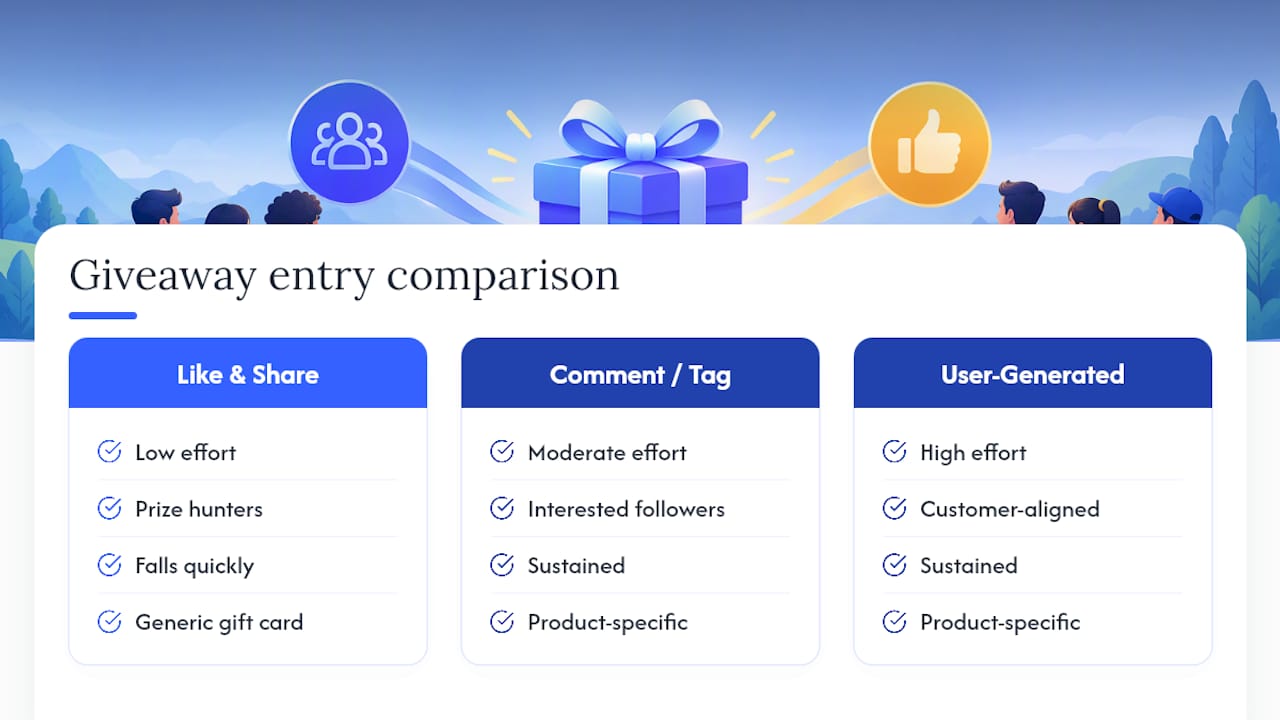
Structure a contest around one of your existing content pillars instead of running it as a standalone gimmick. A bakery giving away a custom cake works better tied to a “tag someone who needs this” comment prompt than a plain “like to win” post, because the comment prompt actually satisfies the same engagement signals Reels and text posts rely on. Keep the prize relevant to your actual audience. A generic gift card draws in prize hunters who unfollow the moment the winner’s announced, while a product-specific prize draws in people who were already close to becoming customers.
Run giveaways on a modest, predictable schedule, maybe once a quarter, rather than constantly, so each one still feels like an event worth participating in. Announce the winner publicly and tag them, which turns the close of the contest into one more piece of shareable, comment-worthy content on its own.
A 60 to 90 Day Plan You Can Copy
Month one: fix your Page, post two Reels a week, join five relevant Groups, and put a small boost behind your single best-performing Reel. Month two: double down on whatever format won, export comments weekly for content ideas, and launch a Group tied to your Page. The pitfall we’d flag hardest: chasing follower count instead of watch time and comments, which quietly kills reach for months before anyone notices why.
— fan
Sources
This guide draws on Facebook’s official Page growth guidance, Reels engagement data from SocialPilot, Sprout Social’s engagement research, and Statista’s engagement rate benchmarks.
- How Facebook’s algorithm favors video and what to post
- 13 Strategies to Increase Facebook Engagement – Sprout Social
- Average Facebook page user engagement rates (selected posts) worldwide – Statista
よくあるご質問
How Long Does It Take to Grow a Facebook Audience?
Most Pages that follow a consistent Reels and engagement routine see measurable movement in engagement rate within 60 to 90 days. Raw follower counts typically lag a few weeks behind engagement gains, so track engagement first.
How Many Reels Should I Post Per Week to Grow Faster?
Aim for 2 to 4 Reels per week plus one long-form video. Consistency at this pace tends to outperform sporadic bursts of higher volume.
Does Buying Facebook Followers Help Page Growth?
No. Broad “page like” campaigns bring in low-intent followers who rarely engage, which drags down your average engagement rate on future posts. A small boost targeted at people who already engaged with a top post produces far better-quality followers.
Do Facebook Groups Actually Help Grow a Business Page?
Yes.
What’s the Single Biggest Mistake People Make Growing a Facebook Page?
Chasing follower count instead of watch time and comments. Facebook’s distribution runs post by post, and early engagement signals matter more than total followers for how far any single post travels.