
目次
The main content creation types are text, video, audio, visuals, social and short-form posts, interactive pieces, gated long-form assets, webinars, and email. Pick by goal, audience, and resources. Short articles lead usage among B2B marketers, while video ranks as the most effective format. On Fanspicy, we see live streams, private messages, and exclusive posts earn directly from fans.
TL;DR:
- Wistia found videos under one minute averaged 50% engagement, so test concepts in short clips before committing to longer productions.
- Gate an ebook or guide only when its value justifies asking for contact details; otherwise, keep it open to protect reach.
- Interactive content appeared in 27% of B2B marketers’ programs; start with a poll or simple quiz, then track completion, shares, and what people do afterward.
- For subscription pages, a predictable schedule beats volume: promise a weekly photo set or monthly longer video, and tell subscribers what is coming.
目次
- 1. Text content: articles, posts, and how-tos
- 2. Video: short-form, long-form, and live
- 3. Audio: podcasts, clips, and voice notes
- 4. Visuals and graphics
- 5. Social media and short-form posts
- 6. Interactive content
- 7. Gated and long-form assets
- 8. Webinars, live events, and virtual experiences
- 9. Email and newsletters
- 10. Tools, AI, and production workflows
- 11. Repurposing and distribution
- 12. How to choose the right formats for your goal
- 13. Content built for subscription platforms and monetization
- 14. Engaging live cam and interactive paid streams
- 15. Private messaging content for fan engagement
- 16. Content types that earn tips and paid posts
- 17. Measuring content on paid and exclusive platforms
- 18. Which formats to prioritize without burning out
- よくあるご質問
- Sources
1. Text content: articles, posts, and how-tos
Text is the base layer of almost every content plan. It covers short posts, long-form articles, listicles, how-tos, and guides. Short pieces answer one question fast. Long-form pieces build depth, rank for broader searches, and give you raw material to cut up later.
The numbers back this up. Content Marketing Institute’s 2025 B2B research found short articles or posts were the most widely used type, at 92% of B2B marketers, with long articles at 69%. Those figures describe B2B marketers, not every creator, but they show how central written formats are.
A few production habits make text work harder:
- Lead with the answer. Put the main point in the first two sentences, then explain.
- Write headlines for a person. A clear promise beats a clever pun.
- Break up the page. Short paragraphs, descriptive subheads, and the occasional list help scanners.
- Cover one search intent per piece. A page that tries to answer five questions usually answers none well.
- Name specifics. Tools, numbers, and examples make a post more useful than general advice.
Choose short text when you need speed, frequency, or a quick answer. Choose long-form when the topic needs steps, comparisons, or proof. A how-to works best when the reader can finish the task while the page is still open.
Text also repurposes easily. A single section of a long article can become a social caption, a newsletter entry, or the script for a short video. A listicle can become a carousel, with each item turned into one slide. Keep every text asset in one folder, tagged by topic, so you can pull from it when you need a quick post. If you want examples built for subscription creators, our guide to content creation ideas for adult creators shows how written teasers support paid content.
2. Video: short-form, long-form, and live
Video is where attention is most competitive, and where the format choice matters most. Think in four length bands: under one minute, one to three minutes, three to five minutes, and long-form. Live streaming sits beside these as its own type, because it happens in real time and invites direct interaction.
Marketers rate it highly. In CMI’s research, video ranked as the most effective format, cited by 58% of marketers, ahead of case studies and short articles.
Short videos under one minute averaged 50% engagement in Wistia’s 2025 report, the highest of any length band. For creators, that makes the first minute the place to test ideas before committing to longer productions.
Each length does a different job:
- Under one minute: discovery, teasers, and quick tips. Built to be watched with no commitment.
- One to three minutes: a single demonstration or story, with a clear start and finish.
- Three to five minutes: tutorials and walkthroughs where you earn authority.
- Long-form: interviews, deep dives, and recorded sessions for your most committed viewers.
- Live streams: real-time interaction, where viewers ask questions, send tips, and shape what happens next.
Wistia also reported that AI use in video production more than doubled year over year, with 41% of brands using AI for video creation, and that captions adoption rose notably. Captions matter because many people watch with the sound off.
A quick production checklist keeps things moving. Write a loose script or outline. Design a thumbnail that matches the promise of the video. Add captions. Check the audio before you check the lighting, since viewers forgive a plain background faster than muffled sound.
Repurposing is where video pays back its effort. Clip the best moments from a long recording, pull a transcript for a written post, and turn a live stream’s highlights into short teasers. On a paid platform, live sessions can be monetized through subscriptions and tips, then clipped into free previews that bring new viewers in.
3. Audio: podcasts, clips, and voice notes
Audio suits people who listen while doing something else: commuting, cleaning, working out. It rewards a distinct voice and consistent structure more than polish.
The common podcast shapes are easy to tell apart:
- Serial: episodes follow one story or theme across a season, so listeners start at the beginning.
- Interview: a host talks with a guest. The guest brings an audience and fresh ideas.
- Solo: one voice, one topic. Easiest to produce, hardest to keep varied.
- Short audio: clips and voice notes for social feeds, or private audio for paying fans.
Production comes down to three basics. First, record in a quiet room with soft surfaces, like a closet full of clothes, to cut echo. Second, use a decent microphone placed close to your mouth and keep volume consistent. Third, settle on a show structure so every episode has the same bones: a short intro, the main segment, and a closing call to action.
Editing can stay simple. Remove long pauses and obvious stumbles, normalize the volume, and add a short intro. Perfection is not required, but clarity is. If listeners cannot understand you, nothing else matters.
Audio is one of the easiest formats to stretch into other formats. A transcript becomes a blog post or a set of social captions. A strong audio moment becomes an audiogram, which pairs a waveform animation with the clip for social feeds. Show notes become a resource page with links and takeaways.
Where does audio fit in the funnel? Short clips work early, introducing your voice. Full episodes work in the middle, where people decide whether they trust you. Private voice messages work late, where a personal touch can turn a casual follower into a paying fan. Pick one lane to start and add the others once your routine is steady.
4. Visuals and graphics
Visual content carries meaning faster than text. It includes photos, illustrations, infographics, and data visualizations, and each has a clear best use.
- 写真 build authenticity and show the real person or product behind the content.
- Illustrations: explain ideas that photos cannot, or give a brand a recognizable look.
- Infographics: turn a process or comparison into a single scannable image.
- Data visualizations: make large datasets readable. CMI’s research found data visualizations used by 57% of B2B marketers, so readers are used to seeing them.
Design principles stay consistent across all of them. Use a limited color palette, readable fonts, and generous spacing. Keep one idea per image. If someone cannot grasp the point quickly, simplify it.
Accessibility deserves real attention. Add alt text that describes what the image shows and why it matters. Include captions when a visual contains key information. Check that text has enough contrast against its background. These steps help people using screen readers and also help search engines understand your page.
Sizing is the practical trap. Each channel crops differently: a square post, a vertical story, and a wide article header all need their own dimensions. Build a template for each so you do not redesign from scratch every time.
Visuals also repurpose well. An infographic can become a blog header, a series of social posts, or slides for a webinar. A strong photo can anchor a newsletter. Keep your original files in high resolution so you can resize without losing quality. A small, well-organized visual library saves hours each month.
5. Social media and short-form posts
Social formats are built for speed and discovery. They include posts, stories, reels, threads, microblogs, and memes, and each platform rewards slightly different habits.
Short-form video is the main discovery engine on many feeds, which lines up with marketers’ plans: short-form video was the top format they intended to invest in more. Stories suit casual, time-limited updates. Threads suit explanations broken into steps. Memes suit relatable humor, if they fit your voice.
Creative constraints help more than they hurt:
- Hook in the first line or second. If the opening is weak, nothing after it gets seen.
- Write captions that add value. Context, a question, or a clear next step beats filler.
- Stay consistent, not constant. A cadence you can sustain beats a burst you cannot.
- Match the platform. Vertical for stories and reels, concise for microblogs, visual-first for photo feeds.
- Invite a response. Ask something specific so replies come easily.
Long assets feed social naturally. Pull one claim from a guide and make it a post. Turn a three-step process into a thread. Cut a webinar into short clips. Each piece points back to the fuller version.
プロのアドバイス Batch your social posts once a week from a single long asset, so every post comes from work you already finished.
For paid creators, social platforms act as the front door. Free posts attract attention, and subscription pages convert it. Our breakdown of social media content marketing for adult creators covers platform-specific distribution in more detail. Watch which formats pull people to your profile, not just which get likes, since likes rarely pay anything.
6. Interactive content
Interactive content asks the audience to do something: answer, choose, calculate, or vote. That participation makes it memorable and lets you personalize results.
Examples map neatly to funnel stages:
- Discovery: short quizzes that sort people into types and suggest content.
- Consideration: calculators that estimate earnings, savings, or fit.
- 婚約: polls and “this or that” posts that let followers shape what you make next.
- Retention: interactive checklists or challenges that bring people back.
CMI reported interactive content used by 27% of B2B marketers, so it remains less common than articles and video, which means it can help you stand out. Practitioner guidance on planning a content mix for nonlinear buyer journeys says interactive content typically performs better for engagement and personalization than static pieces, because people see results about themselves.
You do not need developers to start. Poll stickers on stories take seconds. Form tools can run a simple quiz. A spreadsheet can power a basic calculator. Start with the smallest version, see whether people use it, and invest further only if they do.
Measure what matters: completion rate, shares, and what people do afterward. A quiz that many people start and few finish needs fewer questions. A calculator people use but do not share may need a more surprising result. Treat each interactive piece as an experiment, and keep a note of what you changed so the lessons carry over to your next one.
7. Gated and long-form assets
Gated assets are longer pieces that readers unlock, usually by sharing an email address. They include e-books, white papers, guides, and toolkits. CMI found e-books and white papers used by 51% of B2B marketers, so the format is well established.
Use a gated asset when the content is valuable enough that a reader will trade contact details for it, and when you want a list of people who care about the topic. Keep content open when your goal is reach, since a gate cuts traffic.
Structure matters for both readability and conversion:
- Make chapters modular. Readers should be able to jump to what they need.
- Put one clear call to action per section. Do not scatter five different asks.
- Open with the outcome. Tell people what they will be able to do after reading.
- Use a short form. Every extra field costs you sign-ups.
- Add visuals and checklists. They break up long text and make the asset feel useful.
Gated assets can feed everything else. A chapter becomes a blog post. A checklist becomes a social carousel. A section becomes an email sequence, one lesson per message. A topic can become a webinar. Because these pieces are large, they pay off most when you plan their afterlife before you write the first page.
8. Webinars, live events, and virtual experiences
Webinars and live events ask for more of the audience’s time, which is exactly why they convert well. People who make time for a webinar are often seriously interested. Use them when you want to teach something in depth, answer questions live, or build community around a shared interest.
Formats vary: a workshop that teaches a skill, a panel with guests, a live Q&A, or a virtual event with several sessions. CMI’s findings that live streaming was the second most planned investment show marketers see value in real-time formats.
A short production checklist:
- Choose a platform that handles your audience size and offers chat, polls, and Q&A.
- Write a run-of-show with timings for the intro, main content, interaction, and wrap-up.
- Plan at least two audience interaction moments so people do not just watch.
- Rehearse once, including screen sharing and audio.
- Prepare a follow-up plan before you go live.
The event is only half the work. Afterward, send the recording to registrants, cut highlights into short clips, and turn key questions into articles or an FAQ. Offer a gated resource to attendees as a thank-you, and use it to move interested people toward a subscription, product, or next session. A recording that sits unlabeled in a folder wastes most of its value.
9. Email and newsletters
Email is the format you own. Algorithms change, platforms rise and fall, but a list of people who opted in stays reachable. That makes it central for retention and revenue.
Newsletters take several shapes:
- Digest: a roundup of your latest posts, videos, or streams.
- Curated: a short list of outside links with your commentary.
- Long-form: one essay or lesson per issue, written like an article.
Pick the one you can maintain, and keep each issue focused on a single main idea with one clear call to action.
List building starts with a simple reason to subscribe. Offer a useful checklist, early access, or a regular insight people want. Segment subscribers by interest or behavior so you can send relevant messages instead of one broadcast to everyone. Set a cadence you can keep: weekly or biweekly is easier to sustain than daily.
Email tools are used by 36% of marketers in CMI’s tool adoption snapshot, so it is far from universal, and plenty of creators leave this channel underused.
Monetization follows trust. Newsletters can promote a paid subscription, announce new releases, or sell an email-first offering like a paid weekly edition. They also recycle content cleanly: a blog post becomes an issue, a podcast episode becomes a summary with a link, and a webinar becomes a follow-up sequence. Treat email as the place where your best material gets a second life.
10. Tools, AI, and production workflows
The right tools shorten production time, and the wrong ones eat it. Categories matter more than brand names. In CMI’s tool adoption snapshot, writing and copy tools were used by 89% of marketers, creative asset tools by 53%, SEO tools by 41%, social scheduling tools by 38%, and email tools by 36%. The same source reported that about 68% of marketers were exploring AI, and almost nine in ten already used AI for content.
A practical toolkit usually includes:
- Writing assistants for outlines, drafts, and edits.
- Creative asset tools for graphics, video editing, and audio cleanup.
- SEO tools for keyword research and page checks.
- Schedulers for planning social posts ahead.
- Email platforms for newsletters and segmentation.
The bigger risk is not a missing tool but trying to do everything at once. Practitioners recommend assigning specific roles to each format: short-form video for discovery, tutorials for authority, and interactive posts or direct messaging for driving purchases. Give each format one job and you avoid burning out on formats that do not serve a goal.
AI speeds up drafts, but it needs human checkpoints. Review facts against real sources. Edit for your own voice. Check that images and clips do not misrepresent anything. Read the final piece out loud once. If it sounds like nobody in particular wrote it, rewrite it until it does.
プロのアドバイス Use AI for the first pass on outlines and rough drafts, then spend your own time on the parts only you can supply: opinions, stories, and examples.
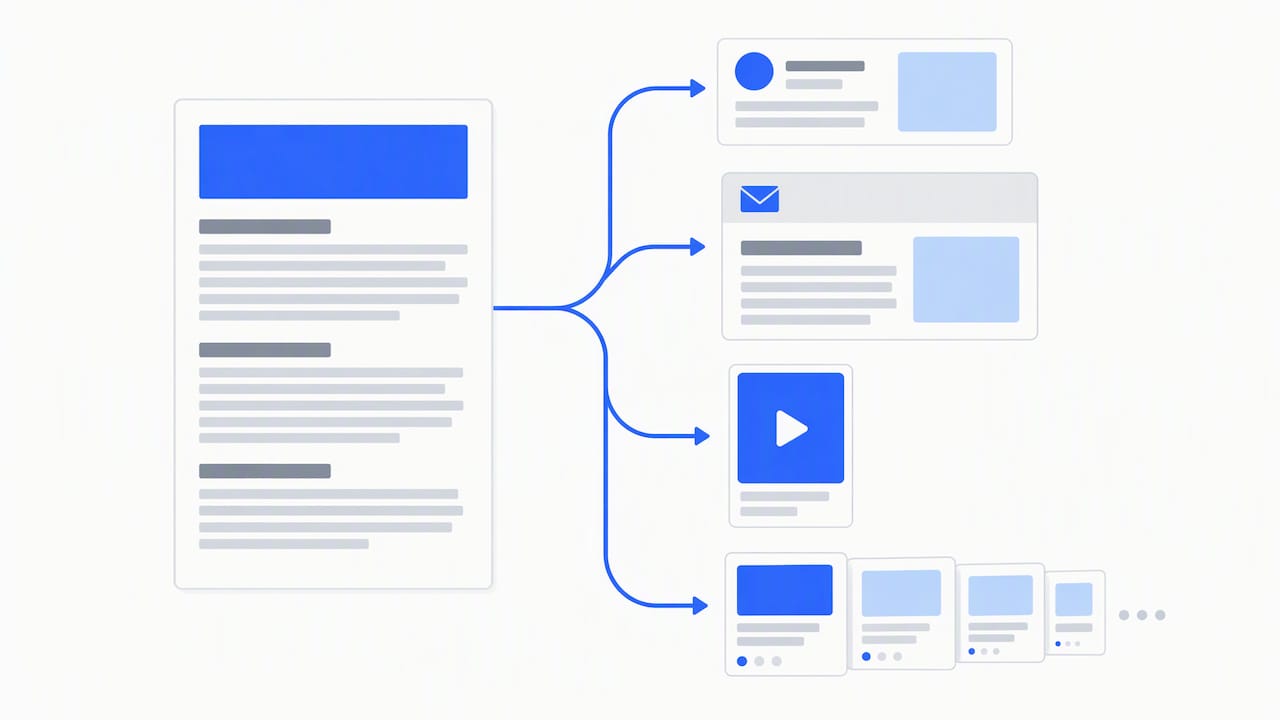
11. Repurposing and distribution
Repurposing means making one idea do many jobs. The aim is not to post the same thing everywhere, but to reshape one core asset for each channel.
A simple flow works for most creators:
- Create the primary asset. Choose one substantial piece, such as a long video, an article, or a live session.
- List the derived assets. Pull out quotes, steps, clips, images, and questions.
- Match each to a channel. Short clips go to feeds, quotes to graphics, steps to a thread, the full piece to your site or paid page.
- Schedule the release. Spread posts over time so one piece carries many days.
- Review results. Note which derivative performed best and make more like it.
Channel match guides priorities. On discovery channels, watch reach and engagement. On owned channels like email and your site, watch sign-ups and clicks. On paid pages, watch conversions and renewals. Do not judge a feed post by revenue or a subscription page by likes.
A quick prioritization checklist can keep you focused. Ask what your main goal is this month, which format your audience already responds to, and how many hours you can give. Then pick one primary asset and three derivatives, no more. For paid creators, our content creation process guide for paid social platforms offers workflow tips that apply here. Distribution is just as important as creation, because a good piece nobody sees does nothing for you.
12. How to choose the right formats for your goal
Choosing formats is a matter of fit, not fashion. Work through these criteria:
- Goal: awareness, consideration, conversion, or retention.
- 観客の行動 where they spend time, and whether they read, watch, or listen.
- Time and budget: what you can sustain, not what you can do once.
- Skills: the formats you can produce well now, and those worth learning.
- Measurement: what number tells you the format worked.
A simple flow: start with your goal, pick the format that fits your audience, check that you can produce it regularly, and decide how you will measure it. If the answer to any step is no, choose a simpler format.
Three starter mixes cover most situations:
| Goal | Core formats | Support formats | Main measure |
|---|---|---|---|
| Discovery | Short-form video, social posts | Visuals, short articles | Reach and profile visits |
| Conversion | Live streams, webinars | Gated guides, email | Sign-ups and purchases |
| Retention | Newsletters, private messages | Exclusive posts, interactive polls | Renewals and repeat engagement |
Start with one mix and give it a consistent trial before changing it. Changing everything at once makes it impossible to know what worked. Review what you measured, keep what earned attention, and drop what did not.
13. Content built for subscription platforms and monetization
Subscription platforms change what “good content” means. Instead of chasing the widest audience, you serve people who already chose to pay, and your job is to keep giving them a reason to stay. The strongest formats are those that feel exclusive: members-only posts, behind-the-scenes photos and video, early access to new releases, and bundles that group related pieces at a set price.
A healthy subscription page usually has three layers. A free layer, such as public previews and teasers, brings in new fans. A subscriber layer holds regular exclusive content that justifies the recurring fee. A premium layer, such as paid posts, bundles, and custom requests, rewards your most engaged fans. Our guide to subscription-based content and recurring revenue explains how those formats map to monetization.
Consistency matters more than volume. Fans pay monthly, so a predictable schedule, such as a weekly photo set and a monthly longer video, builds trust. Tell subscribers what is coming so they feel they are part of something ongoing.
Creators on our platform can sell subscriptions, exclusive content, and paid posts, and we built it to let creators keep more of their earnings and own their audience relationship. Our become a model page explains how to start selling exclusive content, tips, and paid posts. Because the audience is direct, you can test which exclusive formats keep subscribers renewing and shift effort toward those.
14. Engaging live cam and interactive paid streams
Live streaming is the most interactive format a creator can offer. Viewers can react in real time, which makes sessions feel personal in a way recorded content cannot. Live streaming ranked as the second most planned investment among marketers, and on a paid platform it also earns directly.
A few habits make streams hold attention:
- Announce a schedule. Fans show up when they know when.
- Plan a loose structure. An opening, a main segment, and a closing keep things moving, with room for spontaneity.
- Use the chat. Say names, answer questions, and let viewers vote on what happens next.
- Offer paid interaction. Tip menus, goals, and requests give fans a way to take part and support you.
- Keep the setup reliable. A steady connection and clear audio matter more than expensive gear.
Interactive paid streams work best when viewers feel their input changes the outcome. A poll that picks the next topic, a goal that unlocks a special segment, or a Q&A block all create reasons to stay and to spend.
Do not treat the stream as a one-off. Clip the best moments into free previews for your feed, and offer replays to subscribers. A strong live session feeds your short-form content for days. Review each stream afterward: when did viewers join, when did they leave, and what drew tips? Those answers show you what to repeat.
15. Private messaging content for fan engagement
Private messages are the one-to-one layer of a creator business. They let you talk directly with fans, which builds loyalty and opens another revenue stream. Several types work well:
- Welcome messages: a short, warm note to new subscribers that sets expectations.
- Broadcast updates: a message to all subscribers announcing a new post or stream.
- Paid messages: locked content, such as photo sets, clips, or voice notes, that a fan unlocks for a fee.
- Custom requests: personalized content created at a fan’s request, priced accordingly.
- Check-ins: a quick message to a quiet subscriber, which can bring them back.
Practitioners note that direct messaging helps drive purchasing decisions, because it moves fans from browsing to buying through personal contact.
Quality beats quantity here. A thoughtful message to a smaller group often earns more than a mass blast. Use the fan’s name, refer to something they engaged with, and make the offer clear. Keep a record of preferences so each conversation builds on the last.
Set boundaries. Decide your response hours, your pricing for customs, and what you will not do, then state them clearly. That protects your time and keeps interactions pleasant. Private messaging is where free followers turn into paying fans and paying fans turn into long-term supporters, so a small amount of consistent effort here goes a long way.
16. Content types that earn tips and paid posts
Tips and paid posts reward content that makes a fan want to say thanks or unlock more. Not every post suits both, so match the format to the action you want.
Tips tend to follow moments of connection. Live streams, personal updates, and posts that answer a fan’s question all invite a tip because the fan feels seen. A short note that thanks supporters and mentions what the tips will fund can encourage more. Make tipping easy and visible, but do not nag.
Paid posts work when the preview makes the value clear. A free teaser, such as a blurred photo, a short clip, or a strong caption, shows what is behind the lock. The paid version should deliver on that promise and then some. Series help: a multi-part set, a themed collection, or a bundle gives fans a reason to buy the next one.
A few reliable approaches:
- Teaser plus unlock: free preview, paid full version.
- Series and bundles: group related pieces at one price.
- Limited drops: content available for a short window, which encourages quick action.
- Fan-driven topics: let supporters vote on what you make, then sell it.
Our exclusive content, tips, and paid posts help creators monetize their content. Vary formats so fans do not see the same offer every week, and track what sells. Content that earns tips and content that earns paid unlocks often differ, so measure each separately and lean into what your own audience rewards.
17. Measuring content on paid and exclusive platforms
Likes and views are a start, but on paid platforms the real question is whether content earns and retains money. Wistia’s report notes that marketers prioritize engagement rate and conversion, and that logic carries straight over to subscription pages.
Track a small set of numbers:
- Subscriber growth: new sign-ups, and which post or stream brought them.
- Retention and renewals: how many subscribers stay month to month.
- Revenue per format: earnings from subscriptions, paid posts, tips, and messages, tracked separately.
- Conversion from free to paid: how many free followers become subscribers after a teaser or preview.
- Engagement on exclusive content: opens, unlock rates, and replies to private messages.
Compare by format, not just by total. If live streams bring tips but few new subscribers, while short clips bring subscribers but little tipping, you now know each format’s job. That matches the idea of assigning each format a role.
Review on a regular rhythm, such as monthly. Write down what you changed and what happened next, so you do not guess later. Be cautious about small sample sizes: one slow week does not make a trend. Look for patterns across several weeks before shifting your whole plan. Measurement is not about chasing every metric but about learning which content earns attention and income, so your limited time goes where it matters most.
18. Which formats to prioritize without burning out
Creators who last tend to start small. They test one or two formats, measure the results, and double down on what works, rather than trying every format at once.
Practical steps that creators commonly use:
- Pick one primary format. Master it before adding another.
- Test in small batches. Try four posts of a new format, then look at results.
- Set a cadence you can keep. A modest schedule held for months beats an ambitious one that collapses.
- Reuse before you create. Repurpose a good asset before starting something new.
- Schedule rest. Plan breaks into your calendar so they are not accidents.
The most common rookie mistakes are inconsistent posting and chasing every format at once. The fix for both is the same: shrink the plan. Choose fewer formats, give each a clear job, and keep your schedule realistic. Our creator guides and playbooks, including our write-up on types of content creation and revenue, are meant to help you set that plan without overcommitting.
My view, after looking at how these formats stack up: the format you can sustain beats the format that looks best on paper. A plain newsletter you actually send will outperform a polished video series you abandon. Pick the formats that fit your life, then let the results tell you where to grow.
— fan
よくあるご質問
How many types of content creation are there?
There is no fixed number, because lists vary by how finely they split formats. Some guides name 25 common types, while others catalog 113. Most can be grouped into text, video, audio, visuals, social, interactive, and long-form assets.
What are the 4 types of content?
A common simple grouping is written, visual, audio, and video content. Written covers articles and posts, visual covers images and infographics, audio covers podcasts and clips, and video covers everything from short clips to live streams. Many creators add interactive content as a fifth group.
What are the 3 C’s of content creation?
The 3 C’s are often described as clarity, consistency, and connection. Make each piece easy to understand, publish on a steady schedule, and speak to what your audience actually cares about. Sources differ on the exact wording, so treat it as a useful rule of thumb rather than a standard.
How do I choose which content formats to start with?
Start with your main goal, then pick the format your audience already uses and that you can produce regularly. Practitioners suggest giving each format a specific role, such as short video for discovery and tutorials for authority. Test one or two formats before adding more.
Sources
- B2B Content Marketing: 2025 Benchmarks & Trends
- Wistia’s 2025 State of Video Report Shows Use of AI in Video Production More than Doubled Over Last Year
- The 23 Types of Content Marketing Your Business Needs to Know