

目次
Content creation types are the distinct formats you use to communicate a message, from blog posts and short videos to podcasts and interactive tools. The single most useful move you can make right now is to pick your primary marketing goal, awareness, engagement, authority, or conversion, and choose one main format plus one supporting format that serve it directly. Everything else, the categories, the process, the metrics, builds from that decision.
TL;DR:
- Short-form videos and social posts are most effective for building awareness among mobile audiences and should be judged by impressions and shares.
- Long-form content like webinars, case studies, and detailed guides establish authority but require significant time and resources, making them suitable for trust-building over time.
- Repurposing one in-depth asset into multiple formats, such as short clips, blog transcripts, and email snippets, maximizes ROI and content efficiency.
- Choosing formats aligned with your audience’s platform habits and engagement stage improves conversion likelihood and prevents resource waste.
- A focused content strategy begins with one primary format linked to your main goal, tested over several weeks with clear KPIs, before expanding into additional types.
目次
- What Content Creation Actually Means (and Why the Format You Pick Matters)
- The Full Catalog: Textual, Multimedia, and Other Content Formats
- How to Match Content Formats to Your Marketing Goal
- The 5-Stage Content Creation Process
- Metrics That Tell You a Format Is Working
- Turning Format Choices Into Revenue: A Creator’s View
- Weighing the Trade-Offs: What Each Format Costs You
- Where Content Creation Is Headed: Interactive, Live, and Immersive Formats
- The Tools Creators Actually Use to Produce Each Format
- Choosing Formats Based on Who You’re Actually Talking To
- Sources
- よくあるご質問
What Content Creation Actually Means (and Why the Format You Pick Matters)
Content creation is the process of producing material, written, visual, audio, or interactive, that informs, entertains, or persuades a specific audience. Every piece falls into one of three broad buckets, a structure FirstSiteGuide’s breakdown of content types uses to organize the hundreds of formats now in circulation:
- Textual content: blog posts, white papers, email newsletters. Built for search visibility and depth.
- Multimedia content: video, podcasts, infographics. Built for attention and emotional connection.
- Other formats: quizzes, calculators, templates. Built for interaction and lead capture.
Here’s the part creators underestimate: the format you choose doesn’t just change how the content looks, it changes where it lives, who sees it, and how you’ll know if it worked. A podcast lives on Spotify and gets measured by downloads. A landing page lives on your domain and gets measured by conversion rate. Pick the format before you pick the metric, not after.
The Full Catalog: Textual, Multimedia, and Other Content Formats
Marketers searching for “types of content creation” usually want the actual list, not a theory lecture. Here it is, organized by category, with what each format is genuinely good for and what it costs you in production time.
Textual formats
Blog posts remain the workhorse of search-driven traffic. A single well-optimized post (typically 1,200 to 2,500 words) builds compounding organic visibility over months, unlike a social post that dies in 48 hours. Production effort: medium. Best distribution: your owned website, syndicated through email and social snippets.
Guides and how-to content go deeper than blog posts, often 2,500+ words, and target readers actively trying to solve a problem. They’re slower to write but convert well because the reader has already shown intent by searching.
Listicles (“7 ways to…”, “12 types of…”) work because they promise scannable value up front. Production effort: low to medium. They perform especially well for awareness and social sharing.
White papers and case studies carry the most authority weight of any textual format. They require original data or a documented result, which makes them slow to produce (high effort) but extremely effective for B2B trust-building and sales enablement.
よくあるご質問 are low effort, high return. They capture long-tail search queries and reduce support friction simultaneously.
Multimedia formats
Short-form vertical video (under 90 seconds, built for TikTok, Reels, Shorts) is the fastest-growing format for reach right now. Production effort is low relative to its payoff, which is exactly why repurposing trends favor short clips pulled from longer assets rather than shooting new footage for every post.
Long-form video (YouTube tutorials, deep dives) demands more editing time but wins on search discoverability. YouTube specifically rewards longer tutorial content in its own search results, making it a strong authority play if you can sustain the production schedule.
ポッドキャスト build intimacy and repeat listenership that few other formats match, but the effort curve is uneven: recording is fast, editing and show notes are not.
Webinars combine live urgency with lead capture. High effort to plan, but they convert warm audiences better than almost any other single-session format.
インフォグラフィックス compress data into something shareable in seconds. Low to medium effort if you already have the research; they’re most valuable when your data is the actual story.
Animations and explainer videos simplify abstract concepts. High production effort, often outsourced, but effective for product education.
Photography underpins almost everything else, product shots, behind-the-scenes imagery, personal branding, and it’s frequently the cheapest format to produce well with a phone camera and decent light.
Other formats
Email newsletters remain, according to platform-strength comparisons, the highest-converting owned channel for nurturing an audience over time. Low production effort, high retention value.
Landing pages exist for one job: conversion. Every element should point toward a single action.
Calculators, templates, and quizzes trade a useful tool for an email address or a few seconds of attention. Medium effort to build once, then they run largely on autopilot.
プロのアドバイス Don’t build a new format from scratch every time. Take your best-performing blog post and turn its core argument into a 60-second video script, that’s two content creation types produced from one research effort.
How to Match Content Formats to Your Marketing Goal
Choosing among dozens of content creation methods gets simple once you stop asking “what should I make?” and start asking “what does this piece of content need to do?” HubSpot’s own guidance on content marketing types makes the same point: pick formats that match your business goal rather than attempting every format at once.
- Awareness goal → short-form video or social posts. These formats are built for reach, not depth. Judge them by impressions and shares, not conversions.
- Engagement goal → interactive content or email. Quizzes, polls, and newsletters invite a response rather than a passive scroll.
- Authority goal → long-form blog content, webinars, or case studies. These build the kind of trust that takes weeks to earn and pays off for years, particularly when a top-of-funnel asset is deliberately paired with a mid-funnel education format like a webinar or detailed guide.
- Conversion goal → landing pages, email sequences, or paid posts. These formats exist to close, not to introduce.
Before committing, run a four-point checklist: Where does your audience already spend time? What are you actually good at producing consistently? What resources and cadence can you sustain for at least eight weeks? And do you have a distribution plan, or just a publish button?
The starter plan is simple: one primary format tied to your top goal, one supporting format that helps distribute or convert it. CoSchedule’s own catalog documents over 100 content types, but the practical advice underneath that breadth is to start narrow. Test your primary format for a defined window before adding a third.
The 5-Stage Content Creation Process
Every format above runs through the same five stages, whether you’re building a blog post or a livestream calendar.
- Ideation. Pull topics from audience questions, competitor gaps, and keyword research. Keep a running list so you’re never starting from zero.
- Planning. Set the goal, format, and distribution channel before you write a word. This is where most creators skip a step and pay for it later.
- Production. Platform shortcuts matter here: a short video can be shot and captioned in under an hour, while a well-researched blog post or WordStream’s own five-step process both point toward the same reality, that longer formats need dedicated drafting and editing time you should schedule in advance.
- Distribution. Publishing isn’t distribution. Share across owned, earned, and paid channels, and time it to when your audience is actually online.
- Optimization. Review performance data and revise, don’t just publish and move on.
The real efficiency gain sits in repurposing. One long-form video can become a blog transcript, three short clips, an email teaser, and a quote graphic, four to five formats from a single production effort, which is exactly the kind of ROI multiplier repurposing strategies are built around.
Metrics That Tell You a Format Is Working
Different formats need different scorecards, and applying blog metrics to a podcast (or vice versa) will make a working format look like a failure.
- Blog posts: organic traffic, average time on page, keyword rankings.
- Video (short and long): watch time, retention rate, shares.
- ポッドキャスト: downloads per episode, listener retention through the episode.
- Email newsletters: open rate, click-through rate, unsubscribe rate.
- Social posts: engagement rate, saves, reach.
- Landing pages: conversion rate, bounce rate.
For a fast read on whether a new format deserves a bigger investment, run a 30 to 60 day test and watch platform-native engagement signals first. Measuring watch time, retention, and open rates before chasing conversion metrics gives you an early signal without waiting for a full sales cycle to play out. If retention or opens climb steadily across four to six pieces, you have a format worth scaling. If they flatten immediately, cut your losses before you’ve sunk a quarter into it.
Turning Format Choices Into Revenue: A Creator’s View
For independent creators, content creation types aren’t just marketing categories, they’re revenue paths. Some platforms reward creators who match format to monetization intent rather than posting at random.
- Live video converts directly into paid live streams, where fans tip and pay in real time for access.
- Short-form clips work as free trailers that promote a paid subscription, giving fans a taste before they commit.
- Exclusive photo sets or written updates become paid posts, a direct monetization lane for textual and visual content alike.
- プライベートメッセージ turns one-to-one engagement into an ongoing revenue stream, separate from public content entirely.
For a deeper breakdown of formats that pair well with subscription income, Fanspicy’s guide to subscription-based content and recurring revenue walks through the mechanics creators use to keep fans paying month over month.
— fan
Weighing the Trade-Offs: What Each Format Costs You
No content creation type is free of trade-offs, and the ones marketers regret most are the ones chosen without weighing the downside.
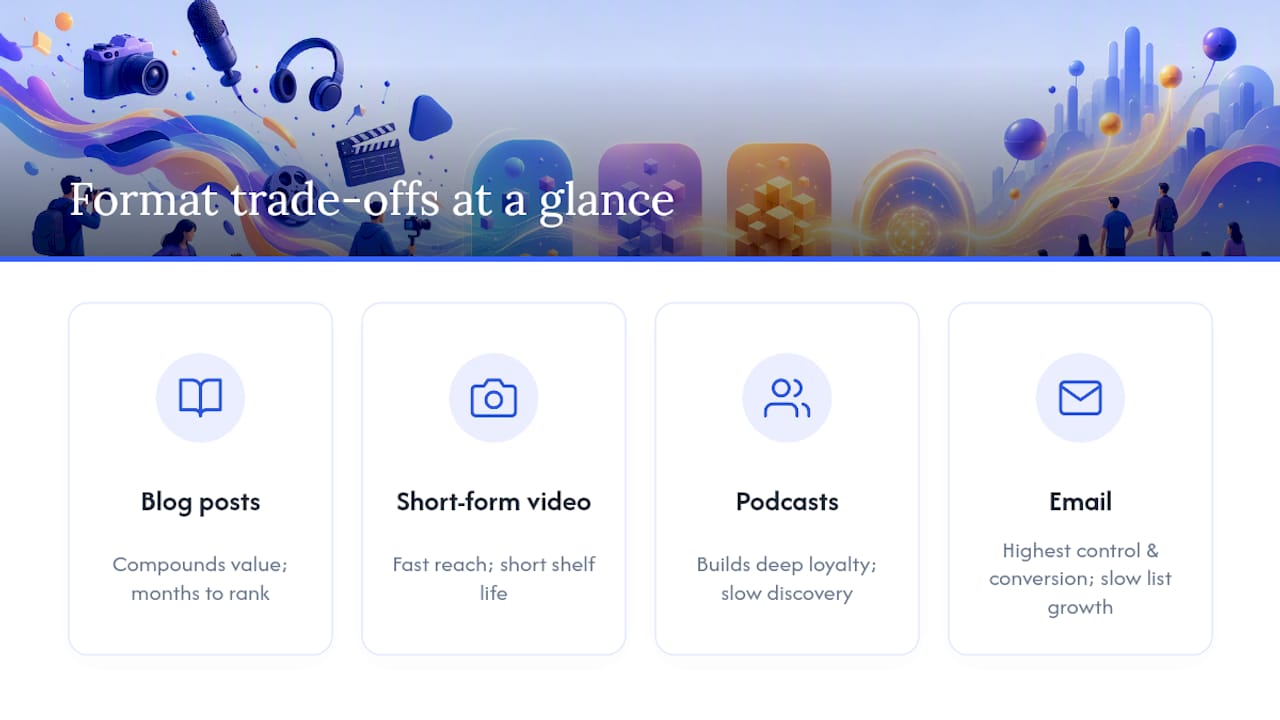
Blog posts compound in value over time but take months to rank, and a single post rarely moves the needle alone. Short-form video reaches new audiences fast but has a short shelf life, today’s viral clip is tomorrow’s forgotten scroll. ポッドキャスト build deep audience loyalty, yet growth is slow and discovery is harder than on visual platforms. Email offers the highest control and conversion of any owned channel, but list growth takes deliberate effort since nobody stumbles onto a newsletter by accident.
Infographics and photography are highly shareable and quick to produce once the research or shoot is done, but they carry limited depth, useful for reach, weak for authority-building. Webinars and white papers build serious credibility and generate strong leads, but the production timeline is long and attendance or download rates can disappoint if promotion is thin.
Interactive content like quizzes and calculators drives strong engagement and data capture, but building a good one requires either technical skill or a budget for one, and a bad one damages trust faster than no tool at all. The pattern across every format is the same: reach and speed trade against depth and durability. Choosing consciously beats choosing by default.
Where Content Creation Is Headed: Interactive, Live, and Immersive Formats
The formats gaining ground fastest right now share one trait: they ask something of the viewer instead of just showing them something.
Interactive content, quizzes, polls, shoppable posts, calculators, converts better than static content because it requires a small action, and that action creates investment. A reader who answers three quiz questions is more engaged than one who scrolled past a paragraph.
ライブ・ストリーミング has moved from a niche format to a mainstream expectation across social platforms and creator platforms alike. It compresses the distance between creator and audience into real time, which is exactly why platforms built around direct fan monetization treat live video as a core revenue format rather than an experiment.
Virtual and augmented reality content is still a smaller slice of the mix for most creators, limited by device adoption and production cost, but brands in retail, real estate, and events are using AR filters and VR walkthroughs to let audiences experience a product before buying it.
Short-form vertical video deserves a second mention here because it isn’t a passing trend, it’s the format most consistently cited as the growth engine of 2026 content strategy, and the smart move is building a repurposing pipeline around it rather than treating it as a separate content stream.
The common thread: audiences increasingly reward content that responds to them, whether that’s a live chat during a stream or a quiz that adapts to their last answer. Static, one-way formats aren’t disappearing, but they’re no longer where the fastest growth lives.
The Tools Creators Actually Use to Produce Each Format
You don’t need an enterprise budget to produce most of the formats covered above, but the right tool does cut production time significantly.
For written content, Google Docs and Grammarly cover drafting and editing, while a keyword tool built into most SEO platforms helps validate topics before you write. For video, CapCut and Adobe Premiere Rush dominate short-form editing on mobile, while Adobe Premiere Pro and Final Cut Pro handle longer, more complex edits. Podcast creators lean on Descript for editing-by-transcript and Anchor (now Spotify for Podcasters) for hosting and distribution.
Design and infographic work runs largely through Canva for speed and Adobe Illustrator for custom, brand-specific graphics. Webinars typically run on Zoom or StreamYard, the latter offering easier multi-platform live streaming. Email newsletters are built and sent through platforms like Mailchimp or ConvertKit, both of which include the open and click tracking you need for the metrics covered earlier.
Interactive content like quizzes and calculators can be built without code using tools like Outgrow or Typeform. For creators building a presence on paid platforms, a tool that centralizes analytics across formats matters more than any single production app, since the real question isn’t “can I make this,” it’s “did this format earn its place in my calendar.”
Choosing Formats Based on Who You’re Actually Talking To
Every format decision should run through one filter before any other: does your specific audience actually consume content this way? A B2B software buyer researching a five-figure purchase behaves nothing like a fan browsing a creator’s page during a lunch break, and treating both audiences the same way wastes production time on formats they’ll never engage with.
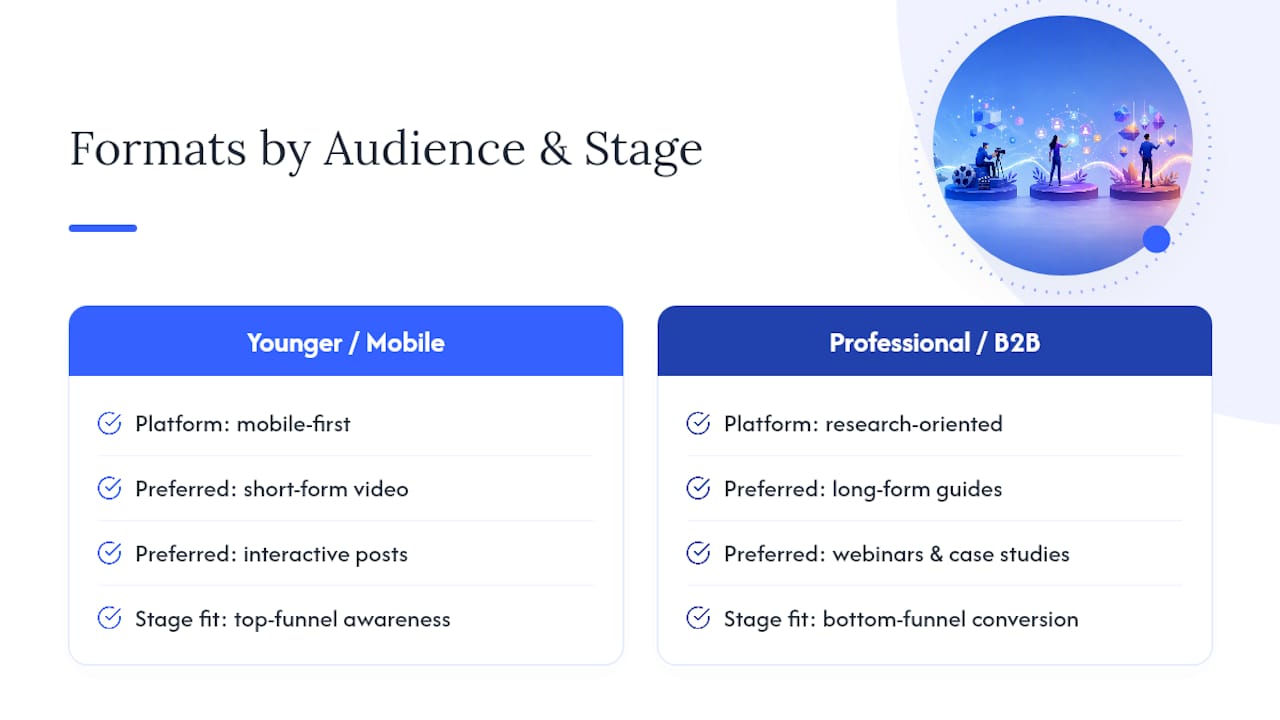
Start with where your audience already spends attention. A younger, mobile-first audience skews toward short-form video and interactive posts; a professional audience researching a purchase decision skews toward long-form guides, webinars, and case studies. Age, platform habits, and purchase intent all shift the calculus.
Consider the buying or engagement stage too. Someone at the top of the funnel, just becoming aware of a problem, responds to lightweight, broad-reach formats like social posts and short video. Someone at the bottom of the funnel, ready to subscribe, buy, or tip, responds to specific, trust-building formats like case studies, testimonials, or a live demonstration. Sending a conversion-stage audience an awareness-stage format (or the reverse) is one of the most common reasons a technically well-made piece of content underperforms.
Finally, weigh format against platform-native behavior. Fans following a creator across social and paid platforms expect different things in each place, teaser content on public social, deeper access behind a subscription. Matching the format to that expectation, rather than posting the same asset everywhere unchanged, is what separates a content calendar that grows an audience from one that just fills a schedule.
Sources
- 100+ Types of Content Creation You Can Use in 2026
- Content marketing types — HubSpot
- 113 types of content marketing you can add to your calendar now
よくあるご質問
How many types of content creation are there?
There’s no fixed number, some catalogs document over 100 distinct formats, but nearly all of them fall under three broad categories: textual, multimedia, and other. What matters more than the total count is picking the two or three formats that actually serve your goal.
What are the 4 types of content?
A common framework splits content into four purpose-based categories: awareness content (social posts, short video), engagement content (quizzes, interactive posts), authority content (blogs, case studies, webinars), and conversion content (landing pages, email sequences). This maps directly to the goal-first approach covered above.
What are the 4 E’s of content creation?
Definitions of this framework vary across marketing resources, so treat any specific version with caution. A commonly cited version centers on Educate, Entertain, Engage, and Empower as the core jobs content should do for an audience.
What are the 3 stages of content creation?
Most frameworks expand this into five stages, ideation, planning, production, distribution, and optimization, but they compress into three broad phases when simplified: planning (ideation and strategy), creation (production), and distribution (publishing and promoting). Skipping the planning phase is the most common reason content underperforms.
What’s the best content type to start with as a beginner?
Start with whichever format matches both your primary goal and your actual production skills, not the format that’s trending. A single blog post or short video, tested consistently for four to six weeks and measured against format-specific KPIs, will tell you more than trying five formats at once ever could.