

Table of Contents
TL;DR:
- Building an engaged community enhances creator retention, loyalty, and monetization over simple content posting.
- Community acts as leverage, supporting growth, stability, and resilience against platform changes, beyond a mere audience.
Content quality gets creators noticed, but community keeps them paid. Some of the most successful creators on subscription-based platforms quietly credit their engaged audiences, not just their content, with delivering stable, scalable income. Yet plenty of creators still treat their audience like a broadcast channel: post, collect revenue, repeat. That approach leaves serious money and loyalty on the table. This article breaks down why community is a structural advantage, how to build one that actually sticks, where monetization works (and fails), and when community alone isn’t the whole answer.
Table of Contents
- Why community matters in creator success
- Building and nurturing your creator community: Tactics that work
- Monetizing your community: What works and what doesn’t
- When community isn’t the main growth driver: The nuance creators need
- Our take: Community is leverage, not a silver bullet
- How Fanspicy can help you build and monetize your community
- Frequently asked questions
Key Takeaways
| Point | Details |
|---|---|
| Community boosts growth | An engaged community turns casual fans into loyal supporters who drive sustained creator success. |
| Metrics matter | Daily active users and retention rates are essential for measuring healthy community momentum. |
| Monetize with value | Offering extras beyond basic access, like exclusive events or resources, increases income and satisfaction. |
| Balance is key | Community is powerful but works best alongside great content and strong platform fit. |
Why community matters in creator success
Now that we’ve set the stage for why communities can’t be ignored, let’s break down exactly what makes them so transformational for creators on subscription platforms.
A passive follower buys once. A community member advocates, renews, and recruits. That distinction is worth everything in a subscription model where churn is the enemy. When fans feel like participants rather than consumers, they stay longer, spend more, and bring others in. That’s not a soft metric. It’s the foundation of sustainable creator income.
Community flips the relationship from transactional to relational. Instead of chasing new subscribers every month to replace those who left, you’re compounding. Each event, response, or personalized interaction deepens the tie between creator and fan. IRL events are one way creators build this connection off-platform, using face-to-face moments to cement loyalty that digital content alone can’t fully create.
Strong content marketing for community-building plays directly into this loop. When your content answers real questions your audience has and invites a response, it seeds conversation. That conversation becomes culture. That culture becomes the glue holding your community together even through slow content weeks or platform algorithm changes.
Here’s what an active, well-tended community actually delivers for creators:
- Reduced churn: Subscribers who feel connected cancel less often.
- Organic referrals: Loyal fans recommend you without being asked.
- Feedback loops: Your audience tells you exactly what content to make next.
- Emotional resilience: A tight community weathers controversy or dry spells better.
- Premium pricing power: Engaged fans accept and often expect higher-tier pricing.
“A creator’s best marketing asset isn’t an ad budget. It’s a community member who genuinely wants to see them succeed.”
Exploring creator content ideas with community feedback in mind shifts your creative process from guesswork to guided strategy. And putting community moderation tips in place early protects that culture from toxic dynamics that erode the trust you’ve worked hard to build.
Building and nurturing your creator community: Tactics that work
With the benefits clear, creators need proven community tactics. Here’s how successful creators actually nurture their communities day to day.
The most common mistake is waiting until you have a large audience before thinking about community. The best communities are built from the very first subscriber. Start the habits early. Here are five concrete steps that work across platforms and niches:
- Onboard intentionally. When someone subscribes, welcome them with a message that sets expectations: what they’ll get, how often, and how they can connect. Make them feel like they joined something, not just bought something. A short welcome video or pinned post does this effectively.
- Moderate actively. Set clear community standards and enforce them fairly and consistently. Toxic members are community killers. Strong community moderation isn’t about being rigid. It’s about protecting the space your fans invested in emotionally.
- Run regular events. Q&As, live sessions, polls, themed weeks. Recurring events create the rhythm that turns a scattered audience into a consistent community. Predictability builds habit, and habit builds loyalty.
- Collect and use feedback. Ask your community what they want to see, what they love, and what’s missing. Then visibly act on it. When fans see their input shape your content, they feel ownership over the community’s direction.
- Reward loyalty. Shout-outs, exclusive content, early access, and personalized perks for long-term subscribers signal that loyalty is recognized and valued.
Pro Tip: Don’t talk at your community. If 90% of your posts are one-way announcements, you’re running a mailing list, not a community. Build interaction into your posting rhythm by ending every update with a question, a poll, or an invitation to share.
For platforms like Discord, retention and engagement metrics such as DAU share and first-day and first-week retention are the clearest early signals of whether you’re building genuine community momentum or just racking up numbers that plateau fast. Track these weekly from day one so you catch disengagement before it becomes churn.

Using subscriber growth tactics in conjunction with community-building compounds both. Growth fills your community with new voices. Community gives those new arrivals a reason to stay. And combining that with smart paid content promotion ensures you’re not just growing a free hangout but a monetizable audience that values what you create. The art of building audience loyalty ties every tactic together into a coherent long-term strategy.
Monetizing your community: What works and what doesn’t
Once your community is thriving, monetization becomes the next step. But how you approach it makes all the difference between growth and backlash.
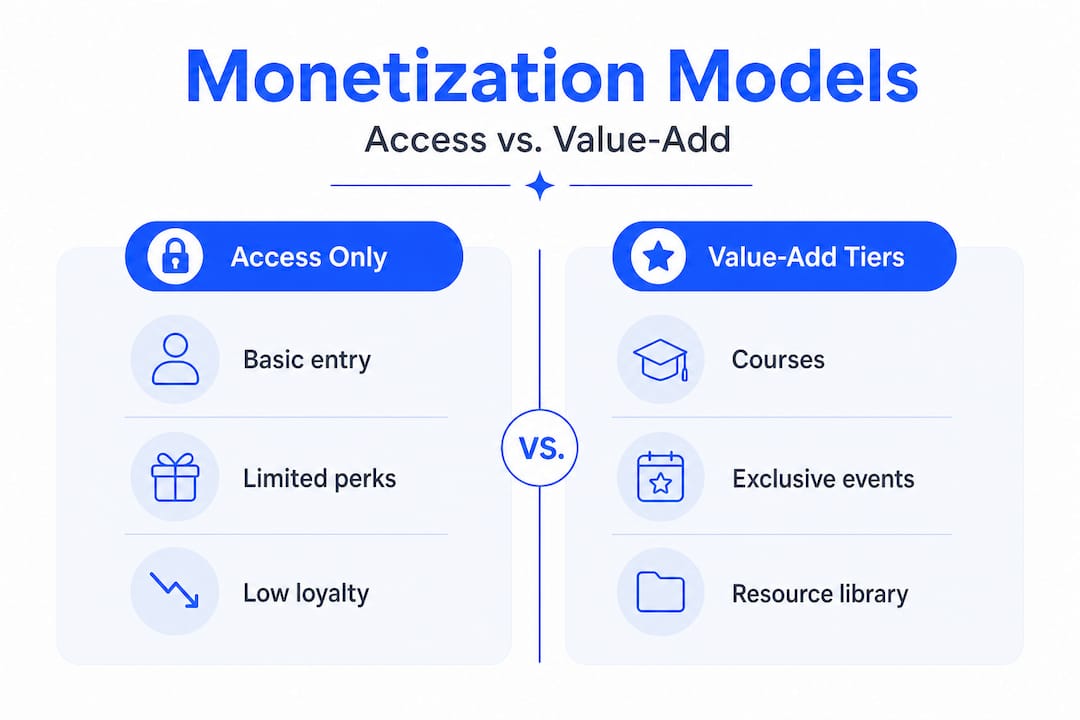
The most common monetization mistake is charging simply for “access.” A paid Discord or subscriber tier that promises community access but delivers nothing extra beyond a different channel quickly feels like a cash grab. Fans see through it fast, and NPS (Net Promoter Score, a measure of how likely fans are to recommend you) drops sharply when they feel deceived.
Community monetization works when paid tiers map to real value-add beyond basic access. Think structured courses, exclusive live office hours, a members-only job board or resource library, personalized feedback, or behind-the-scenes content. When the tier justifies itself with obvious value, satisfaction and retention both climb.
Here’s how different tier structures compare in real outcomes:
| Tier type | Primary value offered | NPS impact | DAU uplift | MRR potential |
|---|---|---|---|---|
| Access only | Community membership | Low or negative | Minimal | Low |
| Content tier | Exclusive posts and videos | Moderate | Moderate | Moderate |
| Coaching/office hours | Direct creator interaction | High | High | High |
| Resource + community | Courses, job board, tools | Very high | High | Very high |
| Hybrid bundle | Content + community + perks | Highest | Highest | Highest |
Case evidence backs this up. Creators who shifted from access-only pricing to value-add tiers have documented NPS jumps from 42 to 58 within a few months, and some have reported reaching meaningful monthly recurring revenue milestones within their first year of applying this structure. The revenue ceiling lifts significantly because subscribers aren’t paying for access. They’re paying for transformation, connection, or professional advantage.
Pro Tip: Before setting your tier prices, list exactly what a subscriber gets in each tier and ask yourself: “Would I pay this if I were in my audience’s shoes?” If the answer is uncertain, the tier needs more substance.
Hybrid monetization strategies combine subscription income with tips, pay-per-view content, and merchandise, spreading revenue across multiple streams so no single product line is the make-or-break. Understanding tiered access benefits gives you the structural blueprint for designing this without overwhelming your audience with too many options.
When community isn’t the main growth driver: The nuance creators need
Monetization and engagement are powerful, but it’s vital not to oversimplify. Here’s when community isn’t the only lever in a creator’s toolbox, and ignoring this can lead you to invest energy in the wrong place at the wrong time.
Some sources emphasize algorithm-driven positioning and content-market fit as the primary growth driver for creators, particularly in the early discovery stage. If nobody’s finding your content, building community is like decorating a restaurant before you’ve attracted your first customer.
Here’s a practical comparison of when each approach drives the most growth:
| Growth scenario | Community-led approach | Content-led approach |
|---|---|---|
| New creator, no audience | Low impact | High impact: discoverability is urgent |
| Growing creator, 500+ subscribers | High impact: retention and referrals | Medium impact: content refines positioning |
| Established creator, loyal base | Essential: scales trust and income | Important: keeps audience engaged |
| Post-algorithm drop | Critical: community buffers income loss | Useful: repositioning content |
| Niche audience, tight topic | Very high: trust drives decisions | High: content specificity attracts search |
The honest truth is that both work together. Content-market fit and community mechanics are not competing philosophies. They’re sequential priorities. Get found with great content that solves a real problem for a specific audience. Then convert that discovery into belonging with community.
Here’s when community is and isn’t the decisive growth factor:
- Community matters most when you’re converting subscribers, improving retention, driving word-of-mouth, and weathering platform disruptions.
- Content-market fit matters most when you’re at zero audience, when algorithmic discovery is your only traffic source, or when you’re repositioning your creator brand.
- Both matter equally when you’re scaling from hundreds to thousands of subscribers and retention starts to become as important as acquisition.
The creators who grow fastest understand their audience deeply and build content with community in mind from the start. They don’t wait until they’re big enough to “deserve” a community. They build community practices into their content strategy from day one, even when there are only twenty subscribers listening.
Our take: Community is leverage, not a silver bullet
Here’s a hard-won perspective you won’t always hear from creator economy content: community is leverage, not identity. The creators who treat “building a community” as a personality trait rather than a strategic tool often burn out or become paralyzed trying to serve everyone. The ones who treat it as leverage ask a sharper question: “What does my community let me do that I couldn’t do alone?”
The answer is substantial. A genuine community lets you test content before producing it at scale. It lets you raise prices with far less churn than a cold audience. It lets you survive algorithm crashes, platform drama, and dry creative spells because your income isn’t entirely dependent on discovery. It lets you know when to pivot and when to double down.
But community is genuinely hard work. Feedback can be harsh. Parasocial expectations can get complicated. Moderation takes time you’d rather spend creating. None of that goes away. The creators who sustain communities long-term aren’t the ones who found it easy. They’re the ones who accepted that it’s work and built systems around it, automated onboarding, peer-to-peer interaction, scheduled events, so the load is distributed rather than resting on one person.
The contrarian point worth sitting with: your content and your community aren’t separate engines. They reinforce each other. Great content attracts the right people. Community shapes better content. When you integrate both, you’re not just building an audience. You’re building an asset that compounds over time. That’s what real loyalty building looks like at the strategy level: two flywheels spinning together, each making the other faster.
Rely on search and social all you want. Those channels remain important. But a creator with 5,000 passionate community members will consistently outperform one with 50,000 passive followers when algorithm winds shift, and they will shift.
How Fanspicy can help you build and monetize your community
If you’ve taken anything from this article, it’s that community and monetization work best when the platform supports both. Fanspicy is built with exactly that in mind for creators who are serious about turning their audience into lasting, compounding income.
Creators on Fanspicy have access to tools for subscription tiers, live cam engagement, and direct fan interaction that mirror the best community-building practices covered above. Want to see what it looks like in practice? Check out creators like JackiePott and Somlusolme who are already using community-first strategies to grow and retain their audiences on the platform. If you’re ready to build something more than a follower count, Fanspicy gives you the infrastructure to do it right.
Frequently asked questions
What are the most important community metrics for creators to track?
DAU share and first-week retention are the clearest early signals of healthy community growth, distinguishing real momentum from numbers that quickly stall. Track these weekly from the moment your community launches.
How do creators use IRL events to build community?
In-person events give creators a way to build relationships beyond the screen, deepening loyalty in ways that digital content alone rarely achieves. Even small-scale meetups create memories that translate into long-term subscriber retention.
Is just charging for community access effective for monetization?
Value-add tiers that include courses, office hours, or resource libraries consistently outperform access-only pricing in both NPS scores and retention rates. Charging purely for access without added substance tends to generate resentment rather than revenue.
Are there situations where community isn’t the key to creator growth?
Yes. Algorithm-driven content-market fit often matters more than community mechanics in the early discovery phase when reaching new audiences is the priority over retaining existing ones. Community becomes increasingly critical once you have subscribers worth retaining.
How can creators avoid burnout while building their community?
Automate your onboarding process with welcome sequences and pinned resources, and actively encourage peer-to-peer interaction so your community sustains itself between your touchpoints. Distributing the engagement load across your audience rather than carrying it all yourself is what makes community sustainable at scale.