

Table des matières
TL;DR:
- Safe payment processing on adult platforms requires comprehensive policies, incident response plans, third-party vetting, and ongoing monitoring beyond basic encryption.
- Most creators neglect governance practices, leaving their earnings vulnerable to breaches, chargebacks, and platform blacklisting.
If you think safe payment processing is just about having an SSL certificate or a checkout button that works, you’re leaving your earnings seriously exposed. For adult content creators, payment safety goes far beyond encryption. It covers how platforms govern financial data, how they respond to breaches, how they screen third-party vendors, and how they protect both your identity and your subscribers’ private information. This guide breaks down exactly what safe payment processing means, why it matters more on adult platforms, and how you can put the right practices to work right now.
Table des matières
- What does ‘safe payment processing’ mean?
- The pillars of safe payment processing: What creators should know
- Why safe payment processing matters on adult platforms
- Choosing and applying safe payment solutions as a creator
- A creator’s reality: Why most get payment safety wrong
- Take control: Safe payments with trusted adult platforms
- Frequently asked questions
Principaux enseignements
| Point | Details |
|---|---|
| More than encryption | Safe payment processing requires governance, policies, and incident response—not just technology. |
| Ongoing vigilance | Continual monitoring, awareness, and management of third-party risks are essential for creators. |
| Choose wisely | Pick platforms with PCI DSS compliance and ask about incident response and staff training. |
| Unique adult risks | Adult content creators face specific challenges that generic payment solutions may not address. |
| Better earnings protection | Applying these principles safeguards both your income and your fans’ privacy. |
What does ‘safe payment processing’ mean?
Most creators picture payment safety as a padlock icon in the browser or a box that says “256-bit encryption.” That’s one piece of the puzzle, but it’s actually the smallest piece. Safe payment processing is a living, ongoing system of policies, governance controls, and risk management practices that protect every dollar moving through your account.
The industry standard that operationalizes this concept is PCI DSS (Payment Card Industry Data Security Standard). Its Requirement 12 goes well beyond network firewalls. It covers maintaining an information security policy, managing third-party service provider risk, and responding to security incidents that could impact the cardholder data environment. In plain terms: the platform holding your earnings needs more than tech. It needs structure, accountability, and a plan when things go wrong.
Understanding the role of payment processing in your business is the first step to protecting it. Here are the key elements every safe payment system must have:
- Security policy: A written, enforced document that spells out how payment data is handled
- Staff and access controls: Who can see what, and strict limits on internal data exposure
- Incident response plan: A clear process for identifying and stopping a breach fast
- Third-party risk management: Vetting every external vendor that touches your payment data
- Ongoing monitoring: Regular reviews and audits, not a one-time setup
“A payment system that never gets reviewed is a payment system that eventually fails you. Safety isn’t a feature you switch on — it’s a practice you maintain.”
Notice what’s not on that list? “Better checkout UX” or “faster payouts.” Those are nice. But they mean nothing if the underlying governance structure is missing. When you hear a platform say they are “secure,” ask which of those five pillars they can actually demonstrate.
| Safety element | What it protects |
|---|---|
| Security policy | Defines how data is handled and by whom |
| Incident response | Limits damage when a breach occurs |
| Third-party management | Prevents vendor-side data leaks |
| Ongoing monitoring | Catches issues before they escalate |
| Access controls | Stops internal misuse of payment data |
The pillars of safe payment processing: What creators should know
With the definition in place, let’s look at what these pillars actually look like in practice and why they matter for your income specifically.
PCI DSS Requirement 12 frames payment safety as an ongoing commitment to policy and incident response management, including third-party (TPSP) risk. This is not optional for platforms that want to stay compliant, and it’s not optional for creators who want to stay profitable. The moment a platform skips one of these pillars, you’re exposed.
Governance and security policy
A security policy sounds bureaucratic, but it’s what separates a platform that handles a breach professionally from one that emails you three weeks later saying “we had a problem.” A strong policy defines who has access to payment data, how long that data is stored, and what happens if an employee leaves or a vendor gets compromised. Without it, decisions get made on the fly during the worst possible moment.
Incident response management
Breaches happen. The question is how fast a platform can contain them. A solid incident response plan means someone is on call, there’s a defined process for isolating the problem, and you get notified within a legally required timeframe. Platforms without this plan often go silent during incidents, which compounds the damage to your reputation and your account.

Third-party service provider (TPSP) risk
This one surprises a lot of creators. Even if a platform’s own systems are secure, every payment gateway, analytics tool, email service, or chat plugin they use is a potential entry point for attackers. Safe platforms manage payment security by vetting and monitoring every third-party integration, not just their own code.
Ongoing monitoring and staff awareness
Security is not a launch checklist. It’s a continuous discipline. That means regular audits of who has access to what, training for anyone who handles payment data, and routine checks to make sure nothing has drifted out of compliance. Platforms that treat security as a one-time setup are ticking clocks.
Pro Tip: When evaluating a platform, ask directly: “What is your incident response process and when did you last test it?” A confident, specific answer tells you a lot. Vague reassurances tell you even more.
Here’s a quick comparison to show the difference between minimal and robust payment safety:
| Fonctionnalité | Minimal platform | Robust platform |
|---|---|---|
| Security policy | Informal or absent | Documented and enforced |
| Incident response | Reactive, ad hoc | Pre-planned, regularly tested |
| TPSP oversight | No formal vetting | Contractual requirements |
| Monitoring | Rare audits | Continuous automated checks |
| Creator notification | Delayed or none | Fast, transparent communication |
Learning how to maximize earnings and safety together is possible only when the underlying payment infrastructure meets all of these standards.
Why safe payment processing matters on adult platforms
Adult content creators operate in a payment environment that is uniquely hostile. Banks flag adult platforms. Payment processors pull out with almost no warning. Chargebacks get weaponized. And the privacy stakes are higher because fans often want their payment activity kept completely private.
This is not a hypothetical risk. Creators lose accounts, miss payouts, and see their subscriber base vanish overnight when a payment provider decides to terminate a platform relationship. A platform with proper governance and PCI DSS controls covering third-party risk, staff screening, and incident response is dramatically more resilient to these disruptions.
The chargeback problem
Chargebacks (when a subscriber disputes a charge with their bank) are a major issue on adult platforms. Without a strong payment security framework, chargebacks pile up, exceed processor thresholds, and get your account flagged or terminated. Platforms with robust transaction monitoring catch suspicious patterns early, dispute fraudulent chargebacks, and protect your earnings before the damage is done.
Privacy as a business asset
Your fans choose you partly because they trust you to keep their support private. If your platform’s payment data leaks, those subscribers disappear. Not just because they’re embarrassed, but because the internet has a long memory. Understanding fan anonymity and privacy is a core part of building sustainable income on any adult platform. Safe payment processing is what makes that privacy promise credible.
Account and platform blacklisting
Payment networks maintain lists of high-risk merchants. If a platform gets added to one of these lists (called a MATCH list), every creator on that platform loses access to card processing, often without warning. Platforms that invest in digital privacy for adult creators and maintain compliance frameworks are far less likely to end up on those lists.
Here are the most common payment risks adult creators face:
- Sudden account termination by payment processors
- Chargeback fraud from bad-faith subscribers
- Data leaks exposing subscriber identities
- Platform blacklisting cutting off all card payments
- Third-party vendor breaches affecting payout timelines
Pro Tip: Always keep a record of your payout history and subscriber data in a secure personal backup. If a platform goes down, you want to be able to rebuild quickly on a new one.
Choosing and applying safe payment solutions as a creator
Now that you understand the risks and the framework, here’s a practical guide to choosing and using safe payment processors on adult platforms.
Step 1: Verify PCI DSS compliance
Ask directly or look for publicly stated PCI DSS compliance. This is the minimum bar. A platform that can’t confirm compliance is a platform where your earnings are at risk.
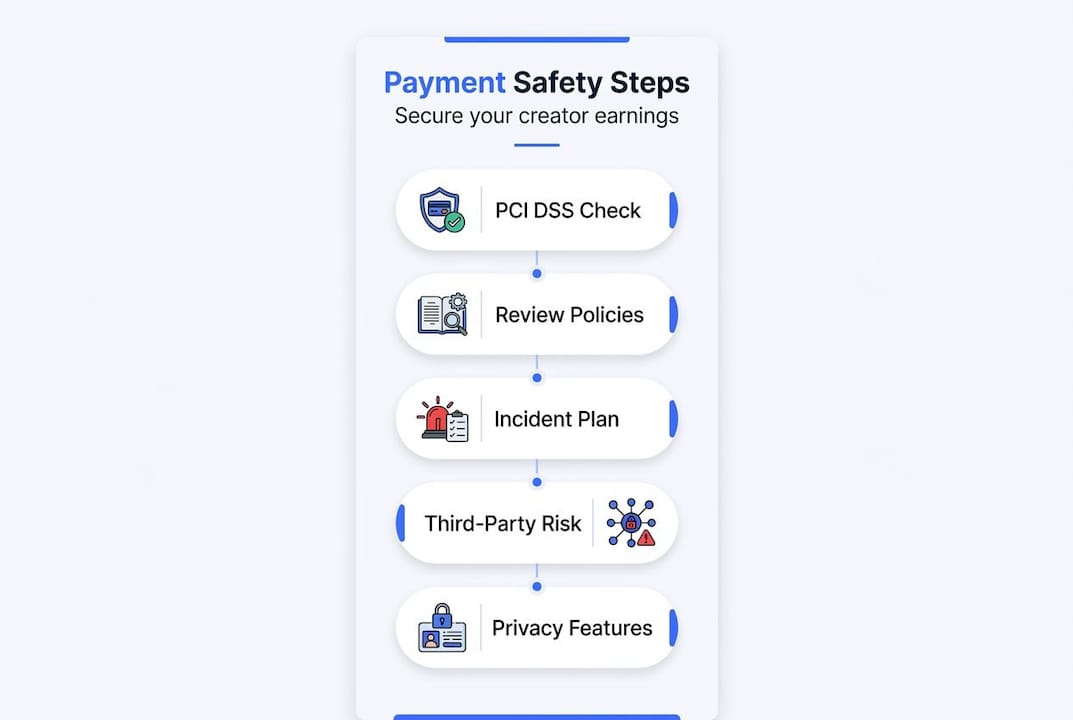
Step 2: Review their data and privacy policies
Read the actual policy documents, not the marketing page. You want to see clear statements about how payment data is stored, how long it’s kept, and who has access. Vague language like “we take security seriously” is a red flag.
Step 3: Ask about their incident response process
What happens if there’s a breach? How fast will you be notified? Is there a dedicated security team? These questions feel uncomfortable to ask, but the answers are critical. Platforms with nothing to hide will answer clearly.
Step 4: Check how they handle third-party risk
Ask which payment gateways and third-party services they use. Do they have formal agreements requiring those vendors to meet security standards? This matters because ongoing security awareness and third-party management are required under PCI DSS for genuinely safe payment processing.
Step 5: Use the platform’s privacy features actively
Once you’re on a platform, don’t assume the defaults are optimal. Review payout settings, two-factor authentication options, and notification preferences. Staying informed about platform updates is also part of your personal security practice. The privacy tips for creators you apply consistently will protect you more than any single platform feature.
Additional practices to maintain ongoing safety:
- Enable two-factor authentication on every account connected to payments
- Use a dedicated email address for your creator accounts
- Regularly review which apps and services have access to your account
- Monitor payout statements weekly for anything unexpected
- Stay connected to creator communities where security updates get shared fast
A creator’s reality: Why most get payment safety wrong
Here’s the uncomfortable truth: most creators don’t get compromised because of bad technology. They get compromised because they treat payment safety as a one-time decision rather than an ongoing practice.
You pick a platform that seems legit, set up payouts, and then never think about it again until something goes wrong. The typical approach is entirely reactive. You only look closely at payment security when a payout is late, an account gets flagged, or a peer posts about losing everything overnight. By then, the damage is already done.
The conventional wisdom in creator communities focuses almost entirely on technical features. “Does it have SSL? Does it use Stripe?” Those are fine questions, but they skip the 80% of payment safety that lives in policy, governance, and ongoing management. The payment processing realities that experienced creators learn the hard way are rarely about encryption. They’re about what a platform does when something breaks.
There’s also a peer knowledge gap. Creators who share tips in communities tend to share growth strategies, content ideas, and promotion hacks. Payment security barely comes up until there’s a crisis. That means most creators are flying blind on the governance side of things, relying entirely on platforms to make good decisions on their behalf.
The most financially resilient creators we’ve seen are the ones who treat their platform relationship like a business partnership. They ask hard questions upfront, they keep personal records, they diversify where possible, and they stay informed about changes in payment industry standards. That is not paranoia. That is professional practice.
Take control: Safe payments with trusted adult platforms
Understanding what safe payment processing actually means is just the first step. The next is finding a platform that lives up to these standards every single day.

Fanspicy is built with creator safety at its core, from secure, compliant payment processing to privacy-first design that protects both you and your subscribers. Governance, transparency, and real support are not afterthoughts here — they’re the foundation. Creators like JackiePott et Somlusolme are already earning confidently on a platform that takes these responsibilities seriously. Ready to move your content and income to a platform that practices what this guide preaches? Explorer Fanspicy and see what safe, creator-first payment processing looks like in real life.
Frequently asked questions
What is the primary requirement for safe payment processing?
A clear security policy, ongoing monitoring, incident response, and reliable third-party management are primary requirements, as outlined in PCI DSS Requirement 12, which covers information security policy, incident response, and vendor risk.
How does PCI DSS help protect creator earnings?
PCI DSS manages cardholder data environment safety through policy, staff awareness, and risk management, setting the standards that platforms must meet to handle your payments reliably.
Why do adult platforms need specialized payment processing?
Adult platforms face more frequent account terminations, chargebacks, and privacy risks than mainstream platforms, requiring systems explicitly designed for privacy protection, policy compliance, and fast incident response controls.
How can creators verify a platform’s payment safety?
Check for confirmed PCI compliance, review published security and privacy policies, and ask about their ongoing policy and incident response management processes before committing to any platform.