

Table des matières
TL;DR:
- A content marketing strategy checklist guides all stages of content creation and aligns efforts with business goals. It emphasizes setting specific objectives, understanding the audience, organizing themes, and planning distribution to drive measurable outcomes. Regular reviews and incorporating AI, repurposing, and updated SEO practices ensure ongoing effectiveness and impact.
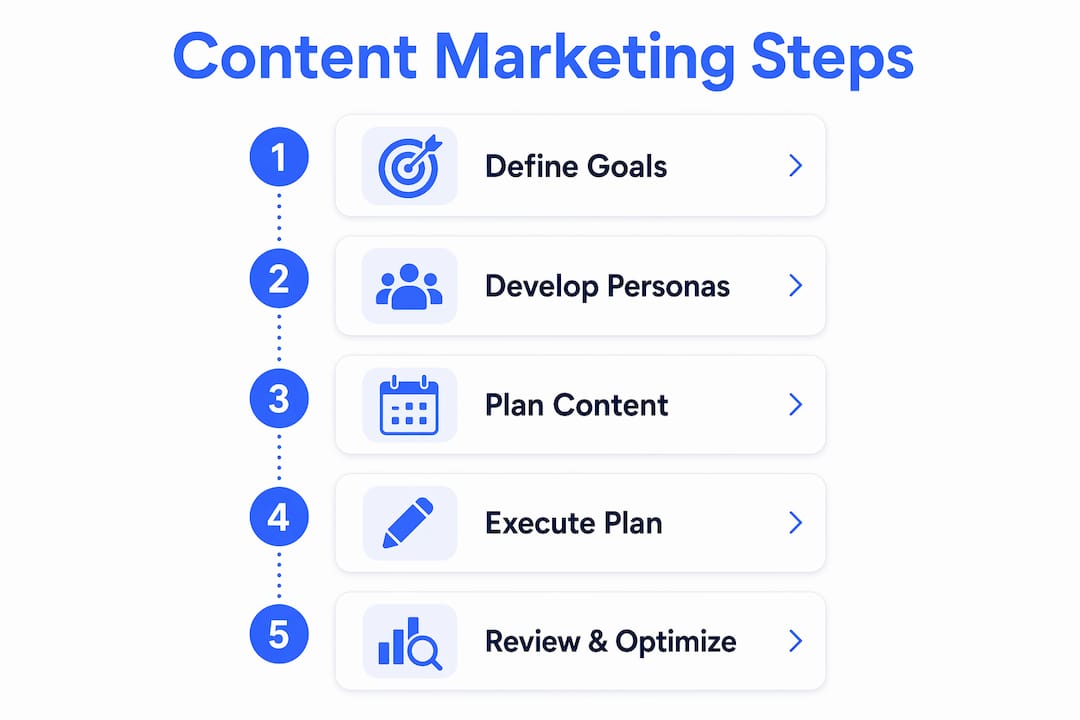
A content marketing strategy checklist is a structured, step-by-step blueprint that guides every stage of your content program, from goal setting and audience research through production, distribution, and measurement. Without one, campaigns drift. Only 47% of B2B marketers have a documented content strategy, which means the majority are producing content without a clear system behind it. That gap is where most wasted budgets and missed revenue targets live. A well-built checklist turns content from a guessing game into a repeatable, measurable system tied directly to business outcomes.
What are the essential components of a content marketing strategy checklist?
Every strong content marketing strategy checklist starts with business-aligned goals. Vague objectives like “create more content” produce nothing useful. Specific targets like 15% organic traffic growth in six months or 50 marketing-qualified leads per quarter give your team a real benchmark to work toward. Those numbers also make it easier to cut content that does not move the needle.

The second component is a detailed audience persona built from real buyer data, not assumptions. Map the full buyer journey: awareness, consideration, and decision. Note the exact language your audience uses to describe their problems. That language becomes your keyword and messaging foundation.
Content pillars and topic clusters come next. A content pillar is a broad theme your brand owns. Topic clusters are the supporting pieces that link back to it. This structure builds topical authority in search engines and keeps your team focused instead of chasing random ideas.
The core checklist components:
- Business goals and KPIs: Tie every content goal to a measurable business outcome.
- Audience personas and journey maps: Build from buyer interviews, sales call data, and search behavior.
- Content pillars and topic clusters: Organize your focus areas around 3–5 core themes.
- Content formats and channel mix: Match format to channel. Long-form articles for search, short video for social, email for nurture.
- Team roles and workflows: Assign clear ownership for writing, editing, design, and publishing.
- Distribution plan: Map how each piece reaches its audience after publication.
- Measurement framework: Connect content metrics to pipeline, revenue, and velocity.
One distinction matters here. A content strategy covers a 1–3 year vision, while a content marketing plan is a quarterly or annual execution schedule. Confusing the two creates operational chaos. Your checklist governs the strategy. Your plan governs the work.
| Composant | Role in the system |
|---|---|
| Goals and KPIs | Define success before production begins |
| Audience personas | Ground every content decision in buyer reality |
| Content pillars | Provide focus and topical authority |
| Distribution plan | Determine reach and amplification for each piece |
| Measurement framework | Link content output to business outcomes |
How do you build a content plan that brings the checklist to life?
A checklist without an execution plan stays theoretical. The practical step is to build a prioritized content plan that maps directly to your checklist items. Organize it into three tiers: current quarter commitments, a next-up queue, and an ideas log. This prevents your team from working on low-priority pieces while high-impact content sits unfinished.
Every content piece in your plan should carry four labels: the topic pillar it belongs to, the business goal it supports, the audience segment it targets, and the primary SEO keyword it targets. Without those four labels, a piece has no strategic home. It becomes content for content’s sake.
Distribution planning belongs inside the content plan, not as an afterthought. Distribution accounts for 80% of content marketing effort. That means for every article or video you produce, you need a written plan covering which channels carry it, what format adaptations it needs, and what paid or organic amplification supports it.
- Set your quarter: Lock in 8–12 anchor pieces per quarter based on pillar priorities and business goals.
- Build the queue: Add 5–10 supporting pieces that feed into each anchor.
- Log ideas separately: Keep a running ideas file so new topics do not interrupt current production.
- Assign distribution tasks: For each anchor piece, list at least three distribution actions before it publishes.
- Review weekly: Check status, update priorities, and move new ideas into the queue when capacity allows.
Regular weekly or quarterly reviews keep the plan agile. Markets shift, search trends change, and buyer priorities evolve. A plan that gets reviewed stays useful. One that sits static becomes a liability.
Conseil de pro : Link every content piece to a specific revenue stage. If you cannot explain how a piece moves a buyer from awareness to decision, reconsider whether it belongs in the plan.
How do AI, repurposing, and AEO/GEO fit into your content marketing checklist?
The 2026 content marketing checklist looks different from what worked three years ago. High-impact content marketing now requires repurpose-and-repeat systems, disciplined AI use, and updated SEO approaches that include Answer Engine Optimization and Generative Engine Optimization. These are not optional add-ons. They are core checklist items.
AI belongs in your workflow at three specific points: research, first-draft generation, and editing support. Use it to surface topic gaps, generate outlines, and check readability. Do not use it to replace editorial judgment. Every AI-assisted piece needs a human editor who checks for accuracy, brand voice, and factual integrity. AI speeds up production. Humans maintain quality.
Repurposing is the most underused tactic in most content plans. One long-form article can become a short video script, an email newsletter, a social carousel, and a podcast talking point. Build a repurposing checklist for every anchor piece you produce. That single habit multiplies your output without multiplying your production costs.
AEO and GEO checklist items:
- Write clear, direct answers to specific questions within every article. AI answer engines pull from content that answers questions explicitly.
- Apply schema markup to articles, FAQs, and how-to content. Schema helps AI platforms identify and cite your content.
- Build E-E-A-T signals into every piece: author credentials, cited sources, and first-hand experience.
- Use structured headings that mirror real user questions. This article’s heading structure is a working example.
- Track AI-driven traffic separately from organic search traffic so you can measure AEO/GEO impact on its own.
Conseil de pro : Write one “citable answer” paragraph per article section. Keep it under 60 words, lead with a direct claim, and follow with one supporting fact. That format is what AI answer engines pull into their responses.
What mistakes should you avoid when using a content marketing checklist?
The most common mistake is producing content without commercial intent. Volume without direction creates a content library that looks impressive and generates no pipeline. Content without business alignment causes poor ROI regardless of how much you publish.
The second mistake is treating distribution as optional. Most teams spend 90% of their time on production and 10% on distribution. That ratio should be closer to even. A great article that no one reads produces the same result as no article at all.
Mistakes that kill checklist effectiveness:
- Mixing strategy with planning: Keeping goals, vision, and tactics in one document creates confusion about what is fixed and what is flexible.
- Relying on internal brainstorming: Evidence-backed topic banks built from buyer language, sales objections, and search data consistently outperform ideas generated in internal meetings.
- Ignoring ROI measurement: Tracking page views without connecting them to leads, pipeline, or revenue tells you nothing useful about content performance.
- Skipping the audience review: Personas built once and never updated drift from reality. Buyer behavior changes. Your personas should change with it.
- Producing without a distribution plan: Every piece needs a promotion plan before it publishes, not after.
The checklist itself can become a trap if you treat it as a static document. Review it quarterly. Cut items that no longer serve your goals. Add items that reflect new channels, new buyer behaviors, or new SEO requirements.
Principaux enseignements
A documented content marketing strategy checklist is the single most reliable way to connect content production to measurable business outcomes like traffic growth, leads, and revenue.
| Point | Details |
|---|---|
| Document your strategy | Only 47% of B2B marketers have a formal strategy; documentation alone separates effective teams from the rest. |
| Set specific KPIs | Targets like 15% traffic growth or 50 MQLs per quarter give your team a real benchmark to hit. |
| Separate strategy from plan | Strategy covers 1–3 years; the plan covers quarterly execution. Keep them in separate documents. |
| Prioritize distribution | Distribution drives 80% of content success; plan it before each piece publishes, not after. |
| Integrate AEO and GEO | Apply schema, write direct answers, and build E-E-A-T signals to appear in AI-driven search results. |
Why I think most content checklists miss the point
Most content marketing checklists I have seen focus on production tasks: write the article, add the keyword, publish the post. That is a production checklist, not a strategy checklist. The difference matters more than most marketers realize.
A real strategy checklist forces you to answer hard questions before you write a single word. Who is this for? What decision does it support? How does it get in front of the right person? What does success look like in 90 days? Those questions are uncomfortable because they expose gaps in your thinking. They are also the only questions that lead to content with real business impact.
The AI and AEO shift makes this even more urgent. Content that gets cited by AI answer engines is content that directly answers specific questions with clear, credible language. That is not a technical trick. It is good editorial practice applied with intention. The content creators who build audiences that last are the ones who treat their checklist as an operating system, not a to-do list.
My honest advice: build your checklist once, review it every quarter, and cut anything that does not connect to a measurable goal. Discipline beats volume every time.
— fan
How Fanspicy supports content creators with real strategy tools
Fanspicy is built for creators who take their content seriously. The platform gives you the infrastructure to promote paid content across multiple channels, connect with an engaged audience, and build a sustainable income from your work. Whether you are refining your content plan or scaling your distribution, Fanspicy provides the tools and community to make it work.
Fanspicy combines live cam, paid social, and creator monetization in one place. That means your content marketing plan has a direct path from production to revenue without stitching together five separate platforms. Creators who want a focused, revenue-aligned content strategy will find everything they need to get started at Fanspicy.
FAQ
What is a content marketing strategy checklist?
A content marketing strategy checklist is a structured framework covering goals, audience research, content pillars, production workflows, distribution plans, and measurement. It ensures every piece of content connects to a business outcome.
How is a content strategy different from a content plan?
A content strategy defines your 1–3 year vision and goals. A content plan is the quarterly or annual execution schedule that puts the strategy into action. Keeping them separate prevents operational confusion.
How often should I review my content marketing checklist?
Review your checklist quarterly at minimum. Weekly reviews of the tactical plan keep priorities current and allow you to incorporate new ideas or shift focus based on performance data.
What are AEO and GEO in content marketing?
Answer Engine Optimization and Generative Engine Optimization are approaches that structure content so AI platforms like ChatGPT and Perplexity can find, cite, and surface it. Schema markup, direct answers, and strong E-E-A-T signals are the core tactics.
Why do most content marketing strategies fail?
The most common failure points are producing content without commercial intent, neglecting distribution, and failing to measure ROI beyond page views. Connecting every content piece to pipeline and revenue targets fixes all three.