
Índice
Paid social advertising is the practice of paying a social media platform to show your content or ads to a targeted group of people. You set a goal, a budget and an audience, and the platform delivers your message to the feeds of people who match. For creators, the real question is what happens after the click, because reach only pays off when your audience lands somewhere you earn from every fan. That is why many creators pair paid reach with a home base like Fanspicy, where creators pay no fees to join and keep earning from subscriptions, paid posts, messages, live streams and tips.
TL;DR
- Paid social means paying platforms to push ads or sponsored posts to a targeted audience, instead of waiting for the algorithm to show your organic posts.
- Platforms sell ad space through auctions, and you are billed per thousand views, per click or per action depending on your goal.
- The main benefits are precise targeting, speed and detailed reporting. The main cost is that visibility stops when the spending stops.
- Creators get the most from paid reach when it leads to a place they can own the relationship with fans and earn from several revenue streams.
Índice
- What paid social advertising means
- Paid social versus organic social
- How paid social advertising works
- Paid social formats and examples
- The benefits of paid social media advertising
- What paid social costs and where returns flatten
- How to tell whether a paid social campaign is working
- What paid social means for creators
- Our perspective
- Put your reach to work on Fanspicy
- PREGUNTAS FRECUENTES
- Sources
What paid social advertising means
The terms paid social, paid social media, paid social marketing and paid social advertising all describe the same thing. Hootsuite’s glossary defines paid social as ads or sponsored content on social media that you pay for with a marketing budget, in order to distribute and promote content to a targeted audience. Shopify describes it as a digital marketing strategy where companies pay social platforms to publish ads in users’ feeds.
In practice, paid social covers boosted posts, feed ads, Stories ads, sponsored content and paid partnerships with influencers. Hootsuite’s 2026 guide lists all of these and makes the key point: organic reach is controlled by the platform’s algorithm, while paid reach is bought directly, with you setting the budget, targeting and how often people see the ad.
Paid social is not the same as paid search. Adobe’s guide explains that paid search is spending to appear on search engine results pages, while social media advertising refers strictly to paid ads on social networks. A search ad meets someone who is looking. A social ad meets someone who is scrolling, which changes how you write it and how you judge it.
Paid social versus organic social
Organic posts are free. You publish them, your existing followers see some of them, and the platform may show them to more people if they perform. Semrush notes that organic posts reach your current audience right away but come with no targeting options, while a paid ad is built to reach new people.
A March 2026 comparison from Searchlab puts rough numbers on the gap. It reports that organic social typically reaches 2 to 7% of followers and takes 3 to 12 months to show results. Paid social has budget-dependent reach, results from immediate to about two weeks, and typical costs of $500 to $5,000 or more per month. Treat these as ballpark figures, since results differ by niche, platform and creative.
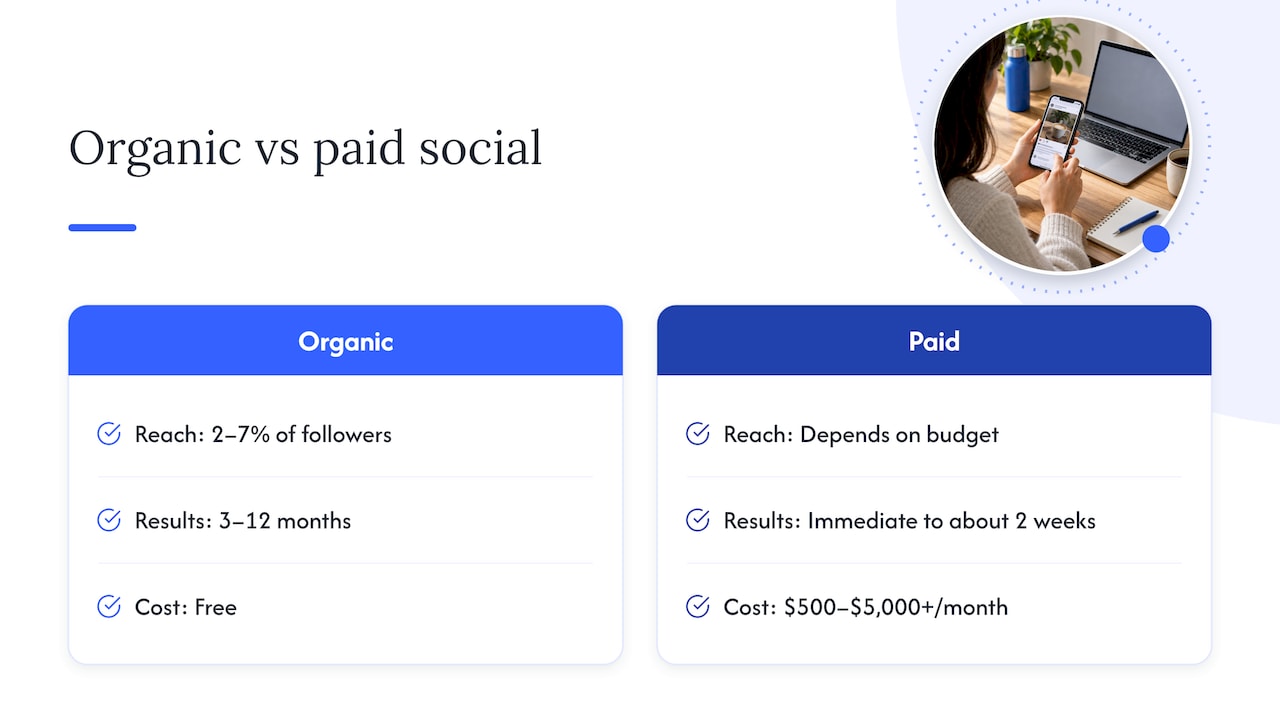
The two work best together. Hootsuite frames it this way: organic builds long-term trust with the people who already follow you, and paid buys immediate reach with measurable results. For a creator, that means your free posts show personality and your paid placements get that personality in front of strangers who might become subscribers.
How paid social advertising works
Every major network runs the same basic process, even though the buttons differ.
- Choose an objective. Hootsuite’s advertising guide says each campaign starts with a goal such as awareness, traffic, engagement, leads or conversions, and the platform’s algorithm optimizes delivery toward that outcome.
- Define the audience. Options include demographics like age and location, interests and behaviors, custom audiences built from your email list or past visitors, lookalike audiences that mirror your best customers, and retargeting of people who already interacted with you.
- Set a budget. You decide the daily or total spend. Spending caps keep a campaign from running past it.
- Upload creative. Formats include images, video, carousels and lead forms, according to Netmark.
- Win the auction. Ad space is sold in real-time auctions. Click Consult explains that platforms weigh your bid, the ad’s relevance to the person, and the predicted chance of the action you want. Strong creative can win placements at a lower cost.
- Pay by the metric you chose. You can pay per thousand impressions (CPM), per click (CPC) or per action (CPA). Shopify notes that Meta charges on a CPM basis, while TikTok uses both CPM and CPC.
- Read the reports. Results appear in the platform’s own dashboard.
One detail matters when you read those dashboards. Dayparter points out that every metric is counted and defined by the platform itself, so a number with the same name may not describe the same user action on two different networks. Compare like with like, and keep your own record of what actually reached your income.
Paid social formats and examples
Paid social ads are usually tagged with a label such as sponsored, promotion or ad. Common formats, per Nurse.com’s 2026 guide, are image ads, video ads, carousels, native-style feed ads and sponsored creator content. That guide also maps platforms to strengths: Facebook for broad reach, Instagram for visual storytelling, LinkedIn for professional targeting, Pinterest for discovery and Snapchat for younger mobile audiences.
Real campaigns show how the formats get used:
- A DeepClick roundup reports that Glossier’s retargeting ads on Meta earned click-through rates 5 to 10 times higher than cold traffic when the ad referenced the exact product a person had viewed.
- The same roundup says Liquid Death’s video built from one-star reviews drew more than 30 million views across TikTok and Meta.
- InBeat reports that a Whisker influencer campaign across YouTube, Instagram and TikTok passed 68 million views, with the cost per thousand views falling to $7.27.
The lesson for a creator is not to copy a big brand’s budget. It is to notice what they share: a clear single goal, a specific audience and a creative idea that makes a stranger stop scrolling.
The benefits of paid social media advertising
Why do so many businesses and creators use paid social platforms? Four reasons come up again and again.
Precise targeting. Sprout Social highlights targeting by interests, behaviors and demographics, so you stop relying on an algorithm to find the right people.
Conversion-ready formats. Buttons, lead forms and outbound links turn attention into action in one tap.
Speed. Paid distribution accelerates growth beyond the organic pace. A new account can reach thousands of relevant people in days rather than months.
Measurement. Reporting covers reach, engagement and conversions, which lets you stop what is not working and fund what is. Semrush lists the usual yardsticks: cost per click, cost per action, return on ad spend (ROAS, the revenue earned for each dollar of ad spend) and return on investment.
The scale of the audience is part of the appeal too. Adobe cites average daily social media use of up to 147 minutes per consumer, and Netmark observes that paid social builds demand among people who were not yet searching, so it works best for introducing yourself to new fans.
What paid social costs and where returns flatten
The plain fact about paid reach is that it lasts only while you fund it. HubSpot notes that continuous investment is needed to keep visibility, and that repeated exposure can cause ad fatigue.
Research on performance marketers points the same direction. A Q1 2025 survey of 307 US performance marketers, published as The Pulse of Performance Advertising, found that nearly 80% of those seeing diminishing returns say the effect starts early in the budget. Over 60% believe ads lose impact because the same people have already seen the same creative too often.
This makes one budgeting rule worth following: every dollar of ad spend should lead to an audience you can monetize in more than one way. A follower who only watches free posts has cost you money. A fan who subscribes, buys a paid post, joins a live stream and tips has paid back the ad many times over. Your revenue per fan matters as much as your cost per click.
How to tell whether a paid social campaign is working
Start with the goal you chose. If it was traffic, look at cost per click. If it was sign-ups, look at cost per action. Then check what a fan is worth to you.
A simple creator check looks like this:
- Add up the ad spend for a week.
- Count the new subscribers that came from the campaign link.
- Divide spend by subscribers to get your cost per subscriber.
- Compare it with what an average subscriber spends with you over a few months.
If a subscriber’s lifetime spend is well above the cost to win them, the campaign is working. Be careful with platform-reported ROAS. AdLibrary’s 2026 guide warns that a reported 4.2x could really be 3.1x or 5.6x depending on tracking quality, and that ROAS alone hides true profitability. Pull trends weekly, not monthly, so you spot tired creative early.
What paid social means for creators
If you sell subscriptions, paid posts, private messages or live shows, paid social is one way to fill the top of your funnel. It is not the only way. Free posts, collaborations and cross-promotion all bring fans in, and our guides on how to promote paid content, social media content marketing for creators y boosting subscriber growth walk through them.
Whatever mix you choose, the destination matters. Fans who arrive from an ad need a place where they can subscribe, tip, message and watch you live without friction, and where you hold the relationship. Fanspicy positions itself on exactly that: creators keep a higher percentage of their earnings, own their audience directly, and can earn through several methods at once. If you already have fans elsewhere, content migration from other platforms is designed to be easy, so your existing library can come with you. To see how the model works, read our overview of subscription-based income y hybrid monetization.
Our perspective
We think paid social is best understood as a way to rent attention. The platforms own the audience, set the auction rules and define the metrics. When you stop paying, the reach stops.
That is why we built Fanspicy around what happens after the introduction. A fan who arrives should find subscriptions, exclusive content, paid posts, private messages, live streams and tips in one place, so each person you win can support you in the way they prefer.
We also believe the creator economy rewards those who keep more of what they earn and keep a direct line to their audience. Fanspicy takes a percentage per transaction, and creators do not pay to join or use it. Every fan you bring, whether from an ad, a collaboration or a free post, is then worth more to you.
fan
Put your reach to work on Fanspicy
Whether you are testing the waters with a small boosted post or running a full campaign, the fans you attract need somewhere to go. Fanspicy gives creators subscriptions, private messages and live streams on the main platform, and exclusive content, tips and paid posts through the creator sign-up page.
If you are ready to turn attention into recurring income, set up your page, bring your existing content over and point your promotion at one link.
PREGUNTAS FRECUENTES
Is paid social advertising worth it?
It is worth it when the cost of winning a customer is lower than what that customer spends over time. Results vary by platform and niche, and HubSpot notes that the need for continuous investment can strain smaller budgets. Start small, track cost per result weekly and scale only what pays back.
What is the difference between paid social and paid media?
Paid media is the wider term for any advertising you pay to place, including search ads, display banners and video. Paid social is the part that runs on social networks. Paid search, by contrast, targets people typing a query, as Adobe explains.
Do I need a big budget to start?
No. Spending caps let you set a daily limit, and you can begin with one audience and one creative. Searchlab puts typical monthly costs at $500 to $5,000 or more, but a smaller test can still show you which message and audience respond.
How is paid social different from working with influencers?
Sponsored influencer content is one form of paid social. Sprout Social notes that the creator economy has expanded the category to include paid partnerships with influential users, alongside boosted organic posts and ads that exist only as paid campaigns.
Where should paid social traffic go?
It should land on a single page where the visitor can take the next step immediately. For creators, that is a profile where fans can subscribe, buy a paid post, message you or tip, such as one on Fanspicy.
Sources
- Hootsuite: What does paid social mean?
- Shopify: Paid Social: Platforms, Tips, and Strategy
- Hootsuite: Organic vs paid social media
- Adobe: Social media advertising
- Semrush: Paid Social Media Advertising Beginner’s Guide
- Searchlab: Organic Social vs Paid Social
- Hootsuite: Social media advertising costs and tips
- Netmark: What Is Paid Social?
- Click Consult: What is paid social media?
- Dayparter: Paid Social 101
- Nurse.com: What Is Paid Social Media Advertising?
- DeepClick: Paid social media advertising guide
- InBeat: Paid Social Advertising
- Sprout Social: Organic vs. Paid Social Media
- HubSpot: Paid Social Media: Worth The Investment?
- The Pulse of Performance Advertising
- AdLibrary: What Is ROAS in Marketing?