

Índice
TL;DR:
- Tokens serve as the virtual currency on cam sites, driving viewer spending through psychological and structural design. Platforms like Chaturbate and LiveJasmin monetize these tokens by taking significant commissions, influencing performer earnings and engagement strategies. Creators optimize income by structuring tip menus, setting minimums, and using interactive triggers to sustain microtransactions within the token economy.
Tokens are defined as the virtual currency of cam sites, purchased with real money and spent on tipping, private shows, and interactive features that drive real-time engagement between viewers and performers. Platforms like Chaturbate and LiveJasmin built their entire monetization models around this token economy, and understanding how it works gives both creators and users a measurable advantage. The role of tokens in cam sites goes far beyond simple payment processing. Tokens shape viewer psychology, determine performer income, and control how platforms extract revenue from every session.
How tokens work in cam sites: the full flow
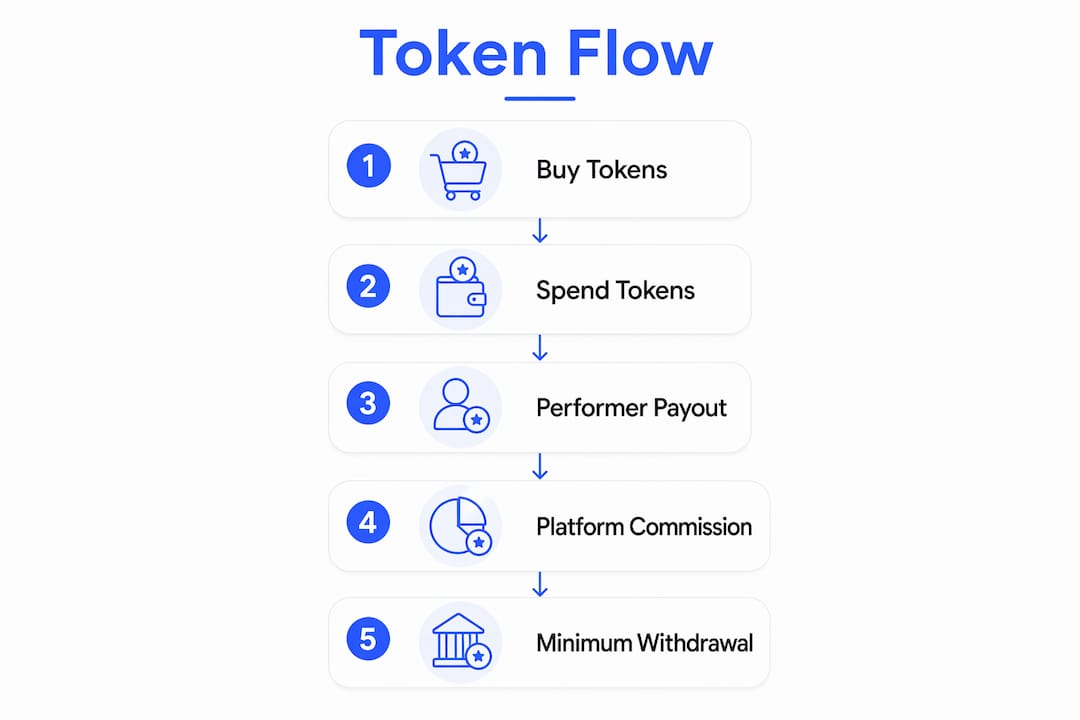
Token systems on cam sites operate on a straightforward but strategically designed loop. A viewer buys a token package with real money, the tokens land in their account balance, and they spend those tokens on tips, private shows, or unlocking specific content. The platform takes its commission from every transaction, and the performer receives their payout share, typically processed on a bi-weekly schedule.

Token pricing and payout rates
The economics are not equal on both sides of the transaction. On Chaturbate, viewers pay roughly double what performers actually receive per token. Viewers pay approximately $0.10 per token depending on the package size, while performers earn around $0.05 per token. That gap represents the platform’s commission, which typically runs between 40% and 50% across major cam sites. This means a performer who receives 1,000 tokens in tips has earned roughly $50, while the viewer spent closer to $100 to send those tokens.
Private shows add another layer to this structure. LiveJasmin charges starting around $1.99 per minute in token equivalents for private sessions, with performers setting their own per-minute rates within platform guidelines. Group shows split the per-minute cost across multiple viewers, lowering the barrier for each individual while maintaining or increasing total revenue for the performer. Understanding this distinction matters enormously if you are a creator deciding which show format to prioritize.
Consejo profesional: Model your earnings by token volume received, not by what viewers appear to spend. A viewer sending 500 tokens at $0.10 each generates $50 in viewer spend but only $25 to $30 in your pocket after platform commission.
Payout thresholds also affect income planning. Most platforms require performers to reach a minimum balance before processing payment, and performer incomes become forecastable when you model token volumes against payout timing. Tracking your average tokens per session and multiplying by your payout rate gives you a reliable weekly earnings estimate.
Why cam sites use tokens instead of direct payments
The decision to use tokens rather than direct cash payments is not accidental. It is a deliberate design choice rooted in behavioral economics and platform revenue strategy.
The most documented reason is psychological. Token abstraction reduces the “pain of paying” by creating distance between the act of spending and the awareness of real money leaving your account. When a viewer tips 50 tokens, they are not consciously thinking “I just spent five dollars.” They are thinking about the interaction they just triggered. This makes microtransactions feel lighter and encourages repeated spending throughout a session.
Beyond psychology, tokens serve several structural purposes for platforms:
- Currency standardization: Tokens create a single pricing unit that works across every country, eliminating the complexity of real-time currency conversion for users in different regions.
- Upfront commitment: Requiring viewers to purchase tokens before entering shows converts passive browsers into financially committed participants, which directly increases session length and interaction rates.
- Flexible monetization: Token systems let platforms run promotions, bonus packages, and loyalty rewards without restructuring their core payment infrastructure.
- Gradual spending design: Unlike a subscription that charges one large amount, token spending mixes tipping and time-based billing, making it easy for users to spend more than they planned without noticing until the session ends.
“Token-based tipping systems intentionally reduce the emotional cost of spending, facilitating frequent microtransactions by masking direct real-money value.” — The Psychology of Tipping & Token Systems 2026
For platforms, this design is highly profitable. For users, it requires conscious budgeting. For creators, it means understanding that your viewer’s willingness to spend is partly a product of how the platform has engineered their perception of value.
How token systems compare across major cam platforms
Not all token economies are built the same. The table below compares how major platforms structure their token systems, commission rates, and billing models.
| Plataforma | Billing model | Viewer cost per token | Performer payout rate | Comisión |
|---|---|---|---|---|
| Chaturbate | Token tipping + private shows | ~$0.10 | ~$0.05 | ~50% |
| LiveJasmin | Credit-based per-minute billing | ~$1.99/min equivalent | Varies by tier | ~30–40% |
| BongaCams | Token tipping + private shows | ~$0.10–$0.12 | ~$0.05–$0.06 | ~40–50% |
| Stripchat | Token tipping + private shows | ~$0.10 | ~$0.05 | ~50% |
The distinction between token systems and credit systems matters. Chaturbate and BongaCams use pure token tipping where viewers send amounts freely. LiveJasmin uses a credit model that maps more directly to per-minute private show billing, which creates more predictable revenue per session but less spontaneous tipping behavior. Platform commission rates vary significantly, and creators should model revenue using token volumes rather than perceived viewer spend to get accurate income forecasts.
The practical implication for creators is that platforms with lower commission rates do not automatically produce higher earnings. Viewer traffic volume, tipping culture, and show format availability all affect real income. A platform taking 40% commission but delivering ten times the viewer traffic can outperform a platform taking 30% with a smaller audience.
How tokens drive user engagement and creator earnings
The token economy creates a specific behavioral loop that benefits both engaged viewers and strategic creators. Tokenization enables numerous monetized micro-moments through tip menu items and interactive device controls, sustaining repeated small spending decisions across entire sessions. Each of these micro-moments is a separate revenue event.
Here is how creators can structure their shows to maximize this effect:
- Build a tip menu with clear token values. Assign specific actions to specific token amounts, such as 50 tokens for a song request or 200 tokens to trigger an interactive device. This gives viewers a clear spending path and removes decision friction.
- Set token minimums for show entry. Shows that require token minimums produce longer session times and more interactive engagement than free-entry rooms. The upfront commitment converts passive viewers into active participants.
- Use milestone goals to build momentum. A public goal of 5,000 tokens to unlock a specific event creates collective viewer motivation. Each tip moves the counter forward, and social proof from other tippers accelerates contributions.
- Connect interactive devices to token triggers. Bluetooth-connected devices that respond to token tips in real time create an immediate feedback loop. Viewers see a direct cause-and-effect relationship between their tokens and your response, which drives repeat tipping.
- Communicate token-per-minute rates before private shows. Clear pricing before private sessions reduces viewer hesitation and improves conversion from public room to private billing. Uncertainty about cost is the primary reason viewers decline private shows.
Consejo profesional: Review your tip menu every two weeks. Items that receive zero tips are not priced correctly or are not appealing. Replace them with options that match what your regular viewers actually request.
Earnings forecasting becomes reliable once you track your average tokens per session consistently. If your average session generates 800 tokens and your payout rate is $0.05 per token, your per-session earnings are $40 before platform fees. Multiply that by your weekly session count and you have a working income model that you can optimize by adjusting show format, session length, or tip menu pricing. Explore live cam earning potential to see how different session structures affect total income.
Key takeaways
The token economy on cam sites is a designed system that converts viewer psychology into platform revenue and performer income, with commission structures determining how much of each viewer dollar actually reaches the creator.
| Point | Details |
|---|---|
| Tokens are virtual currency | Users buy tokens with real money; platforms take 40–50% commission before paying performers. |
| Token abstraction drives spending | Psychological distance from real money makes microtransactions feel smaller, increasing total session spend. |
| Upfront minimums increase engagement | Shows requiring token entry produce longer sessions and more interactive viewer behavior. |
| Platform commission rates vary | Creators should model income by token volume received, not by what viewers appear to spend. |
| Tip menus and device triggers maximize revenue | Structured token spending paths and interactive features sustain repeated micro-moment transactions. |
What I’ve learned about tokens after years in cam platform strategy
The most underestimated aspect of token systems is how much they benefit the platform over everyone else. Viewers think they are getting a flexible, low-pressure way to spend. Creators think they are earning from genuine fan appreciation. Both are true, but the platform has engineered both perceptions deliberately.
What I find genuinely useful for creators is reframing how you think about your token rate. Most creators focus on getting more tips. The smarter focus is on reducing the time between tips. A viewer who tips 20 tokens every two minutes is more valuable than a viewer who tips 200 tokens once and goes quiet. The tip menu, the interactive device, the milestone goal. These are all tools for shortening that interval.
For users, the honest advice is to set a token budget before you enter a room, not after. The platform design works against you once you are inside. The abstraction is real, and it is effective. Decide your limit in real dollar terms before you convert to tokens, and you will spend more intentionally.
The future of token economics on cam platforms is moving toward more granular interactivity. Platforms are adding more trigger points, more device integrations, and more ways to spend small amounts frequently. Creators who understand the behavioral economics of token systems and build their shows around that structure will consistently outperform those who simply go live and hope for tips.
The token system is not neutral infrastructure. It is a revenue engine with specific mechanics. Learn those mechanics and you use them. Ignore them and they use you.
— fan
Start earning smarter with Fanspicy
Fanspicy is built for creators who want more than a passive income stream from cam platforms. The platform gives you the tools to track token-driven engagement, understand what your viewers respond to, and build a monetization structure that compounds over time.
Whether you are just starting out or optimizing an existing cam presence, Fanspicy connects you with an audience that is ready to engage. Explore creator profiles like this high-impact creator to see how token strategy translates into real earnings. You can also see how creators like this Fanspicy member use platform tools to retain viewers and grow token income consistently. Start building your token strategy where the platform works with you, not just around you.
PREGUNTAS FRECUENTES
What is the role of tokens in cam sites?
Tokens are the virtual currency on cam sites, purchased with real money and spent on tipping, private shows, and interactive features. They allow platforms to standardize pricing globally while creating a psychological layer that encourages repeated microtransactions.
How do tokens translate into real money for performers?
Performers receive a payout share per token, typically around $0.05 on platforms like Chaturbate, while viewers pay roughly $0.10 per token. Platform commissions of 40–50% account for the difference between viewer spend and performer earnings.
Why do cam sites use tokens instead of direct cash payments?
Token abstraction reduces the perceived cost of spending, making microtransactions feel less significant than equivalent cash payments. This design increases total session spend and gives platforms flexibility in pricing, promotions, and monetization structures.
Do token minimums really increase viewer engagement?
Yes. Shows that require upfront token minimums produce longer session times and more interactive behavior than free-entry rooms, because the financial commitment converts passive viewers into active participants.
How can creators optimize their token earnings?
Creators maximize token income by building structured tip menus, setting show entry minimums, using milestone goals, and connecting interactive devices to token triggers. Tracking average tokens per session and modeling payout rates gives creators a reliable income forecast they can actively improve.