

Índice
Pick one narrow group of people, commit to one platform where they already gather, and launch an owned channel (email list or private community) the same week you start posting. Publish on that platform three to five times a week for at least 90 days before judging results. Everything else, partnerships, repurposing, monetization, only works once those three pieces are in place.
TL;DR:
- Building an audience requires choosing one niche, a specific platform where your target group already spends time, and posting three to five times weekly for at least 90 days.
- Narrowing your focus to a well-defined audience based on their identity, problems, and desired results guides content and platform choices effectively.
- Consistent content production, batching, and use of templates help sustain growth without burnout, with recurring series boosting return visits more than viral posts.
- Collaborations through newsletter swaps or joint events can significantly accelerate growth when audience overlap and quality are carefully vetted.
- Focus on owned channels like email lists and communities from the start, as these are more reliable for long-term audience retention than platform-dependent reach.
Índice
- How Do You Build an Audience From Scratch?
- Build a Content Production System That Doesn’t Burn You Out
- How Do Partnerships and Cross-Promotion Speed Up Growth?
- How Do You Repurpose Content Across Multiple Platforms?
- Why an Email List or Private Community Comes First
- What Should You Measure, and When Should You Pivot?
- When Should You Start Monetizing Your Audience?
- What the Research Says About Growing an Audience the Right Way
- A Straight Answer From Someone Who Watches This Space Closely
- Turn Your Audience Into Paying Fans With Fanspicy
- Where to Learn More About Audience Growth
- Sources
- PREGUNTAS FRECUENTES
How Do You Build an Audience From Scratch?
Most creators skip straight to content and skip the one decision that determines whether that content ever finds anyone: who, specifically, is it for? Building an audience starts with narrowing your focus, not widening it.
Define your audience using three fields: who they are, what problem keeps them up at night, and what result you’re promising them. “People interested in fitness” is not an audience. “Busy parents who want a 20-minute strength workout they can do before the kids wake up” is. That level of specificity tells you exactly what to post, where to post it, and how to talk about it.
Next, choose one primary platform, the one where that specific group already spends time, not the one you personally enjoy most. A B2B consultant belongs on LinkedIn or in a newsletter, not on TikTok. A visual product brand belongs on Instagram or YouTube Shorts before it belongs on X.
Then pick an angle that’s yours and repeatable. Copyblogger’s framework for building an audience from nothing emphasizes choosing a topic, medium, and signature angle before worrying about growth tactics. A recurring format, a weekly “mistake of the week” series, a Sunday roundup, a specific visual style, gives people a reason to come back on a schedule instead of stumbling onto you once.
Before committing months to any of this, run three quick validation checks:
- Search hashtag and keyword volume to confirm people are actually looking for this topic.
- Post five to ten pieces as a beta test before declaring a niche “yours.”
- Watch early engagement signals (saves, replies, shares) rather than just view counts, since those predict whether people will stick around.
Consejo profesional: If your first ten posts get views but zero comments or saves, the angle is off, not the platform. Adjust the angle before you blame the algorithm.
Build a Content Production System That Doesn’t Burn You Out
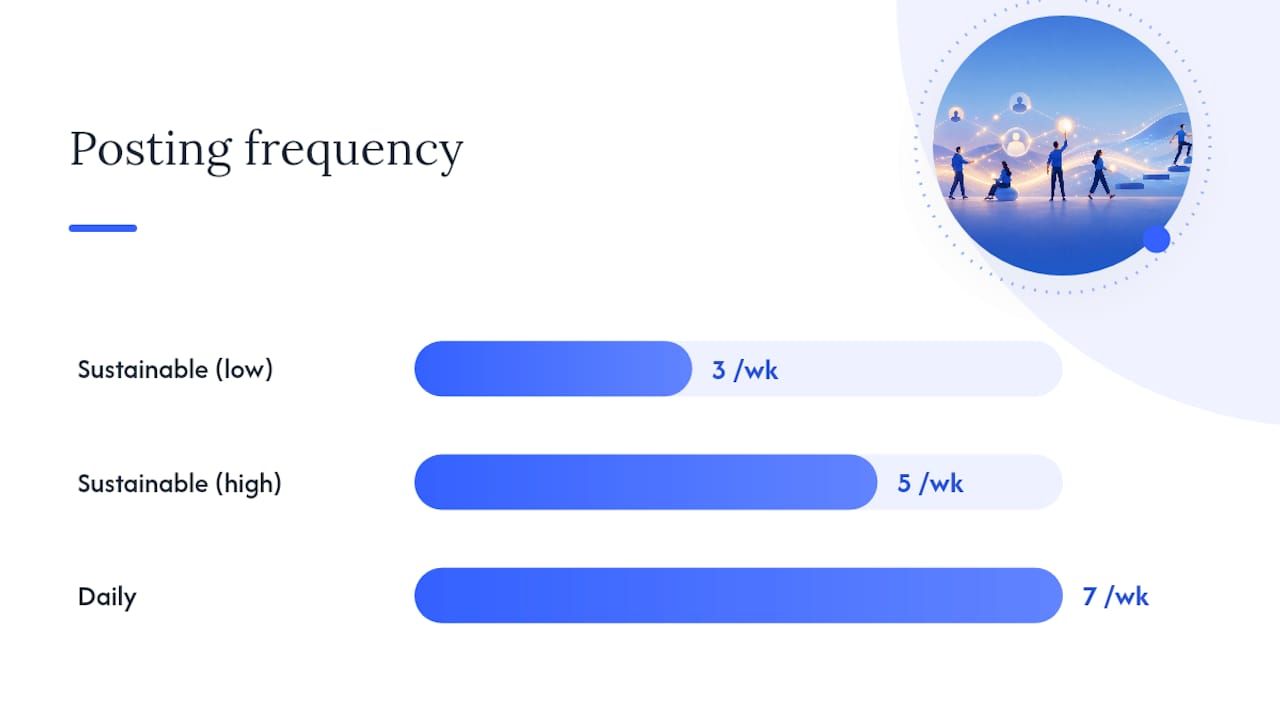
Consistency, not talent, is the single biggest predictor of early audience growth. Practitioner data on cadence and growth inflection points points to three to five posts per week as the sustainable baseline where most creators start seeing measurable traction. Daily posting accelerates growth further, but it also accelerates burnout if you don’t have a system behind it.
Build that system in four steps:
- Set your cadence honestly. Three to five posts a week works for most solo creators balancing a job or business. Daily only works if you batch aggressively or have help.
- Batch your production. Film or write for an entire week in one sitting. Batching cuts the mental cost of “what do I post today” down to almost nothing.
- Build templates for repeat formats. A consistent intro, caption structure, or thumbnail style saves hours and reinforces your signature series.
- Run a lightweight edit pass. Check for a hook in the first three seconds or sentence, one clear takeaway, and a call to action, nothing more elaborate than that.
Organize everything around two or three content pillars (the recurring themes your niche cares about) plus one signature series that becomes your calling card. Copyblogger’s research on early audience building notes that habit-forming recurring series create predictable return visits, which matters more for growth than any single viral post.
Basic scheduling tools (Buffer, Later, or a native platform scheduler) handle distribution once content is batched, so you’re publishing consistently without opening the app every single day.
Consejo profesional: Batch one week ahead, not one month. A full month of pre-planned content stops reflecting what’s actually resonating with your audience right now.
How Do Partnerships and Cross-Promotion Speed Up Growth?
Borrowed trust moves faster than cold discovery. When a creator your audience already respects introduces you to their followers, that introduction expands what beehiiv calls the “surface area of trust”, cutting the skepticism a stranger’s content usually faces.
Before reaching out to anyone, run a quick fit check:
- Audience overlap: do your followers actually care about their topic, and vice versa?
- Quality parity: does their production value and tone match yours closely enough that a swap doesn’t feel like a downgrade for either audience?
- No direct competition: you’re solving adjacent problems, not fighting over the same offer.
Once fit is confirmed, a handful of formats consistently work well: newsletter swaps, guest posts on each other’s blogs, joint live sessions, and co-hosted events or challenges. Beehiiv’s research on collaboration formats that accelerate subscriber growth singles out newsletter swaps and co-hosted events as especially effective when audiences genuinely overlap.
Outreach should be short and specific: name the exact audience segment you think they’d bring value to, propose one concrete format, and suggest a date. Track two metrics after each partnership: new followers gained and, more importantly, how many of those followers actually convert into your email list or community, since that’s the number that tells you whether the traffic was a fit or just noise. Our guide on cross-promotion strategies for creators breaks down outreach templates in more detail.
How Do You Repurpose Content Across Multiple Platforms?
One piece of long-form content should become five to ten smaller pieces, not one post on five platforms. The flow looks like this: long-form video or article, then short clips, then micro-posts (a quote card, a single stat, a one-line takeaway), then a newsletter summary that ties it all back to your owned list.
Follow this checklist to turn one asset into a week’s worth of content in about an hour:
- Pull three quotable moments from the long-form piece for standalone clips or quote graphics.
- Add subtitles to every video clip. Most viewers watch on mute, especially on Instagram and LinkedIn.
- Trim length per platform. Fifteen to thirty seconds for Reels and TikTok, sixty to ninety seconds for YouTube Shorts, longer is fine for the original YouTube upload.
- Move your call to action earlier on short platforms. You have three seconds to earn attention before someone scrolls past.
- Write a two-paragraph newsletter recap linking back to the full piece, so email subscribers get the summary and a reason to click through.
Mailchimp’s research on channel mix confirms that repurposing across social, ads, and landing pages with strong calls to action consistently outperforms posting the same format everywhere and hoping for reach. Prioritize repurposing time toward whichever platform is currently driving the most profile visits, that’s where the marginal effort pays off fastest.
Why an Email List or Private Community Comes First
Platforms change their algorithms without warning. An email list or private community doesn’t. That’s the entire argument for owned distribution: it’s the one channel you actually control, and it’s what keeps an audience yours even when a platform’s reach collapses overnight.
Start the list the same week you start posting, not after you’ve “proven” the niche works. Practitioner guides on building an audience from zero recommend adding an opt-in from day one and publishing at least a few issues before you promote the list anywhere, so new subscribers land somewhere with actual substance already waiting.
Your first three issues should cover: a welcome note explaining what subscribers will get and how often, one piece of genuinely useful content unavailable anywhere else, and a light ask (reply with a question, vote on a topic) to start two-way engagement early.
A retention loop needs three components to actually hold people:
- Exclusive content they can’t get on your public feed.
- Regular engagement prompts (polls, replies, direct questions) that make the list feel like a conversation, not a broadcast.
- Cross-links back to your public content, so the list and the platform reinforce each other instead of competing.
Community-led growth research from Collabonly found that smaller, more engaged private communities often outperform larger, noisier followings on loyalty and word-of-mouth referrals, which matters far more for revenue than raw follower counts. Early growth comes from opt-in placement (link in bio, end of every video, pinned comment) and from partnership boosts once your cross-promotion outreach starts sending people somewhere permanent instead of just to another post.
What Should You Measure, and When Should You Pivot?
Vanity metrics lie. Track five numbers instead: new reach (fresh accounts seeing your content), engagement rate (comments and saves relative to reach), conversion rate into your owned channel, retention (do subscribers stay and open future issues), and revenue per subscriber once monetization starts.
Run experiments like a scientist, not a gambler:
- Write a one-line hypothesis before you test anything (“Posting at 7 AM instead of 7 PM increases completion rate”).
- Test for one to two weeks, long enough to see a pattern, short enough to pivot fast.
- Set a signal threshold in advance (a 20% lift or drop) so you’re not rationalizing noise as a trend.
- If a format underperforms across three consecutive attempts, cut it. If it outperforms twice, double the frequency.
Expect three to six months of consistent execution before growth becomes visible to people outside your immediate circle. That timeline holds whether you’re posting daily or three times a week, consistency compounds slower than most creators expect, then faster than they’re prepared for.
When Should You Start Monetizing Your Audience?
Monetize in sequence, not all at once. Start with small, low-friction asks before introducing anything that requires real commitment from your audience.
The typical sequence looks like this:
- Small asks first: a poll, a reply, a share, actions that cost your audience nothing but attention.
- One-off paid offers next: a single paid post, a small downloadable guide, or a tip jar for people who want to support you directly.
- Recurring revenue last: subscriptions or a premium community, once you’ve proven consistent value worth paying for repeatedly.
Balance every paid ask against free value delivered. A rough rule that works for most creators: for every one paid pitch, deliver at least four to five pieces of free content that stand on their own merit. Ask too often and engagement drops; wait too long and you leave revenue on the table you’ve already earned. Our breakdown of strategies for promoting paid content covers the sequencing in more depth.
What sells also tells you what to make more of. If a specific paid post outperforms the others, that topic deserves more free content leading up to your next offer, monetization data is audience research, not just revenue.
What the Research Says About Growing an Audience the Right Way
The discover→trust→retain model isn’t a slogan, it’s the actual mechanism behind sustainable growth. Beehiiv’s research on audience growth strategies frames 2026 growth around owning distribution and reducing dependence on algorithms that can change overnight, which is exactly why the newsletter or community step in this playbook isn’t optional.
Industry data backs each stage: Mailchimp’s channel-mix research supports the repurposing and multi-channel approach, while creator-economy guides consistently point to one niche, one platform, and immediate list-building as the fastest reliable path from zero. Follow this sequence with real consistency, and most creators see initial traction within three months and compounding growth by six.
A Straight Answer From Someone Who Watches This Space Closely
Consistency beats talent, and ownership beats reach, that’s the whole argument buried under most audience-growth advice. Too many creators chase platform virality and never build anything that survives an algorithm change. Pick one niche today, publish three times this week, and send your first newsletter issue by Friday. Small, specific, and immediate beats “someday” every time.
— fan
Turn Your Audience Into Paying Fans With Fanspicy
Growing an audience is only half the equation. There are platforms designed to help turn engaged followers into paying supporters without taking a large cut of your earnings. Once your list and content cadence are working, platforms offer subscriptions, live streams, private messages, exclusive content, tips, and paid posts, all in one place, so the small asks and one-off offers from your monetization sequence have somewhere real to land.
That fits directly into the sequencing covered earlier: start with tips and a paid post to test demand, then layer in a subscription once your retention numbers hold steady. Certain platforms position themselves as helping creators keep more of what they earn, own their audience relationship directly, and migrate existing content over without starting from zero. If you’ve already got followers who trust you, visit the Fanspicy homepage to see how subscriptions and live streams work, or head straight to the creator sign-up page to set up your first paid post today.
Where to Learn More About Audience Growth
- Beehiiv’s audience growth strategies: the discover→trust→retain framework in full.
- Mailchimp’s channel-mix guide: omnichannel tactics and CTA placement.
- Copyblogger’s build-from-scratch guide: niche, medium, and angle fundamentals.
- Fanspicy’s guide to growing an online audience naturally: more on retention loops.
Sources
- Audience Growth Strategies: Best & Worst Approaches (2026) | beehiiv Blog
- Marketing strategies to grow your audience – Mailchimp
- How to Build an Audience From Scratch In 2026 – Copyblogger
PREGUNTAS FRECUENTES
What Is the Best Way to Build an Audience?
The most reliable method is narrowing your niche, committing to one platform, and starting an owned channel like an email list in the same week you begin posting. Consistency at three to five posts per week, paired with a signature recurring series, builds the habit that turns viewers into a real audience.
What Does It Mean to Build an Audience?
Building an audience means attracting a specific group of people who return for your content repeatedly, not just people who see one post and move on. It requires moving followers from a platform you don’t control into a channel you do, like a newsletter or community, so the relationship survives algorithm changes.
How Long Does It Take to Build an Audience?
Most creators see visible traction within three to six months of consistent, focused publishing. That timeline assumes a clear niche, a steady cadence of three to five posts weekly, and an owned channel started from day one rather than months later.
How Do You Develop a Target Audience?
Define your audience using three specific fields: who they are, the problem they’re struggling with, and the result you’re promising. A precise definition like “new parents wanting quick meal prep ideas” gives you clearer content direction than a broad category, and it’s easier to validate through early engagement signals like saves and comments.
How Does Fanspicy Fit Into Audience Building?
Fanspicy isn’t a discovery platform for finding new followers, it’s where creators convert an audience they’ve already built into paying subscribers through subscriptions, tips, live streams, and paid posts. It fits naturally at the recurring-revenue stage of the monetization sequence, once trust and consistent engagement are already established.