

Índice
Growing a podcast audience comes down to three things: a sharp niche, a steady publishing rhythm, and a way for strangers to find you before they commit to a full episode. In 2026 that last piece mostly means short video clips on YouTube and social feeds. Below you will find where new listeners come from, what “good” numbers look like, how to keep the people you win, and how to turn a small, loyal audience into income.
TL;DR
- Discovery now runs through video: YouTube accounts for about 40% of new podcast discoveries, and short clips are the front door.
- Pick one clear audience and stick to it. Shows that shift topic and tone struggle to build listening habits.
- Treat growth as a repeatable system: consistent output, guest swaps, and every episode cut into many pieces of content.
- Do not wait for ad-scale numbers. A small, engaged audience can pay you directly through subscriptions, tips and exclusive content.
Índice
- Where new listeners actually come from in 2026
- Start with a niche people can recognize in seconds
- Build a repeatable system, not a viral moment
- Use clips as your front door
- Borrow audiences that already trust someone like you
- What good numbers look like, and what to ignore
- Keep the listeners you win
- Why a small, engaged audience can already pay
- Our perspective: own the relationship, not just the feed
- Where Fanspicy fits in your growth plan
- A 90-day plan to start with
- PREGUNTAS FRECUENTES
- Sources
Where new listeners actually come from in 2026
The old advice was to submit your feed to every directory and wait. Directories still matter, but they are no longer where most people start. According to recent research reported by Forbes, YouTube is the leading discovery channel, followed by YouTube Shorts (41%), Instagram Reels (34%) and TikTok (29%). Together, video and social channels drive 61% of new listener growth.
Two details from the same research matter for your plan:
- Discovery is increasingly organic. Among listeners who found a favorite show on social media, 60% found it through content shared by someone they follow, so shareable moments beat paid promotion for most small shows.
- Friends and family are no longer the only recommenders. A 2025 survey from Coleman Insights and Amplifi Media found social media recommendations now carry more weight than they once did.
The practical takeaway: if your show only exists as an audio file in a feed, you are invisible to the places where people are searching. Even a static waveform video on YouTube is a start. A filmed conversation is better.
Start with a niche people can recognize in seconds
Creativity is overrated at the start. Clarity wins. Spotify’s creator guidance points out that the most consistently growing podcasts have a sharply defined identity, such as a specific interest, demographic or mission, so the right listener immediately thinks “this is for me.” A show that keeps changing tone or topic never builds a habit.
Try this test. Finish the sentence: “This show is for [specific person] who wants [specific outcome or feeling].” If your answer is “anyone who likes interesting conversations,” keep narrowing.
Examples of a narrow promise
- Weekly interviews with first-time restaurant owners about their first year.
- A 25-minute show for night-shift nurses about surviving the schedule.
- Candid conversations about modern dating for adults, recorded with a co-host.
Narrow does not mean small forever. It means the first thousand listeners arrive faster and talk about you more. It also helps sponsors and paying fans see what they are buying.
Build a repeatable system, not a viral moment
Acast’s 2026 growth guide argues that growth is a system, with consistency as the most powerful compounding factor. It notes that for standalone shows, moving from one to three episodes a week can nearly double weekly listens, as long as quality holds. The same guide notes that roughly half of all podcasts publish three or fewer episodes, a pattern often called podfade.
You do not need three episodes a week. You need a rhythm you can keep for a year. Here is a workable system:
- Batch record. Record two or three episodes in one session so a busy week never breaks your schedule.
- Set a fixed release day. Habits form around predictability.
- Cut clips the same day. Pull three to five moments per episode while you remember where the good parts are.
- Post on a schedule. Spread the clips across the week on YouTube Shorts, Reels and TikTok.
- Send one email or message per episode. Your own list is the one channel no algorithm controls.
- Review monthly. Look at which clips and topics brought new listeners and do more of those.
The Acast guide describes successful creators repurposing each episode into 20 or more pieces of content, such as clips, quote cards and newsletters. Treat that as a ceiling to work toward, not a day-one requirement.
Use clips as your front door
Clips are the most direct answer to “how do I get found?” Sounds Profitable’s Podcast Atlas calls them the top of the funnel. Coverage of the same study reports that nearly nine in ten podcast listeners watch clips on social at least sometimes. The catch is that only about a third of those viewers reliably become regular listeners.
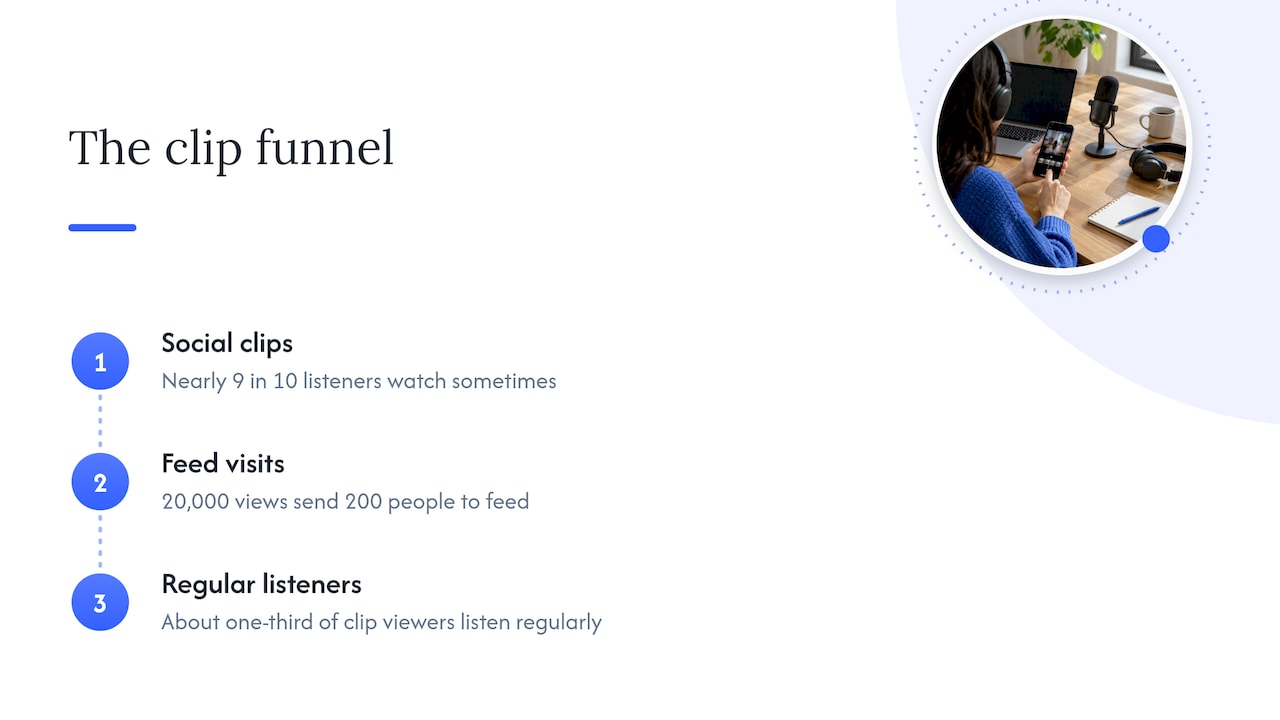
That should change how you judge a clip. Its job is to lower the friction of trying you, not to convert everyone. A clip that gets 20,000 views and sends 200 people to your feed is working.
What makes a clip worth posting
- It starts mid-thought, with the most surprising sentence first.
- It makes sense without context, in 20 to 60 seconds.
- It has captions, since many people watch muted.
- It ends with one clear next step: the full episode, the channel, or your sign-up link.
If you also create social content outside podcasting, the principles carry over. Our guide to social media content marketing for creators covers posting rhythm and content mixes that apply to any audience-first business.
Borrow audiences that already trust someone like you
The fastest growth for a small show is usually another show’s audience. Acast’s guide recommends booking guests whose audiences overlap with yours and cross-promoting with similar shows. A recommendation from a host a listener already trusts is worth more than any ad you could buy.
How to do it without being awkward:
- Pitch shows of a similar size first. They need content and exposure as much as you do.
- Offer a specific episode idea, not a vague “let’s collaborate.”
- Swap trailers or short “if you like this show” messages inside episodes.
- Give guests a ready-made clip and graphic so sharing takes them ten seconds.
Cross-promotion is a long-standing tactic among all kinds of independent creators. Our piece on cross-promotion strategies for creators explains how shout-outs and collaborations build a fanbase when you do not have a marketing budget.
What good numbers look like, and what to ignore
Most new hosts judge themselves against the wrong benchmark. Acast’s 2026 download benchmarks show how modest the real thresholds are:
| Position | Downloads in an episode’s first 7 days |
|---|---|
| Top 50% | More than 28 |
| Top 25% | More than 104 |
| Top 10% | More than 428 |
| Top 5% | More than 1,050 |
| Top 1% | More than 4,763 |
The same source stresses that genre changes everything: a niche business or technology show can be a real success at a few hundred downloads if they are the right listeners. So “how do I get 1,000 listeners?” has a more useful cousin: “how do I get 100 people who would miss the show if it vanished?”
Track three numbers:
- First-week downloads per episode.
- Month-over-month growth.
- How many episodes the average listener sticks around for.
A show with 80 downloads a week and steady growth is in better shape than one with 500 that is shrinking.
Keep the listeners you win
Listening habits are shifting. A 2025 State of Media report found that only 32% of podcast consumers listen frequently, down from 36% in 2024, and that 78% multitask while listening. Most prefer episodes between 20 and 60 minutes.
That suggests a few habits:
- Get to the point in the first minute. Say who the show is for and what this episode delivers.
- Match length to substance. A tight 30 minutes beats a rambling 75.
- Make it easy to return. Use the same format, the same release day, the same intro.
- Ask for one action per episode. Follow, share, reply, or join your list. Not all four.
If your show is not growing, the likely causes are rarely mysterious: a vague niche, an irregular schedule, no video presence, or no clear ask. Fix them in that order.
Why a small, engaged audience can already pay
Many hosts assume income begins at ad-scale. Advertising is real money, but it favors size. Shopify’s CPM guide puts typical podcast ad rates at $12 to $40 per 1,000 listeners, and says emerging shows with about 1,000 listeners per episode often earn $250 to $500 a month. Million Podcasts data cited by Yahoo Finance shows that only 22.9% of 7,800 shows carry any advertising, and that advertised shows reach a median of about 10,000 monthly listeners versus 1,500 for unsponsored ones.
That gap is where direct support matters. Analyst Tom Webster describes an industry moving toward “creator media”, in which the value of an audience lies less in raw downloads and more in the strength of the community around the host. A niche, engaged group will often back a creator directly long before an advertiser notices.
Direct models worth testing:
- Suscripciones for bonus episodes, early access or an ad-free feed.
- Consejos after episodes people love.
- Exclusive content such as behind-the-scenes footage, extended interviews or Q&As.
- Private messages y live sessions for the superfans who want access.
- Bundles that package several of these together.
The guidance on hybrid monetization y recurring subscription revenue on our site explains how mixing income streams smooths out the ups and downs of any single one.
Our perspective: own the relationship, not just the feed
We see the creator economy from the monetization side, and one pattern repeats: creators who grow fastest treat their audience as a community they can reach directly, not a number on someone else’s chart. A podcast feed shows you downloads. It rarely tells you who your best fans are or lets you give them something extra.
That is why we built Fanspicy around direct audience ownership, a higher share of creator earnings, and several ways to earn from the same fan: subscriptions, paid posts, private messages, live streams, bundles and tips. Creators do not pay to join, and fans choose what to support. We also care about easy content migration, because moving to a new platform should not mean starting from zero.
Our advice to any host or streamer with a small audience is simple. Do not wait for 10,000 listeners to ask for support. Offer a clear reason to back you, make it easy, and let your most engaged 1% show you what to build next. Fanspicy is made for independent creators whose content suits an adult audience and who want that direct relationship.
— fan
Where Fanspicy fits in your growth plan
If your show or stream is aimed at adults and you want a place where fans can subscribe, tip, message you and join live streams, you can become a creator on Fanspicy and start with the content you already make. You can also look at how the platform works for fans and creators before you decide.
Use it as the destination at the end of your clip funnel: clips attract strangers, your feed keeps them listening, and your Fanspicy page gives your most committed fans a way to go deeper. If you want ideas for bringing those fans over, our guides on attracting viewers y subscriber growth tactics are good next steps.
A 90-day plan to start with
Days 1 to 14: foundation. Write your one-sentence promise. Record a trailer. Set your release day. Open a YouTube channel and put every episode on it.
Days 15 to 45: rhythm. Publish on schedule. Cut three clips per episode. Pitch five shows of similar size for guest swaps. Start a simple email list.
Days 46 to 90: deepen. Review which clips and topics brought listeners. Double down on those. Offer one paid extra, such as a bonus episode or a monthly live Q&A, to your most engaged fans. Ask listeners directly what they would pay for.
By day 90 you will not be famous, but you will have a system, data, and a core of fans, which is the real asset.
PREGUNTAS FRECUENTES
How do I increase my podcast audience?
Narrow your niche, publish on a fixed schedule, and put clips on YouTube and short-form social feeds, where most new discovery now happens. Add guest swaps with similar shows. Then watch first-week downloads and growth rather than total downloads.
How do I get 1,000 listeners for my podcast?
There is no shortcut, but there is a path: consistent episodes, three to five clips per episode, and cross-promotion with shows that share your audience. Remember that 1,000 first-week downloads puts you near the top 5% of shows, so it is a strong goal rather than a baseline.
How much do podcasts with 10,000 listeners make?
It depends on the mix. Shopify’s guide says mid-sized shows with 5,000 to 10,000 listeners can earn anywhere from $700 to $13,000 a month, depending heavily on whether they combine ads with subscriptions or exclusive offerings. Your own number will depend on niche, sell-through and how many fans pay you directly.
Why is my podcast not growing?
The usual causes are an unclear niche, an irregular schedule, no video or clip presence, and no single call to action. Fix the niche first, since shows that keep shifting topic struggle to build habits. Then commit to a schedule you can keep for at least six months.
Sources
- People Discover Podcasts Via New Methods Impacting What Shows Succeed (Forbes)
- The ultimate guide to growing your podcast audience in 2026 (Acast)
- What’s a good download number for a podcast? (Acast)
- Grow your audience (Spotify for Creators)
- The Podcast Atlas, Part 3: The Front Door (Sounds Profitable)
- Podcast Clips Become Top Discovery Tool, Study Finds (Inside Radio)
- New Data Shows Video Clips, Social Media Fuel Podcast Discovery More Than Ever (Inside Radio)
- State of Media 2025 (Crowd React Media)
- Podcast CPM Guide (Shopify)
- Video Podcast U.S. Ad Spending Estimated At $3B (Yahoo Finance)