

Índice
Paid-content social platforms turn casual followers into predictable, higher-value customers by combining subscriptions, paid messaging, tips, and gated livestreams. Instead of chasing algorithm-dependent ad impressions, creators build direct, recurring relationships with fans who pay monthly and keep paying. Three benefits drive this shift:
- Revenue predictability — subscription billing means income compounds instead of resetting every month.
- Higher revenue per fan — a paying subscriber typically spends more over time than a viewer relying on tips alone.
- Audience ownership — creators keep their fan relationships even when a social network changes its algorithm.
Fanspicy contributor fan has tracked these mechanics across the creator economy, and platforms like Fanspicy are built specifically to capture them.
Principales conclusiones
Paid-content social platforms outperform ad-dependent and tip-only models because subscription inertia and stacked revenue streams compound income over time instead of resetting it every month.
| Point | Details |
|---|---|
| Subscription inertia drives retention | Fans default to staying subscribed, which is why recurring billing outperforms one-off tips over time. |
| Stack three or four revenue streams | Combine subscriptions, paid DMs, tips, and PPV to raise revenue per fan and reduce single-stream risk. |
| Fix churn at the source | Solve onboarding friction and failed payments before blaming low revenue on traffic or ads. |
| Track MRR, ARPU, churn, and LTV | Use these four metrics to decide where to invest promotion time and budget as you scale. |
| Fanspicy supports the full stack | Fanspicy combines subscriptions, paid messaging, tips, livestreaming, CRM, and content protection in one revenue-share platform. |
Índice
- What Are the Benefits of Paid Ads on Social Media for Creators?
- How Should Creators Diversify Their Revenue Streams?
- Why Does Subscription Inertia Matter for Retention?
- What Platform Features Actually Deliver These Benefits?
- Which Metrics Should Creators Track for ROI?
- How Do You Launch a Paid-Content Offer?
- What Types of Paid Social Ads Support Creator Discovery?
- How Does Audience Targeting Work for Paid Ads?
- What Does Budgeting for Paid Social Ads Look Like?
- How Does Paid Social Compare to Organic Reach?
- What Do Real Creator Examples Show About Paid Ads?
- What Are the Common Pitfalls of Paid Social Advertising?
- What I’ve Learned Covering Paid Social Platforms
- How Fanspicy Puts These Benefits to Work
- Sources
What Are the Benefits of Paid Ads on Social Media for Creators?
The core advantage is simple: paid-content platforms convert attention into recurring income instead of one-time transactions. A fan who subscribes once tends to keep paying, month after month, without a creator needing to resell them each time.
That behavior has a name. Researchers call it subscription inertia, and it’s a documented driver of recurring revenue across membership businesses, not just adult content or fan platforms. Consumer inertia has been shown to boost subscription firms’ revenue substantially, because canceling requires active effort while renewing requires none.
Three benefits compound from there:
- Higher revenue per fan. A subscriber paying monthly, plus tips and pay-per-view unlocks, generates more lifetime value than a one-off tipper ever will.
- Community that sustains itself. Fans inside a paid tier interact with each other and the creator directly, which builds the kind of loyalty that free followers rarely develop.
- Compounding income. Each new subscriber adds to a base that renews automatically, so month three’s revenue includes month one’s subscribers who never left.
Statistic callout: Subscription inertia alone can meaningfully lift recurring revenue for membership-based creators compared to one-off monetization, according to PYMNTS’ reporting on consumer subscription behavior.
How Should Creators Diversify Their Revenue Streams?
No single income source protects a creator business. The creators who last stack multiple monetization streams, each suited to a different fan behavior and price point.
- Suscripciones — the recurring base. Best for ongoing access to a content library and direct messaging.
- Mensajes directos de pago — one-to-one interaction fans pay for beyond their subscription, ideal for high-intent superfans.
- Livestream tips — real-time monetization during a broadcast, where fans pay to be seen or to request something specific.
- Contenidos de pago por visión (PPV) — a single premium piece sold outside the subscription, good for exclusive or highly requested content.
- Digital products and bundles — packaged content sold once, useful for building revenue outside the subscription cycle entirely.
Here’s a conservative worked example. A creator with a modest subscriber base earning a consistent monthly amount can generate predictable base subscription revenue. Adding pay-per-view sales that convert at a small fraction of the base subscriber count can increase revenue further. Additional tip income during livestreams can contribute an incremental boost to monthly revenue. Combining multiple revenue streams instead of relying on subscriptions alone increases monthly revenue without requiring more fans.
Industry analysis of the creator economy confirms that creators combining multiple monetization models are more resilient than those depending on a single stream. At small scale, prioritize subscriptions and DMs. At mid scale, add PPV and livestream tips. At larger scale, digital products and bundles round out the mix and reduce reliance on any one stream.
Why Does Subscription Inertia Matter for Retention?
Subscription inertia is the tendency for paying fans to keep renewing rather than actively canceling, and it’s the single biggest reason paid platforms outperform tip-jar models for long-term income. Once a fan subscribes, the default behavior is to stay subscribed. Canceling takes a deliberate decision most people never get around to making.
That doesn’t mean churn isn’t real. The most common causes are predictable:
- Onboarding friction — fans who don’t immediately understand what they’re getting often cancel within the first billing cycle.
- Failed payments — expired cards and declined charges quietly kill recurring revenue if there’s no retry system.
- Unclear fulfillment — fans who don’t know what content or access they’re paying for lose confidence fast.
Operational infrastructure like payment retries and fulfillment tracking is essential to keep subscription revenue from leaking out the bottom.
Fixing this comes down to a few concrete tactics: design simple tiers instead of confusing ones, send a clear welcome message the moment someone subscribes, build community touchpoints like exclusive chat access, and reward long-term subscribers with loyalty perks or price locks.

Consejo profesional: Set up an automatic welcome message for new subscribers that spells out exactly what they get and when. Ambiguity in the first five minutes is the single biggest cause of first-month cancellations.
What Platform Features Actually Deliver These Benefits?
Benefits like predictable income and audience ownership don’t happen automatically. They depend on the platform infrastructure underneath, and this is where the difference between a general social feed and a purpose-built monetization platform becomes obvious.
- Guaranteed delivery. Paid platforms send content directly to subscribers instead of filtering it through an algorithm that decides who sees what.
- CRM and fan data. Knowing which fans are active, lapsing, or high-spending lets creators segment and re-engage instead of guessing.
- Payment reliability. Automatic retry logic on failed cards and chargeback protection keep recurring revenue from quietly disappearing.
- Content protection. Gating and anti-screenshot measures protect exclusive content, which supports higher price points because fans know what they pay for stays exclusive.
Content monetization platforms provide the CRM, payments infrastructure, and content protection that algorithmic social feeds simply don’t offer creators trying to build a business.
Fanspicy was built around this exact gap: creators need guaranteed delivery, dependable payouts, and content protection to charge what their work is actually worth, not what an algorithm decides to show for free.
Fanspicy’s own advantages of paid social media breakdown covers how these mechanics work together on a live platform, with anti-screenshot protections and a payout cadence built specifically for independent creators.
Which Metrics Should Creators Track for ROI?
Five numbers tell you almost everything about a paid-content business:
- MRR (Monthly Recurring Revenue) — subscribers multiplied by average price. 500 subscribers at $15 equals $7,500 MRR.
- ARPU (Average Revenue Per User) — total monthly revenue divided by total fans, including tips and PPV.
- Churn rate — the percentage of subscribers who cancel each month.
- LTV (Lifetime Value) — ARPU divided by monthly churn rate. A $20 ARPU with 5% churn gives an LTV of $400.
- Conversion rate — the percentage of free followers who become paying subscribers.
Early on, track MRR and conversion rate to validate demand. Once you have a stable subscriber base, churn and LTV matter more, since small churn improvements compound faster than new subscriber growth at scale.
How Do You Launch a Paid-Content Offer?
Getting started doesn’t require a perfect plan. It requires a sequence:
- Validate demand. Announce a paid tier to your warmest existing audience before building anything elaborate, and treat the first month as a pilot.
- Set pricing tiers. Offer two or three price points with a discount for annual commitment to lock in longer retention upfront.
- Set up the operational basics. Payment processing, content gating, and a clear onboarding message all need to work before you promote anything.
- Build a retention calendar. Plan recurring content drops and livestream dates so subscribers know what to expect and when.
- Promote where fans already are. Use social platforms for discovery, then funnel that attention to your paid platform for monetization.
Clear packaging and simple tiering measurably improve conversion and retention for paid membership products, more than any single promotional trick.
It pulls hesitant fans off the fence and locks in a full year of predictable revenue in one transaction.*
For discovery tactics that funnel followers toward your paid tier, Fanspicy’s guide on boosting subscriber growth walks through promotional approaches that work specifically for adult content creators.
What Types of Paid Social Ads Support Creator Discovery?
Creators promoting a paid platform typically rely on a handful of ad formats across social networks, each suited to a different stage of the funnel.
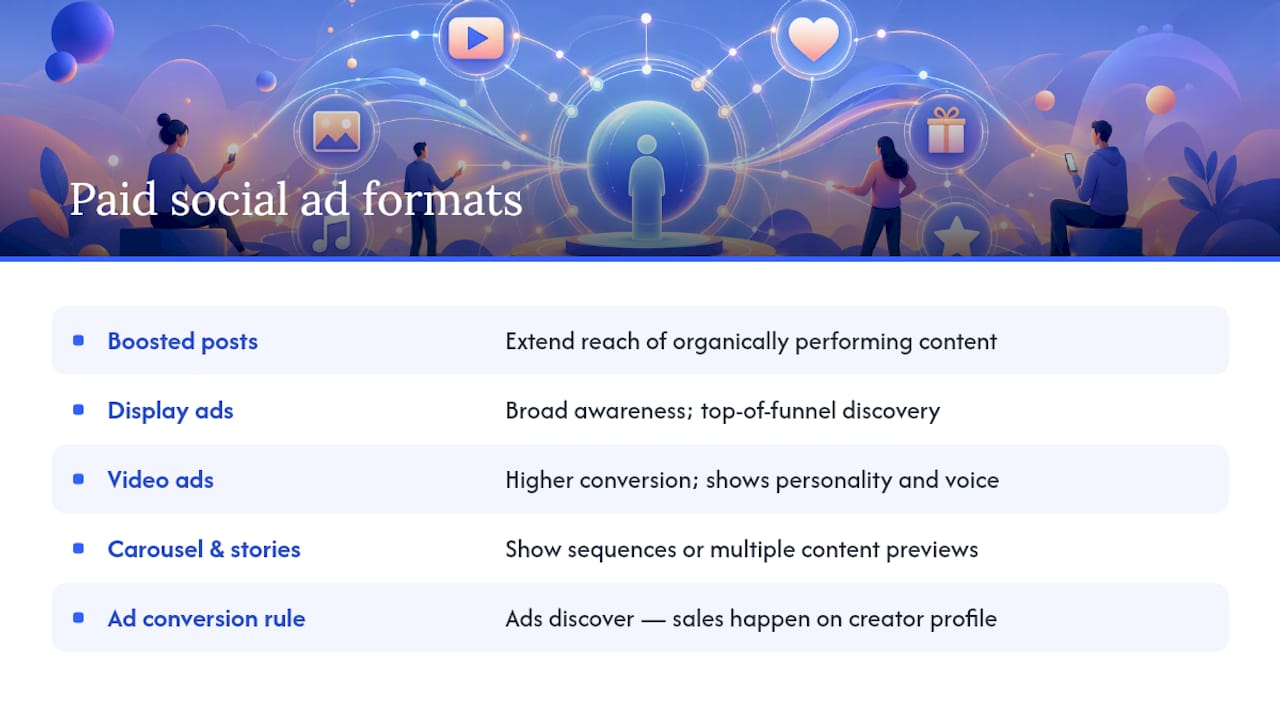
Boosted posts extend the reach of content that’s already performing organically. If a preview clip or teaser is getting strong engagement naturally, boosting it puts more budget behind proven material instead of gambling on unseen content.
Display ads work as broad-awareness tools, placing a creator’s brand or persona in front of new audiences who haven’t encountered them yet. These tend to be lower-intent but useful for top-of-funnel discovery.
Video ads typically convert better for creator promotion than static formats, since they let a prospective fan hear a voice, see a personality, and get a real sense of what a subscription actually delivers.
Carousel and story ads let creators show a sequence, a before-and-after, or several content previews in one placement, which works well for showcasing variety across a content library.
The common thread across all formats: none of them should try to sell a subscription directly inside the ad. Social platforms restrict adult and exclusive content promotion heavily, so the ad’s job is discovery, not the transaction. The actual sale happens once a prospective fan lands on the creator’s paid platform profile, where gated previews and clear pricing do the converting. Fanspicy’s guide to media marketing ideas for adult creators covers campaign angles that stay compliant while still driving real subscriber growth.
How Does Audience Targeting Work for Paid Ads?
Targeting determines whether an ad budget reaches people likely to subscribe or gets wasted on browsers who never convert. Most social ad platforms let creators segment by demographics (age, location, language), interests (content categories, competitor pages followed, engagement patterns), and behavior (past purchases, app activity, time spent on similar content).
Lookalike audiences are the most useful tool available to creators with an existing subscriber base. By uploading a list of current paying fans (where platform policy allows), the ad system finds new prospects who share similar characteristics and behavior patterns. This tends to outperform broad interest targeting because it’s built on people who already proved willing to pay.
Retargeting matters just as much as new-audience targeting. Someone who visited a creator’s profile but didn’t subscribe is a warmer prospect than a cold audience member, and a retargeting ad reminding them of what they saw often converts at a noticeably higher rate than first-touch ads.
Segmentation also applies to messaging, not just audience selection. A younger audience segment might respond to casual, direct language, while an older or higher-spending segment might respond better to ads emphasizing exclusivity and access. Testing two or three audience segments with different creative, rather than one broad campaign, typically surfaces which fans are worth the ad spend and which aren’t.
What Does Budgeting for Paid Social Ads Look Like?
Ad budgets for creator discovery break down into two structures: cost-per-click (CPC) and cost-per-thousand-impressions (CPM), and the right choice depends on the goal.
CPC campaigns work best when the objective is driving traffic to a profile or paid platform link, since the creator only pays when someone actually clicks. CPM campaigns suit broad awareness goals, where the point is simply getting a face and a name in front of as many relevant people as possible.
Most independent creators start small, testing a modest daily budget across a few days before scaling anything up. The instinct to spend heavily on an untested ad is one of the most common budgeting mistakes. A small test budget spread across two or three creative variations reveals which angle resonates before committing real money.
Budget allocation should also account for the platform’s take. Since ad spend only buys discovery, and the actual revenue happens on the paid content platform, the real return on ad spend calculation is: subscriber lifetime value minus the platform’s revenue share, compared against cost per acquired subscriber. A creator spending $50 to acquire a subscriber whose LTV is $400 has a strong return; the same $50 spent to acquire someone worth $60 in lifetime value is not.
Reinvestment matters more than the initial budget. Creators who take a percentage of subscription revenue and funnel it back into promotion consistently outgrow those who treat advertising as a one-time expense rather than an ongoing input.
How Does Paid Social Compare to Organic Reach?
Organic reach is free, but it’s also unreliable. A post that performs well one week can vanish into an algorithm change the next, and creators have no control over that shift. Paid ads buy certainty. A boosted post or targeted campaign guarantees a defined number of impressions to a chosen audience, regardless of what the algorithm decides to prioritize that day.
The tradeoff is cost versus reach. Organic content can go viral and reach far more people than any reasonable ad budget could buy, but it’s unpredictable and can’t be scheduled or guaranteed. Paid reach is smaller per dollar but consistent, which matters enormously for creators trying to hit a subscriber goal by a specific date rather than hoping for a lucky algorithm break.
The strongest approach uses both together. Organic content builds the top of the funnel and establishes a creator’s voice and personality for free. Paid ads then amplify the content that’s already proving itself organically, extending its reach to audiences who’d never have seen it otherwise. This is fundamentally different from relying on an algorithm-dependent feed as the sole revenue engine. Comparative calculations show that owning a direct subscriber base requires far fewer people than matching the same revenue through ad-dependent view counts, which is the core argument for pairing organic and paid social discovery with a subscription platform underneath, rather than depending on either channel alone.
What Do Real Creator Examples Show About Paid Ads?
The clearest pattern among creators who successfully use paid social ads is that none of them expect the ad itself to generate revenue. The ad’s only job is moving a cold viewer to a warm profile visit, and the paid content platform does the actual conversion and billing from there.
Creators who stack three or four revenue streams (subscriptions, paid messages, digital products, and tips) show measurably more financial resilience than those relying on a single stream or on brand deals alone, according to Digiday’s breakdown of creator economy business models. A creator running paid ads purely to grow a subscriber base, while also offering PPV content and livestream tips on the back end, captures value from a single acquired fan in three or four different ways instead of just one.
Subscription-first creators also tend to treat one-off brand partnerships as a bonus rather than a necessity, since owning recurring revenue and subscriber data gives creators real negotiating leverage when brand deals do come along. That reversal, subscriptions as the foundation and everything else as upside, is the throughline across nearly every creator success story worth studying. Fanspicy’s own writeup on subscription-based recurring revenue walks through how this stacking shows up in practice for adult content creators specifically.
What Are the Common Pitfalls of Paid Social Advertising?
The biggest mistake creators make is running ads before they have a converting offer in place. Sending paid traffic to an unclear profile, a confusing subscription tier, or a paid platform without gated previews wastes budget regardless of how well-targeted the ad is.
Overspending on unproven creative is the second most common error. Committing a large budget to a single ad variation, without testing smaller amounts across a few different angles first, often means discovering what doesn’t work only after the money’s gone.
Platform policy is a real constraint, not a technicality to route around. Adult and exclusive content promotion faces heavy restrictions across most major social networks, and accounts that push against those limits risk suspension, which erases both organic and paid reach overnight. Creators need to understand what each platform allows before building a campaign around content it won’t permit.
Ignoring metrics beyond clicks is another frequent trap. A high click-through rate means nothing if none of those clicks convert into subscribers. Tracking cost per acquired subscriber, not just cost per click, is the only way to know if an ad campaign is actually profitable.
Finally, treating paid ads as a replacement for organic presence, rather than an amplifier of it, tends to backfire. Ads perform best when they extend content that’s already resonating, not when they’re the only content a creator produces.
What I’ve Learned Covering Paid Social Platforms
The biggest misconception I run into is creators treating ad spend and platform choice as separate decisions. They’re not. An ad campaign sending traffic to a platform without content protection or reliable payouts is money spent building someone else’s audience metrics, not your own revenue.
The single most common error I see: creators launch a subscription tier before fixing their payment retry and onboarding flow, then blame low revenue on their ad spend instead of the leak underneath it.
How Fanspicy Puts These Benefits to Work
Everything covered above (subscription inertia, revenue stacking, retention mechanics, and platform infrastructure) is exactly what Fanspicy is built around delivering for independent creators. Instead of hoping an algorithm shows your content to the right people, Fanspicy gives you guaranteed delivery to subscribers, CRM tools to segment and re-engage fans, anti-screenshot content protection that supports higher price points, and payment infrastructure with retry logic built to stop revenue from leaking through failed cards.
Subscriptions, paid direct messages, tips, livestreaming, and pay-per-view content all run through one dashboard, so you’re not stitching together five different tools to run one creator business. Fanspicy operates as a revenue-share marketplace: you keep building your audience and setting your prices, and the platform takes a percentage only when you actually get paid.
If you’re ready to see how these mechanics work on a live platform, visit Fanspicy and set up your creator profile to start converting your existing audience into recurring, predictable income.
Sources
- PYMNTS — Study: consumer inertia boosts subscription firms’ revenues
- Digiday — Not all creators are the same: how the creator economy breaks down by business model
- Spenny Piggy — Why memberships are the most stable creator income