

Inhaltsübersicht
TL;DR:
- Starting with affiliate offers and low-cost digital products, creators can quickly earn on social media without a large following. Building a simple funnel that captures emails and promotes one product enables consistent income and diversification across multiple revenue streams. Focus on targeted content, conversion metrics, and owned channels to build a durable, scalable creator business.
Start with affiliate offers and one low-cost digital product, add any platform-native payout you qualify for, and capture emails from day one. That combination gives you the highest probability of earning your first dollars from social media without needing a massive following. Creators who approach social media monetization with a clear system rather than random posting can often reach their first significant income within months, depending on niche and consistency.
Who should start where: Affiliate marketing works for virtually every creator because it requires no product and no follower minimum. Digital products (templates, presets, mini-courses) suit niche experts who can solve a specific problem. Services and consulting fit skill-based creators who can deliver results directly.
Your one-week quick-start checklist:
- Pick one platform where your audience is already active.
- Join one affiliate program (Amazon Associates, ShareASale, or a niche-specific network).
- Create one $5–$50 digital product or service listing and publish it to a link-in-bio landing page.
- Add an email capture to that page and write a two-email welcome sequence.
- Review your FTC obligations for sponsored content disclosures before your first paid post.
Once you have those four pieces in place, you can layer in platform-native programs like the TikTok Creator Rewards Program or the YouTube Partner Program as supplemental income while your owned revenue grows.
Profi-Tipp: Don’t wait until you have 10,000 followers to start. A highly engaged audience of 500 people who trust your recommendations will convert better on affiliate links than 50,000 passive scrollers.

Inhaltsübersicht
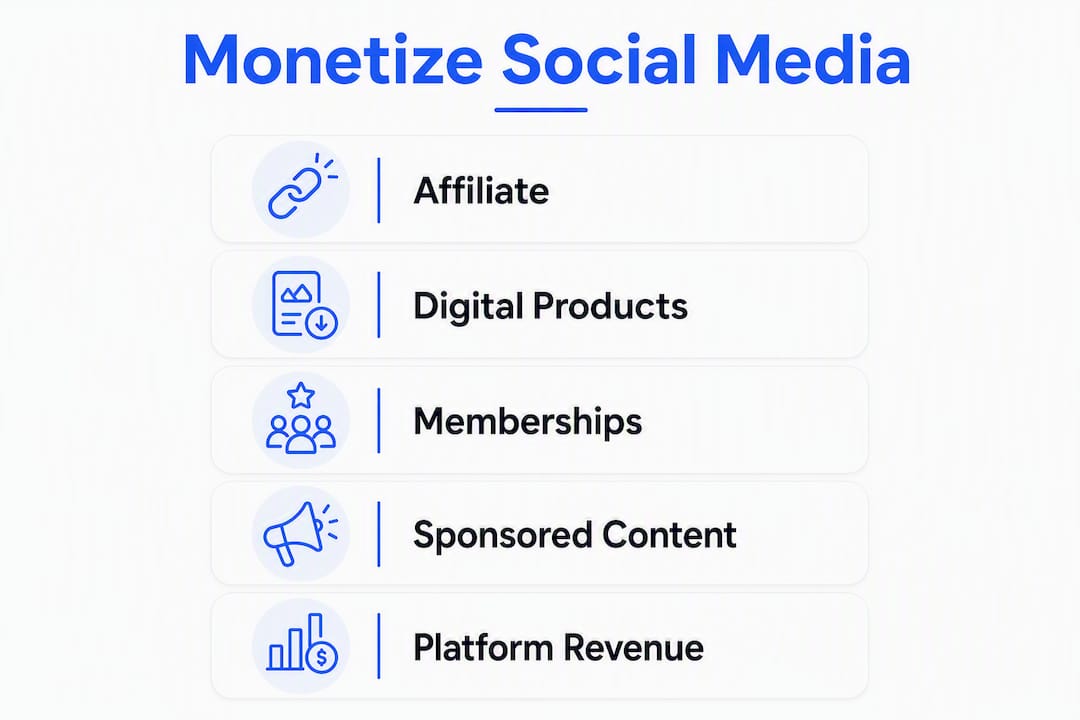
- Monetize Social Media: 10 Methods That Actually Work
- How to choose which monetization methods to try first
- How to optimize your profile and funnel to convert followers into buyers
- Measure what matters: metrics, pricing, and realistic growth timelines
- Platform eligibility, sourced evidence, and what the data says
- Wichtigste Erkenntnisse
- What actually works for small creators (and what most guides skip)
- Fanspicy: a creator-first platform for direct-to-fan income
- Useful sources and next reads
Monetize Social Media: 10 Methods That Actually Work
The creator economy offers more income paths than most creators realize. The methods below are ranked roughly by how quickly a small creator can activate them, with setup steps, realistic earnings, and platform notes for each.

| Method | Am besten für | Follower Threshold | Realistic Early Earnings |
|---|---|---|---|
| Affiliate marketing | All creators | None required | $50–$500/month at 1K–5K followers |
| Digital products | Niche experts | 500+ engaged | $100–$1,000/month |
| Services/consulting | Skill-based creators | - | $500–$3,000/month |
| Sponsored content | Any niche with trust | 1,000 | $50–$500/post (micro) |
| Platform ad revenue | Long-form/video creators | YPP: 1,000 subs + 4,000 watch hours | Modest early; scales with views |
| Paid memberships | Community builders | 500+ loyal followers | $200–$500/month |
| Merchandise/dropshipping | Brand-driven creators | - | Variable; margin-dependent |
| UGC for brands | Any creator with a camera | None required | $150–$500/video |
| Live-streaming tips/gifts | Entertainers, educators | Platform-dependent | Variable |
| Referral/partner programs | SaaS-adjacent creators | None required | Recurring commissions |
Profi-Tipp: Creators with three or more revenue streams earn $75,000 more on average than those relying on a single source. Stack methods deliberately rather than chasing every new program.
Affiliate marketing
Affiliate marketing means promoting another company’s product and earning a commission on each sale you drive. It’s the fastest method to activate because most programs require no follower minimum and you can add links to existing content immediately.
Setup steps: (1) Join one program (Amazon Associates for broad niches, ShareASale or Impact for brand-specific deals, or a niche network like CJ Affiliate). (2) Add your affiliate link to your link-in-bio and pin it in your top-performing post’s comments. (3) Disclose the relationship per FTC guidelines in every post that contains an affiliate link.
Short-form video works especially well for affiliate demos because discovery potential is high. Short-form video accounts for a large share of content consumption, which means a single well-placed TikTok or Reel can drive meaningful affiliate clicks without a large existing audience.
Digital products
A digital product is a one-time-creation asset (a Notion template, Lightroom preset pack, mini-course, or PDF guide) that you sell repeatedly with no fulfillment cost. Niche experts see the best results because buyers pay for specific, proven knowledge.
Setup steps: (1) Identify the single most common question your audience asks you. (2) Package the answer into a $9–$49 product on Gumroad or Payhip. (3) Link it from your bio and mention it in content that addresses that question directly.
Long-form platforms like YouTube support course sales well because viewers spend more time with your content and develop higher trust before buying.
Services and consulting
Selling your skills directly (coaching calls, content audits, social media management, copywriting) generates the highest revenue per customer of any method on this list. A creator with 300 highly engaged followers can earn more from one consulting client than from thousands of affiliate clicks.
Setup steps: (1) Define one specific service with a clear deliverable and price. (2) Create a simple booking page on Cal.com or Calendly with a payment link. (3) Mention the service in your content bio and in posts where you demonstrate the relevant skill.
Sponsored content
Brands pay creators to feature their products or services in posts, videos, or Stories. Sponsored content becomes reliable once you can demonstrate you drive actions, not just impressions. Brands increasingly prioritize conversion ability over raw follower counts, so a micro-creator with a 5% engagement rate often commands better rates than a mid-tier creator at 0.5%.
Setup steps: (1) Build a one-page media kit with your niche, audience demographics, engagement rate, and past results. (2) Pitch brands directly via email or use a platform like AspireIQ or Creator.co to get discovered. (3) Always disclose paid partnerships with “#ad” or “#sponsored” per FTC requirements.
Platform ad revenue and native payments
YouTube’s Partner Program (1,000 subscribers + 4,000 watch hours), TikTok’s Creator Rewards Program, and Meta’s Reels incentives all pay creators based on views or engagement. Platform-specific pay rates vary widely, and ad revenue alone is rarely sufficient at early stages. Treat these as supplemental income while building owned revenue streams.
Paid memberships and subscriptions
A membership gives your most loyal followers exclusive access (bonus content, community, live Q&As) for a recurring monthly fee. Platforms like Patreon, Substack, or a Fanspicy subscription tier handle billing and access control automatically.
Setup steps: (1) Define what members get that free followers don’t. (2) Set two to three pricing tiers ($5, $15, $30) with clear benefit differences. (3) Promote the membership in your top-performing free content as the “next level” for serious fans.
Recurring revenue from memberships creates a predictable income floor that persists even when algorithm changes suppress your organic reach.
Merchandise and dropshipping
Print-on-demand services like Printful or Printify let you sell branded merchandise without holding inventory. Margins are thinner than digital products, so this method works best when your brand identity is strong enough that fans want to wear or display it.
UGC (user-generated content) for brands
Brands pay creators to produce content the brand then uses in its own ads and channels. You don’t need a large following because the brand is buying your production skills, not your audience. Rates typically run $150–$500 per video for creators who can deliver clean, on-brand footage.
Live-streaming tips and gifts
Platforms like TikTok Live, YouTube Live, and Twitch allow viewers to send virtual gifts or tips during streams. Revenue is variable and depends heavily on community warmth and stream frequency, but it adds a real-time income layer for entertainers and educators.
Referral and partner programs
SaaS companies (tools like ConvertKit, Kajabi, or Canva) offer recurring commissions of 20–40% for every customer you refer who stays subscribed. One referred customer can pay you for years. This method suits creators who already recommend tools in their content.
How to choose which monetization methods to try first
Picking the wrong method wastes months. The right choice depends on four things: your audience’s intent, your content format, how much setup time you can invest, and whether you prefer recurring or one-off income.
Three questions to answer before you choose:
- What does your audience come to you to solve? If they follow you for entertainment, affiliate links and tips/gifts convert better than consulting. If they follow you for expertise, digital products and services will outperform ad revenue.
- What format do you publish most? Short-form video drives discovery and affiliate clicks. Long-form video and newsletters support course sales and high-ticket consulting. Live content supports tips and memberships.
- How much time can you invest in setup this month? Affiliate marketing takes a few hours. A mini-course takes a week or two. A full membership community takes ongoing management.
A sample decision path for a micro-creator (1,000–10,000 followers):
- High engagement + niche expertise → start with a $19–$49 digital product and one affiliate program.
- High engagement + entertainment focus → start with affiliate links and test a $5/month membership tier.
- Low engagement + strong skills → skip ad revenue entirely and pitch one consulting client this week.
Red flags to avoid:
- Spreading across five platforms before mastering one.
- Measuring success by follower count instead of click-through rate and conversion rate.
- Relying entirely on platform ad revenue without building an owned email list.
A content strategy built around clear goals and measurement converts social activity into revenue far more reliably than posting without direction. Score each method you’re considering on a 1–5 scale for audience fit, setup effort, and revenue potential. The method with the highest combined score is where you start. Add a second method only after the first is generating consistent results.
How to optimize your profile and funnel to convert followers into buyers
Your profile is the first conversion point. If it doesn’t immediately communicate what you offer and who it’s for, you’re losing revenue before anyone clicks a link.
Profile optimization checklist:
- One-sentence niche statement in your bio (who you help + what outcome you deliver).
- Single primary CTA (“Get my free template,” “Book a call,” “Join my newsletter”).
- Link-in-bio tool (Linktree, Beacons, or Stan Store) with trackable UTM links on every destination.
- Pinned post or highlight reel that showcases your best monetized content.
The funnel behind that profile should follow a simple four-step sequence: a free lead magnet captures the email, a welcome sequence delivers value and introduces your lowest-cost product, a follow-up sequence upsells to a membership or higher-ticket offer. Most creators skip the email step entirely and lose every follower the moment the algorithm shifts.
For tools, Meta Business Suite and Buffer handle scheduling and consistency. Repurpose.io automates cross-platform distribution. ConvertKit or MailerLite manage the email sequence. A simple Carrd or Notion site can serve as your landing page before you invest in anything more complex.
Profi-Tipp: Take your single best-performing piece of content and build a full conversion chain from it: add an affiliate link in the pinned comment, reference your lead magnet in the caption, and route the link-in-bio click to a landing page that captures the email before showing the product. One piece of content, three revenue touchpoints.
Fanspicy’s content scheduling guide covers batching and cadence in detail if you want a repeatable system for keeping that funnel fed consistently.
Measure what matters: metrics, pricing, and realistic growth timelines
Tracking the wrong numbers is one of the most common reasons creators plateau. Follower count tells you almost nothing about revenue potential. These are the metrics that do.
Core metrics to track:
- Email conversion rate (link clicks to email signups): a healthy rate is 20–40% for a targeted lead magnet.
- Click-through rate (post to link-in-bio): tells you whether your content is driving action.
- Average order value (AOV): the average amount a buyer spends per transaction.
- Customer lifetime value (LTV): total revenue per customer across all purchases and subscriptions.
- Ad RPM: revenue per 1,000 views on YouTube or TikTok, useful for benchmarking platform ad income.
- Recurring revenue percentage: the share of monthly income that comes from subscriptions or SaaS affiliates.
Realistic benchmarks by audience size:
| Größe des Publikums | Realistic Monthly Revenue Range | Primary Methods |
|---|---|---|
| Under 1,000 followers | $0–$150 | Services, UGC, affiliate links |
| 1,000 followers | $100–$1,000 | Affiliate + digital product |
| 5,000 followers | $500–$1,000 | Product + membership + sponsors |
| - | $2,000–$5,000 | Full multi-stream stack |
Pricing guidance: Price your first digital product at $9–$49 to minimize purchase friction. Subscription tiers work best at $5, $15, and $30, with the middle tier generating the most revenue in most cases. For one-off services, charge what a single hour of your expertise is worth to the client, not what feels comfortable to you.
The 30-day funnel experiment: Pick one traffic source (one platform, one content type), one landing page, and one product. Track four numbers daily: visits to the landing page, email signups, product page views, and purchases. After 30 days, you’ll know your conversion rate at each step and exactly where to optimize. Analytics tools built for streaming creators can accelerate this process if you’re publishing live or video content.
69% of marketers prioritize performance metrics over vanity metrics, and the creators who earn consistently operate the same way. A small audience with a 3% conversion rate on a $29 product generates more revenue than a large audience with a 0.1% rate.
Platform eligibility, sourced evidence, and what the data says
The creator economy is large and growing. Global social media ad spend is projected to reach $219 billion in 2026, and social commerce sales are on track to hit $1.3 trillion worldwide. Those numbers represent real opportunity for individual creators, not just brands.
Platform eligibility snapshot:
- TikTok Creator Rewards Program: Requires 10,000 followers and 100,000 video views in the past 30 days, plus a personal account in an eligible country.
- YouTube Partner Program: Requires 1,000 subscribers and 4,000 watch hours in the past 12 months (or 500 subscribers + 3,000 watch hours for the lower-tier program).
- Instagram Subscriptions: Available to eligible creators in the U.S. with a professional account; Meta controls rollout and eligibility.
- Instagram Reels incentives: Periodically available to invited creators; not a stable primary income source.
Fanspicy publishes creator-focused guidance on platform selection, content formats, and revenue diversification. The hybrid monetization approach that mixes recurring and one-off revenue streams has shown meaningful gains for creators who implement it consistently.
Profi-Tipp: Use platform-native programs (Creator Rewards, YPP) as a bonus layer on top of owned revenue streams, not as your foundation. Algorithm changes and program rule updates can cut that income overnight. Your email list and your digital products cannot be taken away by a platform update.
Wichtigste Erkenntnisse
The fastest path to social media income combines affiliate marketing, one low-cost digital product, and an email capture, activated within the first week before adding platform-native programs.
| Point | Details |
|---|---|
| Start with affiliate + product | Join one affiliate program and create one $9–$49 digital product before anything else. |
| Build your email list immediately | Route every link-in-bio click to an email capture; owned channels survive algorithm changes. |
| Track conversion rate, not followers | A 3% conversion rate on a small list generates more revenue than a large passive audience. |
| Stack three or more revenue streams | Creators with three or more streams earn $75,000 more on average than single-source creators. |
| Fanspicy for direct-to-fan revenue | Fanspicy’s paid social and subscription infrastructure supports recurring income independent of platform algorithms. |
What actually works for small creators (and what most guides skip)
The conventional advice is to pick a niche, post consistently, and the money will follow. That’s not wrong, but it’s incomplete in a way that costs creators months of wasted effort.
The revenue mix that tends to work for small creators is simpler than most guides suggest: one affiliate program generating passive clicks, one digital product priced under $50 that answers a specific question, and one recurring subscription or membership that gives your most loyal followers a reason to pay monthly. That three-part stack creates an income floor that doesn’t collapse when a single platform changes its algorithm or pauses a creator fund.
What gets skipped in most guides is the funnel. Creators post content, collect followers, and then wonder why no one buys. The gap is almost always the same: there’s no clear path from “I watched your video” to “I gave you my email” to “I bought your thing.” Building that path, even a rough one, is worth more than doubling your posting frequency.
Engagement beats follower count every time. A creator with 800 followers who replies to every comment and genuinely knows their audience’s problems will outperform a creator with 80,000 followers who treats their feed as a broadcast channel. Brands know this. Buyers know this. The data confirms it.
The other mistake worth naming: chasing every new platform feature or monetization program the moment it launches. Creator funds come and go. Bonus programs get restructured. The creators who build durable income treat social platforms as discovery engines and route that traffic to owned channels (email, a website, a paid community) where they control the relationship.
Fanspicy: a creator-first platform for direct-to-fan income
If you’ve built a loyal audience and want to monetize it directly without depending on ad revenue or brand deals, Fanspicy offers a different route. It’s a paid social and live content platform built for creators who want subscription income, tips, and direct fan payments handled in one place, without the platform risk that comes with algorithm-dependent income.
Fanspicy is worth considering when you have a direct-to-fan audience that’s willing to pay for exclusive content, when you want subscription and tipping infrastructure without building it yourself, or when you’re ready to move beyond affiliate links and ad revenue into recurring, owned income. The platform handles payments, access control, and discoverability so you can focus on creating.
For creators who want to promote paid content effectively and convert followers into paying subscribers, Fanspicy’s built-in tools remove most of the technical friction that slows creators down. If you’re ready to test a subscription tier or live content offering, start with a free Fanspicy profile and see whether the direct-to-fan model fits your audience.
Disclosure: Fanspicy is the publisher of this guide. The platform mentioned above is Fanspicy’s own product.
Useful sources and next reads
These resources are worth bookmarking as you build your monetization strategy.
- Master Your Social Media Strategy — Hootsuite: Free strategy template and expert guidance on goal-setting, content mix, and performance measurement.
- Social Media Marketing for Small Business — Sprout Social: Covers scheduling tools, platform selection, and consistency tactics for small teams and solo creators.
- Instagram Affiliate and Shop Features — TechCrunch: Background on Instagram’s native affiliate and shopping tools for creators.
- What Does It Take to Monetize Your Social Media? — FGIA — A straightforward overview of the prerequisites and mindset shifts required before monetization becomes viable.
- Social Media Marketing Guide — Forbes Advisor: Business-focused strategy guide covering platform selection, content planning, and audience growth.
- 7 Media Marketing Ideas for Adult Creators — Fanspicy: Specific revenue ideas for creators in the adult content space, including services and digital goods.
- Types of Content Creation: Maximizing Revenue — Fanspicy: Format-by-format breakdown of which content types generate the most revenue at different audience sizes.