

Inhaltsübersicht
Pick one primary recurring offer, usually a subscription tier, pair it with a tangible premium library, and publish on a predictable cadence. Free to paid conversion averages 2 to 5% across creator platforms, so your first week’s job is simple: price a standard tier, publish three premium items, and shoot three discovery clips.
TL;DR:
- Building a premium content library before launch significantly improves conversion, with 3 to 6 substantial items boosting immediate value perception.
- Keep your monetization simple initially by combining subscriptions and tips, adding pay-per-view only after establishing audience trust.
- Track four key metrics—conversion rate, churn, revenue per user, and tip amount—weekly to identify issues early and refine your strategy.
- Focus on master video and live streams first, as these formats drive engagement and subscription growth, then add supporting content types.
- Distribute teaser clips on platforms where your audience spends time, but always direct viewers to a clear next step, like a landing page or email capture.
Inhaltsübersicht
- What Is Content Marketing Content Creation for Paid Creators?
- How Do You Match Monetization to Format?
- How Do You Productize a Premium Content Library Before Launch?
- How Do You Build a Funnel from Discovery to Paid Subscriber?
- Which Metrics Actually Predict Recurring Revenue?
- Which Content Formats Should You Actually Use?
- How Do You Come Up with Content Ideas That Fans Will Actually Pay For?
- What Tools Actually Save Time on Content Production?
- Does SEO Matter for Paid Creator Content?
- Where Should You Distribute Content Outside Your Paid Funnel?
- How Do You Plan an Editorial Calendar That Doesn’t Collapse?
- My 30/60/90 Day Plan for Getting Paid Content Off the Ground
- Get Your Paid Content Live on FanSpicy
- Sources
What Is Content Marketing Content Creation for Paid Creators?
For an independent creator selling subscriptions, pay-per-view clips, and live streams, content marketing content creation means something different than it does for a retail brand blogging to attract customers. It’s the paid material itself, the subscription posts, the paywalled videos, the private messages, the live sessions, that you produce and package as the product fans buy. Every asset you create either sells access or supports the sale of access. There’s no separate “marketing content” and “real content.” The premium clip is the marketing. The free teaser is the marketing. The whole operation runs on one content engine that both attracts fans and gets paid by them.
That distinction matters because it changes how you plan. A traditional marketer creates free content to build trust, then sells something else. You create paid content directly, and you use short, free samples to prove what the paid version is worth. Get that architecture right and everything downstream, pricing, promotion, retention, gets easier.
How Do You Match Monetization to Format?
Subscriptions, pay-per-view, and tips solve different problems, and mixing all three from day one usually backfires. The strongest live monetization systems layer subscriptions for predictable income, PPV for scarcity events, and tips for spontaneous engagement, then add complexity only after the core offer proves itself, according to NextStream’s live stream monetization playbook.
Abonnements work best for habitual, identity-driven content: a daily behind-the-scenes feed, a recurring show, a membership fans identify with. They reward consistency over novelty.
Pay-per-view fits tentpole moments: a themed live event, a workshop, a one-off broadcast with real scarcity. PPV succeeds when the content is genuinely unavailable elsewhere, not when you PPV everything out of habit.
Tips and micropayments amplify live moments and remove friction for fans who aren’t ready to subscribe. They’re the lowest-commitment way for a casual viewer to become a paying one.
A simple starter structure keeps decision fatigue low for both you and your fans:
- Free tier: short previews, teaser clips, public posts that demonstrate your style
- Standard tier: full access to your regular library, replays, and community posts
- Premium tier: exclusive live sessions, personalized messages, and early access to new drops
One caution worth building into your plan from day one: platform-native revenue policies and eligibility rules shift often, sometimes without warning, which creates real income instability if you depend entirely on any single channel’s built-in tools, per Circle’s creator economy research. Owning your fan contact points, email addresses especially, insulates you from that risk.
Profi-Tipp: Launch with subscriptions and tips only. Add PPV once you have a repeat audience that already trusts your regular content, otherwise you’re asking strangers to pay a premium for an unproven show.
How Do You Productize a Premium Content Library Before Launch?
A paid tier only converts when it’s a real product on day one, not a promise. Building a premium library before you launch turns a vague subscription pitch into something a fan can immediately see the value of, and creators who productize their offer this way consistently convert better than those who don’t, according to a Forbes look at profitable creator platforms in 2026.
Assemble 3 to 6 substantial items before you open the doors:
- Replay bundles of past live sessions, grouped by theme so new subscribers can binge them immediately.
- Exclusive clips shot specifically for paying members, never posted anywhere free.
- Behind-the-scenes breakdowns that show process, not just polished output.
- Guided how-tos or tutorials tied to your niche, something a fan can actually use.
- Templates or checklists, if your content lends itself to structure, that fans can reuse.
- Personalized access perks, like a monthly live Q&A or a private chat window, since fans often pay more for proximity than for extra public content.
That last point deserves emphasis. Access sells harder than volume. A single monthly live Q&A or a batch of personalized replies can outperform another dozen public posts, because what a paying fan actually wants is closeness to you, not more content in general.
Price flexibly around what you’ve built. A one-time bundle works for a themed collection. Recurring access works for an ongoing library that grows monthly. Many successful creators mix both, a bundle to hook new subscribers plus an ongoing subscription that keeps them. Paid content that succeeds long term tends to offer original interpretation or a genuine experience rather than material fans could find free elsewhere, a principle beehiiv’s paid newsletter guide applies just as directly to premium video and live content. Reuse the same raw footage across formats: a long replay becomes three short clips, a live Q&A becomes a written recap for your subscription tier.
How Do You Build a Funnel from Discovery to Paid Subscriber?
Short-form clips do the discovery work, but they only pay off when they lead somewhere specific. The funnel that converts casual viewers into paying fans runs through four stages: a public clip, a capture point, an onboarding sequence, and ongoing retention.
Start with short-form content built for wide reach, cut for the platform it lives on, not recycled straight from a longer piece. From there:
- Link every bio and pinned post to a single landing page or email capture, not scattered across five platforms.
- Offer a short free preview window or early-bird pricing to lower the first-purchase decision.
- Build a welcome sequence that delivers one piece of real value immediately, your best premium clip or replay, so new subscribers feel the purchase paid off in the first five minutes.
- Set expectations early: posting cadence, what’s included at each tier, and when live events happen.
Cross-channel promotion multiplies this funnel without adding much work. Pin your best-converting clip, run a limited trial offer during a launch week, and schedule member-only events on a calendar fans can plan around. Owning the email relationship matters more here than it seems. Creators who capture and use email lists convert and retain better than those relying purely on platform algorithms, per Venture Lab’s creator economy research, because an email sits in your control even when a platform’s discovery algorithm shifts. For a deeper breakdown of promotion tactics by channel, see how to promote paid content at each funnel stage.
Which Metrics Actually Predict Recurring Revenue?
Four numbers tell you almost everything about the health of a paid content business: conversion rate from free to paid, churn by cohort, average revenue per user, and average tip value. Track those weekly and you’ll catch problems before they become a pattern.
Free to paid conversion across creator platforms averages 2 to 5%. If you’re consistently below that range, the funnel or the offer, not your content volume, is usually the problem.
Run small experiments rather than overhauling everything at once:
- Test trial length: a 3-day free trial versus a 7-day one often shifts conversion more than a price change does.
- Test tier benefits: swap what’s included in Standard versus Premium and watch upgrade rates.
- Test replay availability: does gating replays behind a higher tier increase upgrades or just frustrate casual fans?
- Test onboarding incentives: a bonus clip on signup versus none at all.
Retention lives or dies on a few specific levers: a real welcome series, a visible calendar of exclusive events, annual discounts that reward commitment, and dunning recovery for failed payments, which recovers revenue that would otherwise just quietly vanish. A staged rollout, instrument your analytics first, then layer in subscriptions, then tips, then PPV, keeps you from guessing at what’s working, a sequencing NextStream recommends specifically to avoid feature sprawl. Once churn stabilizes, the data will tell you plainly whether your next move is a PPV event, a tipping push, or a sponsorship conversation.
Which Content Formats Should You Actually Use?
Not every format deserves equal investment, and matching the format to the job matters more than producing more of everything.
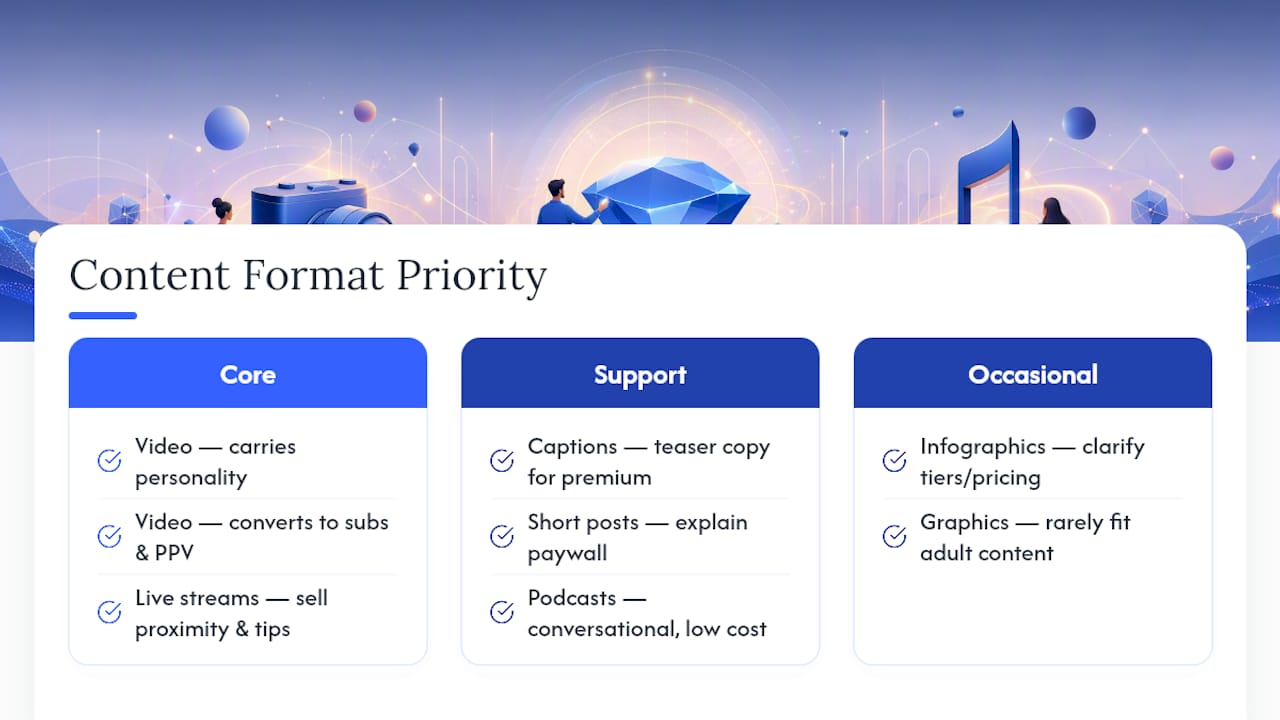
Video is the backbone for paid creators on a live-cam platform: it carries personality, proves production quality, and converts best into subscriptions and PPV. Live-Streams specifically sell proximity, real-time interaction is the entire point, which is why they pair naturally with tips.
Short blog-style posts or captions aren’t wasted effort. A well-written caption on a teaser clip does real work explaining what’s behind the paywall, functioning almost like ad copy for your premium tier.
Podcasts or audio-only content suit creators whose value is conversational or personality-driven rather than visual, and they’re cheap to produce from existing live audio.
Infographics or simple graphic breakdowns rarely fit adult or live-cam content directly, but a clean graphic explaining your tier structure or a pricing chart removes confusion at the point of purchase, which is exactly where confusion costs you the sale.
The mistake most creators make isn’t picking the wrong format. It’s spreading thin across all of them before any single one is working. Master video and live streaming first, since that’s where the engagement techniques that drive subscription growth actually live, then add supporting formats around that core.
How Do You Come Up with Content Ideas That Fans Will Actually Pay For?
Ideation for paid creators starts from a different question than it does for a typical brand: not “what will get views” but “what will a fan pay to keep seeing.” Those aren’t the same list.
Watch what your free content already gets the most comments and replies on. That’s your audience telling you, unprompted, what they want more of behind the paywall. Direct messages are an even richer source: recurring requests in your private messages are essentially a product roadmap fans are handing you for free.
Look at your tip patterns too. Moments that generate spontaneous tips during a live stream reveal exactly what fans value enough to pay extra for in the moment, which tells you what belongs in your next PPV event or premium bundle.
Set a simple recurring habit: once a week, review your last month’s top-performing free clips, your most-replied-to messages, and your highest-tipped live moments. Cross-reference the three. Ideas that show up in more than one list are almost always worth turning into premium content. This beats guessing at trends or copying what other creators are doing, because it’s based on your specific audience’s actual behavior, not a generic content calendar template.
What Tools Actually Save Time on Content Production?
You don’t need an elaborate stack to produce paid content efficiently, but a few categories of tools consistently save creators real hours.
Recording and editing software that supports quick clipping from longer live sessions turns one stream into a week of short-form promotional content. Look for tools with simple trim and caption features rather than full production suites, speed matters more than polish for discovery clips.
Scheduling and automation tools let you queue posts and messages in advance so promotion doesn’t depend on you being online at the exact right hour. This matters especially around live events, where you want teaser posts going out on a fixed schedule leading up to the broadcast.
Analytics dashboards, whether built into your platform or a lightweight third-party tool, are what let you actually see conversion and churn numbers instead of guessing at them.
Messaging and CRM-style tools help manage private messages at scale once your subscriber count grows past what you can track in your head. Losing track of a paying fan’s message is a retention risk, not just an inconvenience.
The goal isn’t collecting tools. It’s removing the busywork that keeps you from shooting the next premium clip.
Does SEO Matter for Paid Creator Content?
Search optimization plays a smaller role for paid creator content than it does for a typical content marketing operation, but it isn’t irrelevant. Where it matters most is on the free, public-facing content that feeds your funnel: bios, public post captions, and any landing page you use for email capture.
Write captions and bios with the actual words a potential fan would search or type, your niche, your format, what makes your live content different, rather than vague, clever phrasing that sounds good but matches no one’s search intent. Keep landing pages focused on a single clear action: subscribe, join the email list, or watch a teaser. A landing page trying to do five things at once converts worse than one doing a single thing well.
Metadata and thumbnail text matter more on platforms where discovery is algorithm-driven, since a clear, specific thumbnail often outperforms a vague but visually striking one for actual click-through. Treat your public content the way any creator would treat top-of-funnel marketing: it exists to be found, not to showcase everything you have.
Where Should You Distribute Content Outside Your Paid Funnel?
Free public platforms exist to feed your paid funnel, not compete with it. Social media, cross-promotion partnerships, and syndication all serve one job: getting new eyes on your teaser content so some percentage of them move down into your owned channels.
Post short-form discovery clips across the platforms where your niche’s audience already spends time, then treat every one of those posts as a funnel entry point, not the destination. A clip that gets views but has no clear next step, no bio link, no pinned post, wastes most of its reach.
Cross-promotion with other creators in adjacent niches, shoutouts, guest appearances on each other’s live streams, expands reach without paid ad spend, and it tends to convert better than cold discovery because the audience arrives with some existing trust. Syndicating clips or highlights to secondary platforms multiplies your discovery surface without extra production work, since you’re reusing footage you already shot for your primary channel.
The common failure here is treating distribution as the whole strategy rather than the top of the funnel. More views on a free platform only matters if some fraction of that traffic converts to a subscriber or a tip, and to attract viewers who actually convert, the destination you’re sending them to matters as much as the clip itself.
How Do You Plan an Editorial Calendar That Doesn’t Collapse?
A workable calendar for a paid creator balances three content types on a fixed rhythm: free discovery content, subscriber-tier posts, and premium or live events. Without a schedule, the premium tier is usually the first thing to slip, since it takes more effort and doesn’t have an external deadline pushing it out the door.
Block your week around live events first, since those have fixed dates fans plan around, then fill in subscriber content on a predictable cadence, daily or several times a week works for most formats, and finally schedule free discovery clips to promote whatever premium content is coming up.
Batch production where you can. Shooting several premium clips or writing several subscriber posts in one sitting, then scheduling them out over the following weeks, protects you from the week where you simply don’t feel like creating. A simple weekly or monthly grid, even a basic spreadsheet with columns for format, tier, and publish date, beats no plan at all. The specific tool matters far less than the discipline of filling it in every week and actually checking it before you sit down to shoot.
My 30/60/90 Day Plan for Getting Paid Content Off the Ground
If I were starting from zero, the first 30 days would go entirely into groundwork: assemble a premium library of at least three solid items, pick one primary monetization method, subscriptions, and publish three short-form clips built purely for discovery.
Days 31 to 60 are about launching, not perfecting. Open the subscription tier, put a real welcome sequence behind it, and run your first honest look at the analytics: conversion rate, early churn, nothing fancy.
By day 90, iterate based on what the numbers actually showed you. Test one PPV event against your existing subscriber base, and build a basic dunning recovery step for failed payments before it quietly costs you revenue. The plan doesn’t need to be dramatic. It needs to be followed.
— fan
Get Your Paid Content Live on FanSpicy
Every layer of this playbook, subscriptions, PPV events, tipping, private messages, live streams, runs on infrastructure you don’t have to build yourself. FanSpicy is built specifically for independent creators monetizing paid and exclusive content, with subscription tiers, live streaming, pay-per-view, tipping, and private messaging all handled inside one creator platform.
That means the productization work covered above, your premium library, your tier structure, your PPV events, plugs directly into tools already built for it, instead of stitching together separate payment processors, messaging apps, and streaming software. If you’ve priced your standard tier and assembled your first three premium items, the next step is straightforward: set up your FanSpicy page and start publishing to fans who are already there to pay for access.
Sources
- Circle — creator economy statistics
- beehiiv — How to write a paid newsletter
- NextStream — Live stream monetization playbook
- Venture Lab — Creator economy trends 2026