

Inhaltsübersicht
TL;DR:
- Social platforms like Instagram, TikTok, and Facebook function as powerful in-platform search engines.
- Combining SEO with paid strategies significantly enhances reach, engagement, and ROI for creators.
- Prioritizing both organic and paid approaches ensures faster growth and sustainable long-term success.
Most creators on paid social platforms assume SEO is someone else’s problem. You post, you promote, you earn. But here’s what that thinking costs you: discoverability. Paid platforms like Instagram, TikTok, and Facebook have evolved into powerful search engines in their own right, and creators who treat them that way are pulling in audiences that others never reach. Meta ads alone drive 19% more incremental search visits, with 71% of that traffic coming from organic search, proving that what you do on paid platforms ripples far beyond the platform itself. This guide breaks down exactly how to use SEO to grow your visibility, engagement, and earnings.
Inhaltsübersicht
- What is social SEO on paid platforms?
- How SEO and paid strategies amplify each other
- Platform-specific SEO tips for top results
- Testing, tracking, and refining: Making SEO scalable
- Organic vs paid: Integrating for long-term creator success
- Our take: Why SEO mastery is now non-negotiable on paid platforms
- Grow your audience and revenue with Fanspicy
- Frequently asked questions
Wichtigste Erkenntnisse
| Point | Details |
|---|---|
| Social SEO builds visibility | Optimizing platform bios, captions, and hashtags helps people find your paid content in searches. |
| Combine paid and organic | Using both strategies together gets you better results than relying on one approach alone. |
| Test and refine for growth | Learn from paid campaign analytics to improve your organic SEO and keep compounding your reach. |
| Platform tactics matter | Each social site has unique SEO tricks, so tailor your approach for Instagram, TikTok, and Facebook. |
What is social SEO on paid platforms?
Social SEO is the practice of optimizing your presence inside social media platforms so that their internal search and discovery systems surface your content to the right people. It is not about ranking on Google. It is about ranking inside Instagram’s Explore tab, TikTok’s search bar, and Facebook’s content discovery feed.
Content creators boost paid platform visibility through keyword-rich bios, captions, alt text, hashtags, and location tags on Instagram, TikTok, and Facebook to rank in in-platform searches. These are not just cosmetic touches. They are the signals that tell each platform’s algorithm who your content is for and when to show it.
Here is what social SEO covers on the platforms you use every day:
- Bios and profile descriptions: Your bio is indexed. Use words your ideal audience actually searches for.
- Captions: Natural keyword placement in captions tells the algorithm what your post is about.
- Alt text: On Instagram especially, custom alt text is a direct SEO signal most creators skip entirely.
- Hashtags: Not just for reach. Hashtags function as category tags that help platforms classify your content.
- Location tags: These drive local and niche discoverability, especially useful for live content creators.
The core difference between traditional SEO and social SEO is intent. Google users search with specific questions. Social platform users browse, discover, and stumble. Your job with social SEO is to make sure that when someone is browsing in your niche, your content is the one they find. If you want a deeper look at how this connects to your overall strategy, check out this guide on promoting paid content effectively.
“Social platforms are no longer just distribution channels. They are search engines with audiences already primed to pay for content they love.”
How SEO and paid strategies amplify each other
Here is something most creators get wrong: they treat SEO and paid promotion as separate tracks. One is free, one costs money, and never the two shall meet. That thinking leaves serious performance gains on the table.
Integrating SEO with paid social reduces CPA (cost per acquisition) through intent-aligned targeting, boosts click-through rates with search-like messaging, and improves ad quality scores on Meta and TikTok. When your paid ads use the same language your audience searches for organically, everything performs better.

The numbers back this up. Brands combining SEO and paid see 38-39% CTR lifts, with SEO delivering 8x ROI compared to 4x for paid alone. E-commerce SEO ROI climbs to 5.2x at 36 months or more. For creators, this means the content you optimize today keeps paying you back long after a paid campaign ends.
Here is a quick comparison of what each approach does on its own versus together:
| Approach | Strength | Weakness |
|---|---|---|
| Paid only | Fast reach, scalable | Stops when budget stops |
| SEO only | Compounding, low cost | Slow to build momentum |
| Combined | Speed plus long-term growth | Requires coordination |
The real-world synergy works like this: you run a paid promotion for a piece of content. You look at which keywords and phrases drove the most clicks and conversions in that campaign. Then you use those exact phrases in your organic captions, bios, and alt text going forward. Your paid data becomes your SEO research, for free.
Here are the biggest ways SEO and paid strategies reinforce each other for creators:
- Paid ad comments reveal what your audience actually wants, which feeds directly into your SEO content calendar.
- High-performing organic posts can be boosted with paid spend, giving your best SEO-optimized content even more reach.
- Consistent keyword use across both paid and organic builds brand recognition in the platform’s algorithm over time.
- Ad quality scores improve when your messaging matches what users search for, lowering your cost per click.
Pro Tip: Spend 10 minutes each week reading the comments on your paid posts. The questions and phrases your audience uses are pure SEO gold. Use them in your next caption or bio update. For more on the benefits of paid social media and how to stack them with organic growth, that resource is worth bookmarking. You can also explore hybrid monetization ideas that work alongside this combined approach.
Platform-specific SEO tips for top results
Knowing the theory is one thing. Knowing exactly what to do on each platform is what actually moves the needle. Each platform has its own algorithm logic, and your SEO moves need to match.
| Plattform | Top SEO signals | Quick win |
|---|---|---|
| Alt text, 3-5 hashtags, location tags | Write custom alt text on every post | |
| TikTok | Captions, trending audio, on-screen text | Add your keyword as on-screen text in the first 3 seconds |
| Keyword bios, engagement signals | Update your page bio with your niche keywords today |
Platform-specific optimization for creators means using alt text and 3-5 targeted hashtags on Instagram, captions with trending audio and on-screen text on TikTok, and keyword-rich bios with strong engagement signals on Facebook. These are not optional extras. They are the foundation of being found.
Here is a step-by-step audit you can run on your own posts right now:
- Check your bio on every platform. Does it include the words someone would type to find a creator like you? If not, rewrite it today.
- Review your last 10 captions. Are your primary keywords appearing naturally in the first two lines? That is where algorithms and users both look first.
- Enable custom alt text on Instagram. Go into advanced settings when posting and write a description that includes your content category and a relevant keyword.
- Audit your hashtags. Replace generic tags like #content with specific niche tags that reflect exactly what you create.
- Add location tags where relevant, especially if you create content tied to a specific city, event, or community.
- Check your TikTok captions. Are they searchable sentences, not just emojis? TikTok’s search indexes caption text directly.
- Boost your top organic posts with a small paid spend to test whether SEO-optimized content performs better when amplified.
Pro Tip: Instead of stuffing captions with hashtags, write captions that answer a question your audience would actually search for. “How I film content from home” performs better in search than a caption that is just a list of tags. For a full breakdown of the content creation process on paid platforms, and for fresh media marketing ideas that pair well with these SEO tactics, both are worth reading alongside this section.
Testing, tracking, and refining: Making SEO scalable
SEO is not a one-time setup. It is a feedback loop. The creators who grow fastest are the ones who treat every post as a data point and every campaign as a research experiment.
Paid social campaigns provide real-time insights including converting ad phrases and engagement patterns that you can use to refine your SEO content and keywords for organic strategies. In other words, your ad account is also your keyword research tool.
Here is how to build a scalable SEO feedback loop:
- Tag your paid campaigns by keyword theme. When you review performance, you will instantly see which content angles resonate most.
- Export top-performing ad copy phrases monthly. These are your highest-converting keywords. Use them in organic captions and bios.
- Track which organic posts get the most saves and shares. Saves especially signal that your content matched what someone was searching for.
- A/B test caption styles. Run two versions of the same post with different keyword placements and see which gets more reach over 48 hours.
- Review your platform analytics weekly. Look at traffic sources. If search is growing, your social SEO is working.
- Update older posts. Refresh the captions and alt text on your top-performing older content with new keywords. Platforms re-index updated content.
Pro Tip: Before spending budget on a new content series, post it organically first. If it gets strong saves and search-driven views without paid support, that is your signal to invest in promoting it. Your organic posts are your cheapest testing ground.
The compounding effect here is real. Each round of testing makes your next post smarter. After six months of this loop, your content calendar is essentially built from data your audience already gave you. For more on building subscriber growth tactics into this kind of iterative system, that guide pairs well with what you have learned here.
“The creators who win long-term are not the ones with the biggest budgets. They are the ones who learn the fastest.”
Organic vs paid: Integrating for long-term creator success
Every creator eventually asks: should I focus on organic SEO or paid promotion? The honest answer is that framing the question that way is already a mistake.
Organic social is cheaper long-term with 61% lower CPL after five months, but it grows slowly. Paid is immediate and scalable with ROAS (return on ad spend) between 2.5x and 4.5x, but it costs money every single day you run it. The smart move is to integrate both, and many successful creators use a 60/40 paid-to-organic time split as a starting point.
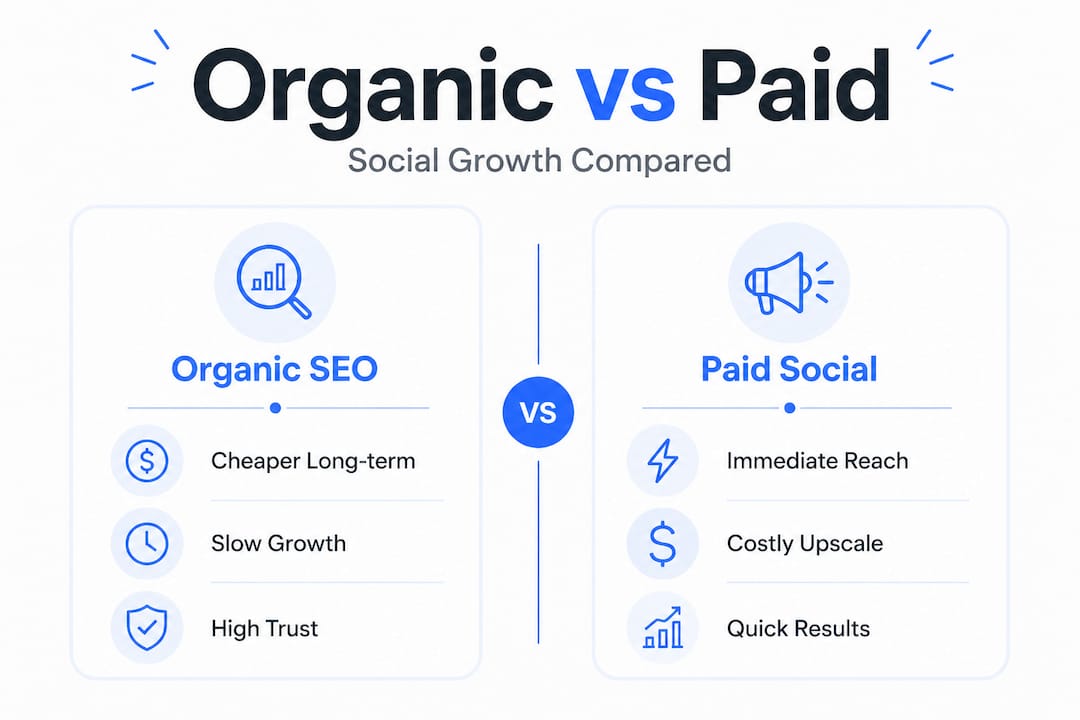
Here is a breakdown of when to lean on each approach:
Prioritize organic SEO when:
- You are building a long-term audience in a specific niche
- You want to lower your cost per new subscriber over time
- You are testing new content formats before spending money on them
- Your existing content library is strong enough to generate search traffic on its own
Prioritize paid when:
- You are launching a new profile or content series and need momentum fast
- You have a time-sensitive promotion or limited offer
- You want to reach a new audience segment outside your current followers
- You have a proven piece of content that deserves more eyes
Combine both when:
- You want to use paid data to sharpen your organic keyword strategy
- You are boosting SEO-optimized posts to accelerate their organic reach
- You want to build brand recognition across both search and feed discovery simultaneously
| Factor | Organic SEO | Paid social | Combined |
|---|---|---|---|
| Speed to results | Slow (3-6 months) | Fast (days) | Balanced |
| Long-term cost | Niedrig | Hoch | Mäßig |
| Scalability | Mäßig | Hoch | Hoch |
| Trust-building | Stark | Mäßig | Stark |
For a deeper look at how content marketing for creators fits into this balance, that resource covers the strategic side in detail.
Our take: Why SEO mastery is now non-negotiable on paid platforms
Here is what most SEO guides for creators will not tell you: the window to get ahead on social SEO is right now, and it is closing.
Most creators on paid platforms are still ignoring SEO entirely. They post, they pay to boost, and they wonder why growth feels like a treadmill. The ones pulling ahead are treating their platforms like search engines and building content that compounds over time. Hybrid strategies win because paid gives you speed and testing capability while social SEO delivers compounding returns. Paid ad comments reveal content gaps. Social signals indirectly boost SEO through branded searches and backlinks. It is a system, not a tactic.
The uncomfortable truth is that SEO on paid platforms is not glamorous work. It is writing better alt text. It is spending 20 minutes rewriting your bio. It is reading your ad comments instead of just counting likes. But this is exactly why it works. Most creators will not do it, which means the ones who do stand out immediately.
Speed and adaptability are the real skills here. The algorithm changes. Platform search behavior shifts. What worked six months ago may need updating. The creators who build a habit of testing, learning, and refining are the ones who stay visible regardless of what the platform does next.
SEO mastery does not replace great content. It makes great content findable. Every dollar you spend on paid promotion goes further when the content it promotes is already optimized to be discovered. Every organic post you publish has a longer shelf life when it is built around what your audience is actually searching for. Explore the full range of content types for revenue to see how SEO-optimized formats can work across your entire catalog.
Grow your audience and revenue with Fanspicy
You now have a complete framework for turning SEO into a growth engine on paid social platforms. The next step is putting it into practice on a platform built to support exactly this kind of strategic creator.
Fanspicy is a paid social media and live cam platform designed for creators who are serious about building an audience and earning real income. The tools, the community, and the infrastructure are already here. Creators like Jackie Pott und somlusolme are already using the platform to grow their reach and revenue. Set up your creator profile, apply the SEO strategies from this guide, and start building the kind of compounding visibility that pays you back month after month.
Frequently asked questions
What is the difference between SEO for Google and for social media platforms?
SEO for Google targets traditional web search results, while social SEO optimizes in-platform features like hashtags, captions, and alt text to rank in Instagram, TikTok, and Facebook’s own search systems.
How can I use keywords effectively on paid social media posts?
Place your primary keywords naturally in your bio, the first two lines of your captions, your image alt text, and your hashtags for the strongest in-platform discoverability signals.
Does investing in SEO on paid platforms really boost ROI?
Yes. Combining SEO with paid strategies produces 38-39% CTR lifts, and SEO alone delivers 8x ROI compared to 4x for paid-only campaigns.
Can I test my SEO ideas with paid campaigns before going fully organic?
Absolutely. Paid campaigns reveal converting phrases and engagement patterns in real time, making them the fastest and most affordable way to validate your SEO keyword strategy before committing to it organically.
Is organic social traffic always better than paid?
Not always. Organic delivers 61% lower CPL over time but grows slowly, while paid scales fast with 2.5-4.5x ROAS. Integrating both gives you the speed of paid and the long-term value of organic.