

جدول المحتويات
What is a subscription revenue model?
The subscription revenue model charges customers a recurring fee at regular intervals for continued access to a product or service. Rather than closing a one-time sale and moving on, businesses build an ongoing relationship with each customer, collecting monthly or annual payments that compound into predictable, long-term income. The concept is older than most entrepreneurs realize: 17th-century publishers pioneered it with book and periodical subscriptions, and the same core logic now powers everything from SaaS platforms to creator content.
Several operational elements make the model work in practice:
- Recurring billing cycles (monthly, quarterly, or annual) with automated payment processing
- Customer accounts that track subscription status, usage, and renewal dates
- Subscription tiers offering different access levels at different price points
- Key metrics including churn rate, customer lifetime value (LTV), and monthly recurring revenue (MRR)
- Automated billing infrastructure that reduces manual intervention and keeps revenue flowing with minimal friction
Automated billing and account management are the operational backbone of any subscription business. Without them, the model’s core promise of predictable revenue falls apart quickly. The shift from one-time sales to recurring streams also changes how you design products, manage customer relationships, and measure success. Churn and LTV replace units sold as the metrics that actually tell you whether the business is healthy.
The main subscription revenue model examples you need to know
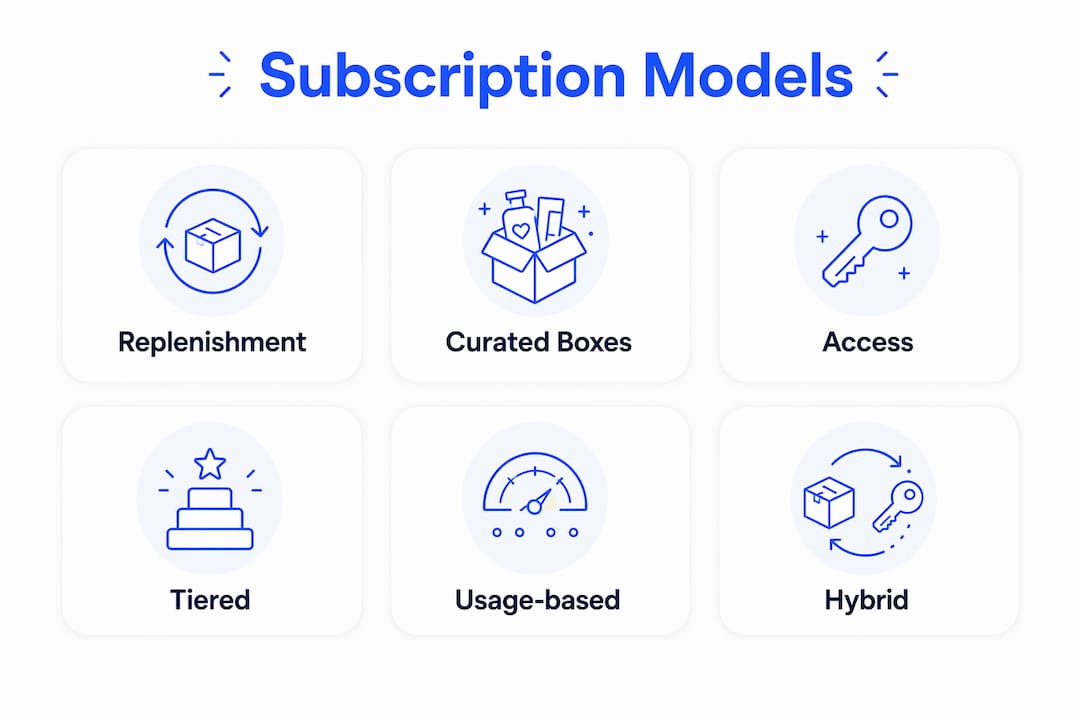
Stripe’s resource library identifies six core subscription model types, each suited to different products, markets, and customer behaviors. Understanding the distinctions helps you choose the right structure from the start rather than retrofitting one later.
Replenishment subscriptions
Customers receive a product on a fixed schedule, typically because they use it up and need more. Dollar Shave Club built its entire brand on this model, shipping razors and grooming supplies monthly so customers never had to think about restocking. The appeal is pure convenience, and the business benefits from predictable order volumes and reduced customer acquisition costs over time. The challenge is that cancellations can be costly if the unit economics are thin, so retention tactics and churn monitoring matter more here than in almost any other model.
Curated box subscriptions
A curated selection of products arrives each period, often themed around a lifestyle, hobby, or interest. Birchbox popularized this format in the beauty space, sending subscribers a monthly mix of sample-sized products. The discovery element drives initial excitement, but that novelty can wear off. Churn rates for curated box models tend to run 10–15% monthly, which means retention programs and personalization are not optional extras.
Access subscriptions
Subscribers pay for unlimited access to a content library or platform. Netflix is the defining example: a very large subscriber base pay a fixed monthly fee for unlimited streaming. Access models generate the strongest retention of any subscription type, with monthly churn rates typically in the 3–6% range, because the value accumulates the longer someone stays subscribed. The more content a subscriber has watched, the more invested they feel in staying.
Tiered subscriptions
Different price points unlock different features or service levels. HubSpot is the textbook example: free tools at the entry level, then Starter, Professional, and Enterprise tiers that expand capabilities as a business grows. SaaS platforms use this structure constantly because it lets them serve solo founders and large enterprises from the same product. Slack and Zoom follow the same pattern, often starting with a freemium tier to reduce the barrier to first sign-up.
Usage-based subscriptions
Customers pay based on how much they actually consume. Amazon Web Services (AWS) charges for compute time, storage, and data transfer, meaning a startup’s bill looks nothing like an enterprise customer’s. This model aligns cost with value, which customers appreciate, but it makes revenue forecasting harder since monthly totals fluctuate with usage.
Hybrid subscriptions
A base subscription fee combines with optional one-time purchases or usage charges. Amazon’s Subscribe & Save program lets shoppers lock in a discount on regular deliveries while still buying other items individually. Hybrid models lower the barrier for customers who are not ready to commit fully to a subscription, making them particularly useful when you are testing product-market fit in a new category.
How real industries apply these models
SaaS: Adobe and HubSpot
Adobe’s move from perpetual software licenses to Creative Cloud subscriptions is one of the most studied pivots in tech history. Rather than selling Photoshop for a one-time fee of several hundred dollars, Adobe now charges monthly or annual fees for access to the full Creative Suite. The shift initially met resistance from longtime customers, but it gave Adobe a predictable, growing revenue base and made the software accessible to freelancers who could not afford a large upfront purchase. HubSpot’s tiered model works similarly, letting small businesses start free and upgrade as their marketing and sales needs grow, with enterprise contracts at the top of the stack.

Streaming media: Netflix
Netflix’s access model scales in a way that traditional media distribution simply cannot match. Fixed content production costs spread across a massive subscriber base, so each additional subscriber adds revenue with minimal marginal cost. The company’s pricing strategy has evolved over time, adding an ad-supported tier to capture price-sensitive subscribers without cannibalizing its premium plans. That tiered-within-access structure is worth noting: even “pure” access models often layer in pricing variations to maximize revenue across different customer segments.
E-commerce: Dollar Shave Club and Birchbox
Dollar Shave Club’s replenishment model disrupted the razor market by combining subscription convenience with direct-to-consumer pricing that undercut traditional retail. Birchbox took a different angle, using the curated box format to introduce subscribers to new beauty brands, effectively turning its subscriber base into a discovery engine that brands paid to access. Both companies demonstrated that subscription models in physical goods require tight logistics and a clear answer to the question of why a customer should not just buy from a store.

Creator economy: direct-to-fan subscriptions
The creator economy has produced one of the most interesting subscription model examples of the past decade. Platforms built around direct-to-fan monetization let creators charge tiered membership fees for exclusive content, behind-the-scenes access, and direct interaction. Patreon’s 0% commission structure gives creators more control over their earnings than traditional platform advertising ever could. The model works because fans who pay for access are more engaged and more loyal than passive social media followers, which translates directly into lower churn and higher LTV per subscriber.
Fanspicy operates in this space, offering creators a platform where subscription-based recurring revenue from fans forms the foundation of their income. The direct-to-fan model removes the advertiser as an intermediary, which changes the creative incentives entirely.
Health and wellness
Subscription models in health and wellness range from gym memberships (the original access subscription) to meal kit services and telehealth platforms. Meal kits like the category that companies such as HelloFresh popularized use a replenishment-adjacent structure, delivering weekly boxes of pre-portioned ingredients. The challenge in this category is high churn driven by lifestyle changes and cooking fatigue, which has pushed most players toward flexible pause and skip options to keep subscribers from canceling outright.
Automotive
Vehicle subscription programs let drivers swap cars on a monthly basis, paying a flat fee that covers insurance, maintenance, and registration. The model has not yet reached mass adoption, but it appeals to urban drivers who want flexibility without a multi-year lease commitment. Several automakers have tested subscription tiers for in-car software features, charging monthly fees to unlock capabilities like enhanced autopilot or heated seats that are already physically installed in the vehicle.
Education and e-learning
Online learning platforms use access models almost universally, charging monthly or annual fees for a library of courses. The value proposition is clear: one subscription replaces dozens of individual course purchases. The e-learning market has grown substantially over the past several years, driven by remote work and the demand for continuous skill development. Platforms in this space compete heavily on content breadth and instructor quality, since those two factors determine whether a subscriber renews or cancels at the end of their first term.
How subscription models differ from traditional revenue models
The contrast between subscription and one-time sales models goes deeper than just how often customers pay. The entire business logic shifts.
Revenue predictability is the most immediate difference. A traditional retailer wakes up each month not knowing how much it will sell. A subscription business starts every month with a known baseline from existing subscribers, then adds or loses from there. That predictability changes how you plan inventory, hire staff, and approach investors.
Key structural differences between the two approaches:
- Customer relationship: Traditional models end at the point of sale; subscription models begin there. Every month is a renewal decision, which means customer success becomes a core business function, not an afterthought.
- Cash flow timing: Many subscriptions collect payment upfront (annual plans), giving businesses working capital before they deliver the full service. Traditional sales collect at delivery.
- Revenue concentration risk: One-time sales can spike and crash with market conditions. Recurring revenue smooths those swings, though it does not eliminate them entirely.
- Metrics: Traditional businesses track revenue and margin. Subscription businesses add MRR, churn rate, LTV, and customer acquisition cost (CAC) as primary indicators of health.
- Pricing psychology: A $15 monthly fee feels smaller than a $180 annual purchase, even though they are identical. Subscriptions use this to make premium products accessible to customers who would balk at a large upfront number.
The challenges are real, too. Churn compounds in reverse: losing 5% of subscribers monthly means losing more than half your base in a year if you do not replace them. Customer acquisition costs must be recovered over the lifetime of the subscription, which means a business can look profitable on paper while actually losing money on each new subscriber if LTV is too low. Harvard Business School research frames this as a fundamental shift in how firms must think about strategy: the subscription model “dominates firm strategy and operational metrics” in ways that one-time sales models simply do not require.
Modern insights and strategic approaches to subscription models in 2026
Choosing the right subscription model is not a branding decision. It is a product and market decision, and getting it wrong early is expensive to fix.
“Successful subscription businesses shift company focus from product sales to customer relationship management, leveraging data to reduce churn and increase Lifetime Value.” — Harvard Business School
Model selection follows product type. Content-driven businesses (streaming, creator platforms, online learning) thrive on access models because the value compounds with continued use. SaaS tools benefit from tiered pricing because different customer segments have genuinely different needs and willingness to pay. Physical goods businesses often do best with replenishment or hybrid models, where the subscription adds convenience rather than replacing a purchase decision entirely.
Hybrid models reduce launch risk. For entrepreneurs launching a new subscription product with uncertain demand, starting with a hybrid structure lets customers choose between recurring and one-time purchases. This approach generates market data without forcing commitment, and it often converts one-time buyers into subscribers once they experience the product. Hybrid models help lower barriers to adoption in categories where customers are unfamiliar with the subscription format.
Churn is the metric that kills subscription businesses slowly. Most founders focus on acquisition; the ones who build durable businesses obsess over retention. Tactics that consistently reduce churn include annual plan incentives (discounted pricing in exchange for upfront commitment), pause options that prevent outright cancellation, and personalized onboarding that gets new subscribers to their “aha moment” as quickly as possible.
نصيحة محترف: Before launching any subscription tier, calculate the minimum LTV needed to recover your CAC at your expected churn rate. If the math does not work at realistic retention numbers, adjust pricing or reduce acquisition costs before scaling.
The creator economy offers a particularly instructive case study in subscription model evolution. Direct-to-fan platforms have demonstrated that tiered memberships with exclusive content and interaction create stronger fan loyalty than any advertising-based model. Creators who build subscription income report more stable earnings and more creative control than those who depend on platform algorithm changes for their reach. The recurring revenue model, applied to individual creators rather than large media companies, has genuinely changed what it means to build a sustainable creative career.
Stripe’s research reinforces a point that experienced operators know well: subscription model choice depends on product type and target market preferences, and the businesses that succeed long-term are the ones that align their model to how their customers actually want to buy, not how the business wants to sell.
الوجبات الرئيسية
Subscription revenue models generate predictable, recurring income by charging customers regular fees for continued access, and the model type you choose should match how your customers naturally want to consume your product.
| Point | Details |
|---|---|
| Six core model types | Replenishment, Curated Box, Access, Tiered, Usage-Based, and Hybrid each suit different products and markets. |
| Access models retain best | Access subscriptions like Netflix see monthly churn of 3–6%, compared to 10–15% for curated box models. |
| Churn compounds fast | Losing subscribers monthly without replacing them erodes your base faster than most founders expect. |
| Hybrid models reduce risk | Letting customers choose between recurring and one-time purchases lowers barriers and generates real market data. |
| Creator economy validates the model | Direct-to-fan subscriptions give creators stable recurring income and stronger fan loyalty than ad-based platforms. |