
目录
You monetize a newsletter by choosing one revenue model, proving it with a small group of readers, and then layering a second and third stream on top. The five models that work are paid subscriptions, sponsorships, affiliate links, your own products or services, and community or events. For creators who already sell to fans, the strongest foundation is a paid subscription you own, backed by tips, paid messages and exclusive drops, on a platform that lets you keep more of what you earn.
This guide shows what each model pays, what it takes, where it goes wrong, and how to build a plan that fits your list size.
TL;DR
- Newsletters earn from five sources: reader payments, sponsors, affiliate commissions, your own offers, and community or events. Most mature newsletters run two or three at once.
- Paid subscriptions are the hardest to start: the median free-to-paid conversion is 0.62%, about six payers per thousand free readers.
- Under 1,000 subscribers, donations, affiliate links and small digital products are the realistic starting points.
- Fanspicy lets creators sell subscriptions, exclusive content, paid posts, private messages, live streams, bundles and tips in one place, with no fee to join.
目录
- The five ways newsletters make money
- How much can a newsletter really earn?
- Match the model to your list size
- Model 1: Paid subscriptions
- Model 2: Sponsorships and ads
- Model 3: Affiliate links
- Model 4: Your own products and services
- Model 5: Community, events and tips
- How to turn free readers into paying ones
- A 90-day plan to start earning
- Our perspective
- Where Fanspicy fits
- 常见问题
- Sources
The five ways newsletters make money
Every guide on this topic repeats the same list because the money really does come from only a few places. One creator-economy playbook reduces it to five models:
- Sponsorships and ads. Businesses pay to reach your readers.
- Paid subscriptions. Readers pay you for premium content.
- Affiliate or referral revenue. You earn a commission when a reader buys something you recommended.
- Your own products and services. Courses, templates, ebooks, coaching, consulting.
- Community and events. Paid groups, webinars, live sessions.
A useful way to sort them is by who pays. Readers pay you directly in models 2, 4 and 5. Businesses pay you for access to your readers in models 1 and 3. Direct reader revenue is the one you control, because no advertiser can pull a budget and no affiliate program can change its terms overnight.
The same playbook warns that stacking models in the wrong order is the most common reason newsletter businesses stall. So the order matters as much as the list.
How much can a newsletter really earn?
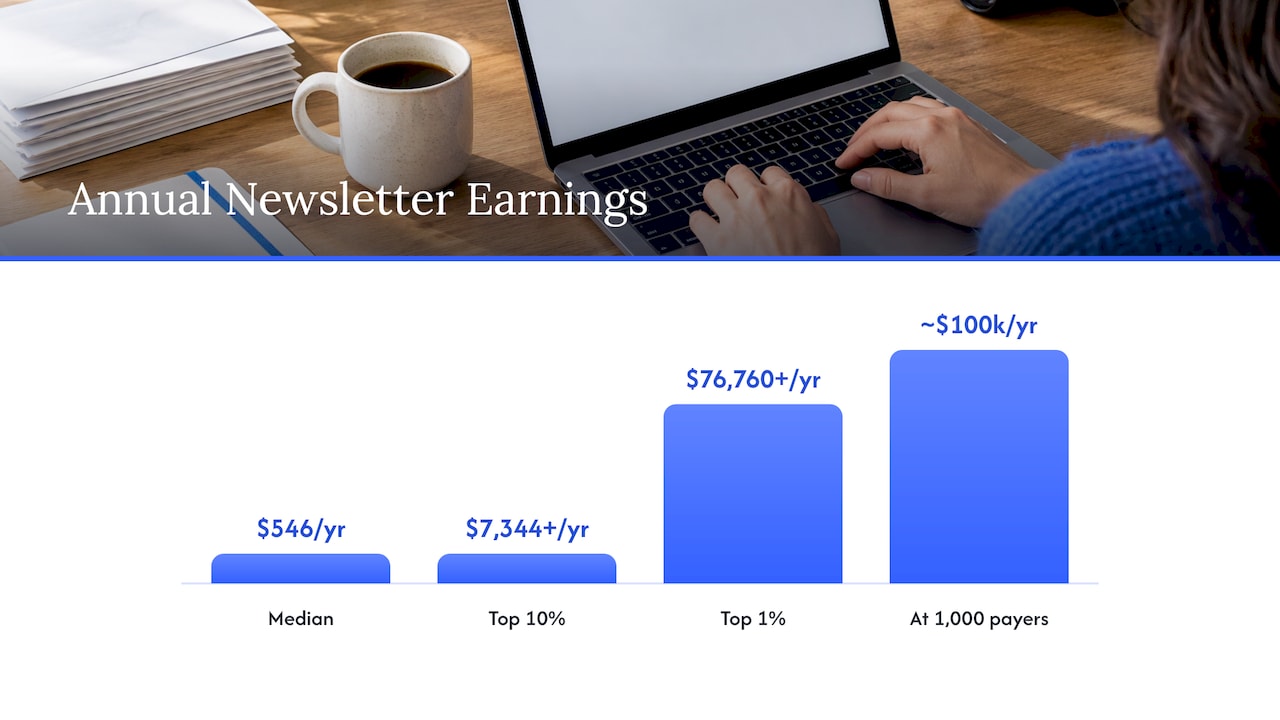
Expect a slow start, then a steep curve. An analysis of 272,000 active paid-newsletter publications (November 2026, US) found that the median paid newsletter grosses an estimated $546 a year. The top 10% earn $7,344 or more, and the top 1% earn $76,760 or more. Only about 1 in 230 active newsletters has more than 1,000 paying subscribers, the point where a typical newsletter grosses around $100,000 a year.
Two lessons follow from those numbers.
Audience size matters less than payers. Of the newsletters offering paid plans in that dataset, 60% had fewer than 10 paying subscribers. The gap between a free list and a paid list is where most newsletters get stuck.
Several modest streams beat one big hope. A creator-business analysis from Creator Spotlight observes that subscription-only businesses are the exception, and that brand partnerships or advertising are usually the biggest earner for creators who run multiple streams.
The simple formula for a paid list is subscribers multiplied by price multiplied by retention. Retention is the part people underestimate: a reader who stays twelve months is worth twelve times a reader who leaves after one.
Match the model to your list size
The stage-by-stage stack in the same creator-economy playbook is a practical map:
| List size | What to lead with |
|---|---|
| 0 to 500 | Low-friction affiliate links |
| 500 to 3,000 | Add a $49 to $199 digital download or short course |
| 3,000 to 15,000 | Sponsorships plus affiliates and courses |
| 15,000 to 50,000 | 付费订阅 |
| 50,000+ | Paid subscriptions and community, plus sponsorships, events and your own products |
Treat this as a guide, not a rule. A tight niche with 800 engaged readers can support a paid tier long before a broad list of 20,000 casual readers can. Creator Spotlight’s data shows that niche sets the price ceiling more than list size: a 1,000-subscriber investing newsletter can charge $27 a month, while a 100,000-subscriber travel newsletter typically charges $7.
If you already have fans on social media, in a messaging app or on a dating profile, you have an audience that may convert faster than a cold email list, because they already pay attention to you personally. The task is to move them somewhere you can reach and sell to repeatedly.
Model 1: Paid subscriptions
A paid subscription turns your best work into recurring income. It is the model most creators want and the one that needs the most trust.
What to charge
The published data points to a narrow band. The median paid newsletter in the 272,000-newsletter dataset charges $7.99 a month. The two most common prices are $5 and $8, and most publications that offer an annual plan price it at roughly ten times the monthly rate.
That means an annual plan is effectively two months free, which is a clean pitch: readers commit upfront and you get cash earlier.
How to test your price
Don’t judge a price test by conversion rate alone. The cheaper option almost always wins on conversion, which tells you nothing about revenue. Humblytics’ analysis recommends scoring tests on revenue per paywall visitor (price multiplied by purchase conversion). Its decision rule: a move from $10 to $15 wins only if the higher price keeps more than 66.7% of the lower price’s conversion rate.
With a small list you will not get statistically clean results anyway, so test two prices, not four, and let the numbers run long enough to mean something.
What readers pay for
People pay for access, speed and closeness, not just words. The offers that tend to justify a recurring charge are content they can’t get free, early access, direct replies and a sense of being inside a circle. That is why creators on a subscription platform often sell more than a feed: a subscription for the core content, paid posts for individual drops, and private messages for one-to-one attention. If you want to go deeper on keeping people subscribed, our guide to exclusive content that retains subscribers and the step-by-step retention process cover the routines that protect your retention number.
Model 2: Sponsorships and ads
Sponsorships pay you to put a brand in front of your readers. They are common, but they reward list size and engagement, so they usually arrive after you have grown.
What sponsors pay
Pricing is usually set by CPM, the cost per thousand subscribers. EmailOctopus gives the formula as the cost of the ad divided by subscribers, multiplied by 1,000, and suggests starting at $15 to $30 CPM, with $30 to $50 or more for established, highly engaged lists. Specialized business audiences can go far higher: the creator-economy playbook cites $100 or more CPM for finance and tech newsletters.
A worked example: a 10,000-subscriber list at $40 CPM earns $400 per sponsored issue. Send twice a week with one sponsor and that is roughly $3,200 a month.
Small lists earn less. Paved’s sponsorship guide reports that most publishers it surveyed started by charging $25 to $200 for a single ad and raised prices after successful campaigns. GDA’s guide puts deals under 1,000 subscribers at $30 to $200 per issue.
Where it goes wrong
- Chasing size over fit. Advertisers value clicks and engaged readers. Audience fit lets you charge more when clicks are likely to turn into leads or signups, and traffic that doesn’t engage is worth less.
- No media kit. Matt McGarry’s sponsorship guide lists what a kit needs: a brand intro, subscriber, open and click numbers, reader demographics, ad examples, pricing, past sponsors and the buying process.
- Selling too early. Sponsors rarely pay in the first months, so don’t build your plan around them on day one.
To find advertisers, shortlist brands you would genuinely recommend, look at who already sponsors similar newsletters, and email them with your reach and audience data.
Model 3: Affiliate links
Affiliate marketing has the lowest barrier to entry. You link to products you already use, and you earn a commission when a reader buys. GDA’s guide recommends one product per email, described through your own experience, with a clear affiliate disclosure.
The disclosure is not optional decoration. If you earn from a link, say so in plain words near the link, and check the current endorsement rules of the country your readers live in.
The weakness is dependence. Matt McGarry notes that affiliate terms and payouts can change, so treat affiliate income as a supplement to something you control, not a foundation.
Recurring-commission software programs are the strongest category. The creator-economy playbook gives the example of a referral who stays on a $149 monthly plan for two years paying about $1,000 in lifetime commission at a 30% recurring rate.
Model 4: Your own products and services
Selling your own offers keeps the most money, because there is no sponsor to negotiate with and no platform taking a cut of a third party’s deal. GDA’s guide lists courses, templates, ebooks and coaching, and suggests a three-email launch sequence: announce, answer questions, create urgency. It also recommends an inexpensive “easy win” product offered right after someone joins.
For creators, “your own products” often means the content itself. Bundles of past work, a single paid post, a custom request answered through a private message, or a live session are all products. They need no course platform, no shipping and no inventory, which is why they suit people who already create regularly.
Model 5: Community, events and tips
Community and events cover paid groups, webinars and live sessions. Donations and tip jars are the lightest version of this. The creator-economy playbook counts community and events as the fifth model, and GDA calls tip jars low-effort supplemental income, while noting that tip tools take roughly 5% on top of payment processing fees.
Tips work best when they sit beside something fans already value, such as a live stream or a reply to a message, rather than as a stand-alone request.
How to turn free readers into paying ones
Conversion is the hardest step, so plan it. The median free-to-paid rate is 0.62%, and the top quarter of publishers convert at roughly 2% to 5% according to Creator Spotlight. That means a list of 5,000 free readers produces about 31 payers at the median and 100 to 250 at the top.
The tactics that move you toward the top quarter:
- Build the habit first. GDA’s guide is not alone in advising that you publish consistently before you charge. Aim for ten to fifteen free issues so readers know what they get.
- Show the value. Publish part of a premium piece free, then put a clear callout where the paid portion begins.
- Make the first offer small. A low-priced first purchase builds the buying habit.
- Default to annual. Annual plans reduce churn and bring cash forward.
- Ask directly. Many readers never pay simply because nobody invited them to.
For promotion routines that bring fresh people to your paywall, see our guides on promoting paid content 和 cross-promotion between creators.
A 90-day plan to start earning
Weeks 1 to 2: pick one model. Choose the one that fits your list. Under 1,000 subscribers, that is usually affiliate links, a small digital product or a low-priced paid tier for your most loyal readers. Matt McGarry suggests thinking about long-term monetization once you reach 1,000 to 5,000 subscribers.
Weeks 3 to 6: ship and measure. Offer it, track revenue per reader reached, and note which sends produce replies and purchases.
Weeks 7 to 10: add a second stream. If paid subscribers are growing, add paid posts or messages. If a sponsor shows interest, build the media kit.
Weeks 11 to 13: raise or reshape. Increase prices where demand is strong and fix the offer where readers hesitate.
The rule that holds throughout: start with one method and do it well before combining.
Our perspective
A newsletter list is rented space if all your revenue depends on someone else’s ad budget or affiliate terms. The most durable income comes from fans who pay you directly, again and again.
That is how we built Fanspicy. Creators sell subscriptions, exclusive content, paid posts, private messages, live streams, bundles and tips from one profile. Our positioning is simple: creators keep a higher percentage of their earnings, own their audience relationship, and can move content over from other platforms without starting from zero.
Creators don’t pay a fee to join or use Fanspicy. The platform takes a percentage commission per transaction, so we only do well when you do. We think that alignment is what a creator economy should look like.
If you already write, stream or post for an audience, the sensible move is to give your most engaged followers a paid home and then layer sponsors and affiliate income around it, in that order.
fan
Where Fanspicy fits
If your plan includes selling directly to fans, Fanspicy gives you the tools in one place: subscriptions, private messages and live streams on the main platform, and exclusive content, tips and paid posts when you become a model. Creators do not pay to join, and the platform takes a commission only when a fan pays.
If you’re ready to start, set up your profile, bring your existing content across, and offer your first subscription tier to the followers who already engage most. For ideas on what to sell next, see our overview of creator business models and the guide to recurring revenue from subscriptions.
常见问题
How much money can you make from a newsletter?
It varies widely. In a dataset of 272,000 active paid newsletters, the median earned about $546 a year and the top 1% earned $76,760 or more. Reaching 1,000 paying subscribers is the milestone where a typical newsletter grosses around $100,000 a year.
How do you get people to pay for a newsletter?
Publish free issues consistently, show a preview of premium work, and make a specific offer. Keep the first price low, and default to an annual plan. The median conversion from free to paid is 0.62%, so expect to ask repeatedly and to grow your free audience alongside.
How many subscribers do you need before sponsors pay?
Small deals exist under 1,000 subscribers, typically $30 to $200 per issue. Larger, steadier sponsor income depends on engagement as much as size, and many advertisers prefer lists of 5,000 or more engaged readers.
What is the easiest way to start monetizing?
Affiliate links to products you already use, with a clear disclosure, are the lowest-effort start. Pair them with a small digital product or a paid tier for your most loyal readers, then add sponsors as your list grows.
Sources
- How much do paid newsletter writers make? Data from 270,000 active newsletters
- How to Monetize a Newsletter in 2026: The 5 Revenue Models
- Newsletter Monetization: Turn Your Email List Into Revenue
- Are paid newsletters a good business model?
- How to A/B Test Your Newsletter Subscription Price in 2026
- How to monetise and get sponsors for your newsletter
- How to Win Newsletter Sponsorships: 5 Lessons
- How to sell newsletter sponsorships even if you have a small list
- The 3 Best Ways To Start Monetizing Your Newsletter
- Monetization 101: All the ways to make money from your newsletter