
目录
“Thick Asian” is an internet shorthand for Asian women with fuller hips, thighs and curves, a body type that mainstream media long under-represented and that social platforms now celebrate openly. People search it for three reasons: to understand the phrase, to find positive representation, or, if they are creators, to work out how to turn a big, engaged audience into steady income. This guide covers all three, honestly and without hype.
TL;DR
- “Thick” describes a body shape (full hips, thighs, a defined waist), not a size on a chart, and it is used by many women as a term of pride.
- Searches for the phrase are driven by representation: Asian women with fuller bodies were rarely visible in fashion and media until recently.
- Body ideals are shaped by culture and context, so no single standard describes “the Asian body type”, and the continent holds many different shapes.
- Creators in this niche often find that social reach does not pay the bills. A direct-to-fan platform with a higher creator payout share, owned audiences and flexible earning tools can.
- Everyone in this space should be an adult, consenting and verified. That is the baseline, not a bonus.
目录
- What “thick Asian” actually means
- Why the search keeps growing
- Celebrating versus fetishizing
- The creator side: attention is not income
- What to look for in a platform
- Perspective: why we built Fanspicy for independent creators
- How to get started on a creator-first platform
- Join Fanspicy as a creator
- Tips for fans who want to support creators well
- A quick word on the other “thick” results
- 常见问题
- Sources
What “thick Asian” actually means
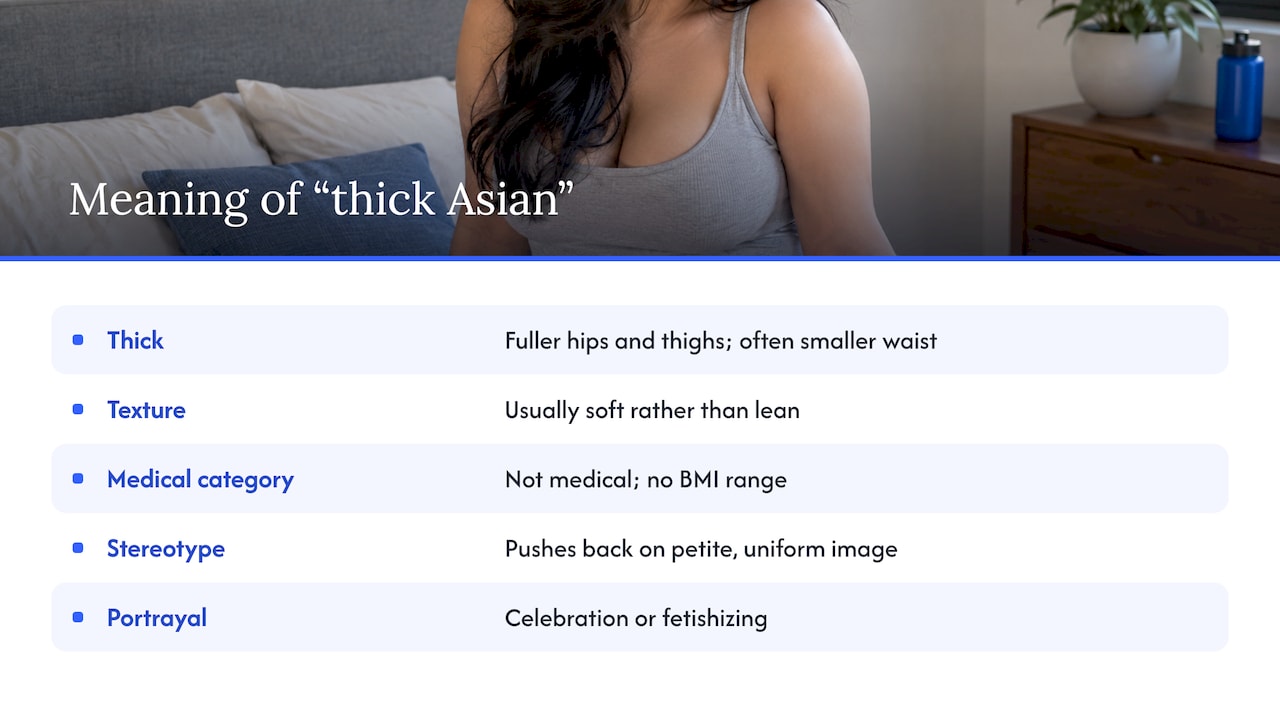
The word “thick” in American slang means curvy with substance: fuller hips and thighs, often paired with a smaller waist, and usually soft rather than lean. It is not a medical category and it does not map to a BMI range. Two women of the same weight can look entirely different, and only one might call herself thick.
Attached to “Asian”, the phrase does something specific. It pushes back on a narrow stereotype that Asian women are petite, slight and uniform. Look at what ranks for the term: fan-run Instagram accounts, a YouTube channel that frames the topic as beauty, confidence and power breaking outdated stereotypes, hashtags on X and TikTok, and image libraries. Much of that is celebration. Some of it is fetishizing, and a thoughtful reader should be able to tell the difference.
A note on the “Asian body type”
People also ask what the Asian body type is called. There is no such single thing. Asia spans more than four billion people across East, South, Southeast, Central and West Asia, with enormous variety in height, frame and build. Researchers who study body image find that culture plays an important role in shaping body image, and that people from different cultures hold different beliefs about the “ideal” body. For bicultural people, such as many Asian Americans, those ideals shift with identity and context.
In plain terms: when someone says “thick Asian”, they are naming one body type among many, and the label says more about the viewer’s categories than about any population.
Why the search keeps growing
There is no mystery in the volume. A few forces stack on top of each other.
- Representation gaps. Model Yumi Nu, described by Vogue as the first Asian curve model to appear in Vogue or Sports Illustrated, said she did not see her own race or body type in the media as a child. When the gap is that visible, people go looking for themselves online.
- Fashion is slowly widening. British Vogue placed Nu among the names at the forefront of inclusivity in fashion, and she later appeared on the cover of Vogue Japan, two years after her earlier landmark appearance.
- Short-form video rewards identity. TikTok and Instagram let women tell their own stories in their own words, and communities form around shared experience.
- Pressure on the other side. Weight-based prejudice is real. A narrative review in the medical literature describes weightism as pervasive and one of the socially accepted types of discrimination in Asia. Research on Asian American women also links cultural variables such as perceived discrimination to internalized weight issues. Spaces that celebrate fuller bodies matter in that context.
That last point deserves care. Celebration and pressure can coexist in the same feed. If a body-image topic affects your health or mood, a licensed therapist or your doctor is the right person to talk to, not a hashtag.
Celebrating versus fetishizing
Search results for this phrase mix empowering content with content that reduces women to a category. A few signals help you tell them apart, whether you are a fan or a creator.
- Who controls the image? Content a woman makes, prices and publishes herself is different from scraped or AI-generated imagery. Several top results are stock libraries and generated images, which involve no real person’s consent at all.
- Is the person a person? Good creators have names, voices, opinions and a personality beyond a body type. Fans who engage with that tend to stay subscribed longer.
- Is it age-verified and consensual? Legitimate platforms verify that everyone depicted is an adult. In the US, federal law (18 USC § 2257) requires record-keeping proving that performers in sexually explicit content are 18 or older. Platforms that skip this are not ones to trust with your content or your money.
For fans, the practical rule is simple: support creators directly, respect their boundaries, and treat a subscription as a relationship with a working professional.
The creator side: attention is not income
Most creators in this niche already have what brands pay millions to build: an audience that cares. The problem is conversion. Free social platforms control reach, can limit or remove accounts without notice, and do not pay a creator for the engagement she generates. A viral reel brings followers, but followers are not revenue.
That is why many independent creators build a direct-to-fan income stream on the side or as their main business. The building blocks are consistent across the creator economy:
| Income stream | 工作原理 | Best for |
|---|---|---|
| 订阅 | Fans pay on a recurring basis for ongoing access | Creators who post on a steady schedule |
| Paid posts and exclusive content | Individual items unlocked for a price | Higher-effort sets, videos, behind-the-scenes |
| Private messages | One-to-one conversations and custom requests | Creators who enjoy direct fan interaction |
| 直播流 | Real-time sessions with chat and tipping | Personality-driven creators with loyal fans |
| Bundles | Several items packaged at one price | Converting casual browsers into buyers |
| 小贴士 | Fans pay extra, any time, as appreciation | Every creator, on every kind of post |
No single stream wins. The creators who last tend to combine two or three, so that a slow week on one does not sink the month.
What to look for in a platform
If you are choosing where to build, judge platforms on criteria that affect your actual take-home and your long-term control. Alternatives generally fall into three types: the large, established subscription sites, newer creator-first marketplaces, and general social networks that have bolted on tipping. Compare them on these points.
- Revenue share. What percentage of each transaction do you keep? A few points of difference compounds quickly at scale.
- Joining cost. Do you pay anything to join or to use the platform?
- Audience ownership. Can you bring your fans with you, and can you take them if you leave?
- Migration. If you already have a library elsewhere, how easily can you move content over?
- Range of earning tools. Subscriptions only, or also messages, live streams, bundles and tips?
- Discoverability. Will new fans actually find you, or do you carry all the promotion alone?
- Verification and safety. Are creators and fans age-verified, and is there a clear process for reporting abuse?
Write your own scorecard with these seven points, rate each platform you are considering from one to five, and let the numbers argue for you.
Perspective: why we built Fanspicy for independent creators
We see the same pattern from creators in this niche. They have devoted followers, strong content and a clear voice, and they still feel stuck because the platforms they started on pay them little or nothing for the audience they build. They are also tired of being sorted into a category without being treated as businesses.
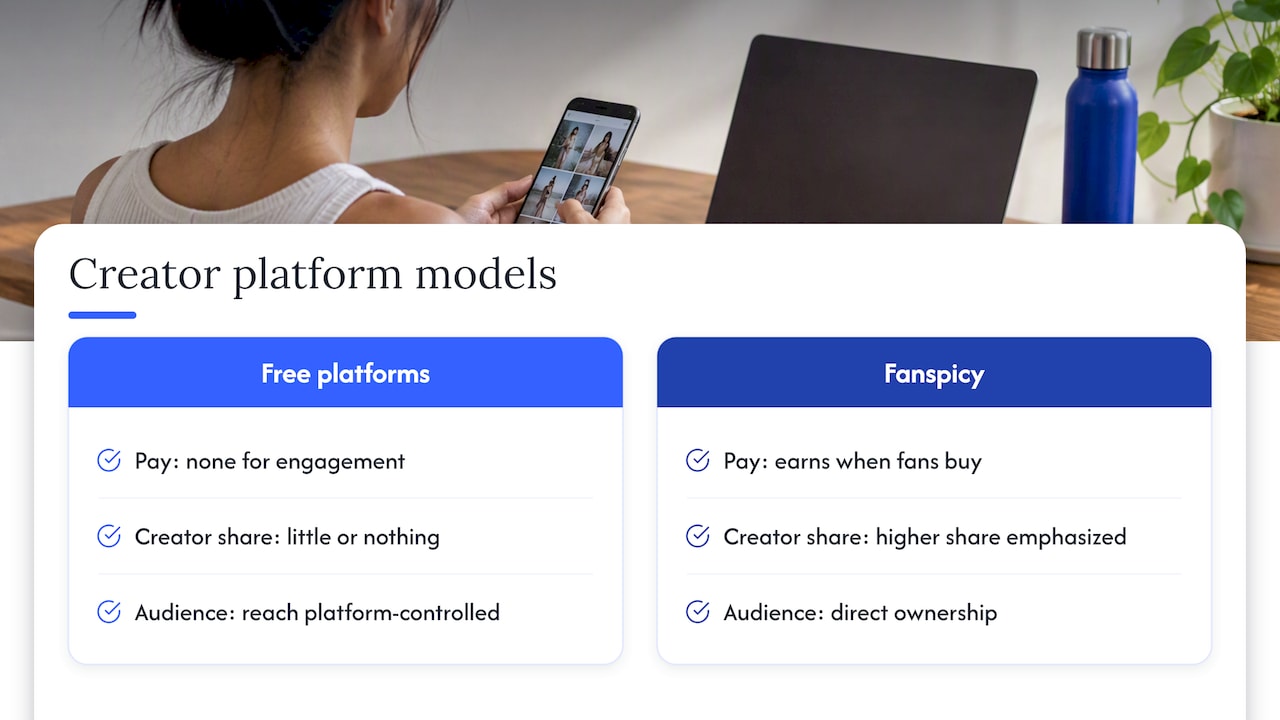
So we built Fanspicy around a different premise. Creators do not pay to join or use the platform. We take a percentage of each transaction, which means we earn only when a fan buys from a creator, and our interests line up with theirs. We emphasize keeping a higher share of earnings for creators, direct ownership of the audience, and flexible ways to earn: subscriptions, paid content, private messages, live streams, bundles and tips.
We also built for people who already have content elsewhere, because starting over is the biggest barrier to switching. Easy migration from other platforms, and support for many content types and creator categories, are the features we hear about most from creators who are ready to move.
The thing we would tell any creator, including those building a brand around a body type that media ignored for too long: you are not a keyword. You are the owner of a small media company, and the platform you choose should behave like a partner to that company.
— fan
How to get started on a creator-first platform
If you are a creator ready to test the waters, a sensible first month looks like this.
- Decide your lanes. Pick two earning streams to begin with, for example subscriptions plus tips, and add live streams once your routine is steady.
- Verify and set up your profile. Use a clear name, a recognizable photo and a short bio that says what fans get. Complete any identity and age checks the platform requires.
- Move your best content. Bring over the pieces that already performed well, then add new, exclusive material so subscribers have a reason to stay.
- Seed a free post. Free previews let fans sample your style before paying. You can see how this looks in practice in a free curvy post from a creator on the platform.
- Announce it where your audience already is. Point your existing social followers to one link and tell them what they get that they cannot get on the free feed.
- Review after 30 days. Which posts converted? Which message tone got replies? Double down on what worked.
Creators on any platform should also keep their own records of income and expenses. Self-employed creators in the US generally owe tax on this income, so a licensed accountant or tax professional can tell you what applies in your state.
Join Fanspicy as a creator
Fanspicy is a paid social media and live cam platform where independent creators sell subscriptions, exclusive content, paid posts, private messages and live streams, and receive tips from fans. Creators do not pay a fee to join. If you are ready to turn your audience into income, become a model on Fanspicy. If you are a fan who wants to support independent creators directly, start from the Fanspicy home page.
Tips for fans who want to support creators well
Fans make this economy work, and small habits make a big difference to the people you follow.
- Subscribe to creators, not categories. Follow people whose voice and style you enjoy rather than hunting a search term.
- Tip for what you value. A tip on a post or during a live stream is a direct thank-you that goes to the creator.
- Respect boundaries. Custom requests are the creator’s call. A no is a complete answer.
- Keep it private. Do not screenshot, repost or share paid content. It is the creator’s livelihood.
- Stay adult-only. Both parties should be adults, and you should use platforms that verify it.
A quick word on the other “thick” results
The questions people ask beside this search show how varied the intent is. Some are about hair: Asian hair is generally described as straight, darkly pigmented and large in diameter, though a study of young adults from 24 ethnic groups found large variations and high diversity in human hair overall. That is a different subject from body shape, and the research on it is about biology, not beauty standards. If you came here for the hair question, those two reviews are the place to start.
常见问题
What does “thick Asian” mean?
It is slang for Asian women with fuller hips, thighs and curves. It describes a body shape rather than a measurable size, and many women use it as a positive self-description. It is also used by some content makers in a fetishizing way, so context matters.
What is the Asian body type called?
There is no single Asian body type. Asia includes many populations with very different builds, and research shows that ideals of the “perfect” body differ by culture. Terms like “petite”, “curvy” or “thick” describe individuals, not a continent.
Who is the plus-size Asian American model?
Yumi Nu is the name most often cited. Vogue reported that she was the first Asian curve model to appear in Vogue or Sports Illustrated. She has since continued to appear in fashion and swimwear media.
Can creators earn from this niche without relying on social media reach?
Yes, by moving fans onto a platform where they pay directly. Subscriptions, paid posts, private messages, live streams and tips let a creator earn from a smaller, loyal audience rather than depending on viral reach. On Fanspicy, creators do not pay to join, and the platform takes a percentage only when a fan buys.
Sources
- Weightism in Asia: A Narrative Review and Implications for Practice
- Yumi Nu Is Your New Favorite Model, Vogue
- Model Of The Moment Yumi Nu On The Illusion Of The “Summer Body”, British Vogue
- Yumi Nu on the Cover of Vogue Japan, Sports Illustrated
- The relationship among cultural variables and weight issues for Asian American women
- Complexity of culture: the role of identity and context in bicultural individuals’ body ideals
- Asian Hair: A Review of Structures, Properties, and Distinctive Disorders
- Diversity in human hair growth, diameter, colour and shape
- Age Verification for the Creator Economy
- Curvy Thick Asians, YouTube