

目录
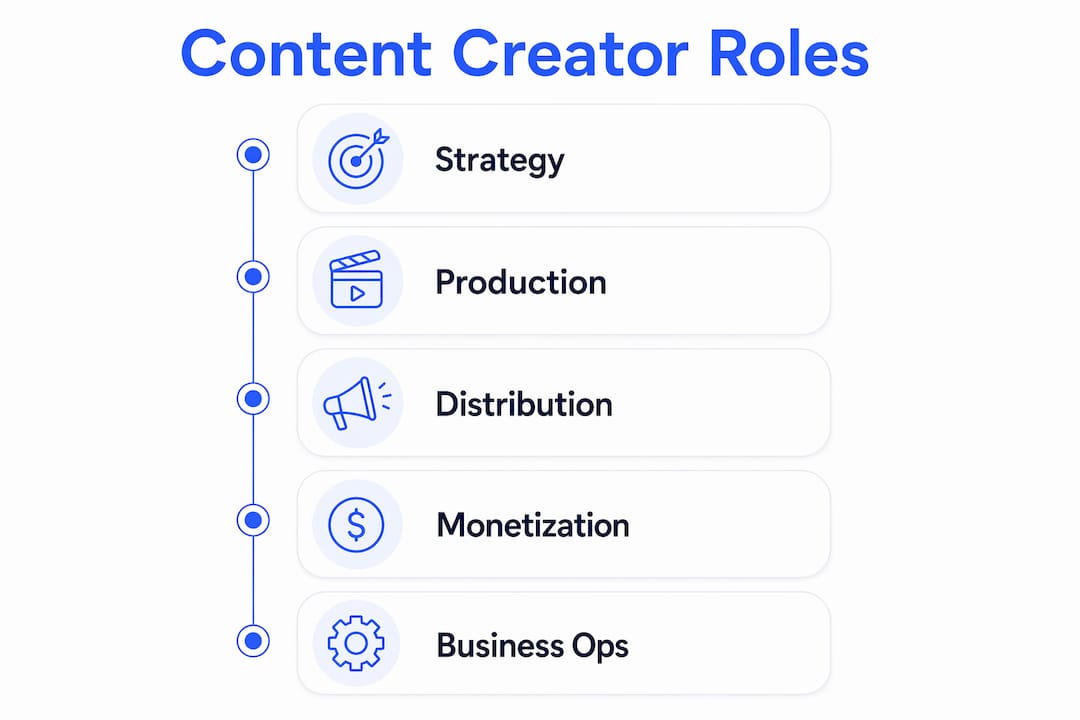
The roles of a content creator on a live cam or subscription platform break into nine coordinated business and creative functions: strategy, production, distribution and promotion, community management, monetization and business operations, analytics and optimization, legal and compliance, technical operations, and creator wellbeing. A modern creator’s day covers researching ideas, performing or recording, editing, publishing, reviewing analytics, managing community, and making business decisions — essentially running a small media company. Fanspicy is built specifically for creators operating across all nine of these functions.
Start here: Track last week’s hours across each domain. If a large majority of your time goes to production alone, you have a delegation or prioritization gap.
- Strategy: content calendar, niche positioning, audience research
- Production: filming, lighting, audio, editing, live performance
- Distribution/promotion: posting schedules, teasers, cross-platform repurposing
- Community management: DMs, moderation, fan retention
- Monetization/business ops: pricing, invoicing, payment tracking
- Analytics/optimization: KPI review, A/B tests, content iteration
- Legal/compliance: consent records, age verification, copyright, platform rules
- Technical operations: equipment maintenance, stream settings, backups
- Creator wellbeing: scheduling rest, mental health, boundary-setting
专业提示 When time is short, protect revenue-driving tasks (production, monetization) and legal obligations (consent, age verification) first. Everything else can be batched or delegated.
目录
- What do the roles of a content creator actually involve?
- How should you split your time and budget?
- What U.S. legal and compliance rules apply to you?
- What does a repeatable production workflow look like?
- How do you build and convert a paying audience?
- How do you structure revenue and handle U.S. taxes?
- Which metrics should you track and how do you run experiments?
- Who should you hire first and what should the job look like?
- What does a realistic 90-day plan look like?
- How has the creator role evolved and where is it heading?
- How do roles differ across YouTube, TikTok, Instagram, and subscription platforms?
- What skills does each role domain actually require?
- What are the biggest pitfalls creators run into?
- What do successful creator role structures look like across niches?
- Key Takeaways
- The creator role is a business, not a side hustle
- Fanspicy is built for creators who operate this way
- Useful sources
What do the roles of a content creator actually involve?
Core creator responsibilities organize into distinct domains, each with concrete deliverables. For live cam and subscription creators, the stakes in each domain are higher because your content is both the product and the brand.
战略 means setting a weekly content calendar, defining your niche (fetish category, persona, content style), and researching what your audience pays for. Deliverables: a monthly content plan and a list of top-performing content types.
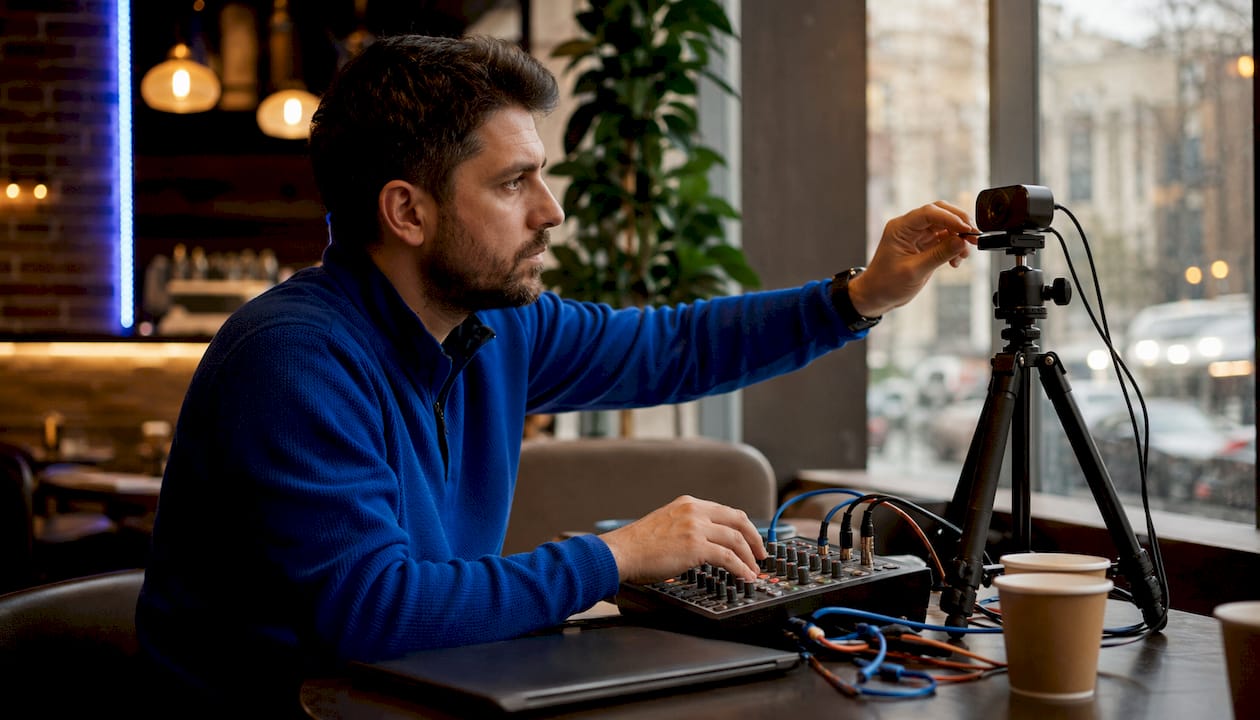
Production covers everything from lighting setup to post-production. For live shows, that means managing stream quality in real time. For recorded content, it means file naming, color correction, and caption files. Skills England’s occupational standard notes that creators are responsible for delivering high-quality content on time and within budget while staying aware of the legal and regulatory framework throughout.
Distribution and promotion involves deciding where content goes after it is created — teasers on social, email blasts to your subscriber list, or repurposed clips for discoverability. Community management on platforms like Fanspicy means moderating comments, setting DM boundaries, and converting free viewers into paying subscribers.
Monetization and business ops includes setting subscription tiers, tracking pay-per-view (PPV) revenue, and keeping clean payment records. Analytics means reviewing subscriber growth, churn, and average revenue per user (ARPU) weekly. Legal and compliance covers consent documentation, age verification, and copyright. Technical operations means keeping your gear calibrated and your backups current. Wellbeing means scheduling recovery time — burnout is one of the fastest ways to kill a channel.
专业提示 Creators who treat their channel as a media asset rather than a posting habit build more durable income. Separate the “performer” role from the “operator” role mentally, even if you are the same person doing both.
How should you split your time and budget?
Solo live cam and subscription creators typically allocate their working week something like this:
| Domain | % of Weekly Time |
|---|---|
| Production (live + recorded) | a significant portion |
| Community management | a notable portion |
| Promotion/distribution | a substantial share |
| Strategy and planning | a moderate share |
| Analytics and optimization | a smaller share |
| Business ops and bookkeeping | a minor share |
| Legal/compliance admin | a minimal share |
| Technical maintenance | a very small share |
Startup costs vary by setup level:
| Item | Low Setup | Mid Setup | High Setup |
|---|---|---|---|
| Camera | low-end budget | mid-level investment | high-end investment |
| Lighting | low-end budget | mid-level investment | high-end investment |
| Microphone | low-end budget | mid-level investment | high-end investment |
| Background/set | low-end budget | mid-level investment | high-end investment |
| Editing software | free options | common monthly subscriptions | higher-priced monthly subscriptions |
| Moderation (freelance) | no cost option | typical monthly cost | higher-end monthly cost |
| Legal/tax setup | minimal startup cost | moderate setup fee | higher setup fee |
| Payment processor fees | typical percentage range | typical percentage range | typical percentage range |
专业提示 Invest in lighting before anything else. A $200 ring light and a clean background outperform a $1,500 camera in a dark room every time.
What U.S. legal and compliance rules apply to you?
Non-negotiable legal priorities for U.S. creators: consent documentation, age verification, copyright clearance, payment compliance, and platform moderation rules. Skipping any one of these can result in account termination or legal liability.
- Retain signed model releases for every person who appears in your content, including yourself for third-party productions.
- Record verbal or written consent before filming any collaborative content.
- Store government-issued ID checks securely and separately from content files; use encrypted cloud storage.
- Understand DMCA basics: if someone uses your content without permission, you can file a takedown notice; if you use music or clips you do not own, you are exposed.
- Keep payment processor statements and 1099-K forms for every tax year.
- Follow each platform’s community guidelines — violations can demonetize or remove your account without appeal.
Platform moderation policies and privacy regulations are part of a creator’s professional responsibility, not optional add-ons.
专业提示 Keep a single encrypted folder labeled “Compliance” with subfolders for consent forms, ID records, and payment statements. Review it quarterly. Consult an attorney who works with adult content creators before you scale past your first $50,000 in annual revenue.
This article is general information, not legal or tax advice. Confirm current rules with a qualified professional for your specific situation.
What does a repeatable production workflow look like?
A consistent workflow keeps quality high and prevents the chaos that kills creator schedules.
- Research and brief: identify the content type, theme, and audience need for this session.
- Setup and technical check: test lighting, audio levels, stream bitrate, overlays, and tip/join mechanics before going live.
- Performance or record: execute the show or recording; stay present, not distracted by backend tasks.
- Capture and quick edits: clip highlights, add captions, correct color, and name files with a consistent convention (date_title_version).
- Publish and repurpose: post to your primary platform, then schedule teasers or clips for promotion channels.
- Archive and metadata: back up raw files to a secondary location; tag content for easy retrieval and future repurposing.
Pre-show checklist (copy and run before every stream):
- Camera angle and focus confirmed
- Lighting balanced, no harsh shadows
- Audio levels tested at -12 dB to -6 dB
- Stream bitrate set (minimum 4,500 Kbps for 1080p)
- Tip menu and join mechanics active
- Emergency contact or moderator online
- Background clean and on-brand
Treating content as an asset library rather than disposable posts pays off when you need to repurpose a six-month-old clip into a new PPV bundle.
How do you build and convert a paying audience?
Retention beats acquisition for stable subscription income: a subscriber you keep costs far less than a new one you chase.
- Prioritize existing subscribers: send exclusive content, early access, or personal DMs before promoting publicly.
- Set clear DM boundaries in your bio and pinned posts; enforce them consistently.
- Gate private content behind tiers — free viewers see teasers, paying subscribers get the full show.
- Use limited-time offers (48-hour discounted subscriptions, PPV bundles) to create urgency without devaluing your catalog.
- Build an email or SMS list independent of any platform — it survives account suspensions.
For promotion, NSFW marketing tactics like teaser clips, countdown posts, and referral incentives consistently outperform generic social posting for adult creators.
专业提示 Reply to every new subscriber’s first message within 24 hours. That single habit has a measurable impact on 30-day retention.
How do you structure revenue and handle U.S. taxes?
Principal revenue models for subscription creators: subscriptions, tips and gifts, PPV content, content bundles, paid DMs, and affiliate or referral programs. Early-stage creators should anchor on subscriptions for predictable income, then layer PPV and tips as the audience grows.
Sample pricing tiers:
- Starter ($9.99/mo): access to regular posts and public streams.
- Core ($19.99/mo): all starter content plus exclusive recorded content and priority DM responses.
- VIP ($49.99/mo): everything in core plus monthly private show access and custom content requests.
Bookkeeping checklist:
- Save every payment processor statement monthly.
- Categorize expenses: equipment, software, moderation, legal/tax, marketing.
- Reconcile income by source (subscriptions vs. tips vs. PPV) each month.
- Issue invoices for any brand deals or affiliate payments you receive.
专业提示 Open a dedicated business checking account on day one. Set aside a portion of gross income for federal and state estimated taxes. Save every 1099-K your payment processors issue — the IRS matches these to your return.
Which metrics should you track and how do you run experiments?
Core KPIs for live cam and subscription creators:
- Subscriber growth rate: new subscribers minus cancellations per week.
- Churn rate: percentage of subscribers who cancel each month; target below 10%.
- ARPU (average revenue per user): total monthly revenue divided by active subscribers.
- Session length: average time viewers spend in a live show; longer sessions correlate with higher tip totals.
- Free-to-paid conversion rate: percentage of free followers or trial users who become paying subscribers.
- Retention cohorts: how many subscribers from month one are still active in month three.
Experiment template:
- State a hypothesis: “Adding a tip goal overlay will increase average tips per stream by 15%.”
- Choose one metric to measure: average tips per stream.
- Set a test duration: four consecutive streams.
- Define a decision rule: if tips increase, keep the overlay; if flat or down, remove it.
Adobe’s guidance frames content creation as a set of muscles — analytics is one of them, and neglecting it is one of the main reasons creators plateau.
Who should you hire first and what should the job look like?
Hire for tasks that free your direct creative time or multiply revenue. The order: moderator first, then video editor, then social promoter, then bookkeeper.
Short job descriptions:
- Moderator: monitor live chat and DMs, enforce community rules, flag escalations. Scope: per-stream or hourly ($12–$18/hr). Requires a signed confidentiality agreement before access.
- Video editor/producer: clip highlights, add captions, color-correct, and deliver files within 24 hours of a session. Scope: per-video ($25–$75/video depending on length).
- Social promoter: schedule and post teasers, manage approved social accounts, report weekly engagement data. Scope: retainer or per-post ($15–$25/hr).
- Bookkeeper: reconcile monthly statements, categorize expenses, prepare quarterly tax estimates. Scope: monthly ($100–$300/mo for basic services).
Hiring checklist:
- Post a trial task before committing to ongoing work.
- Require a signed NDA and consent agreement covering your content and identity.
- Set up payment through a business account, not personal Venmo.
- Plan a one-week onboarding with documented processes before going independent.
Indeed’s role definitions confirm that creators rely on writing, design, video, analytics, and organization skills — hiring fills the gaps where your own skill set ends.
What does a realistic 90-day plan look like?
The 90-day focus: establish audience growth, lift monetization, and lock in operational stability.
Days 1–30 (foundation):
- Audit your current time split across all nine role domains.
- Set up your compliance folder: consent forms, ID storage, payment records.
- Open a dedicated business bank account.
- Publish a consistent schedule (minimum three shows or posts per week).
- Identify your top three revenue streams and set baseline metrics.
Days 31–60 (growth):
- Launch a second subscription tier or your first PPV bundle.
- Hire a moderator for live shows.
- Start a weekly analytics review: subscriber growth, churn, ARPU.
- Run your first experiment (tip overlay, pricing test, or content format change).
- Build or grow an email list with at least one off-platform touchpoint.
Days 61–90 (optimization):
- Review experiment results and implement winners.
- Hire a video editor if production time exceeds 10 hours per week.
- Set quarterly estimated tax payment if income exceeds $1,000/quarter.
- Repurpose top-performing content into a new bundle or PPV offer.
- Set 90-day goals for the next cycle based on retention cohort data.
Use proven growth strategies to pressure-test your promotion tactics at each milestone checkpoint.
How has the creator role evolved and where is it heading?
The creator role has shifted from hobbyist posting to a structured media profession. Early platforms rewarded volume; today’s subscription and live cam economy rewards depth, consistency, and direct monetization. Creators now operate more like independent media businesses than social media users — managing contracts, tax obligations, and audience data alongside their creative output.
Emerging trends shaping the role in 2026: AI-assisted editing tools that cut post-production time, subscription bundling across multiple platforms, and growing demand for interactive live formats that blur the line between performance and community. Creators who stay current with platform developments and consumer trends hold a durable advantage.
How do roles differ across YouTube, TikTok, Instagram, and subscription platforms?
Platform architecture shapes which creator responsibilities dominate. On YouTube, long-form production and SEO optimization consume the most time. On TikTok, trend responsiveness and volume matter more than polish. Instagram balances visual aesthetics with Stories-based community engagement.
Subscription and live cam platforms like Fanspicy shift the weight toward community management, monetization mechanics, and compliance. The audience relationship is direct and transactional — subscribers pay for access, not just attention. That changes the priority order: retention and conversion outrank raw reach, and legal compliance (consent, age verification) is non-negotiable rather than optional.
Coursera’s overview notes that freelance creators handle their own business infrastructure, while in-house creators align with employer goals. On subscription platforms, every creator is effectively a freelancer running their own business.
What skills does each role domain actually require?
| Domain | Core Skills |
|---|---|
| 战略 | Audience research, content planning, competitive analysis |
| Production | Camera operation, lighting, audio, editing (Premiere Pro, DaVinci Resolve, CapCut) |
| Distribution | SEO basics, scheduling tools, cross-platform repurposing |
| Community management | Moderation, empathy, boundary-setting, conflict de-escalation |
| Monetization/business ops | Pricing strategy, invoicing, payment platform literacy |
| 分析 | Data interpretation, A/B testing, spreadsheet basics |
| Legal/compliance | Consent law basics, DMCA, platform policy literacy |
| Technical operations | Equipment troubleshooting, streaming software (OBS, Streamlabs), backup systems |
| Creator wellbeing | Time management, stress recognition, scheduling recovery |
No creator enters with all nine skill sets. The goal is competence in production and community management first, then build or hire the rest.
What are the biggest pitfalls creators run into?
The most common and costly mistakes follow a predictable pattern.
Skipping compliance early. Consent records and age verification feel bureaucratic until a platform removes your account or a legal dispute surfaces. Set these up before your first paid subscriber.
Treating analytics as optional. Creators who ignore churn data keep producing content their audience has already stopped paying for. A weekly 20-minute review prevents months of wasted effort.
Underpricing from fear. Many creators set subscription prices too low to attract volume, then burn out trying to serve a large, low-paying audience. A smaller, higher-paying subscriber base is more sustainable.
No off-platform audience. A platform ban or algorithm change can erase years of work overnight. An email list is insurance.
Conflating performer identity with business identity. Mixing personal finances with creator income, or skipping an LLC, creates tax and liability exposure that compounds over time.
What do successful creator role structures look like across niches?
Structure varies by niche, but the underlying logic is consistent: the most durable creators separate the creative function from the operational function, even when one person handles both.
A solo live cam creator on a subscription platform typically runs a lean structure: performer and strategist in one role, with a part-time moderator and a monthly bookkeeper. Content decisions stay with the creator; administrative and moderation tasks are delegated as soon as revenue supports it.
A fitness or lifestyle creator on YouTube often adds a dedicated editor and a social manager earlier, because production volume is higher and the monetization model (ad revenue plus sponsorships) requires more distribution work. The compliance burden is lower, but the analytics function is heavier.
A multi-platform adult creator managing both live cam and recorded subscription content tends to build the most complex structure: moderator, editor, social promoter, and bookkeeper, with the creator retaining strategy, performance, and community relationship management. This mirrors the small media business model that JoinBrands identifies as the hallmark of top-tier creators.
Key Takeaways
The most durable creators treat their channel as a media business with nine distinct operational roles, not a single creative job.
| Point | Details |
|---|---|
| Audit your time first | Track hours across all nine domains this week to find your biggest gap. |
| Compliance is non-negotiable | Set up consent records, ID storage, and payment files before scaling revenue. |
| Retention beats acquisition | Keeping existing subscribers costs less and earns more than chasing new ones. |
| Hire moderator first | Delegating live chat frees direct creative time and protects your community. |
| Fanspicy fits this model | Fanspicy supports live cam and subscription creators across streaming, monetization, and community tools in one platform. |
The creator role is a business, not a side hustle
The conventional framing of content creation as a creative pursuit undersells what it actually takes to build sustainable income on a subscription or live cam platform. The creators who last are not the most talented performers — they are the ones who treat their channel as a media asset with an operating system behind it. Strategy, compliance, analytics, and delegation are not distractions from the creative work. They are what make the creative work pay.
The 90-day plan in this article is not aspirational. It is the minimum viable structure for a creator who wants to still be earning in year three. Start with the compliance folder and the business bank account. Run the first experiment by day 45. Review retention cohorts at day 90. The data will tell you what to do next.
Fanspicy is built for creators who operate this way
If you want a platform designed for live cam and subscription creators, Fanspicy gives you streaming and subscription support in one place, with creator tools built for the direct monetization model this article describes.
Fanspicy supports the full creator workflow: live performance, subscription tiers, PPV content, and community management, without forcing you to stitch together multiple platforms. Creators who want to put the 90-day plan into practice on a platform built for this audience can get started on Fanspicy 今天。
Useful sources
- Skills England — Content Creator Occupational Standard: use this for role definitions, legal obligations, and professional duty frameworks.
- JoinBrands — What Is a Content Creator: use this for domain breakdowns and creator role structure.
- YourVideoEditor — What Does a Content Creator Do: use this for daily workflow and small media business framing.
- Adobe — What Is a Content Creator: use this for skills development and analytics discipline.
- Indeed — What Does a Content Creator Do: use this for hiring descriptions and skill requirements.
- Coursera — What Is a Content Creator: use this for freelance vs. in-house role distinctions and business infrastructure.
- Wikipedia — Content Creation: use this for platform moderation policy context and copyright basics.
- Fanspicy — Content Promotion Workflow: use this for promotion workflow and revenue-building tactics specific to the Fanspicy platform.