

目录
TL;DR:
- Promotional tools drive customer awareness, trust, and conversions through integrated channel strategies. Measuring true success requires focusing on incremental sales and aligning tactics with each funnel stage. Effective growth depends on coordinated messaging, disciplined measurement, and safeguarding brand value.
Promotional tools are the communication channels marketers use to inform, persuade, and remind customers about products or services, forming the backbone of every revenue-generating campaign. The role of promotional tools spans six core categories: advertising, sales promotion, public relations, personal selling, direct marketing, and digital marketing. Each serves a distinct function, yet the real power comes from combining them into a unified strategy. Content creators and marketers who understand this mix, and measure it correctly, consistently outperform those who rely on a single channel.
What are the main types of promotional tools and their roles in marketing?
"(《世界人权宣言》) promotional mix elements cover six distinct categories, each built for a different job in the customer journey. Understanding what each tool does, and what it cannot do alone, is the starting point for any effective marketing strategy.
Advertising builds awareness at scale. Paid placements across television, search engines, social media, and display networks put your message in front of audiences who have never heard of you. The trade-off is cost: broad reach comes with lower targeting precision compared to newer digital formats.
Sales promotion drives trial and short-term purchase behavior. Coupons, limited-time discounts, free samples, and loyalty rewards push customers from consideration to conversion. This tool works fast, but overuse carries a real risk covered in detail later in this article.
Public relations builds credibility without a media buy. Press coverage, influencer partnerships, and community events create third-party endorsements that paid advertising cannot replicate. Audiences trust earned media more than paid placements, which makes PR a long-term brand asset.
Personal selling creates direct, two-way relationships. Sales teams, account managers, and creator-to-fan interactions fall into this category. It is the most expensive tool per contact but delivers the highest conversion rates for complex or high-ticket offerings.
Direct marketing reaches specific individuals with personalized messages. Email campaigns, SMS sequences, and direct mail are the primary formats. The strength here is precision: you control who receives the message, when, and with what offer.
Digital marketing now sits at the center of modern promotion. Digital marketing includes social media, content marketing, influencer partnerships, mobile ads, and search marketing, combining the targeting of direct marketing with the scale of advertising. For content creators especially, digital channels are where audience relationships are built and monetized.
- Advertising: awareness and reach
- Sales promotion: short-term conversion lift
- PR: credibility and earned trust
- Personal selling: high-value relationship building
- Direct marketing: personalized, measurable outreach
- Digital marketing: precision targeting with real-time feedback
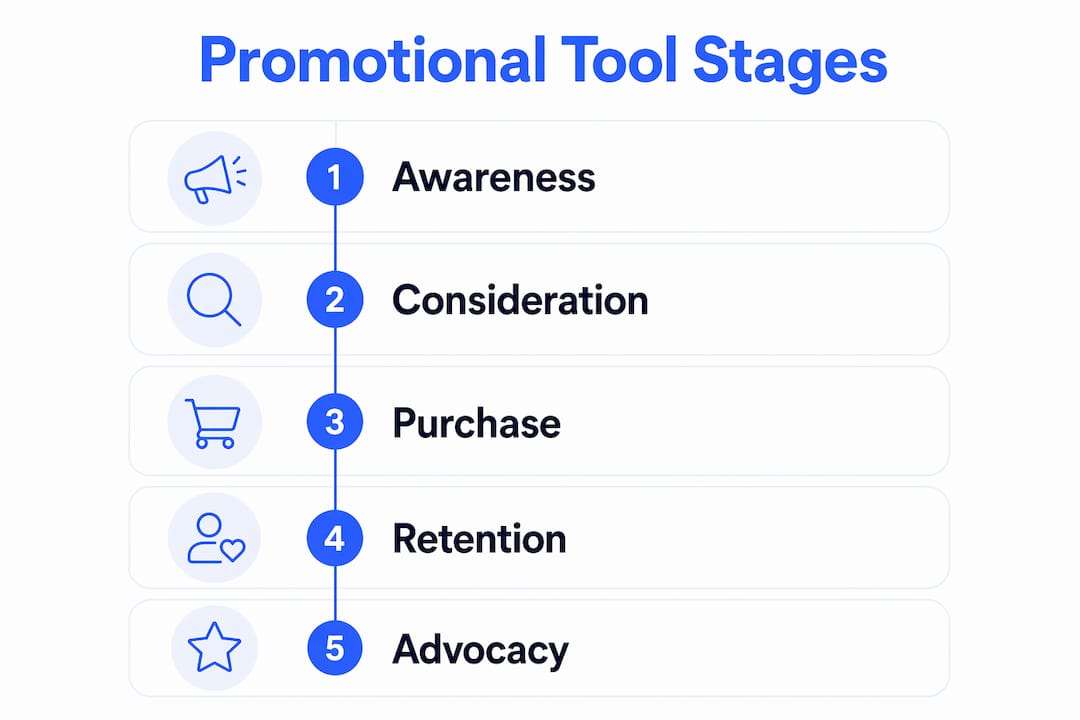
专业提示 Map each promotional tool to a specific stage of your funnel before you spend a dollar. Advertising fills the top, PR and content marketing build the middle, and sales promotions close the bottom. Running all six without this map wastes budget on the wrong audience at the wrong moment.
How do integrated promotional tools work together to engage audiences?
The importance of marketing tools multiplies when they operate as a system rather than in isolation. Integrated marketing communications (IMC) is the discipline of aligning every channel around a single, consistent message. Promotional tools multiply effectiveness when integrated for consistent messaging, rather than used independently.

A PR story about a product launch lands harder when a paid social campaign amplifies it the same week. A sales promotion converts better when email sequences have already warmed the audience. The Apple iPhone launch is the textbook example: product announcements, media briefings, retail promotions, and digital ads all hit simultaneously with identical messaging, creating a cultural moment no single channel could have produced alone.
Here is how a coordinated sequence typically works in practice:
- Awareness phase: Advertising and PR introduce the product or offer to a broad audience.
- Consideration phase: Content marketing, influencer partnerships, and email nurture sequences build familiarity and trust.
- Conversion phase: Sales promotions, personal selling, and direct marketing close the deal with specific offers.
- Retention phase: Loyalty programs, community engagement, and personalized direct marketing keep customers active.
The contrast between siloed and integrated promotion is stark. A creator who runs a discount offer without any prior content warming the audience will see weak conversion. The same offer, preceded by two weeks of educational content and a PR mention from a trusted voice in the niche, performs at a measurably higher rate. Channel synergy reinforces each tool’s impact across the customer journey, turning individual tactics into a compounding system.
| Approach | Typical outcome |
|---|---|
| Single channel, no coordination | Short-term spike, low retention |
| Two channels, partial alignment | Moderate lift, inconsistent messaging |
| Full IMC across 4+ channels | Sustained engagement, higher CLV |
How do you measure the effectiveness of promotional tools?
Measuring the effectiveness of promotional strategies is where most marketers lose money without realizing it. The critical distinction is between apparent lift 和 incremental sales. Apparent lift is the raw sales increase during a promotion. Incremental sales represent net-new demand that would not have existed without the promotion. These two numbers are rarely the same.
Trade promotions in FMCG markets show apparent lift but fail to produce incremental sales in 70 to 90% of cases, leading to wasted spend. That statistic means the majority of promotional budgets in consumer goods are funding purchases that would have happened anyway, just at a lower margin.
Three mechanisms inflate apparent lift without creating real value:
Pull-forward happens when customers buy earlier than they would have, not more than they would have. The promotion moves demand from next month into this month, creating a spike followed by a trough.
Cannibalization occurs when a promoted product steals sales from another product in your own catalog. Total revenue stays flat while margin drops.
Stockpiling describes customers buying in bulk during a discount, then not purchasing again for months. Volume looks great; profitability does not.
Measurement frameworks for 2026 prioritize incremental sales, ROI calculated on incremental margin net of promotion costs, basket size, customer acquisition cost (CAC), and customer lifetime value (CLV) over raw sales uplift. This shift matters because a promotion that looks profitable on gross revenue can be deeply unprofitable once you account for the discount, the logistics, and the cannibalized sales.
The Ibotta retail case study demonstrates what good measurement looks like in practice. The campaign delivered a 9.5% incremental lift in sales per household and a 7.2% increase in household penetration, both measured against a matched control group. That methodology, test versus control with proper incrementality accounting, is the gold standard.
For B2B marketers, attribution windows are the hidden variable. LinkedIn ads deliver 8.4× ROI over a 12-month attribution window, far outperforming shorter windows that miss the delayed effect of complex sales cycles. Cutting the window to 30 days makes the same campaign look mediocre.
专业提示 Before launching any promotion, define your control group. Even a simple A/B split, where half your audience sees the offer and half does not, gives you the data to calculate true incrementality rather than guessing from aggregate sales figures.
What are the best strategies for using promotional tools to grow audience and revenue?
The benefits of promotional tools for businesses and creators depend entirely on how well the strategy matches the audience, the product stage, and the platform. Generic promotional tactics applied without this context produce generic results.
- Match the tool to the product life cycle. New products need advertising and PR to build awareness. Mature products benefit more from loyalty programs and direct marketing to retain existing customers. Applying heavy discounting to a new product trains early adopters to expect low prices permanently.
- Protect brand equity when running sales promotions. Frequent discounting weakens brand value and compresses margins over time. Limit discount promotions to specific windows, pair them with clear value messaging, and avoid making price the primary reason to buy.
- Use digital precision to test before scaling. Run small paid social tests across two or three audience segments before committing full budget. Digital channels give you real-time feedback that traditional advertising cannot match.
- Integrate paid, earned, and owned media. Paid media buys reach. Earned media (PR, reviews, word-of-mouth) buys trust. Owned media (email lists, communities, content libraries) buys long-term retention. All three together produce the highest CLV.
- Measure downstream, not just upstream. Clicks and impressions are inputs. Incremental sales and retention are outputs. Optimize for the outputs, and use the inputs only as diagnostic signals.
- Sequence your channels deliberately. Awareness channels should run before conversion channels. A sales promotion launched before the audience knows what they are buying converts poorly and wastes the discount.
Content creators on paid platforms have a specific advantage here: direct audience relationships. Email lists, community posts, and live interactions are owned media assets that most traditional brands cannot replicate. Pairing these with targeted paid promotion and strategic PR creates a promotional mix that is both cost-efficient and highly measurable. For practical tactics tailored to this context, the guide on promoting paid content covers channel sequencing in detail.
Key takeaways
The most effective promotional strategy combines integrated channel coordination with incrementality-based measurement, not raw sales lift, to drive sustainable audience growth and revenue.
| Point | Details |
|---|---|
| Define the promotional mix | Use all six tools (advertising, PR, sales promotion, personal selling, direct, digital) mapped to funnel stages. |
| Integrate for amplification | Consistent messaging across channels multiplies impact beyond what any single tool delivers alone. |
| Measure incrementality, not lift | 70 to 90% of trade promotions show apparent lift without generating net-new demand. |
| Protect brand equity | Limit discount frequency to avoid training audiences to wait for lower prices. |
| Align attribution windows to buying cycles | B2B campaigns measured at 12 months show dramatically higher ROI than those cut at 30 days. |
What I’ve learned about promotional tools that most guides won’t tell you
The conventional advice says to diversify your promotional mix and measure everything. That is correct, but it misses the harder truth: most marketers are measuring the wrong thing and calling it success.
I have watched creators and brand teams celebrate a 40% sales spike during a promotion, only to find the following month’s numbers 35% below baseline. The promotion did not grow the audience. It borrowed from future revenue and handed it back at a discount. That is not growth. That is a margin transfer to your most price-sensitive customers.
The measurement sophistication gap is widening in 2026. Platforms now offer attribution data that was unavailable three years ago, yet most teams still optimize for clicks and surface-level engagement. The creators and marketers who will win are those who build control groups into every campaign, track CLV alongside CAC, and resist the pressure to declare a promotion successful based on a single week’s numbers.
The other thing most guides skip: the sequencing of channels matters more than the budget split between them. A well-timed PR mention followed by an email sequence followed by a limited offer will outperform a larger budget spread evenly across all channels with no narrative thread connecting them. Audiences need context before they respond to offers. Build the context first.
My prediction for the rest of 2026: short-form video and community-based promotion will continue to outperform static ad formats for audience engagement, but the creators who pair those channels with disciplined email marketing and incrementality tracking will separate themselves from those chasing platform algorithms alone.
— fan
How Fanspicy supports your promotional strategy
Fanspicy is built for creators who take their promotional strategy seriously. The platform combines paid subscription management, live cam tools, and audience analytics in one place, giving you the data to measure what actually drives subscriber growth rather than guessing from follower counts.
Creators on Fanspicy use the platform’s built-in promotional features alongside the subscriber growth tactics covered in Fanspicy’s resource library to run coordinated campaigns across owned and paid channels. If you want to see what a well-structured creator profile looks like in practice, Jackie Pott’s page on Fanspicy shows how promotional positioning and audience engagement work together on the platform. Start building your promotional mix where the measurement tools already exist.
常见问题
What is the role of promotional tools in marketing?
Promotional tools inform, persuade, and remind customers about products or services through channels including advertising, PR, sales promotion, personal selling, and digital marketing. Their combined role is to move audiences through the customer journey from awareness to purchase and retention.
What is the difference between apparent lift and incremental sales?
Apparent lift is the raw sales increase during a promotion, while incremental sales measure net-new demand that would not have occurred without the promotion. Research shows 70 to 90% of trade promotions in FMCG markets show apparent lift without generating true incremental sales.
How do you measure the effectiveness of promotional strategies?
Effective measurement uses test and control groups to isolate incremental sales, then calculates ROI based on incremental margin net of promotion costs. Key metrics include CAC, CLV, basket size, and attribution windows aligned to actual buying cycles.
Why is integrated marketing communications important for promotional tools?
IMC ensures consistent messaging across all channels, which multiplies the impact of each individual tool. A PR story amplified by a digital campaign and supported by a sales promotion converts at a higher rate than any of those three tactics running independently.
How can content creators use promotional tools to grow revenue?
Creators should map each tool to a funnel stage, protect brand equity by limiting discount frequency, and measure downstream outcomes like CLV rather than surface metrics like clicks. Platforms like Fanspicy provide the analytics infrastructure to track these metrics directly within the creator’s workflow.