

Зміст
TL;DR:
- Video has become essential for engagement on social media, with short-form content dominating growth and reach.
- Creators must develop platform-specific strategies, maintain consistent production cadence, and focus on authentic, quick videos.
Social media and video marketing is the strategic creation and distribution of video content designed specifically for social platforms to engage audiences and drive measurable business outcomes. LinkedIn video posts receive 3x the engagement of text-only posts, and YouTube Shorts can hit engagement rates as high as 5.91%. These numbers reflect a simple reality: video is no longer a nice-to-have for creators and marketers. It is the baseline expectation. Tools like smartphone cameras, CapCut, and scheduling platforms such as Heropost have made professional-quality video production accessible to anyone willing to build a real system around it.
What are the key components of a social media video marketing strategy?
A strong video content strategy starts with knowing exactly who you are making content for. Audience research through platform analytics, direct interviews, or comment mining tells you what problems your viewers need solved. Without that foundation, every video you produce is a guess.

Clear goals come next. Mapping video types to funnel stages prevents random content creation and ties every production decision to a business result. Awareness content looks different from conversion content, and both look different from loyalty content designed to retain existing fans or subscribers.
Platform selection is where most creators make their first major mistake. TikTok, Instagram Reels, LinkedIn, and YouTube Shorts each serve different audiences with different content expectations. Choosing the wrong platform for your audience wastes production time before you even press record.
Video format specs matter more than most creators realize. Short-form video performs best at 15–60 seconds with a 9:16 vertical aspect ratio across TikTok, Reels, and YouTube Shorts. Authentic, lo-fi style content consistently outperforms high-budget productions on these platforms. Viewers reward realness over polish.
Порада професіонала: Build a simple one-page content brief for every video before you film. Include the platform, goal, hook, key message, and call to action. This cuts editing time and keeps your output consistent.
A production workflow that actually runs on schedule looks like this:
- Audience research: Identify pain points through analytics or direct feedback
- Goal mapping: Assign each video to an awareness, conversion, or loyalty objective
- Platform targeting: Choose the primary platform before scripting, not after
- Format planning: Lock in length, aspect ratio, and style before production
- Production and review: Efficient workflows run on a 10–12 week timeline with discovery, framework, and production phases built in
- Platform versioning: Create distinct cuts for each platform to avoid algorithm penalties
How do platform algorithms affect social media video reach in 2026?
Every major platform runs a different distribution model, and treating them as interchangeable is one of the most expensive mistakes in video marketing. Understanding each algorithm is not optional. It is the difference between organic reach and invisible content.
Instagram Reels favors non-follower discovery, meaning your content gets shown to people who have never heard of you. TikTok, by contrast, leans toward follower-based retention, rewarding creators who keep their existing audience watching. These two platforms require fundamentally different content approaches even when the video format looks similar.
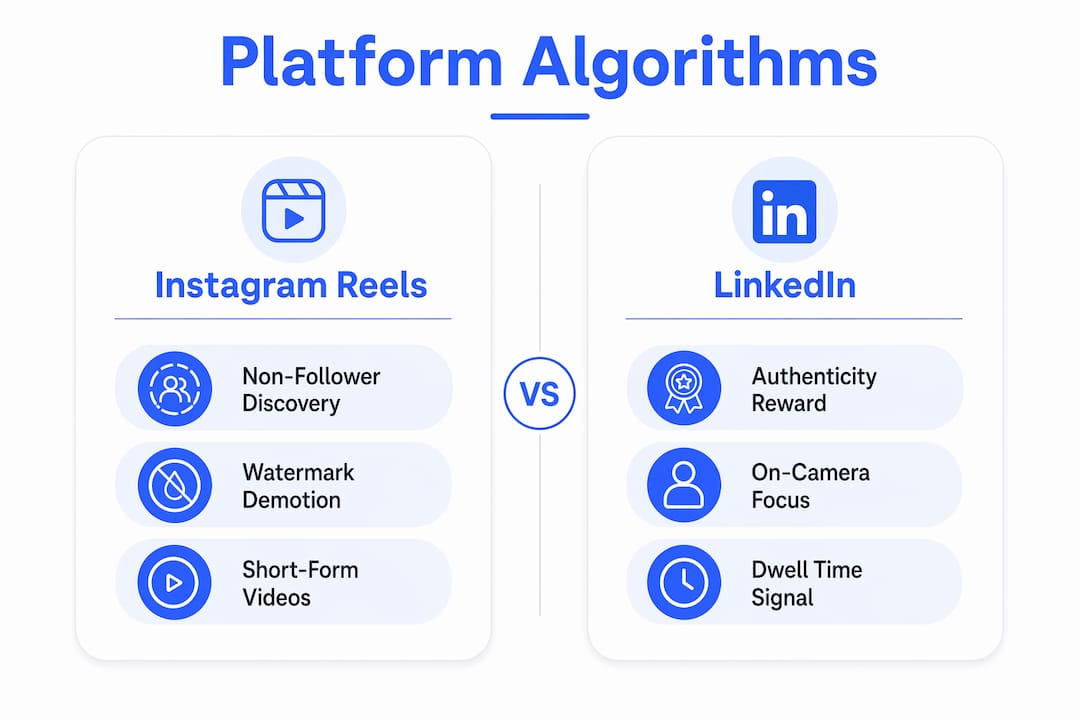
Meta’s July 2025 update actively demotes cross-posted videos that carry competitor watermarks on Instagram Reels. Posting a TikTok watermarked video directly to Reels now suppresses its reach. This is not a rumor. It is a documented policy change that every creator needs to account for in their workflow.
| Платформа | Distribution model | Best content style | Engagement signal |
|---|---|---|---|
| Instagram Reels | Non-follower discovery | Trending audio, fast cuts | Shares and saves |
| TikTok | Follower retention | Personality-driven, series | Watch time and replays |
| YouTube Shorts | Interest-based discovery | Educational, how-to | Click-through to long-form |
| Network and dwell time | On-camera, professional insight | Comments and dwell time | |
| Facebook Reels | Organic reach amplification | Relatable, community-driven | Reactions and shares |
LinkedIn rewards on-camera authenticity and dwell time signals more than any other platform. Creators who speak directly to camera on LinkedIn consistently outperform those who post polished graphics or repurposed clips. The platform’s algorithm reads how long viewers stay on a video, not just whether they liked it.
Порада професіонала: For minimum viable versioning, create three cuts of every video: one for TikTok with the original audio and pacing, one for Reels with the watermark removed and a slightly different hook, and one for YouTube Shorts with a keyword-optimized title. This takes under 30 minutes per video and protects your reach across all three platforms.
What is the ideal content cadence for sustainable video production?
Sustainable video marketing runs on a three-tier cadence model: Peak, Pulse, and Presence. Each tier serves a different purpose and requires a different level of production investment. Trying to produce everything at the same quality level burns out creators and drains budgets fast.
Peak content is your annual flagship. Think a major brand video, a documentary-style piece, or a high-production launch video. You produce one or two of these per year. They anchor your brand identity and are worth the extra investment.
Pulse content is your monthly heartbeat. Pulse videos run at 1–4 per month and represent your core educational or promotional content. These are the videos that build authority, explain your offer, and keep your audience engaged between major launches. Most of your production budget should go here.
Presence content is your weekly or daily volume. These are short, fast, lo-fi clips that keep your name in front of your audience. Behind-the-scenes footage, quick tips, reaction clips, and repurposed Pulse content all qualify. The goal is consistency, not perfection.
Here is how to build a production system that actually holds up over time:
- Document your roles. Assign one person to scripting, one to filming, and one to editing. Even solo creators benefit from separating these phases mentally.
- Create a content brief template. Every video starts with a brief that includes the platform, goal, hook, and call to action.
- Batch film weekly. Film three to five Presence videos in one session. This cuts setup time and keeps your output steady.
- Repurpose Pulse content. A 90-second Pulse video becomes three Presence clips, a carousel, and a quote graphic with minimal extra work.
- Use a scheduling tool. Heropost and similar platforms let you queue content across multiple platforms from one dashboard, which removes the daily friction of manual posting.
- Review and iterate monthly. Pull your analytics at the end of each month and cut the formats that are not performing.
Порада професіонала: Shift your budget away from Peak content and toward Pulse and Presence. A single expensive brand video rarely outperforms a consistent stream of authentic monthly content. Volume and consistency beat occasional perfection every time.
The most common pitfall is over-planning. A video strategy aligned with business goals needs rapid iteration, not a six-month planning phase. Build a 90-day sprint, execute it, and adjust based on real data.
How do you optimize video content for engagement and discoverability?
The first three seconds of any video determine whether a viewer stays or scrolls. On TikTok and Reels, a weak hook kills reach before the algorithm even has a chance to distribute your content. Open with a bold claim, a surprising visual, or a direct question. Never open with a logo or a slow intro.
Captions and on-screen text are non-negotiable. A large share of LinkedIn and Facebook viewers watch video on mute, and adding text keeps them watching. Tools like CapCut and Descript generate auto-captions in minutes. There is no reason to skip this step.
Hashtags and keywords feed the social SEO layer that platforms use to categorize and distribute content. Use three to five specific hashtags per post rather than a wall of generic tags. On YouTube Shorts, the video title and description carry more weight than hashtags, so write them with search intent in mind.
Live streaming on Instagram, TikTok, YouTube, and LinkedIn triggers high engagement because algorithms reward real-time interaction. Going live once a week, even for 15 minutes, builds audience trust faster than any pre-recorded format. The urgency of live content drives comments, shares, and follows that pre-recorded videos rarely match.
Short-form video is top-of-funnel content. Its job is to grow your audience, not to monetize it directly. YouTube long-form pays 5–10x more per view than Shorts. The smart move is to use Reels and TikTok to drive viewers toward long-form YouTube content and email lists where the real revenue happens. Creators who understand this funnel structure build businesses. Those who chase short-form views alone build audiences they cannot monetize.
For content creation ideas that convert short-form viewers into paying subscribers, the key is always a clear next step at the end of every video.
Key Takeaways
A sustainable video marketing strategy requires platform-specific content, a three-tier production cadence, and a clear funnel that moves short-form viewers toward higher-monetization channels.
| Point | Details |
|---|---|
| Platform versioning is mandatory | Remove watermarks and adjust cuts for each platform to avoid algorithm penalties. |
| Short-form drives the top of funnel | Use TikTok and Reels to grow audiences, then convert them to long-form YouTube and email. |
| Cadence beats perfection | Produce 1–4 Pulse videos monthly and batch-film Presence content weekly for consistent output. |
| Hooks decide reach | The first three seconds determine whether the algorithm distributes your video at all. |
| Lo-fi outperforms polish | Authentic on-camera content consistently outperforms high-budget productions on most platforms. |
What I have learned after years of watching creators get this wrong
Most creators treat video as a creative outlet first and a business tool second. That order is backwards. Treating video as a business tool, not just creative content, is what separates creators who scale from those who plateau after six months of effort.
The creators I have watched build real income from video share one habit: they iterate fast and plan light. They film, post, check the data, and adjust within days. They do not spend three weeks perfecting a script. The algorithm rewards frequency and watch time, not production budgets.
The other thing that surprises most people is how little production quality matters on short-form platforms. A shaky, authentic clip filmed on a phone in natural light regularly outperforms a studio-produced video on TikTok and Reels. Viewers are not watching for production value. They are watching for personality, information, and connection.
The platform nuance piece is where I see the most wasted effort. Creators post the same video to every platform and wonder why reach is flat. TikTok and Instagram Reels are not the same platform. They reward different behaviors, different content styles, and different audience relationships. Treating them as one channel is like sending the same email to every segment of your list and expecting the same open rate.
The creators who win in 2026 are the ones who build a real system, stay consistent, and let the data tell them what to make next. Video is not magic. It is a production and distribution discipline, and the ones who treat it that way are the ones still growing a year from now.
— fan
Fanspicy: built for creators who take video seriously
Fanspicy is a paid social media and live cam platform built for creators who want to monetize their audience directly, without relying on ad revenue or algorithm-dependent income. If you have been building a video audience on TikTok, Reels, or YouTube Shorts, Fanspicy gives you the infrastructure to convert that audience into paying subscribers.
The platform supports content scheduling, subscriber management, and live streaming in one place. That means you can run your short-form social strategy and your paid content operation without switching between five different tools. For creators ready to move beyond free content and build a real revenue stream, explore Fanspicy’s creator platform and see how it fits your current video marketing setup. You can also check out these paid content promotion strategies to get more from every video you produce.
ПОШИРЕНІ ЗАПИТАННЯ
What is social media video marketing?
Social media video marketing is the strategic creation and distribution of video content across platforms like TikTok, Instagram, LinkedIn, and YouTube to grow audiences and drive business outcomes. It connects every video to a measurable goal such as engagement, leads, or sales.
How long should social media videos be?
Short-form videos perform best at 15–60 seconds on TikTok, Instagram Reels, and YouTube Shorts. Longer educational content works well on YouTube, where watch time directly affects monetization.
Which platform has the best engagement for video?
YouTube Shorts delivers an engagement rate as high as 5.91%, while LinkedIn video posts generate 3x the engagement of text posts. The best platform depends on your audience type and content goal.
Should I post the same video on every platform?
No. Cross-posting identical videos, especially with competitor watermarks, triggers algorithm penalties on Meta platforms as of july 2025. Create platform-specific cuts with adjusted lengths and removed watermarks for each channel.
How often should I post video content on social media?
Post 1–4 Pulse videos per month as your core content, and supplement with weekly or daily Presence clips. Consistency across a 90-day window matters more than any single high-production video.