

Зміст
TL;DR:
- Messaging is the most controllable channel for content creators and marketers to engage subscribers and increase retention. It outperforms email and phone calls on response rates and satisfaction, especially when combined with rich, media-rich, and personalized two-way interactions. Implementing omnichannel, timely, and relationship-focused messaging strategies significantly enhances subscriber loyalty and lifetime value.
Messaging is the single most direct lever content creators and marketers control to keep subscribers engaged and paying. 73.3% of consumers prefer messaging when communicating with a business, which means the role of messaging in retention is not a soft skill. It is a measurable competitive advantage. Platforms like WhatsApp, RCS, and in-app chat have replaced email as the primary relationship channel, and messaging apps earn a 98% customer satisfaction score according to Zendesk’s 2026 research. For creators on paid social and live cam platforms, that satisfaction gap between messaging and every other channel translates directly into subscriber lifetime value.
Why messaging outperforms other channels for retention
Messaging beats email and phone calls on every metric that matters for retention: response rate, satisfaction, and emotional proximity. Consumers read texts within minutes, while marketing emails average open rates well below 30%. That immediacy is not just convenient. It signals to a subscriber that you are present and responsive, which builds the kind of trust that prevents cancellations.
The satisfaction data from Zendesk makes the case clearly. Messaging apps scored 98% CSAT, the highest of any channel measured. No other communication method comes close. For a content creator managing hundreds of paying subscribers, that gap means fewer refund requests, more renewals, and stronger word-of-mouth referrals.
Rich messaging channels push the advantage further. WhatsApp supports video, voice notes, and interactive buttons. RCS, the next-generation SMS standard, now has 96% device coverage, and 59% of businesses plan to deploy it in 2026 according to Bandwidth’s State of Messaging Report. That coverage means creators can send branded, media-rich messages to nearly any subscriber without requiring a separate app download.
Plain SMS still works, but the gap between a text-only message and a WhatsApp voice note with a personal greeting is the difference between a transaction and a relationship. Creators who treat messaging as a relationship channel rather than a broadcast tool consistently outperform those who do not.
How omnichannel coordination drives higher retention rates
Single-channel messaging is no longer a viable strategy. 98% of messaging interactions in 2025 were omnichannel, according to Infobip’s analysis of 628 billion mobile interactions. That figure means your subscribers are already moving between platforms. The question is whether your messaging moves with them or against them.
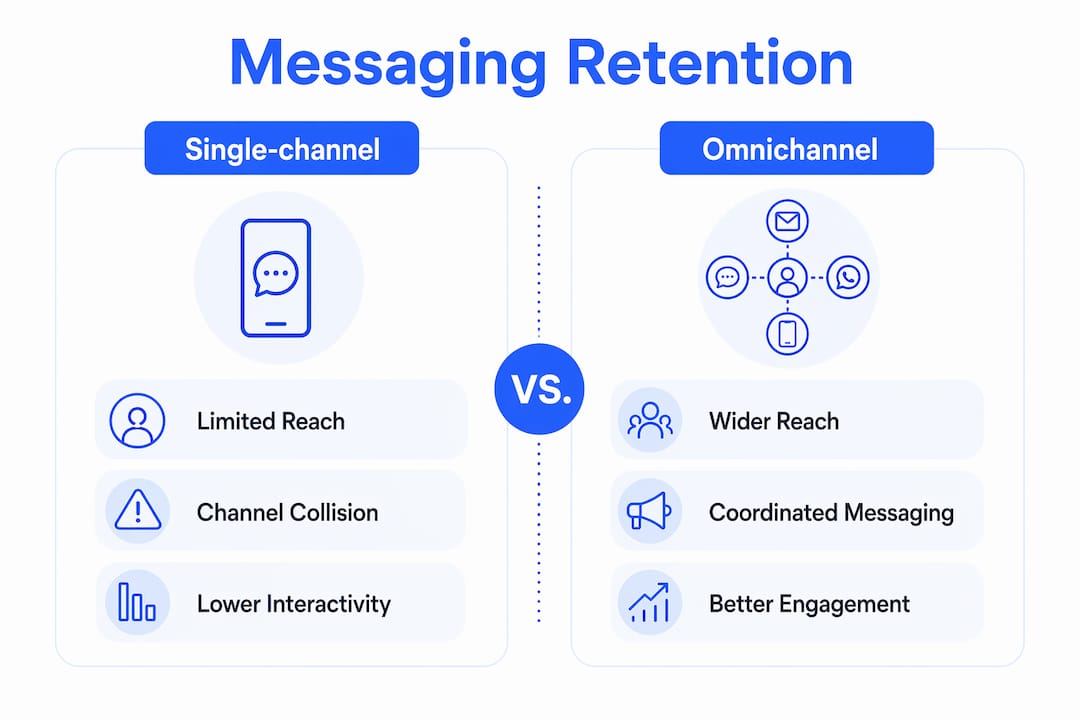
The risk of ignoring coordination is channel collision. Sending the same promotional message across email, SMS, and push notifications on the same day does not multiply impact. It multiplies annoyance. Channel collision causes fatigue and opt-outs, which directly undercuts retention. A subscriber who opts out of your messages is far more likely to cancel than one who simply does not open a single email.
The table below shows the practical difference between single-channel and omnichannel messaging approaches for creators:
| Factor | Single-channel messaging | Omnichannel messaging |
|---|---|---|
| Subscriber reach | Limited to one platform | Covers preferred channels per user |
| Message fatigue risk | High when volume increases | Low with pacing and governance |
| Personalization depth | Minimal, one-size-fits-all | Tailored by behavior and channel |
| Retention impact | Помірний | Significantly higher |
| Opt-out rate | Higher over time | Lower with coordinated cadence |
The solution is governance: a clear system that controls who receives which message, on which channel, and when. Infobip’s research frames this as the difference between broadcasting and orchestrating. Orchestrated messaging respects subscriber preferences and journey stage. Broadcasting ignores both.
Порада професіонала: Map your subscribers into at least three behavioral segments: new (under 30 days), active, and at-risk. Send different message types and cadences to each group rather than one message to all. This alone reduces opt-outs and improves renewal rates.
For creators on Fanspicy, this means using analytics for messaging timing to identify when individual subscribers are most active, then scheduling outreach to match those windows rather than blasting at a fixed time.
What makes two-way and personalized messaging so powerful?
The most striking evidence for two-way messaging comes from James Madison University. After implementing a two-way SMS system with human responders, JMU raised its first-year student retention rate to 92%. The program worked because it replaced automated check-ins with real conversations. Students who felt heard stayed enrolled. Subscribers who feel heard renew.

The parallel for content creators is direct. A subscriber who receives a personalized voice note after their first month is not experiencing a marketing funnel. They are experiencing a relationship. That emotional distinction is what separates creators with 80% renewal rates from those stuck at 40%.
Zendesk’s expert guidance on retention reinforces this point. Delivering the right message at the right time based on customer journey stage is the core of effective retention messaging. A new subscriber needs onboarding and reassurance. An active subscriber needs exclusive value and recognition. An at-risk subscriber needs a reason to stay, not another promotional offer.
The specific behaviors that separate high-retention messaging from low-retention messaging include:
- Responding to subscriber replies within 24 hours rather than leaving them unanswered
- Referencing past interactions or purchases to show you remember the individual
- Sending milestone messages (first month, first purchase, anniversary) that acknowledge the relationship
- Asking questions that invite a reply rather than statements that close the conversation
- Adjusting message frequency based on individual engagement signals, not a fixed schedule
“Retention hinges on emotional connection built through personalized, timely messaging tailored to customer journey stages.” — Zendesk, 2026
For creators managing large subscriber bases, human-in-the-loop messaging does not mean personally writing every message. It means building systems where real responses are possible for high-value or at-risk subscribers, while automation handles routine updates. The subscriber retention process for adult creators on Fanspicy follows exactly this model.
Effective messaging strategies to boost retention in 2026
The first 72 hours after a subscriber joins are the highest-leverage window you have. In-app messaging through welcome messages and guided tours can prevent 80% of app deletions by addressing user confusion early, according to HelpShift. For creators, this means a structured onboarding sequence is not optional. It is the foundation of your retention rate.
A practical messaging cadence for creators looks like this:
- Hour 1: Send a personal welcome message that confirms access and sets expectations for what the subscriber will receive.
- Day 2 to 3: Send a value-reinforcement message highlighting one specific piece of content or feature they may not have discovered yet.
- Day 7: Check in with a direct question. Ask what they are enjoying or what they want to see more of. This opens a two-way channel.
- Day 30: Send a milestone message acknowledging their first month. Include an exclusive offer or preview to reward loyalty.
- Ongoing: Use behavioral signals (views, clicks, replies) to trigger contextual messages rather than relying on a fixed broadcast schedule.
Micro-moment messaging is the practice of sending messages that resolve immediate subscriber doubts at key lifecycle points: after a purchase, during onboarding, or following a support interaction. These messages prevent churn by answering questions before subscribers have to ask them. A subscriber who receives an order confirmation with a personal note from the creator is far less likely to cancel than one who receives a generic receipt.
Порада професіонала: Use rich media in at least one message per week. A 15-second voice note or a behind-the-scenes photo sent via WhatsApp or in-app chat generates significantly more replies than a text-only message. Replies are the clearest signal that a subscriber is engaged and unlikely to churn.
Creators who want to go deeper on interactive messaging features will find that polls, Q&A prompts, and exclusive previews sent through messaging channels consistently outperform passive content drops for retention. The interaction itself is the retention mechanism, not just the content.
Key takeaways
Effective messaging in retention requires personalization, two-way interaction, and omnichannel coordination working together. No single tactic replaces the system.
| Point | Details |
|---|---|
| Messaging preference is dominant | 73.3% of consumers prefer messaging over other contact methods, making it the primary retention channel. |
| Satisfaction scores are unmatched | Messaging apps earn 98% CSAT, higher than any other communication channel measured by Zendesk. |
| Two-way interaction drives loyalty | JMU’s human-in-the-loop SMS program achieved 92% retention by enabling real conversations, not broadcasts. |
| Omnichannel coordination is required | 98% of interactions are omnichannel; single-channel strategies cause fatigue and increase opt-out rates. |
| Onboarding messaging is the highest-leverage window | Welcome messages and guided onboarding prevent up to 80% of early subscriber drop-off. |
Why I think most creators are using messaging backwards
Most creators treat messaging as a distribution channel for content announcements. That is the wrong mental model, and it explains why so many struggle with retention despite posting consistently. Messaging is not a megaphone. It is a telephone. The moment you start using it to broadcast rather than converse, you lose the one thing that makes it more powerful than every other channel: proximity.
I have watched creators with smaller audiences consistently outperform larger ones on renewal rates because they reply to messages, ask questions, and make subscribers feel like individuals rather than line items. The data from JMU’s SMS program confirms what those creators already know intuitively. Real conversations retain people. Automated sequences do not.
The emerging shift toward RCS and AI-assisted messaging will make this even more pronounced. Creators who build genuine two-way habits now will have a structural advantage when richer channels become standard. Those who rely on automation will find that subscribers can tell the difference, and they will act on it.
My honest advice: audit your last 30 days of subscriber messages. Count how many were broadcasts and how many were genuine conversations. If the ratio is worse than 3:1, your messaging strategy is working against your retention rate, not for it.
— fan
Start building retention through messaging on Fanspicy
Fanspicy gives content creators and marketers the tools to put these strategies into practice on a platform built for paid social, live cam, and direct subscriber engagement. The messaging and interaction features on Fanspicy are designed to support personalized outreach, two-way conversations, and the kind of subscriber relationships that drive long-term loyalty.
If you are ready to move from broadcast messaging to genuine subscriber retention, explore what Fanspicy offers for creators who want to grow and keep their audience. The platform combines the direct messaging tools, analytics, and content features that make the strategies in this article executable from day one.
ПОШИРЕНІ ЗАПИТАННЯ
What is the role of messaging in customer retention?
Messaging is the primary channel for building the ongoing relationship that keeps subscribers from canceling. Personalized, timely messages delivered on preferred channels produce the highest customer satisfaction scores of any communication method, according to Zendesk’s 2026 research.
How does personalized messaging improve retention rates?
Personalized messaging improves retention by making subscribers feel recognized as individuals rather than recipients of mass broadcasts. Zendesk identifies delivering the right message at the right journey stage as the core driver of emotional connection and long-term loyalty.
Why is two-way messaging more effective than automated broadcasts?
Two-way messaging enables real conversations that resolve doubts and build trust in ways automated sequences cannot replicate. James Madison University’s two-way SMS program demonstrated this directly, achieving a 92% retention rate by pairing outreach with human responders.
What is omnichannel messaging and why does it matter for retention?
Omnichannel messaging coordinates outreach across multiple channels based on subscriber preferences and behavior rather than sending the same message everywhere at once. Infobip’s analysis of 628 billion interactions found that 98% of messaging in 2025 was already omnichannel, making coordinated strategies the baseline expectation.
When should creators send retention messages for maximum impact?
The first 72 hours after a subscriber joins are the most critical window. Welcome messages and onboarding guidance during this period can prevent up to 80% of early drop-off, according to HelpShift. After onboarding, behavioral signals like views and replies should trigger messages rather than a fixed broadcast schedule.