
Innehållsförteckning
Automated content creation means using software to produce content with minimal human input: drafting captions, planning calendars, cutting clips, scheduling posts. For independent creators it works best as an assistant for the repetitive 70 percent of the job, while you keep the parts fans pay for: your face, your voice, your judgment. This guide shows what to automate, how to build a simple pipeline, and which rules to respect.
TL;DR
- Automated content creation is software doing the production work (writing, editing, formatting, scheduling) that a person would otherwise do by hand.
- A reliable pipeline has a trigger, AI generation, a human review gate, scheduled publishing and a measurement loop.
- Automate planning, repurposing and distribution first. Keep the personal, paid-for moments (private messages, live streams, signature content) human.
- AI-generated material has limited copyright protection in the U.S., and platforms increasingly require disclosure of realistic synthetic media.
- Fanspicy gives creators one place to sell subscriptions, paid posts, private messages, live streams and tips, so the time you save goes straight into content fans value.
Innehållsförteckning
- What automated content creation actually is
- Where automation helps creators most
- A five-part pipeline you can build this week
- Keeping quality and your voice intact
- Rules and risks to know before you automate
- Perspective: automate the workload, never the relationship
- Turning saved time into income
- Build your pipeline on a platform made for creators
- A simple starter routine
- VANLIGA FRÅGOR
- Sources
What automated content creation actually is
The phrase covers a wide range of tools, so it helps to separate two terms. Content automation is the broad idea: technology that speeds up writing, editing, distributing and tracking performance so you can focus on higher-value work. Automated content creation is the production step inside it, where software writes the text, images or video instead of a person.
There are two main families:
- Template and data-driven automation. You fill a template with fixed inputs, such as a weekly schedule post that pulls in your stream times. One industry guide argues these are the most reliable type because the facts come from data.
- Generative AI. Models trained on large datasets simulate human creativity. They are more flexible, but they predict likely words rather than look up facts, so they need checking.
How does generation work under the hood? Large language models predict the next token in a sequence, having learned grammar, facts and style patterns from training text. Give one a clear prompt and it produces a coherent paragraph. Give it a vague prompt and you get vague, generic copy, which is the main reason automated posts feel flat.
Where automation helps creators most
Most creators on paid social platforms do not struggle to have ideas. They struggle with the volume: posting teasers, answering the same questions, planning a month of drops, reshaping one shoot into ten pieces. That is where automation pays off. Creators can use AI to plan calendars, draft scripts, batch-produce content and repurpose long-form material while keeping their voice and final judgment.
Here is a practical split between tasks worth automating and tasks worth keeping personal.
| Task | Automate? | Why |
|---|---|---|
| Content calendar and posting schedule | Ja | Pure planning work, easy to template |
| Caption and teaser drafts | Yes, then edit | Fast first drafts, but your voice must show |
| Repurposing one shoot into clips, previews and stills | Ja | Saves hours of formatting |
| Cross-platform promo posts | Ja | Repetitive and rule-based |
| Analytics summaries | Ja | Numbers are easy to pull automatically |
| Private messages and custom requests | Keep human | Fans pay for real attention |
| Direktsändningar | Keep human | The live connection is the product |
| Signature exclusive content | Keep human | Your identity is what people subscribe to |
If you want ideas on what to put into that pipeline in the first place, our list of content creation ideas for adult creators is a good starting point, and the overview of types of content creation and revenue shows which formats tend to earn.
A five-part pipeline you can build this week
The guides that rank for this topic describe similar workflows. One breaks a working pipeline into a trigger, AI generation, a human review gate, scheduled publishing and a measurement loop. Another describes a five-stage version for solo creators: a brief, a source asset, derivatives, quality assurance and an archive. Here is how that translates into a creator routine.
1. Start with a brief, not a prompt
Write a short brief once: who the content is for, your tone, words you never use, the offer you are promoting and the call to action. Reuse it every time. A good brief is the single biggest quality lever, because it replaces a dozen repeated decisions.
2. Capture one source asset
Shoot or record the thing only you can make: a photo set, a video, a stream replay. Everything else is derived from it. One workflow guide describes this as a content-multiplication approach, where one original piece becomes platform-specific versions.
3. Generate derivatives
Use tools to cut previews, resize for different feeds, draft captions and write post variations. Set a trigger, for example “new file added to this folder,” so the draft appears without you remembering to ask.
4. Add a human review gate
This is the step you never skip. Nothing publishes until you approve it. A technical walkthrough of an AI content system makes the same point: approved content is published through platform APIs only after a human approval gate. For a creator, that can be as simple as a queue you scan for five minutes each morning.
5. Schedule, then measure
Publish from the approved queue on a schedule, then feed results back into your brief. Measurement results can feed back into briefs and prompts, so your next batch improves on the last. Track what actually matters to a creator business: new subscribers, renewals, tips per post, and replies to paid messages.
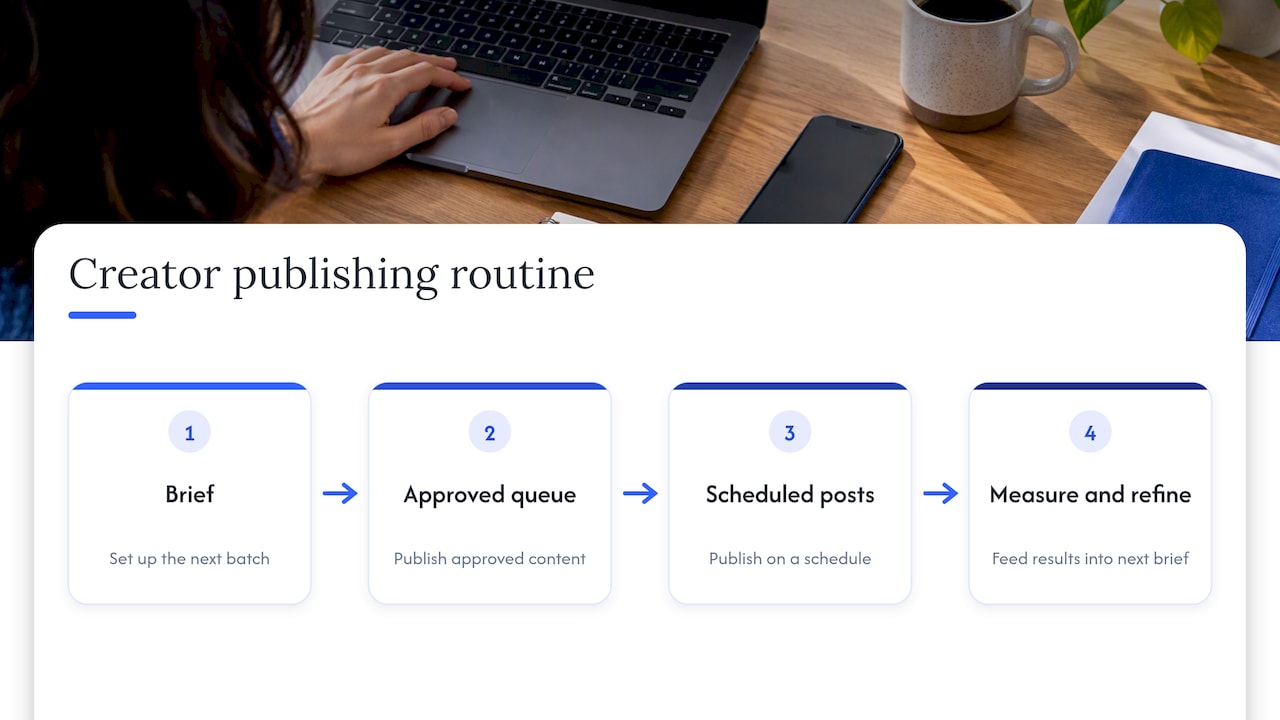
If you want a fuller streaming-focused version of this routine, see our content creation workflow guide and the content creation process for paid platforms.
Keeping quality and your voice intact
The fastest way to lose subscribers is to sound like everyone else. Research from the ACM on generative AI in content creation points to mandatory human review gates, manual judgment steps and spot-checks against trusted originals as the way creators keep quality and authenticity. The same publication stresses that automated systems cannot replace the responsibility creators carry for accuracy, brand alignment and originality.
Turn that into habits:
- Keep the choice steps manual. You pick the final photo, the final caption, the final offer. The tool proposes.
- Compare side by side. Put the automated version next to something you wrote yourself. Ahrefs recommends comparing output with human-made versions, checking links and dates, and scanning for formatting errors that reveal automation failures.
- Feed it your own words. Paste in a few of your best past captions and messages so drafts match your phrasing, slang and boundaries.
- Audit monthly. Read the last 20 automated posts in a row. If they could belong to any creator, tighten the brief.
- Aim to cut decisions, not to maximize volume. One pipeline guide argues the goal should be minimizing redundant human decision-making, with a person still the final arbiter of facts, brand and release.
Businesses that do this well use AI to clear operational drag so human experts can focus on strategy and editorial quality. For a creator, the “expert” is you, and the strategy is what you offer fans and why.
Rules and risks to know before you automate
Automation adds speed, and speed magnifies mistakes. Four areas deserve attention.
Copyright
The U.S. Copyright Office states that material whose expressive elements are determined by the technology in response to a human prompt is not protected by copyright, and that works mixing AI material with human authorship are evaluated case by case. In practice: the photos you shoot and the words you write yourself are your strongest assets. Fully generated pieces may be easier for others to copy. Keep originals and edit history so you can show what you made.
Consent, likeness and style mimicry
Participants in an FTC panel on AI and creative fields noted that many developers do not publicly disclose what is in their training data and raised concerns about synthetic voices and images that imitate artists. For adult creators this is concrete: never generate or share content that uses another person’s face, body or voice without their clear consent, and be cautious with tools that will not tell you how they were trained. Our guide to content moderation steps for adult creators covers the review habits that keep an account safe.
Disclosure
Platforms are tightening labels for synthetic media. YouTube, for example, requires creators to disclose AI-generated or meaningfully altered content that looks realistic, and it may apply labels automatically; creators who consistently fail to disclose can face penalties, including removal or suspension from its partner program. Check the current rules of every platform where you promote, since they change. Our explainer on adult content online, rules and safe use is a useful companion.
Security and runaway automation
If you connect tools with API keys, treat them like passwords. One technical guide recommends secrets managers for keys, treating ingested content as untrusted input to prevent prompt injection, and keeping audit trails. The same source recommends human approval gates and a kill switch, so you can stop all scheduled posting with one click if something goes wrong.
Perspective: automate the workload, never the relationship
We build Fanspicy for independent creators, and we see the same pattern again and again: the creators who grow are not the ones who post the most, they are the ones whose fans feel known.
That is why we think of automation as a tool for the back office of a creator business. Let software handle calendars, formatting, reminders and promo drafts. Spend the hours you save on what fans actually pay for: subscriptions to a person they like, private messages that feel personal, live streams with real conversation, exclusive posts with a point of view.
A platform should support that approach. Fanspicy lets creators sell subscriptions, paid posts, private messages, live streams, bundles and tips in one place, with direct ownership of their audience and easier migration of content from other platforms. Creators do not pay fees to join or use the platform, and we aim to let them keep a higher share of what they earn. Cleaner workflows only matter if the money from those fans comes back to you.
Our advice is simple: automate to protect your energy, keep a human gate on everything that goes out, and never let a tool speak for you in the moments that build loyalty.
fan
Turning saved time into income
Once your pipeline runs, the question is where the extra hours go. Three uses tend to pay back first:
- More live time. A scheduled promo post before each stream costs you nothing once it is automated, and the stream itself is the product.
- Faster replies to paid messages. Use saved replies as a starting point, then personalize the first line every time.
- Bundles and paid posts. Repurposed previews can point to a bundle or a paid post, which gives each shoot more than one chance to earn.
For the promotion side, our guides on social media content marketing for adult creators och media marketing ideas to boost income show how to send traffic from free feeds to your paid page.
Build your pipeline on a platform made for creators
Automation is only half of the equation. You also need a home where fans can subscribe, unlock paid posts, message you, tip and join your live streams. On Fanspicy, creators can sell subscriptions, private messages and live streams from one profile, with no fee to join, and the platform takes a commission per transaction.
If you already have content elsewhere, our positioning is built around easy migration, so you can bring your audience along. Ready to set up your page? Become a creator on Fanspicy and start selling exclusive content, paid posts and tips.
A simple starter routine
If you want to begin tomorrow without buying anything new, try this one-week plan:
- Day 1: Write your brief: audience, tone, banned phrases, current offer.
- Day 2: Collect 10 of your best past captions as style samples.
- Day 3: Pick one source asset and generate five caption variations and a posting schedule.
- Day 4: Review and edit, comparing each draft to your own writing.
- Day 5: Schedule the approved posts, with a note on what you will measure.
- Day 6: Spend the saved time on a live stream or personal replies.
- Day 7: Review results, update the brief, and decide what to automate next.
The point is not to build a machine that runs without you. It is to give yourself a calm, repeatable system so that creative energy goes where it earns.
VANLIGA FRÅGOR
What is automated content creation?
It is the use of software to produce content with little human effort, from drafting captions to editing clips and scheduling posts. It sits inside the wider practice of content automation, which also covers distribution and measurement. Most creators use a mix of templates and generative AI, with a person approving every piece.
How can I create content automatically without sounding robotic?
Start with a detailed brief and examples of your own writing, then edit every draft before it goes out. Keep the personal moments, such as private messages and live streams, fully human. Review a batch of past posts monthly and tighten your instructions if they start to sound generic.
Is there an AI for content creation?
Yes, many tools can draft text, generate images, voices and video, or assemble them into workflows. Choose based on the task, and check how each tool handles your data and your rights. Whatever you pick, add a human approval step before publishing.
Can I own the copyright to AI-generated content?
In the United States, material whose expressive elements are determined by AI in response to a prompt is not protected by copyright, and mixed works are judged case by case. Content you shoot, write or edit yourself stands on firmer ground. For a specific work or dispute, talk to an intellectual property attorney.
Sources
- Semrush: What Is Content Automation & How Can You Use It?
- Outrank: What Is Content Automation? Types, Levels and Examples
- IBM: What is AI-Generated Content?
- Inspace: How Does AI Content Generation Work?
- Zenler: How Creators Can Use AI to Plan, Script and Produce Content
- Revid.ai: Automated Content Creation Workflow and Brief Template
- Astorie: A 5-Stage AI Content Pipeline for Solo Creators
- Full Stack Creators: How to automate your entire content workflow
- Projectorum: Building an AI content machine
- ACM: Content Creation with Generative AI
- Ahrefs: How to Automate Content Creation
- Previsible: Content Automations and Workflows
- U.S. Copyright Office: Copyright Registration Guidance for Works Containing AI Material
- FTC: Staff Report on AI and Creative Fields
- YouTube Help: Disclosing the use of GenAI content