

Оглавление
You can monetize a blog with six main models: display ads, affiliate links, sponsored posts, digital products, memberships and paid services. The best choice depends on your traffic and on how loyal your readers are. Most bloggers start with one stream, then layer on a second and a third as the audience grows. This guide explains how each method works, what it requires, and how to combine them into a plan that pays.
TL;DR
- Monetizing a blog means earning revenue from the content you publish, through advertising, affiliate marketing, product sales, subscriptions and coaching.
- Match the method to your audience: broad, high-volume traffic suits ads, while loyal readers suit memberships and subscriptions.
- Disclose every affiliate link and sponsored post next to the endorsement itself, as the FTC requires in the U.S.
- Blend two to four complementary streams instead of relying on one, so a change in ad rates or search traffic does not erase your income.
- If you have a personality-driven audience, a paid membership or creator subscription can turn readers into direct, recurring supporters.
Оглавление
- What it means to monetize a blog
- The six main ways to make money from a blog
- How to choose the right mix for your blog
- Disclosure rules every blogger should know
- A 90-day plan to start earning
- Our perspective: own the relationship with your audience
- Take your blog audience to a paid community
- Common mistakes that hold blog income back
- ЧАСТО ЗАДАВАЕМЫЕ ВОПРОСЫ
- Sources
What it means to monetize a blog
Monetizing a blog means generating revenue from the content you publish and the audience that reads it. WordPress.com describes it as using revenue models such as advertising, affiliate marketing, sponsored content, and the sale of products or services.
There are two broad ways to think about it. Some models earn money from attention: readers see an ad, and an advertiser pays. Others earn money from trust: readers buy something you recommend, made, or offer. Attention scales with traffic. Trust scales with how well your readers know you. Strong blogs usually use both.
Income is rarely immediate either. Ahrefs notes that successful blog monetization takes planning and dedication, even with effective strategies. Treat the first months as a time to build the audience and test what it responds to.
The six main ways to make money from a blog
Here is a quick comparison before we go through each method.
| Method | Best for | How you get paid | Effort to start |
|---|---|---|---|
| Display ads | High-volume, broad traffic | Clicks or impressions | Низкий |
| Affiliate links | Readers searching for products | Commission on sales | Low to medium |
| Sponsored posts | Engaged, niche audiences | Flat fee per post | Средний |
| Digital products | Blogs with clear expertise | Direct sales | Высокий |
| Memberships and subscriptions | Loyal, returning readers | Recurring fees | Medium to high |
| Coaching and services | Authority in a specific niche | Hourly or package fees | Средний |
1. Display advertising
Ads are the most familiar route. You join an ad network, place ad units on your pages, and earn when visitors view or click them. Ad networks also simplify things for advertisers: they bundle many sites into one line item that can be bought with a single contract and payment.
Here is how earnings work with Google AdSense. Ads are matched to your site based on content and visitors. Advertisers bid in a real-time auction, and the highest-paying ads show. Your income varies because advertisers pay different prices, and some pay per click while others pay per impression.
Relevance matters. Google says ads that match your blog’s content and readership often attract premium pricing. A blog with a tight topic and a clear reader profile tends to be more valuable to advertisers than a scattered one.
Before you apply, check the basics. To take part in AdSense, publishers must be 18 or older, own the site content, and follow Google’s program policies. Payment begins once your earnings reach $10 or the local equivalent, and payments are issued between the 21st and 26th of the month when the balance clears the threshold and no holds apply.
If you run WordPress.com, note that WordAds is available on the Premium plan and above.
Ads work best when you have volume. Adsterra’s framework suggests high-volume, broad traffic is best suited to display and native ads, while loyal traffic fits subscriptions better. That is a useful rule of thumb for your first decision.
2. Affiliate marketing
With affiliate marketing you promote a product or service and earn a commission on sales made through your tracked link. Forbes describes it as one of the core ways bloggers earn.
Affiliate income rewards intent. Someone who searches for “best budget laptop for students” is close to buying, so a well-researched comparison with affiliate links can convert far better than a banner ad on the same page. The matching principle is simple: pair high-intent product searchers with affiliate links, and pair loyal readers with subscriptions.
Practical tips:
- Recommend only what you have used or properly researched.
- Put links inside genuinely helpful content: comparisons, tutorials, buying guides.
- Update posts regularly so product details and links stay current.
- Disclose the relationship clearly (see the disclosure section below).
3. Sponsored posts
A sponsored post is content you create in partnership with a brand, for a fee. Forbes reports that rates can range from $100 to $10,000 per post, depending on audience size and engagement. That range is wide, so treat it as a ceiling to work toward, not a starting expectation.
Brands pay for access to an audience they cannot easily reach elsewhere. To win deals:
- Build a simple media kit with your traffic, audience profile and past results.
- Pitch brands that already fit your topic, not the biggest names.
- Agree on scope, number of revisions, and usage before you write.
- Keep your editorial voice. Readers notice when a sponsored post sounds like an ad.
4. Digital products
E-books, templates, and online courses let you package what you know into something readers download or stream. Forbes notes this lets bloggers turn expertise into resources that bring in recurring income. Google also lists physical products, digital products delivered electronically, and coaching packages as options. Physical goods bring stock and shipping, which is why many bloggers begin with digital.
The easiest product to sell is one your readers already ask about. Look at your most-read posts, your email replies, and the questions in your comments. If the same problem keeps coming up, a template or short course can solve it.
5. Memberships and subscriptions
A membership charges a regular fee for exclusive content, an ad-free experience, or access to a private community. Semrush describes membership programs in exactly those terms, and WordPress.com lists paid memberships and content subscriptions among the ways to earn from a site.
This model is the most direct expression of trust. A small group of devoted readers can pay more than a large crowd of passing visitors, and the income repeats each month. It also reduces your dependence on search rankings and ad rates, because you own the relationship.
What to put behind the paywall: early access, deeper guides, member-only Q&As, downloadable resources, behind-the-scenes updates. Keep a strong free tier so new readers can sample your work.
6. Coaching, consulting and services
If your blog proves expertise, you can sell your time. Coaching and consulting let you monetize niche knowledge one-on-one or in groups, and Forbes reports they often command premium rates for high-ticket work. Freelance services, audits and workshops belong here too. This stream needs few readers, but it caps out at the hours you have.
How to choose the right mix for your blog
Start from your audience, not from the list of methods. Ask three questions:
- How much traffic do you have, and where does it come from? Large, casual search traffic points to ads and affiliate content.
- How often do readers come back? Returning readers point to memberships, products and email-driven offers.
- How much do readers trust you personally? High trust supports coaching, premium subscriptions and sponsorships.
Then build in stages. One recommendation is to start with the strategy that fits your current growth stage and add streams as you expand, and to blend two to four complementary streams to reduce platform risk and seasonality.
A sensible progression looks like this:
- Early stage (building traffic): publish consistently, set up affiliate links where they genuinely help, and start an email list.
- Growing stage: add display ads, pitch a few sponsored posts, and launch a first digital product.
- Established stage: open a membership or subscription for your most loyal readers, and add coaching or services.
For a deeper walk-through by traffic stage, see our guide on stacking three to five revenue streams, and our overview of seven proven website monetization methods.
Disclosure rules every blogger should know
If you earn from affiliate links or sponsored posts and you publish for a U.S. audience, disclosure is not optional. The FTC requires bloggers to disclose material connections, such as payment or free products, when they endorse a product or service. The same source notes that advertisers may be held liable for deceptive claims made by the bloggers they pay.
Three practical rules follow from FTC guidance:
- Place the disclosure with the endorsement. The FTC’s influencer guide says disclosures are likely to be missed if they sit only on an About Me or profile page.
- Say it plainly and up front. The FTC does not require specific wording. Disclosures should convey the information straightforwardly and appear where people are most likely to notice them.
- Disclose in every post. A line near the top of each affected post, such as a plain statement that you earn a commission from links, is simpler than relying on a site-wide notice.
These rules are U.S. rules. If you publish for readers elsewhere, check the advertising rules of that country.
A 90-day plan to start earning
Turn the options above into a schedule you can follow.
- Weeks 1 to 2: audit. List your top 10 posts by traffic and note what readers are trying to do on each page. Decide whether they are browsing, comparing or ready to buy.
- Weeks 3 to 4: set up your first stream. Choose affiliate links for comparison and review posts, or apply for an ad network if your traffic is broad. Add clear disclosures.
- Weeks 5 to 8: start an email list. Offer a simple free resource. Email is the bridge between casual visitors and paying supporters.
- Weeks 9 to 12: test a second stream. Draft a media kit and pitch three brands, or outline a small digital product based on your most common reader questions.
- After day 90: review and layer. Keep what earns, drop what does not, and plan a membership once you see readers returning.
Our perspective: own the relationship with your audience
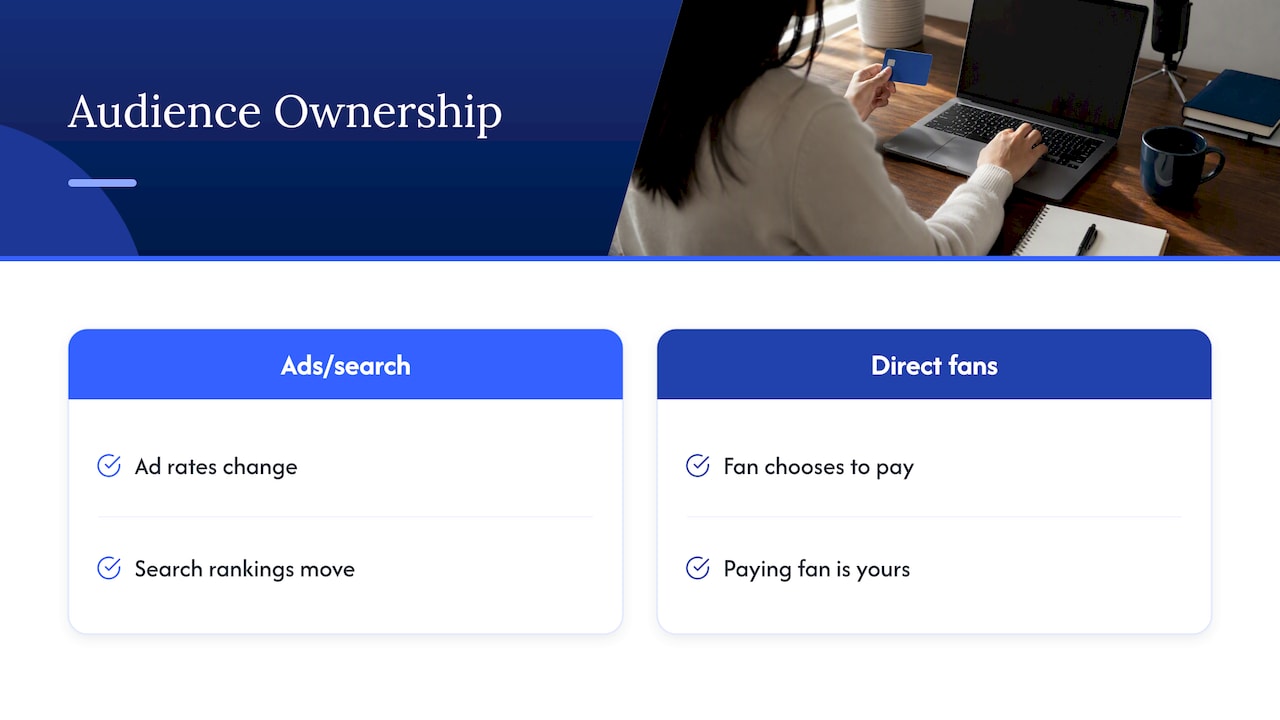
We work with independent creators every day, and one lesson shows up again and again: the creators who earn most reliably are the ones who own their audience. Ad rates change and search rankings move, but a fan who chooses to pay you directly is yours.
That is why we built Fanspicy as a paid social media and live cam platform where creators sell subscriptions, exclusive content, private messages, live streams, bundles and tips. Our model is a revenue share: creators do not pay fees to join or use the platform, and we take a percentage commission per transaction. We designed it to let creators keep a higher percentage of what they earn, to make it easy to migrate content from other platforms, and to support many content types and creator categories.
For bloggers, the takeaway is practical. If you have a voice, a niche and readers who come back, a paid layer is a game-changer. Flexible earning methods let you combine recurring subscriptions with one-off purchases like tips and paid messages, so income does not hinge on a single source. We explore that mix in our piece on hybrid monetization for creators and in our look at subscription-based recurring revenue. Small purchases matter too, and we cover them in the role of microtransactions.
— fan
Take your blog audience to a paid community
If your readers already follow you for your personality, your expertise or your content, you can give them a direct way to support you. On Fanspicy, creators can offer subscriptions, private messages and live streams, and sell exclusive content, paid posts and accept tips from their fans.
It works as a complement to your blog, not a replacement. Keep your articles free for discovery, and use a paid space for the content that deserves a premium. If you are ready to test the waters, start with one offer and see how your audience responds. When you are ready to grow, our guides on promoting paid content и boosting subscriber growth cover the next steps, and our secure payment steps help you set up payouts with confidence.
Common mistakes that hold blog income back
- Chasing one stream. Relying only on ads leaves you exposed when rates or traffic dip. Diversify across two to four streams.
- Monetizing before you have readers. Ads on a site with little traffic earn almost nothing and can make the experience worse. Build value first.
- Ignoring intent. Placing affiliate links in posts where readers are only learning, not buying, wastes the opportunity.
- Forgetting disclosure. Hidden or missing disclosures put you and your sponsors at risk.
- Skipping the email list. Without a direct channel, you depend on platforms you do not control.
- Underpricing your work. Sponsored posts and services reflect your audience and engagement. Price from your results, not from fear.
ЧАСТО ЗАДАВАЕМЫЕ ВОПРОСЫ
How much traffic do I need to monetize a blog?
There is no universal minimum. Affiliate links, products and coaching can earn from small but focused audiences, while display ads reward volume. Check the eligibility rules of any ad network you plan to use before you apply.
What is the easiest way to start monetizing a blog?
Affiliate links and display ads are the lowest-effort starting points, because you do not have to create a product. Affiliate links in helpful comparison posts usually suit new blogs best, since they pay on reader intent rather than traffic volume.
Do I have to disclose affiliate links and sponsored posts?
Yes, for a U.S. audience. The FTC expects you to disclose material connections, such as payments or free products, next to the endorsement itself, in plain language. Burying the notice on an About page is not enough.
When does Google AdSense pay?
AdSense starts the payment process once your earnings reach $10 or the local equivalent. If the balance meets the threshold by month-end and there are no holds, payment is issued between the 21st and 26th of the following month.
Can I charge readers directly instead of showing ads?
Yes. Paid memberships and content subscriptions are a standard way to earn from a blog. They work best when readers return often and value exclusive content, and they give you recurring income that does not depend on ad rates.
Sources
- How To Make Money Blogging, Google AdSense
- Monetize Your WordPress.com Site, WordPress.com Support
- How AdSense works, Google AdSense Help
- Eligibility requirements for AdSense, Google AdSense Help
- Steps to getting paid, Google AdSense Help
- The Design of Online Advertising Markets, Ben Edelman
- How To Make Money Blogging: 7 Methods, Forbes
- How to Monetize a Blog, Semrush
- What is the best way to monetize a website, Watsspace
- Publisher Monetization Strategies, Adsterra
- How Do Blogs Make Money, Ahrefs
- FTC enforcement speech, Federal Trade Commission
- Disclosures 101 for Social Media Influencers, FTC
- Myths about endorsements, FTC