

Оглавление
Promotional video marketing is one of the most direct paths from brand awareness to customer action available to marketers today. A promotional video is a short, focused clip, typically between 30 seconds and three minutes, built specifically to generate excitement around a product launch, sale, event, or campaign and push viewers toward a specific action. The results speak clearly: adding video to a landing page can boost conversions by up to 80%, and 74% of viewers who watch a product-use video go on to purchase the item. Tools like Canva have made production accessible to teams of any size, removing the barrier that once made video a big-budget luxury.
The core benefits that make promotional video worth prioritizing:
- Conversion lift: Video on landing pages drives measurable purchase behavior.
- Brand recall: Viewers retain video content far more readily than text or static images.
- Email performance: Embedding video in email can boost click-through rates by 200–300%.
- Mobile reach: Video consumption on mobile devices continues to grow year over year.
- Social sharing: Entertaining branded videos earn organic distribution when viewers share them.
- SEO value: Pages with video keep visitors engaged longer, sending positive signals to search engines.
This guide walks through every stage of the process: how to create a promotional video from scratch, real-world examples that illustrate what works, platform-specific optimization for 2026, storytelling techniques that build lasting brand loyalty, and the metrics that tell you whether your campaign is actually performing.
How to create a promotional video that actually converts
A promotional video without a clear objective is just content. The production process only works when it starts with strategy.
1. Define your objective and audience. Decide exactly what action you want viewers to take: register, buy, share, or click. Then build a detailed picture of who you are reaching, what platforms they use, and how much they already know about your brand. This shapes every creative decision that follows.
2. Write a script built around a hook. The first few seconds carry the entire weight of your video. Open with a question, a bold claim, or a visual that stops the scroll. Follow with a concise story arc: problem, solution, proof, and a single clear call to action. Keep language conversational rather than promotional.
3. Choose the right length and format. Most promotional videos run 30 seconds to three minutes, but the platform determines the ceiling. A 15-second cut works for Instagram Reels; a 60-second version suits YouTube in-stream. Plan multiple cuts from a single shoot rather than producing separate videos for each channel.
4. Plan your production setup. Good lighting and clean audio matter more than camera quality. Natural window light, a simple backdrop, and a lapel microphone produce results that outperform expensive setups with poor sound. Shoot in 9:16 vertical if social placements are your primary target.
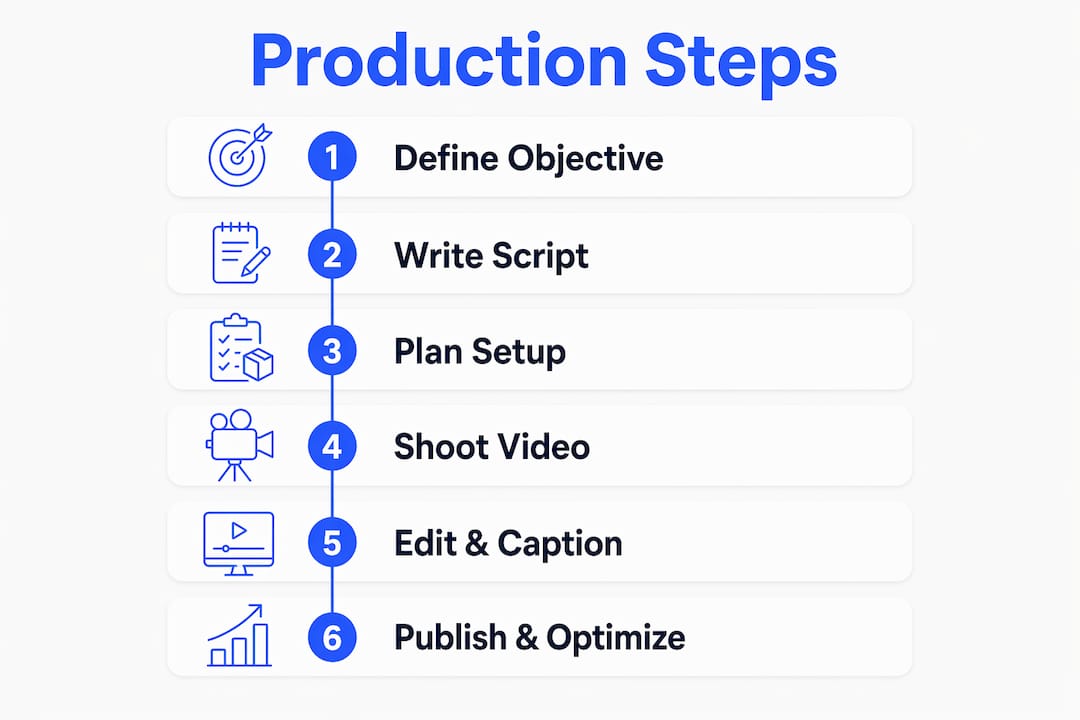
5. Choose your editing tools. Canva’s video editor handles templates, text overlays, and brand color application with minimal learning curve, making it a practical starting point for marketing teams without dedicated editors. For more control over cuts and motion graphics, tools like Adobe Premiere Pro or DaVinci Resolve give you frame-level precision.
6. Add captions and visual cues. 85% of social video is watched without sound. Burned-in captions are not optional on Meta Reels, TikTok, or YouTube Shorts. Every key message needs to land visually, not just through audio.
7. Address budget and legal considerations. License all music through platforms like Artlist or Musicbed to avoid copyright strikes. If you feature people, collect signed release forms. Budget for at least two to three creative variants so you can test hooks before committing full spend to one version.
8. Repurpose across channels. A single 60-second video can yield a 15-second teaser for Stories, a square cut for LinkedIn, a horizontal version for YouTube in-stream, and a GIF for email headers. Repurposing multiplies reach without multiplying production cost.
Key tips to keep in production:
- Keep on-screen text to 3–5 words at a time.
- Place your brand logo in the first three seconds.
- End every version with one explicit call to action.
- Test at least two different opening frames before scaling spend.
Совет профессионала: Shoot your hook last. Once you have filmed the full video, you will know exactly which moment is most compelling. Use that moment as your opening frame.

15 promotional video examples that show what great looks like
Strong promotional video campaigns share a few consistent traits: a specific hook, a clear narrative, and a format matched to the platform. These 15 examples illustrate the range of approaches that work across industries and objectives.
1. Apple product launch films. Apple opens every product video with a visual problem, not a product shot. The viewer sees the limitation first, then the solution. The pacing is slow and cinematic, which works because Apple runs these on owned channels where audiences are already warm.
2. Vidico SaaS explainer videos. Vidico specializes in animated explainer videos for software brands. Their approach keeps screen time under 90 seconds, uses motion graphics to simplify complex workflows, and places the CTA at the 75% mark rather than the very end, capturing viewers before drop-off.
3. Canva’s “What Will You Design Today?” campaign. Canva uses real user creations as the visual backbone of its promotional content. The message is aspirational without being abstract. Viewers see finished work, not software features, which makes the value proposition immediate.
4. Dollar Shave Club’s launch video. This is the textbook case for conversational tone over sales pitch. The founder walks through a warehouse, speaks directly to camera, and makes the audience laugh. It drove massive subscriber growth on a minimal budget because the personality was the product.
5. Airbnb host story videos. Airbnb’s promotional content centers on individual hosts rather than the platform itself. Relatable characters, real locations, and genuine emotion build trust faster than any feature list. The brand appears at the end, not the beginning.
6. Slack’s “So Yeah, We Tried Slack” video. Slack dramatized the chaos of email-heavy work life before showing how the product changed it. The before-and-after structure is one of the most reliable formats in video advertising because it mirrors how buyers actually think.
7. GoPro user-generated content campaigns. GoPro built an entire promotional strategy around footage shot by customers. The production quality is raw and authentic, which performs better on cold audiences than polished studio work. Native, lo-fi vertical content outperforms polished 16:9 on cold traffic by 2–3x in hook rate.
8. Peloton instructor-led teaser videos. Short clips featuring instructors mid-class create urgency and FOMO without explaining the product at all. The emotional energy of the instructor is the hook. This format works particularly well for subscription-based products.
9. Shopify “Let’s Make You a Business” campaign. Shopify’s promotional videos follow aspiring entrepreneurs through the moment they decide to start. The narrative arc is personal and specific, which makes the viewer see themselves in the story rather than watching someone else’s journey.
10. HubSpot educational promo videos. HubSpot promotes its platform through short educational clips that solve a real problem in under two minutes. The viewer gets value before any sales message appears. This builds credibility and positions the brand as a resource rather than a vendor.
11. Nike “Just Do It” short-form social cuts. Nike’s social promotional content strips the message down to a single athlete, a single moment, and a single emotion. No product features, no pricing, no explanation. The brand recall comes from consistency of tone across hundreds of short clips.
12. Wistia’s Webinarpalooza promo. Wistia promoted a 30-day webinar event with a video that relied entirely on visuals and music rather than dialogue. The absence of narration made the video feel more like a movie trailer than a corporate announcement, which drove strong engagement.
13. SaleCycle webinar promo. SaleCycle used a green-screen setup to preview webinar content in a light, entertaining format. The video earned an 86% engagement rate and drove 24 direct sign-ups from the CTA button, proving that production value matters less than relevance and clarity.
14. BambooHR Facebook page promo. BambooHR created a short video to grow their social following rather than sell a product. The objective was narrow and the video reflected that focus. Single-objective videos consistently outperform those trying to accomplish multiple goals at once.
15. Creator-led product demos on TikTok. Brands that partner with creators who already have an established voice on TikTok see stronger hook rates than those running traditional ads. The creator’s audience trusts their recommendation, and the native format feels organic rather than paid. This approach works especially well for content creators building discoverability in competitive digital spaces.
Совет профессионала: Before producing your own video, search your category on TikTok’s Creative Center and YouTube’s Ad Library. The ads that have been running for 30 or more days are the ones that are working. Study their opening frames before you write your script.
How to optimize your promotional videos for 2026 platforms
Platform optimization is where most promotional video campaigns lose performance they earned in production. The format that works on YouTube in-stream will actively hurt you on Instagram Reels.
The foundational rule for 2026: default to 9:16 vertical. The majority of paid social impressions are now mobile, and Meta Reels, TikTok, Instagram Stories, and YouTube Shorts all require vertical format. Letterboxed 16:9 video on these placements typically posts hook rates 30–50% lower than native vertical cuts.
Platform-specific priorities:
- Meta Reels and Stories: 9:16, 15–30 seconds, burned-in captions required, sound off by default.
- TikTok In-Feed: 9:16, 15–30 seconds, audio-first platform where sound design matters more than on Meta.
- YouTube Shorts: 9:16, under 60 seconds, treat the first 5 seconds as the entire hook window since viewers can skip at that point.
- YouTube In-Stream Skippable: 16:9, 15–30 seconds for prospecting, with the first 5 seconds carrying the full hook job. YouTube skippable ads allow viewers to skip after 5 seconds; advertisers pay only on interaction or 30-second views.
- LinkedIn Video: 16:9 or 1:1, 15–30 seconds, burned-in captions required, B2B context with a lower hook rate floor.
Sound design deserves specific attention. TikTok is audio-first, meaning music and voice tone actively drive engagement. Meta and YouTube Shorts are sound-off by default, so every key message must work through captions and on-screen graphics alone. Producing two audio mixes, one for audio-on platforms and one optimized for silent viewing, is worth the extra hour in post-production.
For distribution, blending video formats matched to customer journey stages improves both engagement and conversion rates. Connected TV and in-stream ads suit brand awareness campaigns. Shoppable and social formats work best for direct conversion. Running the same creative across every placement without adapting it is one of the most common and costly mistakes in video advertising.
Mid-roll YouTube ad placements now require active frequency management. Without capping, you risk overexposure that erodes goodwill and inflates cost per acquisition. A reasonable starting point is two to three impressions per user per week for non-skippable formats.
Storytelling and branding strategies that build real viewer loyalty
The promotional videos that drive long-term brand growth share one quality: they make the viewer feel something before they ask the viewer to do something. Storytelling is the mechanism, not a stylistic preference.
The most reliable narrative structure is the problem-solution arc with a relatable character at the center. The viewer needs to see themselves in the story, not the brand. Conversational, story-driven videos foster deeper consumer connection and loyalty than direct sales pitches. This does not mean avoiding your product. It means leading with the human experience of the problem your product solves.
Strategies that consistently strengthen brand storytelling:
- Lead with the character, not the product. Open on a person in a recognizable situation. The product enters as the resolution, not the introduction.
- Keep the tone conversational. Write scripts the way people actually speak. Formal language creates distance; casual language creates trust.
- Maintain visual consistency. Color palette, typography, and logo placement should be identical across every video you produce. Brand recall builds through repetition of visual cues.
- Design for silent viewing. Every key point needs an on-screen text equivalent. Captions are not an accessibility feature; they are a primary communication channel for most social viewers.
- Pace through the critical middle section. The “second-7 problem” describes the drop-off point where viewers who survived your hook make a second skip decision around seconds 7–9. Cuts every 1.5–2.5 seconds through seconds 5–15 keep the brain engaged with new information and prevent that second abandonment.
Совет профессионала: Authenticity outperforms polish on cold audiences. A creator-style video shot on a phone with genuine energy will outperform a studio production with a flat script. Invest in the story before you invest in the equipment.
Brand consistency across channels also matters for discoverability. Marketers building paid content promotion strategies find that audiences who recognize a brand’s visual and tonal signature across platforms convert at higher rates than those encountering it for the first time on each channel.
The balance between polished and native content depends on audience temperature. Warm audiences who already know your brand respond well to higher-production brand films. Cold audiences, people encountering you for the first time in a feed, respond better to native, creator-style content that does not immediately read as an advertisement.
How to measure whether your promotional video campaigns are working
Measurement is where video advertising strategy either compounds or collapses. Without a clear framework, you end up optimizing for vanity metrics and missing the signals that actually predict revenue.
Start with the metrics that reflect creative performance before spend performance:
Hook rate (3-second video plays divided by impressions) tells you whether your opening frame is stopping the scroll. A healthy hook rate on cold traffic sits at 25–35%. Below 15%, the platform algorithms reduce distribution regardless of your bid.
Hold rate measures what percentage of viewers who passed the 3-second mark continued watching to the 50% or 75% mark. This is the metric that exposes the second-7 problem. If your hook rate is strong but your hold rate collapses between seconds 7 and 15, the opening is working but the middle is losing people.
View-through rate (VTR) tracks how many viewers watched to completion or to the 30-second mark on longer formats. On YouTube skippable in-stream, well-optimized campaigns see view-through rates around 31.9%.
Click-through rate (CTR) measures how many viewers acted on your CTA. A strong CTR with a weak hook rate means your message is compelling but your audience targeting is too narrow. A strong hook rate with a weak CTR means your creative is entertaining but your offer is not landing.
Cost per acquisition (CPA) и return on ad spend (ROAS) are the bottom-line metrics that connect video performance to business outcomes. These require proper attribution windows and consistent tracking setup before launch, not after.
Additional measurement practices worth building into every campaign:
- Pull per-second video play data to find the exact frame where viewers drop off. This tells you whether to re-edit or re-shoot.
- Run A/B tests on opening frames before scaling budget. Two versions of the first three seconds can produce dramatically different hook rates with identical production costs.
- Segment reporting by device, since CTV, mobile, and desktop audiences behave differently and mixing them obscures performance signals.
- Track creative fatigue. User-generated content typically maintains performance for 30–45 days before metrics decline; studio content often holds for 60–90 days. Refresh creative before the drop, not after.
- Use Customer Match exclusions in Google Ads to stop serving awareness-stage video to people who already converted. It wastes budget and inflates CPA.
The most common measurement mistake is diagnosing a hook problem when the data actually shows a hold rate collapse. Pull the retention curve before you re-shoot anything.
Key Takeaways
Promotional video marketing drives measurable results when creative format, platform specs, storytelling structure, and performance measurement all work together from the start.
| Point | Details |
|---|---|
| Conversion impact | Video on landing pages can boost conversions by up to 80%; 74% of viewers who watch a product-use video subsequently purchase the item. |
| Platform format discipline | Default to 9:16 vertical for social placements; letterboxed 16:9 cuts hook rates by 30–50% on Reels and Shorts. |
| Hook window | A video ad has 1.4 seconds to stop the scroll and 5 seconds to deliver the value proposition. |
| Silent viewing | 85% of social video plays without sound; burned-in captions are a primary communication channel, not an afterthought. |
| Measurement priority | Track hook rate, hold rate, and per-second retention curves before diagnosing creative problems or scaling spend. |