

Оглавление
TL;DR:
- Live pay-per-view charges viewers a one-time fee for access to a specific live event, without a recurring subscription.
- It relies on complex backend infrastructure such as signed URLs, DRM, and CDN scaling to ensure secure, high-quality streaming.
If you’ve ever wondered why some live events cost extra to watch even when you already pay for a streaming service, you’re not alone. Understanding what is live pay-per-view cuts through that confusion fast. Live pay-per-view is a model where you pay a single, one-time fee to access one specific event. No subscription required. No bundled content you don’t want. Just direct access to what you actually came to watch. This guide covers how it works technically, how it compares to other streaming models, and how creators and fans can both benefit from it.
Оглавление
- Key Takeaways
- What is live pay-per-view and how it works
- How the technology behind it actually works
- PPV vs. subscription vs. on-demand streaming
- How creators and fans can use live PPV
- My take on where live PPV is heading
- Start monetizing live events on Fanspicy
- ЧАСТО ЗАДАВАЕМЫЕ ВОПРОСЫ
Key Takeaways
| Point | Details |
|---|---|
| PPV is transactional, not recurring | You pay once for one event, not a monthly fee for a library of content. |
| Access windows are limited | Most live PPV events grant access for 24 to 48 hours, sometimes with replay included. |
| Security runs deep | DRM, signed tokens, and forensic watermarking protect content and paying viewers’ access. |
| PPV beats subscriptions for premium moments | Exclusivity and countdown urgency drive higher willingness to pay than recurring plans. |
| Creators control their revenue directly | PPV lets creators monetize specific events without giving a platform a subscription cut. |
What is live pay-per-view and how it works
Pay-per-view is a model where viewers pay to watch individual events rather than subscribing to a full channel or content library. The “live” version of this takes that concept and applies it to real-time streaming. You pay before the event starts, gain access at the scheduled time, and watch it as it happens.
The mechanics are straightforward from the viewer’s side. You find the event, complete a one-time payment, and receive access to the live stream. Most platforms then give you a limited access window of 24 to 48 hours, which often includes a replay option after the live broadcast ends. That window is a defining feature of PPV. It creates scarcity, which is part of what makes the model work commercially.
Content that performs well as live pay-per-view includes:
- Combat sports like boxing and MMA, where the outcome is unknown and the live experience is the product
- Concerts and live performances where the energy of the moment cannot be replicated in a recording
- Webinars and expert sessions where creators monetize knowledge in real time
- Gaming events and tournaments with high audience engagement and competitive stakes
- Exclusive creator content on platforms like Fanspicy, where fans pay to access a specific live session
What separates PPV from a regular subscription stream is the transaction structure. A subscription gives you access to a catalog for a recurring fee. PPV charges you once for one thing. There is no ongoing commitment, which actually lowers the barrier for fans who are interested in one specific event but not ready to subscribe to a whole platform.
Совет профессионала: If you’re a creator considering PPV, price your event based on perceived exclusivity, not just production cost. A live session that cannot be replicated commands more than a recorded tutorial.
How the technology behind it actually works
The user experience of live pay-per-view feels simple. You pay, you watch. But the infrastructure making that possible is genuinely complex. Here is how the key pieces fit together:
- Payment and entitlement. When you complete a purchase, the platform creates an entitlement record tied to your account. This record is what the system checks before it lets you watch anything.
- Authentication via signed URLs or tokens. The stream is not publicly accessible. Transactional paywalls combined with signed URL authentication verify that your session is authorized before the player even loads the stream.
- DRM license check. Before your device can decrypt and play the video, it must obtain a DRM license. Edge authorization enforces purchase rights dynamically, meaning the license is only issued if your entitlement is valid at that exact moment.
- Live origin and CDN scaling. Once authenticated, the stream is delivered through a content delivery network. Scaling PPV streams for unpredictable concurrent viewers requires coordination between authentication, CDN, DRM, and live origin infrastructure. A major boxing match might spike to hundreds of thousands of viewers in seconds.
- Anti-piracy measures. High-value live PPV events are piracy targets. DRM alone is not always enough. Forensic watermarking embeds invisible identifiers into each viewer’s stream, so if a recording leaks, the source can be traced back to a specific account.
“PPV is where payment processing, entitlement management, and protected delivery intersect. The user experience feels simple but relies on complex backend coordination.” — Cloudinary
For creators and platform operators, understanding this stack matters because each layer has a cost and a failure point. A broken DRM handshake means viewers can’t watch. A CDN that doesn’t scale means buffering during peak moments. Choosing a platform that handles all of this for you, like Fanspicy does, removes the technical burden entirely.
PPV vs. subscription vs. on-demand streaming

Most people think of streaming as one thing. It is actually several different business models with different implications for both viewers and creators.
| Model | Payment structure | Content access | Best for |
|---|---|---|---|
| Live PPV | One-time fee per event | Limited window (24-48 hrs) | Premium live events, exclusives |
| Subscription (SVOD) | Recurring monthly fee | Full library during subscription | Ongoing content consumption |
| Video on demand (VOD) | One-time fee per title | Longer or permanent access | Films, recorded series |
PPV differs from subscription VOD by charging a defined fee for specific content with a limited access window, while subscriptions offer broader access for a recurring payment. The key distinction is that PPV is transactional video on demand focused on individual assets, not a library.
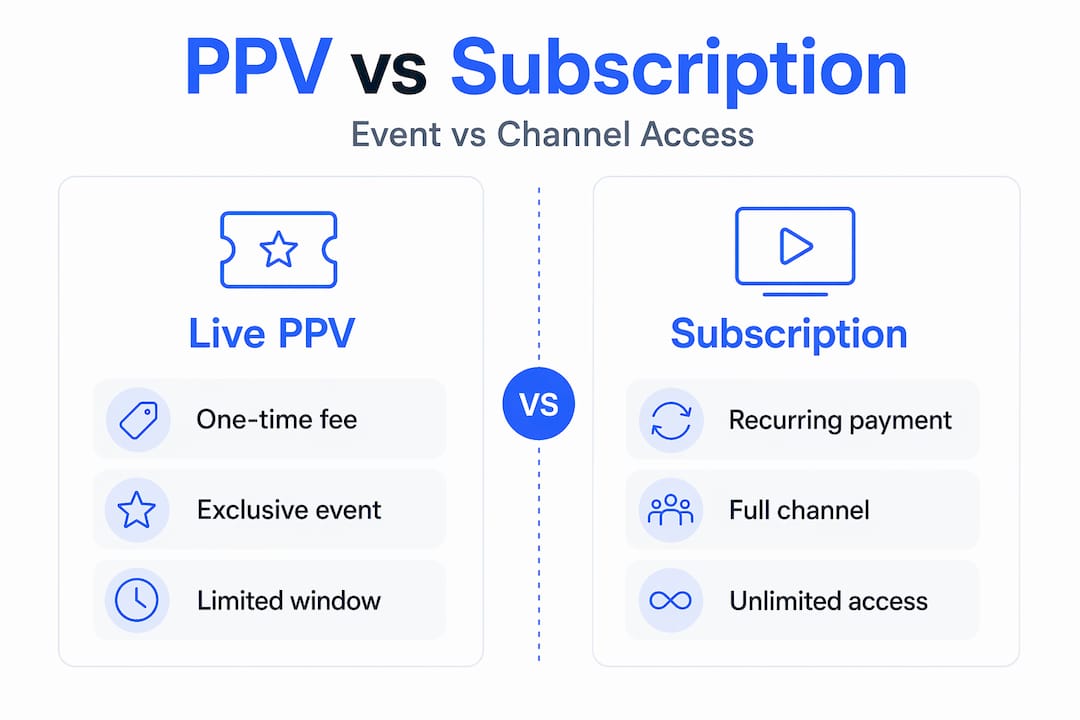
For creators, this difference is significant. A subscription model requires you to produce consistent volume to retain subscribers. PPV lets you monetize specific high-value moments without that pressure. One well-produced live event can generate more revenue in two hours than weeks of subscription content.
For fans, the math is also different. Paying $15 to watch one live event you genuinely want is often a better deal than paying $12 a month for a platform where you only watch one thing anyway.
Совет профессионала: Countdown to event, exclusivity, and a one-time payment drive higher willingness to pay than subscription pricing. Use a visible countdown timer on your event page to activate that urgency.
The subscription model wins on convenience and volume. PPV wins on premium moments. The smartest creators use both, running a subscription for regular content and PPV for special events that deserve their own spotlight.
How creators and fans can use live PPV
For creators, live pay-per-view is one of the most direct paths to revenue from a live audience. You set the price, you control the event, and every purchase goes toward your bottom line. The marketing of PPV events is where most creators underinvest. Promotion needs to start at least two weeks before the event, with consistent reminders across every channel you own.
Practical strategies that actually move tickets:
- Early bird pricing. Offer a lower price for the first 48 to 72 hours after announcing the event. This rewards loyal fans and creates an early sales spike that builds social proof.
- Teaser content. Release short clips, behind-the-scenes previews, or guest announcements to build anticipation without giving away the main event.
- Collaboration. Bring in a guest creator or co-host whose audience overlaps with yours. Both of you promote the event, and both audiences see it.
- Replay upsell. Offer replay access at a slightly lower price after the live event ends. This captures viewers who missed it and extends your revenue window.
For fans, the benefits of PPV are real and underappreciated. You pay only for what you want. You get access to exclusive live content that is not part of any subscription library. And the live event experience, with a real audience watching at the same time, creates a shared moment that a recording simply cannot replicate.
Platforms like Fanspicy are built specifically for this kind of direct creator-to-fan monetization. Creators can set up live PPV sessions, control pricing, and engage with their audience in real time. You can read more about maximizing live stream revenue to understand what the best-performing creators do differently. Understanding why PPV content boosts earnings compared to other models is also worth your time if you’re serious about monetization.
My take on where live PPV is heading
I’ve watched the live pay-per-view space shift dramatically over the past several years, and the most interesting change is not the technology. It’s the audience expectation. Viewers in 2026 expect a frictionless purchase experience, instant access, and a stream that doesn’t buffer. When any of those three things fail, they don’t complain. They leave and they tell people.
What I’ve learned from watching creators succeed and fail with PPV is that the technical side is now mostly solved by good platforms. The real differentiator is the event itself. Viewers will pay for something they genuinely cannot get anywhere else. They will not pay, no matter how slick the checkout page, for something that feels like it could have been a YouTube video.
The piracy challenge is real and it’s not going away. DRM and watermarking help, but the honest truth is that determined bad actors will always find a way. The better protection is building an audience that values supporting you directly. Fans who feel connected to a creator are less likely to share a leak and more likely to buy the next event.
I also think the subscription fatigue that’s been building for years is going to push more creators toward PPV. People are canceling subscriptions they don’t use. A one-time payment for something specific is a much easier yes. That’s a genuine opportunity for creators who understand how to build anticipation and deliver on it.
— fan
Start monetizing live events on Fanspicy
If you’re a creator ready to turn your live sessions into real revenue, Fanspicy gives you the tools to do it without the technical headache. The platform handles secure payment processing, access control, and live streaming in one place, so you can focus on the event itself.
Fans get a safe, high-quality viewing experience with access to exclusive live content from creators they actually want to support. No bloated subscription bundles. Just direct access to what you want to watch. Check out live PPV creators like somlusolme on Fanspicy и jackiepott on Fanspicy to see what a well-run live pay-per-view experience looks like in practice. If you’re a creator, get started on Fanspicy and set up your first live PPV event today.
ЧАСТО ЗАДАВАЕМЫЕ ВОПРОСЫ
What is live pay-per-view in simple terms?
Live pay-per-view is a model where you pay a single fee to watch one specific live event. Unlike a subscription, there is no recurring charge and no access to a broader content library.
How does pay-per-view work for online streaming?
You purchase access before the event, receive authentication credentials, and stream the content during a defined window. Signed URLs and DRM verify your purchase and protect the stream from unauthorized access.
What types of events use live pay-per-view?
PPV events include combat sports, concerts, live shows, and webinars, as well as exclusive creator sessions on platforms like Fanspicy. Any time-sensitive, premium live content is a strong candidate.
How long do you have access after buying a live PPV event?
Most platforms offer a 24 to 48 hour access window that includes the live broadcast and often a replay. Some platforms extend this for higher-priced events.
Is live pay-per-view better than a subscription for creators?
PPV gives creators direct revenue from specific high-value events without requiring ongoing content volume. It works best alongside a subscription model, with PPV reserved for premium or exclusive live moments.