

Оглавление
TL;DR:
- Streaming surpassed traditional TV in 2025 with a 44.8% share of viewership.
- Mid-tier and niche creators are winning due to engagement and diversified monetization strategies.
- AI tools and multi-platform streaming are essential for scaling and protecting creator income.
Streaming crossed a line in 2025 that nobody in traditional media saw coming. For the first time, streaming surpassed broadcast and cable with a 44.8% share of total TV usage, making it the undisputed home of modern content consumption. For creators and streamers, this is not just a stat worth noting. It rewrites your entire playbook: where you show up, how you earn, and who you compete with. This guide breaks down the platforms, the money, and the strategies that actually work so you can build something real in 2025 and beyond.
Оглавление
- How streaming platforms became the new mainstream
- The new landscape of monetization in 2025
- Why niche and mid-tier creators are winning
- AI, multi-streaming, and the future of creator growth
- The uncomfortable truth about streaming success in 2025
- Unlock your next level with Fanspicy creators
- Frequently asked questions
Key Takeaways
| Point | Details |
|---|---|
| Streaming overtakes TV | In 2025, streaming became the dominant way people consume content, offering huge opportunities for creators. |
| Diverse earning strategies | Creators use subscriptions, ad revenue, merch, and sponsorships to maximize income across platforms. |
| Power of niches | Mid-sized and niche streamers see stronger community growth and brand deals than mega-creators in 2025. |
| AI and multi-streaming | AI tools and streaming on multiple platforms are now essential for scaling reach and reducing risk. |
| Audience ownership matters | Long-term success means building your own audience assets and tracking what works, not just chasing the next big platform. |
How streaming platforms became the new mainstream
The 2025 milestone was not a surprise to anyone paying attention, but the scale of it still stings for traditional broadcasters. Streaming now holds 44.8% of total TV usage, surpassing broadcast and cable combined for the first time in history. YouTube leads the pack with a 12.5% share of all TV usage. Netflix follows closely. Then come the rest: Hulu, Prime Video, Disney+, Peacock, and a growing wave of niche platforms.
What drove this shift? A few forces collided at once:
- Faster internet infrastructure made buffering nearly obsolete in most developed markets
- Smart TV adoption put streaming apps front and center on every screen in the house
- Content personalization got dramatically better, keeping viewers watching longer
- On-demand flexibility made appointment viewing feel outdated by comparison
On the technical side, VoD bitrate improved 9% while join time dropped 14%, meaning streams load faster and look better than ever. Viewers notice, even if they cannot name the metric.
“The viewer is no longer a passive consumer. They choose what to watch, when to watch it, and who they watch it with. Creators who understand this have an enormous advantage.”
Globally, the trend is not limited to the US. Southeast Asia, Latin America, and parts of Africa saw major streaming growth driven by mobile-first consumption. This matters for creators because your potential audience is not just domestic. The live streaming trends shaping 2025 are global, and platforms are actively rewarding creators who tap into international audiences.
For creators, the practical takeaway is simple: your audience has moved. They are on streaming platforms, not flipping through cable channels. If your content strategy still treats streaming as secondary, you are already behind. Understanding real-time streaming engagement is now a core skill, not an optional extra.
Now that you see the magnitude of streaming’s rise, let’s break down the platforms and what makes them tick in 2025.
The new landscape of monetization in 2025
With streaming bigger than ever, let’s look at how creators are actually turning viewership into revenue in 2025.
The money is real, but it is spread across more channels than most new streamers expect. Monetization now spans subscriptions, ads, tips, affiliates, sponsorships, and merchandise. Each platform has its own rules, splits, and audience expectations.
Here is a quick comparison of the major platform splits:
| Платформа | Revenue split | Ad RPM range | Best for |
|---|---|---|---|
| Kick | 95/5 (creator keeps 95%) | Ограниченный | Gaming, live content |
| Twitch | 50/50 to 70/30 | Умеренный | Gaming, communities |
| YouTube | 70/30 | $1.61 to $29 per 1k views | All content types |
The full-time creator median sits at $133,000 per year, while mid-tier streamers earn between $3,000 and $8,000 per month. Those numbers are achievable, but they require stacking multiple revenue streams, not relying on one.
Here are the revenue streams worth prioritizing right now:
- Подписки: Recurring income, platform-dependent splits, most stable base
- Ad revenue: Passive but volatile, tied to RPM and niche
- Tips and donations: High in live settings, community-driven
- Sponsorships: Highest ceiling for mid-tier and above
- Merch and digital products: Platform-independent, you own the margin
- Affiliate deals: Low effort, scales with audience trust
Pro Tip: Do not wait until you have a large audience to diversify. Build your monetization method examples from day one, even if the numbers are small. The habit of stacking income sources protects you when one platform changes its algorithm or payout structure.
The biggest pitfall creators face is over-relying on a single platform. Payout delays, policy changes, and audience fragmentation can wipe out months of work overnight. A solid content monetization guide will always point you toward owning your audience, not just renting access to them through a platform. Explore the full range of monetization types before you commit to one path.
Why niche and mid-tier creators are winning
Once you know how the money is made, the next question is: who is actually winning in 2025? The answer may surprise you.
It is not the mega-streamers with millions of followers. The creators seeing the most consistent growth, the best brand deals, and the strongest community loyalty are niche and mid-tier streamers. Algorithms and brands now favor creators with tight, engaged audiences over those with massive but passive followings.

Why does this happen? Brands have gotten smarter. They track engagement rates, not just subscriber counts. A creator with 8,000 loyal viewers who respond, subscribe, and buy is worth more to a sponsor than someone with 500,000 passive followers who scroll past every post.
Here is a data snapshot of how mid-tier creators compare:
| Creator tier | Avg. monthly viewers | Avg. monthly income | Brand deal frequency |
|---|---|---|---|
| Micro (under 1k) | Under 500 | $500 to $1,500 | Occasional |
| Mid-tier (1k to 10k) | 1,000 to 5,000 | $3,000 to $8,000 | Regular |
| Full-time (10k+) | 10,000+ | $10,000+ | Consistent |
If you are building your channel right now, here is what actually moves the needle:
- Pick a specific niche and own it completely before expanding
- Stream on a consistent schedule so your audience knows when to show up
- Build an email list or off-platform community from your first 100 followers
- Engage directly in comments, DMs, and live chats every session
- Track your top-performing content and double down on what works
Pro Tip: Your niche does not have to be tiny to be profitable. It just has to be specific enough that your audience feels like you are talking directly to them. Explore growing creator earnings strategies that work at every stage of growth.
Avoiding platform dependency is the other half of this equation. Niche business models that include owned assets like websites, email lists, and paid subscriptions outside of a single platform are far more resilient. Combine that with diverse monetization strategies and you have a business, not just a channel.
AI, multi-streaming, and the future of creator growth
These emerging trends are not just changing who wins. They are rewriting the rules for how to scale, automate, and protect your streaming business.
AI is now embedded in nearly every part of the creator workflow. From auto-captioning and thumbnail generation to analytics dashboards that tell you exactly when your audience drops off, AI tools now cover production, partner selection, and nuanced engagement analysis. The creators using these tools spend less time on repetitive tasks and more time on the content itself.
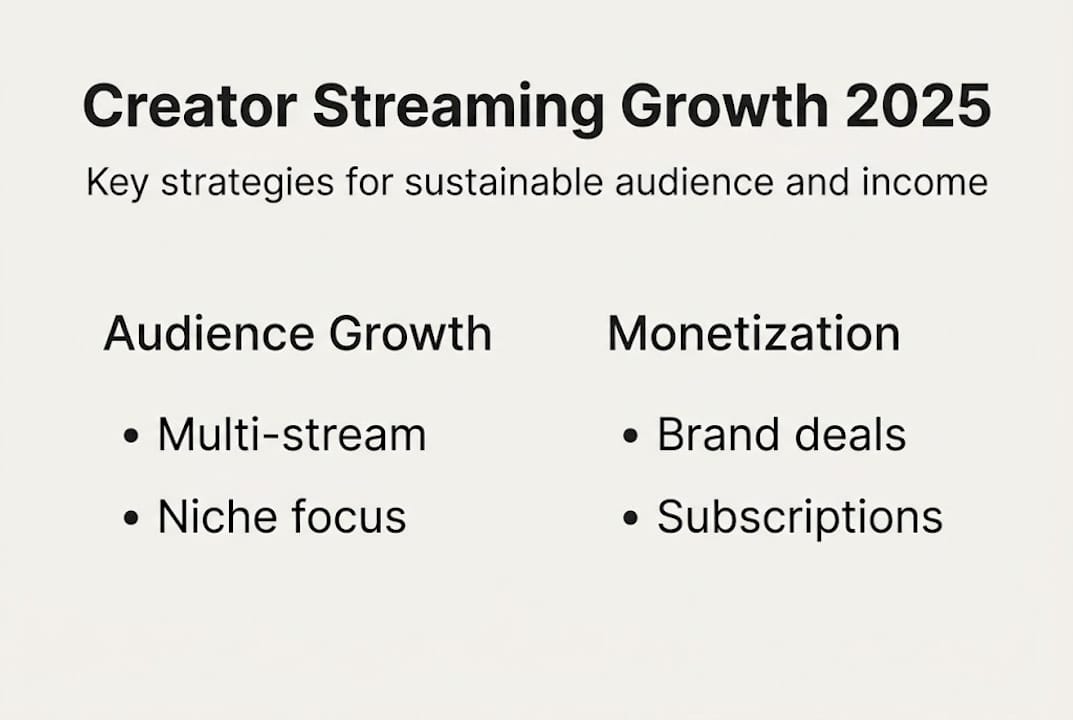
But there is a real caution here. AI influencers, the fully synthetic kind, average just 1.02% engagement on Instagram. Human creators who use AI as a tool, not a replacement, consistently outperform them. Authenticity is still the product.
Here is how smart creators are using AI right now:
- Automated clip generation from long-form streams for short-form repurposing
- AI chatbots in live chat to handle common questions and keep engagement up
- Analytics tools that flag which content types drive subscriptions vs. one-time views
- Thumbnail and title A/B testing tools that remove guesswork from growth
- Collaboration matching platforms that use AI to pair creators with compatible brands
“The creators who scale in 2025 are not the ones who work harder. They are the ones who automate the repetitive parts and stay human where it counts.”
Multi-streaming is the other major shift. Kick’s 95/5 split is genuinely disruptive, but its audience is still smaller than Twitch or YouTube. Streaming to multiple platforms at once hedges your risk. If one platform changes its algorithm or terms, you are not starting from zero. The multi-streaming benefits go beyond just reach. They include audience data diversity and reduced single-platform dependency.
For advanced monetization strategies, combining AI-powered tools with a multi-platform presence is quickly becoming the baseline for serious creators, not an advanced tactic.
The uncomfortable truth about streaming success in 2025
Beyond the stats and strategies, here is what creators need to internalize to thrive in 2025 and beyond.
The biggest mistake we see creators make is chasing platforms instead of building audiences. Every few months, a new tool or platform promises to change everything. Some do. Most do not. The creators who consistently grow are the ones who treat their audience as an asset they own, not a number on someone else’s dashboard.
Measurement lags affect 20% of marketers who held back budgets because they could not track creator content performance. The fix is not more platforms. It is smarter tracking: repurposing content for paid ads, building off-platform email lists, and measuring what actually converts.
Platform fatigue is real. More platforms do not equal more money. They equal more complexity, more context-switching, and less creative energy for the work that actually matters. The creators who win long-term pick their platforms intentionally, build owned assets alongside them, and treat their deep dive on monetization as a living strategy, not a one-time setup. Brand safety, revenue tracking, and protecting your creative energy are the unsexy fundamentals that separate sustainable careers from burnout.
Unlock your next level with Fanspicy creators
If you are ready to put these strategies into practice, Fanspicy is built for exactly this moment. As a creator-first live cam and paid social platform, Fanspicy gives you the tools to monetize your audience directly, without the platform politics that drain your earnings elsewhere.
See how creators like Jackiepott и Tesb are building real income streams on a platform designed to reward authentic engagement. Whether you are scaling from mid-tier or launching your first paid channel, Fanspicy connects you with an audience that is ready to support your work. Discover more creators and explore what a creator-first platform actually looks like in practice.
Frequently asked questions
What is the most profitable streaming platform in 2025?
Kick offers the highest split at 95/5, meaning creators keep 95% of subscription revenue, but YouTube and Twitch offer larger audiences and more diverse earning tools including ads and memberships.
How much do mid-tier streamers typically earn?
Mid-tier streamers earn between $3,000 and $8,000 per month in 2025, with income growing significantly when multiple revenue streams like sponsorships and subscriptions are combined.
How has AI changed streaming for creators in 2025?
AI now handles production, partner selection, and engagement analysis for creators, but fully AI-driven influencers average just 1.02% engagement, proving human authenticity still drives real results.
Why are niche creators getting more attention from brands?
Brands now prioritize engagement over raw follower counts, making niche and mid-tier creators with loyal, responsive audiences far more attractive for deals and long-term partnerships.
What’s the biggest challenge for streamers in 2025?
Measurement lags affect budgets and make revenue tracking harder, so the smartest creators repurpose content for paid ads and use multi-streaming to reduce reliance on any single platform’s data.